
The Difference Between Model-Level Safety and System-Level Security
Model safety filters harmful outputs; system security controls what your architecture can do. Why provider alignment is not your production posture.
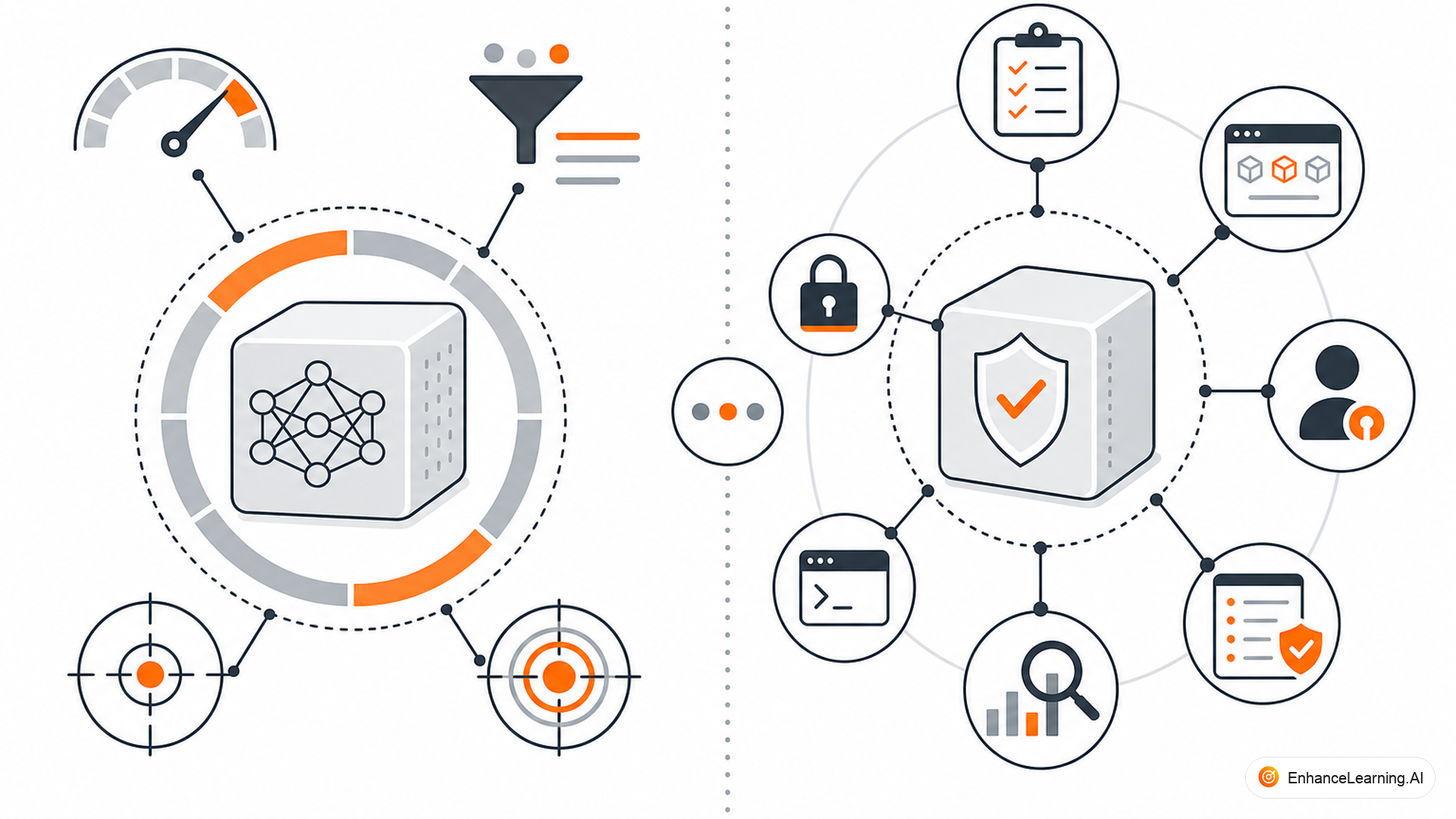
"We use GPT with safety training" is a common answer when security asks how customer data is protected. It conflates two responsibilities: model-level safety — what the provider does inside the weights and inference stack to reduce harmful generations — and system-level security — what your team builds around the model to protect tenants, credentials, and side effects.
Both matter. Only one is under your control at deployment time. Confusing them leads to signed contracts and open tool paths.
Model safety vs system security#
Model-level safety includes alignment fine-tuning, refusal behavior on disallowed content categories, provider-side content filters, abuse monitoring on the API, and safety benchmarks published in model cards. The provider optimizes for broad deployment across millions of users with unknown applications.
System-level security includes your authentication, authorization, tool allowlists, retrieval scoping, logging, encryption, incident response, and compliance evidence for your product's data flows and blast radius. You own this regardless of which foundation model you call.
A model that refuses to help build malware can still email a customer's entire order history to an attacker if your agent has an unscoped send_email tool and no runtime policy.
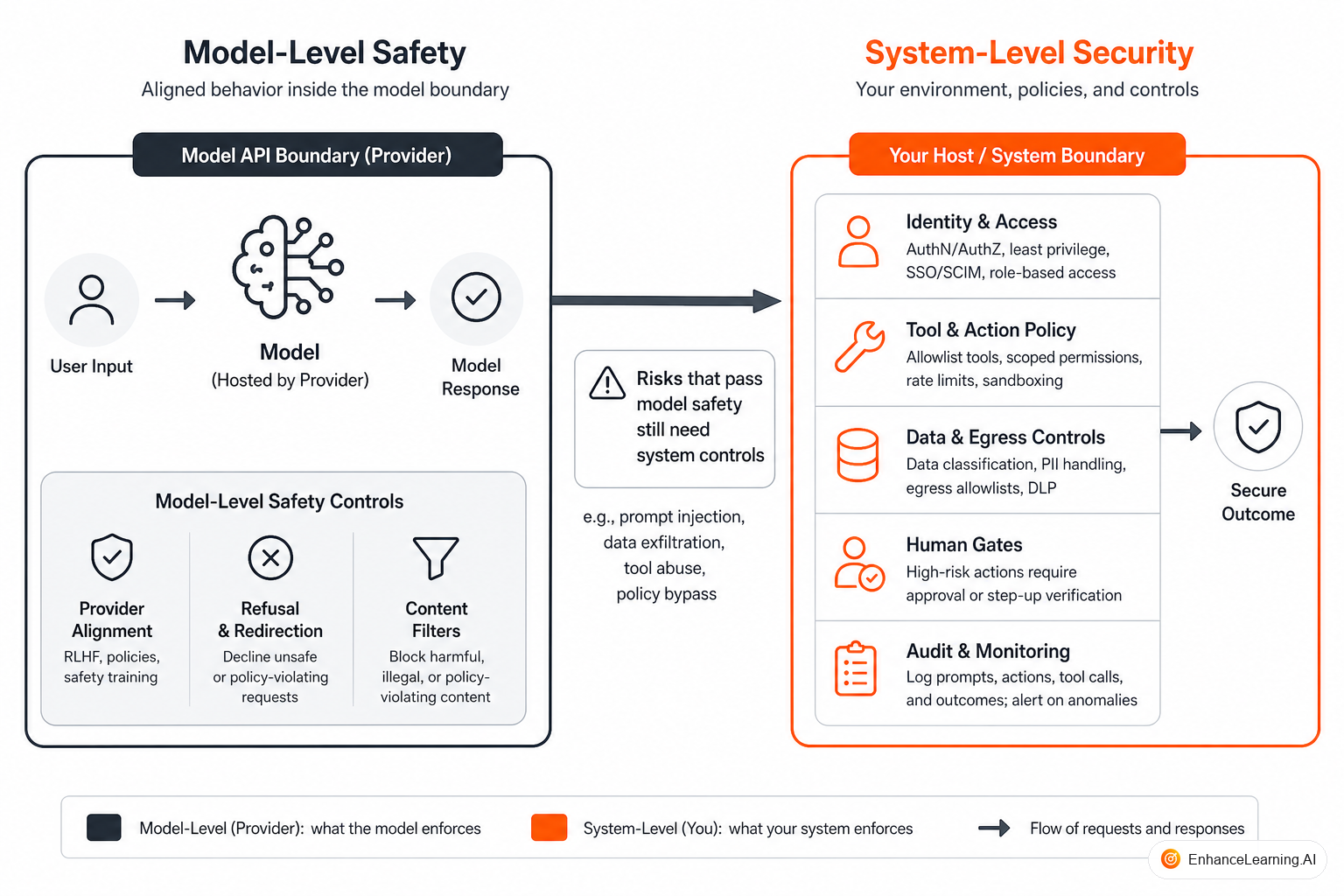
What model safety actually covers#
Providers invest heavily in reducing:
- Hate, harassment, and sexual content in outputs
- Obvious illegal instruction following in isolation
- Some classes of jailbreak across generic chat surfaces
- API abuse patterns at the provider boundary (rate, known attack signatures)
These controls operate on tokens in and tokens out of the provider's service. They do not know your database schema, your tenant model, or which tools your orchestration layer exposed five minutes ago.
Model safety evals (public benchmarks, red-team reports) measure average behavior on standardized prompts. They do not certify your RAG pipeline against indirect injection in a customer-uploaded wiki, or your refund agent against amount-cap bypass via retrieved text.
Auditors assess your controls over customer data and system access. A vendor's safety whitepaper does not satisfy access reviews, change control on agent tools, or proof of tenant isolation. Cite provider safety as upstream defense-in-depth — not as the control that closes the finding.
What system security must cover#
Everything that turns model output into real-world effects:
- Identity binding — sessions, agent principals, scoped credentials
- Tool and API gates — allowlists, schema validation, business policy
- Data boundaries — per-tenant retrieval, redaction, retention, erasure
- Context trust — treating RAG and uploads as hostile input
- Observability — trajectories, denials, approvals, anomaly detection
- Supply chain — pinned model versions, prompt/tool change control
If it can happen because your code called an API, it is system security — even when the model suggested the call.
Responsibility matrix#
| Risk | Model-level safety | System-level security |
|---|---|---|
| Toxic content in a public chatbot reply | Primary provider concern | You add product-specific filters if needed |
| Jailbreak to reveal system prompt | Partially mitigated by provider | You avoid secrets in prompts; enforce tool bounds |
| Indirect injection via RAG document | Not visible to provider | Your workflow design and enforcement |
| Cross-tenant data via vector search | Not applicable at provider | Your index scoping and query filters |
| Unauthorized refund | Not a model safety category | Your policy engine and authz |
| PII in application logs | Provider may filter API logs | Your log redaction and retention |
| Compliance evidence for regulators | Vendor attestations help | Your audit trails and data maps |
Read the last column. That is the job list that survives a due-diligence call.
Why providers cannot secure your system#
Foundation model APIs are deliberately application-agnostic. The provider does not know whether {customer_email} in a tool arg belongs to the requesting user, whether delete_record is appropriate, or whether retrieved chunk 7 contains adversarial instructions. Passing that context upstream at inference time is incomplete and often impossible without leaking proprietary workflow logic.
Safety filters at the API also face adversarial trade-offs: aggressive filtering breaks legitimate enterprise use cases (medical, legal, security research). Providers tune for the median. You tune for your risk appetite and regulatory regime.
Expecting the model to "just say no" to a harmful action conflates content moderation with authorization. Refusal is a soft control. authz.deny() is a hard one.
# Model safety: soft control (probabilistic)
system_prompt = "Never disclose other users' data."

# System security: hard control (deterministic)
def search_orders(query: str, ctx: RequestContext) -> list[Order]:
    if not ctx.identity.authenticated:
        raise AuthenticationError()
    # Tenant filter enforced regardless of model behavior
    return db.orders.filter(
        tenant_id=ctx.identity.tenant_id,
        query=query,
    ).limit(ctx.policy.max_results)
The prompt supports correct behavior. The function guarantees isolation even when the model hallucinates a broader query or an injected doc says "search all tenants."
Handoff points between layers#
Design explicit boundaries:
- Provider boundary — prompts and completions; apply DPA, residency, and retention terms
- Your inference gateway — PII scrubbing, logging policy, model version pins
- Orchestration — context assembly, retrieval, tool proposal
- Enforcement — authz, policy, human approval
- Downstream systems — same security standards as pre-AI services
Model safety failures at step 1 (harmful content) are provider incidents or shared triage. Security failures at steps 3–4 (data exfiltration, unauthorized writes) are your incidents — regardless of model brand.
Contract and procurement implications#
Vendor questionnaires often ask: "Does the model refuse harmful requests?" Add: "Does our system enforce tenant isolation on retrieval and tools?" Legal should not sign AI addenda that shift system security accountability to "the AI vendor's safety team."
Negotiate provider commitments on data handling (training opt-out, retention, subprocessors). Separate those from your obligation to implement runtime controls. Both appear in the contract; they answer different questions.
When model safety helps system security#
Defense in depth is real. Provider refusals reduce some abuse on user-facing chat surfaces. Content filters catch obvious policy violations before customers see them. Provider abuse teams may flag anomalous API keys.
Use model safety as one layer — especially for consumer-facing generative features — while building deterministic controls for anything that touches money, health data, or privileged operations.
For internal agents with powerful tools, weight system controls heavier than refusal tuning. The user is an employee; the risk is action, not toxic prose.
Summary#
Model-level safety shapes what the foundation model tends to say; system-level security determines what your product can do with data and credentials. Providers own the former within their API; you own the latter in full. Treating alignment benchmarks as proof of production security leaves tool abuse, tenant leaks, and audit gaps unaddressed. Document both layers in architecture reviews — and assign owners only for the layer your team can actually enforce.
Want premium architecture blueprints?
Be among the first to explore interactive reference architectures, implementation playbooks, and premium engineering resources at launch.
Related Articles
Recommended reading based on this topic.
Prompt Injection, Tool Abuse, and AI Security Basics
How prompt injection and tool abuse show up in production AI systems, and the controls that belong in code: isolation, allowlists, human gates, and monitoring.
Read ArticleThe AI-Native Security Stack: Identity, Policy, and Enforcement Layers
A three-layer security stack for AI systems: agent identity, policy definition, and runtime enforcement. A shared model for engineering and governance.
Read ArticleThe Difference Between AI Security and Traditional Application Security
What carries over from AppSec into AI systems — and what breaks when LLMs and agents join the request path. Avoid blind playbook reuse.
Read Article