
AI Evaluation vs AI Observability: Scores Aren’t Traces
Evals measure whether quality meets bar. Observability explains why behavior changed. Conflating them leaves teams blind to both regressions and root causes.
A platform lead once told me their AI feature was "fully observable" because they had dashboards for request volume, p99 latency, and token spend. When faithfulness collapsed after a reindex, those dashboards stayed green. They had telemetry — not evaluation. Conversely, a team with rigorous golden-set gates kept blocking releases without understanding why cases flipped; they had scores — not traces. Evaluation and observability are complementary disciplines. Conflating them is how teams miss both quality cliffs and the data to fix them.
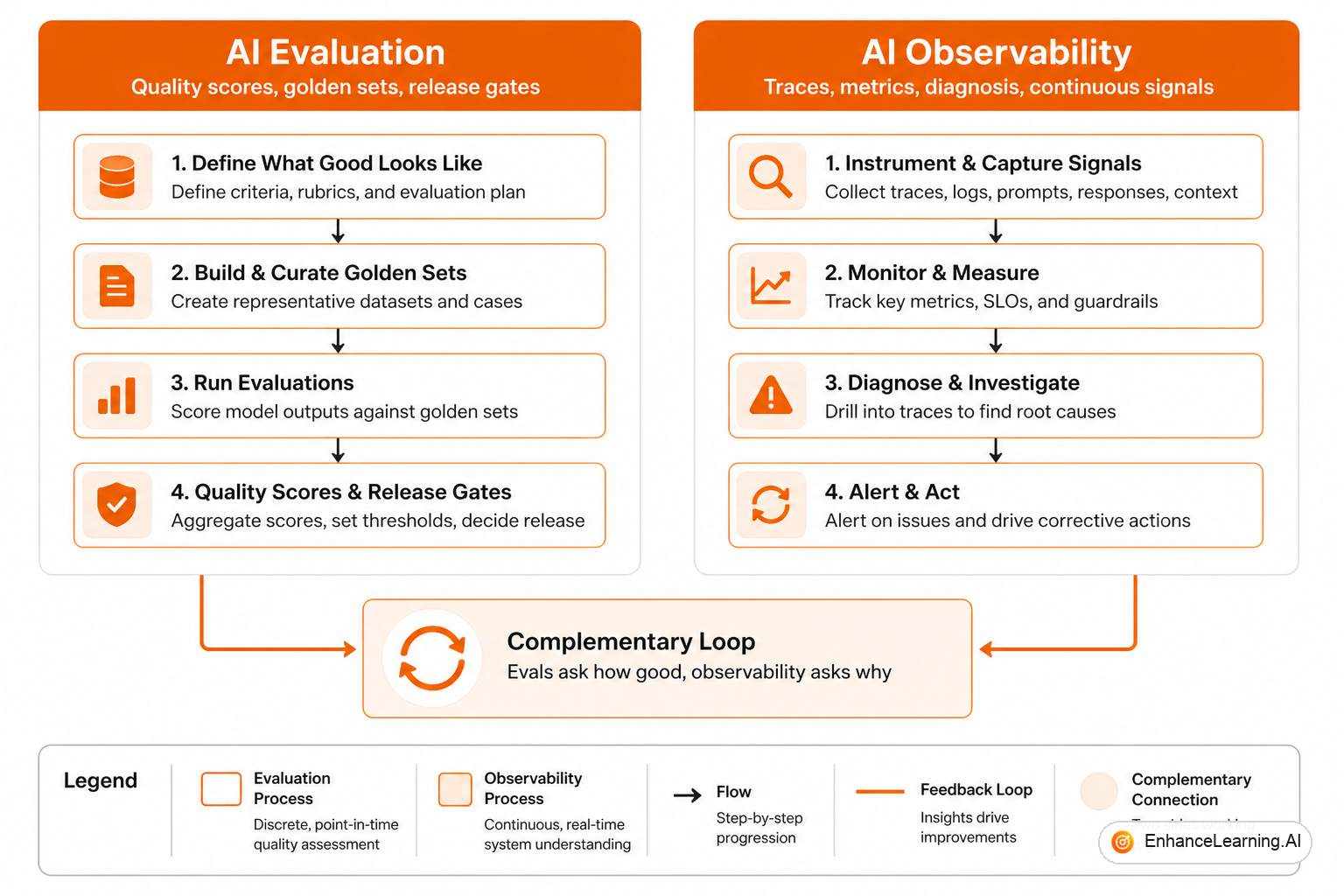
Evaluation asks: did we meet the bar?#
AI evaluation assigns scores or pass/fail judgments against defined criteria on fixed or sampled inputs. Offline golden sets, LLM-as-judge rubrics, trajectory checks, and online quality sampling are all evaluation activities. The output is a metric you can threshold: faithfulness rate, schema validity, task success, refusal accuracy.
Evaluation is comparative and normative. You compare this release to the last good one. You compare production samples to agreed standards. You decide whether behavior is acceptable — not merely whether it occurred.
Observability asks: what happened on the path?#
AI observability captures runtime signals sufficient to reconstruct request paths: prompts or hashes, retrieved chunk IDs, model alias and version, tool arguments and results, token counts, latencies per stage, finish reasons, errors. The output is evidence for diagnosis — spans, logs, metrics — not a quality verdict by itself.
Observability is descriptive. It tells you the agent called search_policy three times before exceeding its step budget. It does not tell you whether the final answer was faithful. You need evaluation logic applied to observability data — or to cases derived from it — to get that answer.
Side-by-side: different jobs, shared infrastructure#
| Aspect | Evaluation | Observability |
|---|---|---|
| Primary question | Is output good enough? | What happened step by step? |
| Output | Scores, pass/fail, trends | Traces, metrics, logs |
| Timing | Often batch; also sampled online | Continuous, per request |
| Data needs | Labels, rubrics, golden cases | Instrumentation schema |
| Decisions enabled | Release gates, quality budgets | Incident triage, root cause |
| Without the other | Scores without diagnosis | Traces without verdicts |
Mature teams wire them together: observability produces traces; evaluation consumes traces or exports cases from them; regressions trigger trace deep-dives.
Observability without evaluation gives you perfect visibility into a system you cannot certify. Evaluation without observability gives you a failing score and a guessing meeting. Budget both from week one.
How they reinforce each other in production#
Evals detect; observability explains. A golden set shows faithfulness dropped six points after a deploy. Traces reveal retrieved chunks shifted because embedding model version changed — not because generation logic broke. Without evals, you might not notice until support escalates. Without observability, you revert blindly or debate prompts for days.
Observability feeds eval datasets. Mine production traces where users regenerated answers, escalated to humans, or thumbs-downed results. Turn those into labeled cases.
Evals prioritize observability investment. If online faithfulness sampling flags a job class weekly, instrument that workflow first with full trajectory capture.
from dataclasses import dataclass
from datetime import datetime

@dataclass
class TraceRecord:
    trace_id: str
    workflow: str
    retrieved_chunk_ids: list[str]
    model_alias: str
    input_tokens: int
    output_tokens: int
    tool_calls: list[dict]

@dataclass
class EvalVerdict:
    trace_id: str
    faithfulness: float
    passed: bool
    evaluated_at: datetime

def join_eval_to_trace(
    verdict: EvalVerdict,
    trace: TraceRecord,
) -> dict:
    """Link quality verdict to path evidence for incident review."""
    return {
        "trace_id": verdict.trace_id,
        "workflow": trace.workflow,
        "passed": verdict.passed,
        "faithfulness": verdict.faithfulness,
        "retrieved_chunks": trace.retrieved_chunk_ids,
        "model": trace.model_alias,
        "token_total": trace.input_tokens + trace.output_tokens,
        "tool_call_count": len(trace.tool_calls),
    }
The join function is the handoff between disciplines. Incident reviews should start from a trace ID that links to an eval verdict, not from a screenshot.
Where teams mix them up#
Treating token dashboards as quality monitoring. Token volume and latency explain cost and performance — they do not measure answer correctness.
Logging outputs without scoring them. Storing prompts and completions is observability. It becomes evaluation only when you apply rubrics or graders on a schedule with thresholds.
Paging on eval pass rate without traces. Responding without trajectory data turns every page into archaeology. Ensure every sampled eval case retains a trace ID.
Building eval runners that discard context. A faithfulness score without retrieved evidence attached is an orphan metric. Persist what the judge saw so artifacts reconcile.
Operating model: one loop#
Platform typically owns observability schema. Domain teams own eval cases and thresholds. Shared incident loop: eval alert fires → trace reconstruction → hypothesis → fix → eval re-run.
Weekly rhythm: review eval trends by job class; pull five failing trace IDs for significant deltas; classify root cause (retrieval, prompt, tool, model, data drift); add golden cases; close observability gaps.
If you are resource-constrained, instrument trajectory capture on the highest-traffic workflow first, then build twenty golden cases, then add online sampling — not the reverse. When faithfulness alerts fire, check retrieval and model alias before jumping to prompt edits.
Summary#
AI evaluation measures whether system behavior meets defined quality standards. AI observability captures the runtime evidence needed to understand and debug behavior. Evals without observability produce unexplained regressions. Observability without evals produces data-rich confusion. Treat them as paired capabilities — shared trace IDs, mined production cases, and incident loops that move from score to path and back — or you will keep mistaking visibility for quality and scores for diagnosis.
Want premium architecture blueprints?
Be among the first to explore interactive reference architectures, implementation playbooks, and premium engineering resources at launch.
Related Articles
Recommended reading based on this topic.
How to Evaluate AI Systems in Production
A practical eval stack for production AI: golden sets, trajectory checks, LLM-as-judge pitfalls, online sampling, and regression gates that block bad releases.
Read ArticleWhy Reproducibility Matters in AI Evaluation Pipelines
Eval results you cannot replay are opinions. Seed control, environment pinning, and auditable artifacts make evaluation pipelines trustworthy.
Read ArticleWhy AI Eval Frameworks Need Versioning Just Like Code
Unversioned eval logic, datasets, and judge prompts make regression analysis unreliable. Treat eval artifacts as managed code with semver and changelogs.
Read Article