
Why Reproducibility Matters in AI Evaluation Pipelines
Eval results you cannot replay are opinions. Seed control, environment pinning, and auditable artifacts make evaluation pipelines trustworthy.
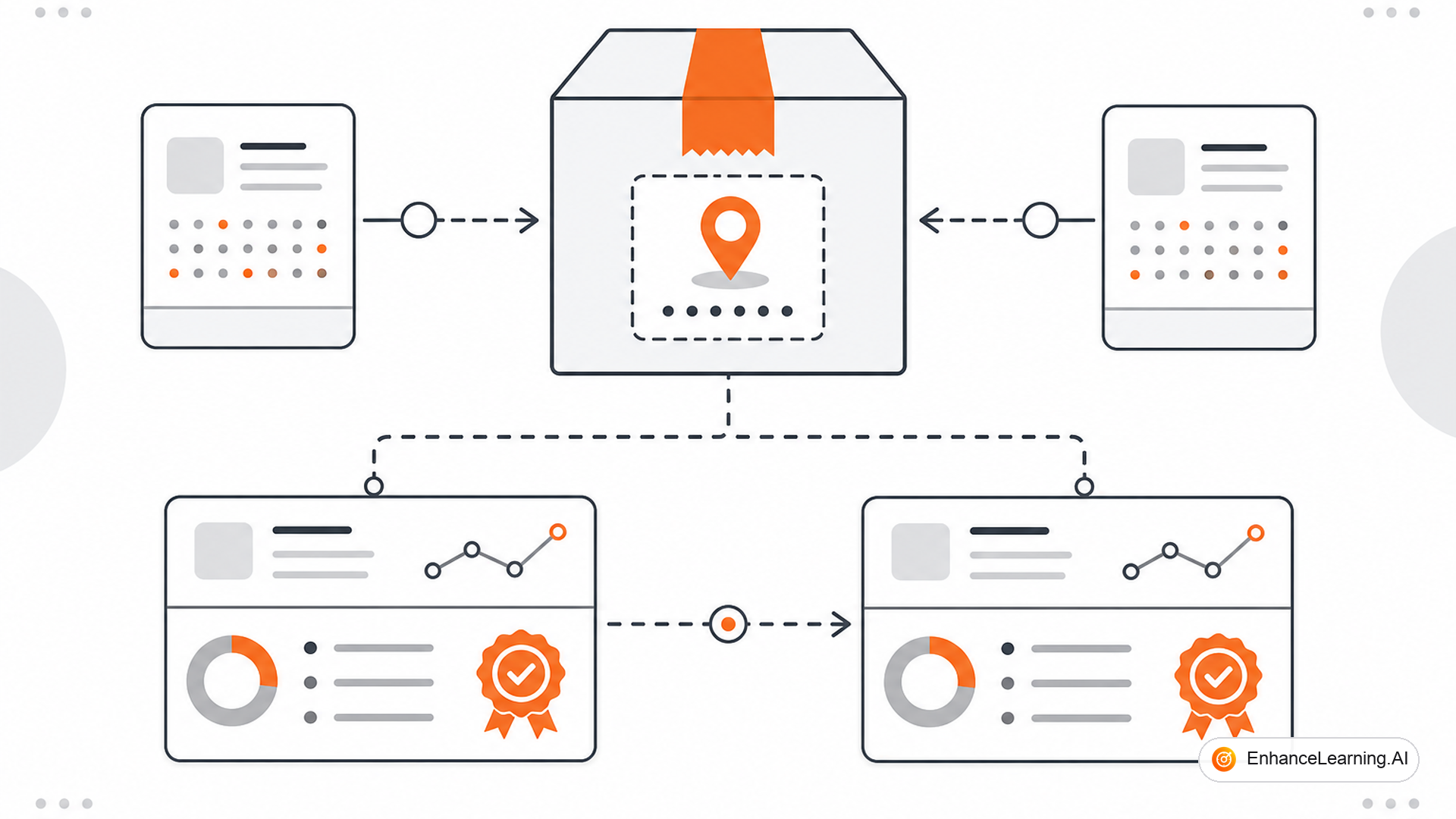
Two engineers run the same golden set against the same commit. Pass rates differ by five points. They argue about whether the prompt regressed until someone notices different temperature defaults, an unpinned judge model receiving a silent vendor update, and non-deterministic parallel ordering affecting tie-break logic. The eval pipeline "worked" both times — it just did not measure the same thing twice. Reproducibility is not optional for AI evaluation. It is the difference between evidence and noise when releases, incidents, and compliance reviews depend on your numbers.
Reproducibility defined for eval pipelines#
A reproducible eval run means: given the same system under test (commit, config, model aliases, index snapshot) and the same eval artifact manifest (dataset version, runner version, judge version, seeds, environment), any authorized re-execution produces scores within agreed tolerance — ideally identical for deterministic checks, narrowly bounded for stochastic judges.
Tolerance must be explicit. LLM outputs vary. Reproducibility in AI eval is not always bit-identical replay. It is controlled variance: document what drift is acceptable and when divergence triggers investigation.
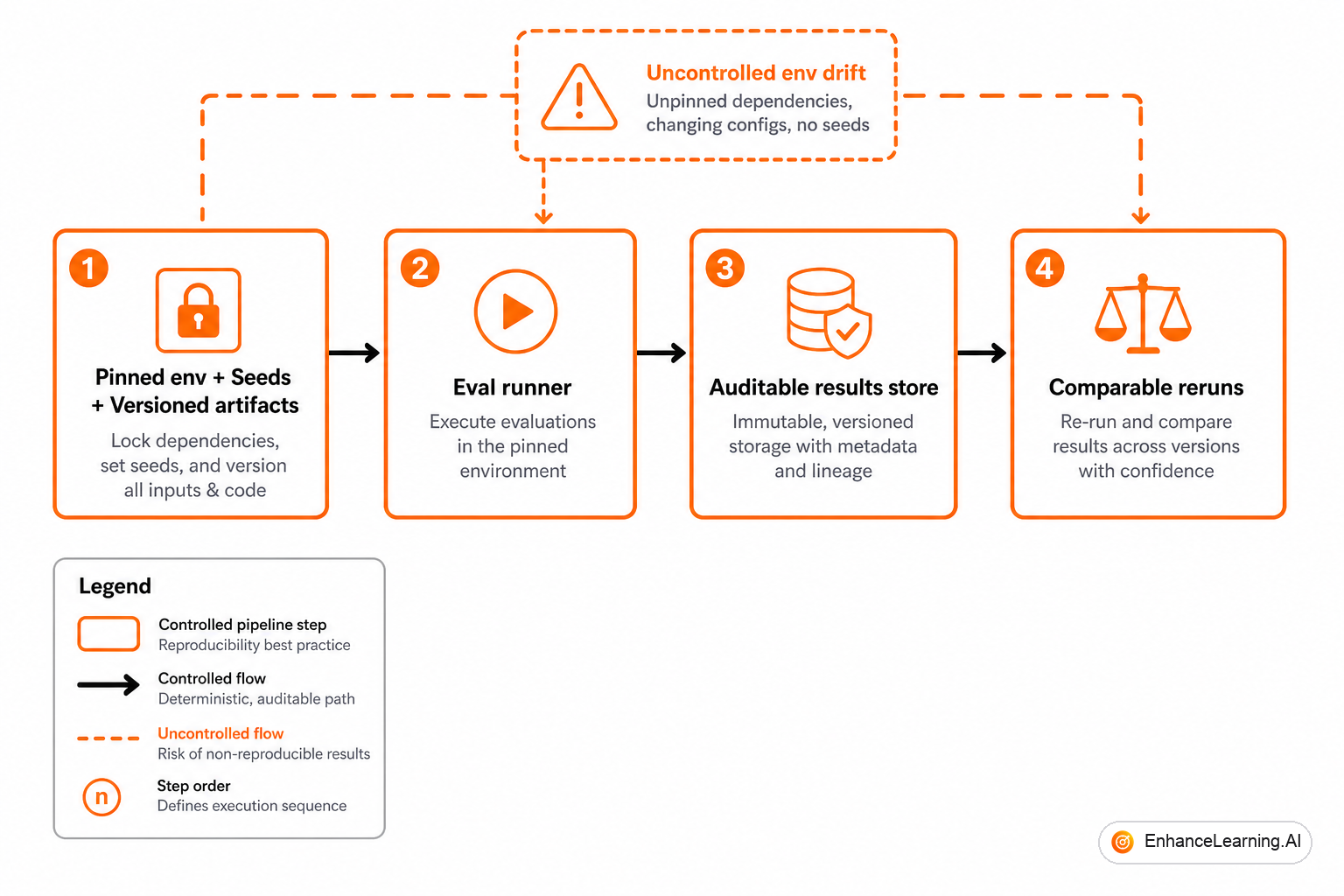
Why pipelines fail to reproduce#
| Failure source | Symptom | Fix |
|---|---|---|
| Unpinned model alias | Same name, different weights | Pin revision; log provider request IDs |
| Missing seed control | Different "creative" failures | Set seed where API supports; run K trials |
| Environment drift | CI vs laptop vs staging differ | Containerize runner; lock dependencies |
| Non-idempotent retrieval | Index changed between runs | Snapshot index ID or frozen corpus |
| Race in parallel runner | Flaky ordering in aggregation | Deterministic sort keys; fixed worker count |
| Mutable dataset | Cases edited mid-run | Content-addressed dataset hash |
Most "flaky eval" tickets trace to this table — not to inherent LLM randomness alone.
If your run record cannot answer "exactly what did we execute," reproduction is impossible. Persist manifest + environment digest + artifact hashes before debating scores.
Seed management in stochastic systems#
Providers expose seed parameters inconsistently. Practical policy:
- Deterministic layers first — schema validation, citation set comparison, tool call sequence checks — should be 100% reproducible
- Generation under test — fix seed when supported; otherwise run N trials and report mean/variance
- LLM judges — pin judge seed; run dual-judge agreement on calibration subset; widen tolerance if vendor ignores seed
import os
import random
import hashlib
from dataclasses import dataclass

@dataclass
class ReproConfig:
    dataset_hash: str
    system_commit: str
    model_revision: str
    judge_model_revision: str
    seed: int
    trials: int

def configure_reproducibility(cfg: ReproConfig) -> None:
    random.seed(cfg.seed)
    os.environ["EVAL_RUN_SEED"] = str(cfg.seed)
    os.environ["EVAL_TRIALS"] = str(cfg.trials)

def aggregate_trials(trial_passed: list[bool]) -> dict:
    n = len(trial_passed)
    passed = sum(trial_passed)
    return {
        "pass_rate": passed / n,
        "trials": n,
        "all_pass": passed == n,
        "any_pass": passed > 0,
    }

def environment_digest() -> str:
    """Hash versions of runner deps for audit trail."""
    material = f"{os.environ.get('RUNNER_IMAGE_TAG')}:{os.environ.get('PYTHONHASHSEED')}"
    return hashlib.sha256(material.encode()).hexdigest()[:16]
For high-stakes gates, require all_pass across trials — expensive but unambiguous. For exploratory runs, report distribution.
Environment pinning#
Eval runners belong in containers with locked dependency trees. Record runner image digest, lockfile hash, behavior-affecting env vars, and timezone/locale if they affect formatting checks. Staging evals must use the same runner image as CI.
Index and corpus pinning matters for RAG evals. Running against latest index guarantees non-reproduction. Reference snapshot IDs; rebuild snapshots from archived corpus when reproducing historical runs for audits.
Result auditability#
Store immutable result bundles per run:
- Manifest fingerprint (dataset, runner, judge versions)
- Environment digest
- System under test identifiers
- Per-case inputs, outputs, scores, trace IDs
- Provider request IDs for model calls
- Aggregated metrics and threshold verdict
Object storage with write-once policy beats mutable database rows. Auditors and incident reviewers should reproduce a failing case with one command: eval replay --run-id abc123 --case-id support-047.
If replay requires tribal knowledge, reproducibility failed.
Statistical handling when exact replay is impossible#
When vendors change behavior without notice, exact reproduction breaks. Freeze known-good provider snapshots where contracts allow, widen tolerance temporarily with a documented incident reference, shift gate reliance to deterministic checks until the vendor stabilizes, and maintain a human-labeled calibration set to detect judge drift. Report scores with confidence intervals when using trial aggregation — 92% ± 4% tells a different story than a point estimate presented as precise.
CI and release integration#
- Nightly runs write immutable bundles; baselines reference bundle IDs
- PR evals compare against baseline bundle with identical manifest — abort diff if manifest changed without explicit comparison mode
- Release checklist includes
eval replayspot-check on three failed/passed cases from the PR report - Tag
official=trueonly from CI; filter exploratory runs out of release dashboards - No manual runs for gate decisions — ad hoc CLI invocations skip logging
Pinning adds minutes to pipeline setup and saves weeks per score dispute. Parallelize safely with deterministic case ordering and isolated worker seeds derived from hash(case_id + run_seed).
Summary#
AI evaluation pipelines produce evidence only when runs are reproducible: pinned models and indexes, controlled seeds, containerized environments, and immutable result bundles with full manifests. Without reproducibility, pass rates fluctuate for artifact reasons — not product reasons — and teams lose the ability to defend release decisions or satisfy audits. Treat reproducibility as a pipeline requirement from day one, not a cleanup task after the first scoring dispute.
Want premium architecture blueprints?
Be among the first to explore interactive reference architectures, implementation playbooks, and premium engineering resources at launch.
Related Articles
Recommended reading based on this topic.
Why AI Eval Frameworks Need Versioning Just Like Code
Unversioned eval logic, datasets, and judge prompts make regression analysis unreliable. Treat eval artifacts as managed code with semver and changelogs.
Read ArticlePoint-in-Time Evals vs Continuous Evals in AI-Native Systems
Snapshot golden runs catch regressions at release. Continuous sampling catches drift in production. You need both modes — they answer different questions.
Read ArticleWhy AI Evaluation Must Run at Every Lifecycle Stage
Pre-launch gates are not enough. Evaluation belongs at design, build, staging, production, and post-incident — each stage catches failures the others miss.
Read Article