Strengths
Reproducible
same cases, comparable scores
Gate-friendly
clear pass/fail for CI and release approval
Diagnostic
case-level diffs show exactly what flipped
Snapshot golden runs catch regressions at release. Continuous sampling catches drift in production. You need both modes — they answer different questions.
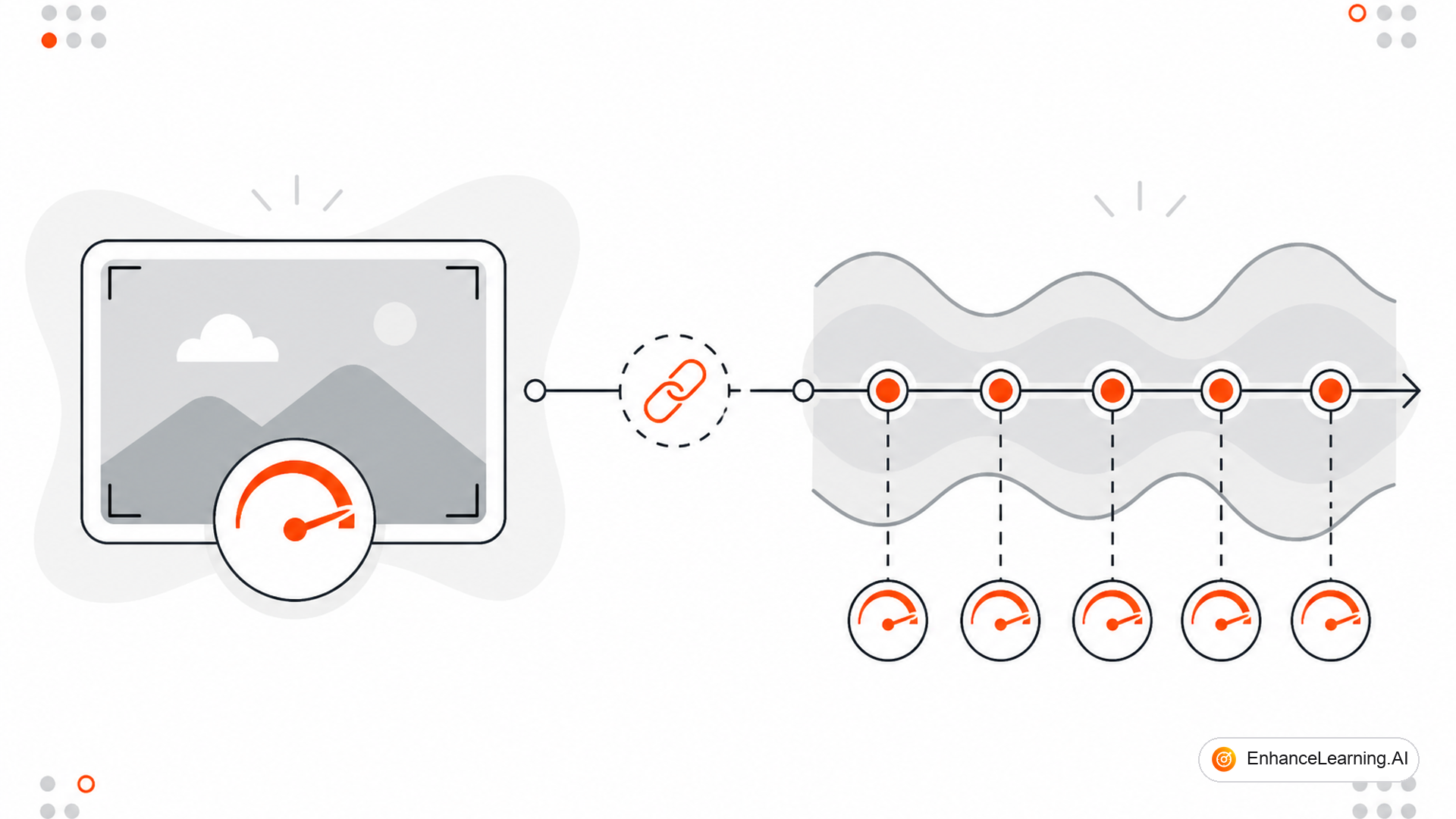
Point-in-time evals are the snapshot your team runs before a release: same golden set, same runner, compare scores to last week's baseline. Continuous evals are the ongoing sample of live traffic scored on faithfulness, tool success, and schema validity — trending daily while users work. Teams pick one and wonder why quality surprises still arrive. Snapshots catch regressions you anticipated at deploy boundaries. Continuous measurement catches drift you did not schedule — corpus changes, query seasonality, silent model updates. AI-native systems need both modes, wired so each reinforces the other.
Point-in-time evals run a fixed dataset against a defined system configuration at a specific moment. Inputs, labels, and runner version are pinned. Results compare run N to run N-1 or to a blessed baseline artifact. This is the AI equivalent of integration tests before promote.
Point-in-time evals
3 strengths · 3 limits
Reproducible
same cases, comparable scores
Gate-friendly
clear pass/fail for CI and release approval
Diagnostic
case-level diffs show exactly what flipped
Stale the day after
production inputs diverge from golden sets
Blind to novel failures
only tests what you already labeled
Batch latency
full runs take minutes to hours at scale
Use point-in-time evals at PR merge, nightly, and before model or index migrations.
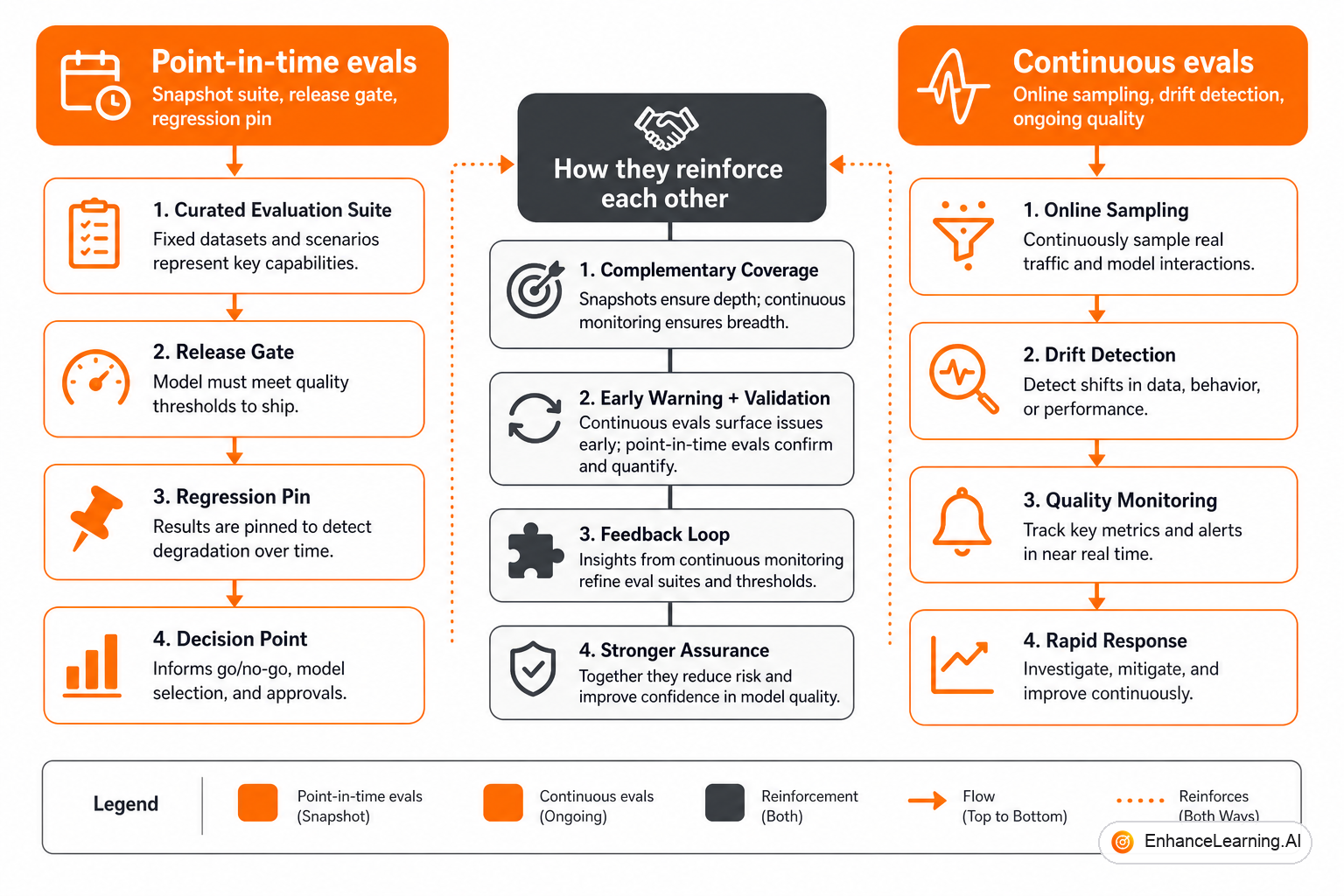
Continuous evals score a sample of production traces on a schedule — hourly, daily, or triggered by volume thresholds. Inputs are live. Labels come from automated judges, heuristics, or delayed human review on a subset.
Continuous evals
3 strengths · 3 limits
Drift detection
catches corpus and usage shifts offline suites miss
Novel failure discovery
surfaces patterns before full labeling investment
Executive-friendly trends
quality rate over time, like error budgets
Noisier
sampling variance and judge instability create false alarms
Harder to reproduce
live inputs may not replay identically
Label lag
human review on samples trails automated scores
Use continuous evals for production monitoring, mining golden cases, and validating that launch-week quality holds in month three.
| Scenario | Point-in-time | Continuous |
|---|---|---|
| Block bad PR | Primary | Too slow/noisy |
| Approve model migration | Primary (+ shadow) | Supplement |
| Detect reindex drift | Misses until rerun | Primary |
| Discover new failure class | Misses | Primary |
| Explain single regression | Primary | Harder |
| Compliance audit trail | Primary | Supporting trend |
Neither row suggests "optional." They cover different time horizons.
Continuous → point-in-time. Production samples that fail faithfulness or tool checks become candidates for golden set addition. Label them with constraints, dedupe ticket variants, version in git. Tomorrow's point-in-time run includes today's production surprise.
Point-in-time → continuous. Golden case definitions inform online graders — same rubric, same schema checks. When continuous scores diverge from offline golden trends, investigate configuration drift: different model alias in prod, feature flag mismatch, index partition lag.
Shared artifacts. One judge prompt version. One faithfulness rubric. One schema validator. Divergent logic between modes produces arguments about methodology instead of fixes to the system.
from datetime import datetime, timezone
from uuid import uuid4

class EvalRun:
    def __init__(self, mode: str, runner_version: str, dataset_version: str):
        self.run_id = str(uuid4())
        self.mode = mode  # "point_in_time" | "continuous"
        self.runner_version = runner_version
        self.dataset_version = dataset_version
        self.started_at = datetime.now(timezone.utc)

def compare_runs(baseline: dict, current: dict, case_ids: list[str]) -> list[dict]:
    """Case-level diff for point-in-time; aggregate for continuous."""
    flips = []
    for cid in case_ids:
        b = baseline.get(cid, {})
        c = current.get(cid, {})
        if b.get("passed") != c.get("passed"):
            flips.append({"case_id": cid, "before": b, "after": c})
    return flips

def continuous_alert(
    daily_rates: list[float],
    window: int = 7,
    sigma: float = 2.0,
) -> bool:
    """Simple drift alert on continuous faithfulness rate."""
    if len(daily_rates) < window + 1:
        return False
    recent = daily_rates[-1]
    history = daily_rates[-(window + 1):-1]
    mean = sum(history) / len(history)
    variance = sum((x - mean) ** 2 for x in history) / len(history)
    std = variance ** 0.5 or 1e-6
    return recent < mean - sigma * std
Pin runner_version and dataset_version on every run — point-in-time or continuous — or cross-mode comparison becomes meaningless.
Alert when continuous faithfulness drops two standard deviations below the seven-day mean and confirm with a targeted point-in-time rerun on recently mined cases. Single-mode alerts generate pager fatigue.
Sample continuous traffic intelligently: oversample high-risk job classes and tool side effects; always score escalations and regenerations; use cheaper heuristics on wide nets and LLM judges on narrow nets. Keep golden sets lean — prune duplicates aggressively.
Snapshot-only team. Passed launch golden set at 96%. Three months later, a new product documentation format entered the index. Continuous sampling was absent. Faithfulness on setup queries collapsed. Nightly golden still passed — cases used old doc formats. Users noticed first.
Continuous-only team. Rich production dashboards, no PR gates. An engineer merged a prompt edit that broke schema validity on a payment workflow. Continuous sample had not yet included that low-traffic path. Incident found via finance reconciliation, not eval alert.
Both modes together would have caught their respective gaps within hours.
Point-in-time evals provide reproducible, gate-ready snapshots on owned golden sets — essential at PR, nightly, and migration boundaries. Continuous evals trend quality on live traffic and surface drift offline suites cannot foresee. AI-native systems need both: snapshots to block regressions and explain diffs; continuous measurement to detect reality diverging from the lab. Wire them through shared rubrics, versioned runners, and a production-to-golden feedback loop — or you will keep choosing between false confidence and false alarms.
Be among the first to explore interactive reference architectures, implementation playbooks, and premium engineering resources at launch.
Recommended reading based on this topic.
Eval results you cannot replay are opinions. Seed control, environment pinning, and auditable artifacts make evaluation pipelines trustworthy.
Read ArticleUnversioned eval logic, datasets, and judge prompts make regression analysis unreliable. Treat eval artifacts as managed code with semver and changelogs.
Read ArticlePre-launch gates are not enough. Evaluation belongs at design, build, staging, production, and post-incident — each stage catches failures the others miss.
Read Article