
Automation, Orchestration, and Agentic AI Agency
Clear definitions of automation, orchestration, and agentic agency in AI-native engineering — so teams stop using three different words for the same slide.
Stand in a hallway long enough and you will hear automation, orchestration, and agency used as if they were synonyms for “the computer did a thing.” They are not. Mixing them up produces bad architecture reviews: people argue about tools when they are actually arguing about who owns the next decision.
Three words, three jobs#
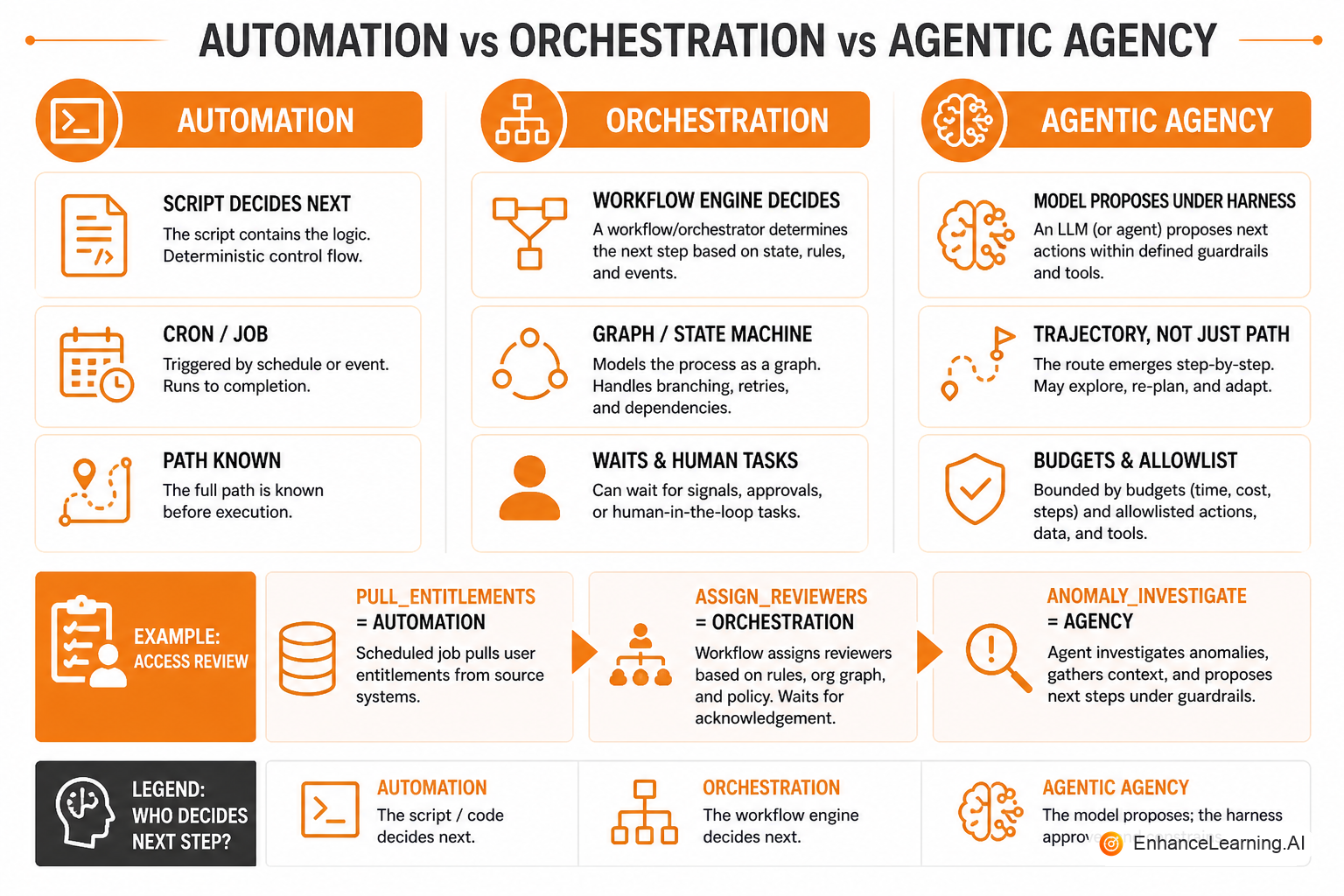
Automation — a machine executes a known procedure without a human in the loop for that procedure. The path is predetermined. Think: nightly ETL, webhook → queue → worker, classic RPA script.
Orchestration — software coordinates multiple steps, systems, or services over time: order, parallelism, retries, compensations, human tasks. The path is still largely authored by engineers (or a workflow designer). Think: Temporal/Airflow/Camunda graphs, sagas, approval chains.
Agentic agency — a model is authorized to propose the next step (usually a tool call or exit) based on observations, inside a harness that enforces policy and budgets. The path is not fully known at design time. Think: bounded investigate-and-act loops.
Automation can exist without orchestration (one script). Orchestration can exist without agency (fixed graph). Agency almost always sits on orchestration machinery — timers, state, retries — but the source of the next edge differs.
The distinction in one table#
| Term | Who decides next step? | Path known up front? | Typical artifact |
|---|---|---|---|
| Automation | Code / script | Yes | Job, bot, cron |
| Orchestration | Workflow definition | Mostly yes | Graph, state machine |
| Agentic agency | Model proposal + harness | Partially no | Trajectory under budget |
Where teams get tangled#
Tangled claim 1: “We orchestrate agents.” Sometimes true (an orchestrator schedules bounded agent runs). Sometimes false (they orchestrate LLM nodes and call them agents).
Tangled claim 2: “We automated the process with AI.” Often means an LLM drafts text inside an automated pipeline. Agency never entered the building.
Tangled claim 3: “Agency replaces orchestration.” It does not. Agency without durable orchestration is a while-loop in a web request — fine for demos, cruel in production.
One business process, three layers#
Take employee access reviews:
- Automation — nightly job pulls entitlements from the IdP into a warehouse.
- Orchestration — workflow assigns reviewers, waits, escalates on SLA breach, writes decisions back.
- Agentic agency (optional) — for anomalous bundles, a bounded agent gathers context from tickets and suggests a revoke/keep package for the reviewer; it does not revoke by itself without a gate.
Strip layer 3 and the process still works. Strip layer 2 and agency has nowhere safe to put waits and audits. Strip layer 1 and everyone arguments about stale CSV uploads.
type Decider = "script" | "workflow" | "model_harness";

interface StepMeta {
  name: string;
  decider: Decider;
  sideEffects: "none" | "read" | "write";
}

const accessReview: StepMeta[] = [
  { name: "pull_entitlements", decider: "script", sideEffects: "read" },
  { name: "assign_reviewers", decider: "workflow", sideEffects: "write" },
  { name: "anomaly_investigate", decider: "model_harness", sideEffects: "read" },
  { name: "apply_decision", decider: "workflow", sideEffects: "write" },
];

function assertSafety(steps: StepMeta[]) {
  for (const s of steps) {
    if (s.decider === "model_harness" && s.sideEffects === "write") {
      throw new Error(`${s.name}: agentic writes need an explicit gate step`);
    }
  }
}
That tiny assert encodes the vocabulary into CI. Culture follows what CI blocks.
Agency is not “more orchestration”#
Orchestration authors the map. Agency explores a neighborhood of the map under rules. You enlarge orchestration when you know more branches. You enlarge agency when branches cannot be enumerated without paying for discovery.
Signs you wanted orchestration but bought agency:
- Every run’s tool sequence is identical
- You disable the loop “for reliability” and nothing breaks
- Compliance asks for the full path enumeration and you can give it
Signs you wanted agency but bought orchestration:
- Operators constantly add one-off branches for “special cases”
- Evidence location changes per ticket
- A human’s real procedure is “keep digging until sure”
Practical naming guidelines#
In repos and runbooks:
- Call cron/workers automations
- Call graphs/state machines orchestrations or workflows
- Call bounded model-driven loops agents (or agentic slices)
- Call LLM nodes that only transform text LLM steps — not agents
In exec forums, refuse the mega-phrase “AI automation orchestration agents.” Pick the noun that matches the decider.
“For the step that scares us, who is allowed to choose the next action — script, workflow engine, or model-under-harness?” Write the answer on the whiteboard. Then design controls for that answer only.
How the three show up in AI-native platforms#
A sane platform offers all three as productized capabilities:
- Job runner / automation catalog
- Workflow engine with human tasks and sagas
- Agent runtime with tool catalog, budgets, traces, eval hooks
Shared identity, secrets, and observability across them. Separate risk tiers. Separate SLOs. The platform mistake is forcing every use case through the agent runtime because that was the funded narrative.
Decision cheat sheet#
When a team asks “should this be an agent?” walk this order:
- Can a script finish it with stable inputs? → automation
- Does it need waits, multi-system choreography, or humans? → orchestration
- Does a human today invent next steps from new evidence each time? → consider a bounded agentic slice inside the orchestration
- If step 3 is “no,” stop. Do not add agency for prestige
Document the answer in the ADR. Six months later, when someone wants to “agentify” the whole graph, you will have a paper trail.
Common executive confusion: “orchestration platform” sold as “agent platform.” Buy orchestration for durable work. Add agency as a runtime capability on top — not as a replacement for sagas, timers, and compensation.
Examples that lock the vocabulary#
- Password reset email — automation (or a thin API). No agency required.
- Quarter-close checklist across five systems — orchestration with human tasks.
- Fraud case with unknown evidence sources — orchestration plus a bounded agentic investigation slice.
- Weekly KPI scrape into a sheet — automation. Calling it an agent confuses the on-call rotation.
Write these four on a wiki. New projects must map to one before they get an environment. Vocabulary becomes a gate, not a debate club.
Summary#
Automation executes known procedures. Orchestration coordinates multi-step work over time. Agentic agency lets a model propose next steps under a harness when the path cannot be fully scripted. Use the words to name the decider — and build only as much agency as discovery requires.
Want premium architecture blueprints?
Be among the first to explore interactive reference architectures, implementation playbooks, and premium engineering resources at launch.
Related Articles
Recommended reading based on this topic.
Why Most AI Agents Are Workflows in Disguise
Tell true agentic reasoning from deterministic orchestration in disguise — and assess whether your system chooses next steps or follows scripts.
Read ArticleThe Difference Between Orchestrated AI Workflows and Ad Hoc Scripts
Formal workflow engines versus informal scripted automation — and how to recognize when orchestration infrastructure becomes necessary.
Read ArticleLoop Engineering for Agentic Systems
How to design agent loops that terminate: observe, decide, act, verify — with budgets, escapes, and feedback that does not spin forever.
Read Article