
The Difference Between Agent Orchestration and Agent Collaboration
Orchestration and collaboration are not interchangeable multi-agent patterns. Learn when to centralize control and when peers should negotiate.
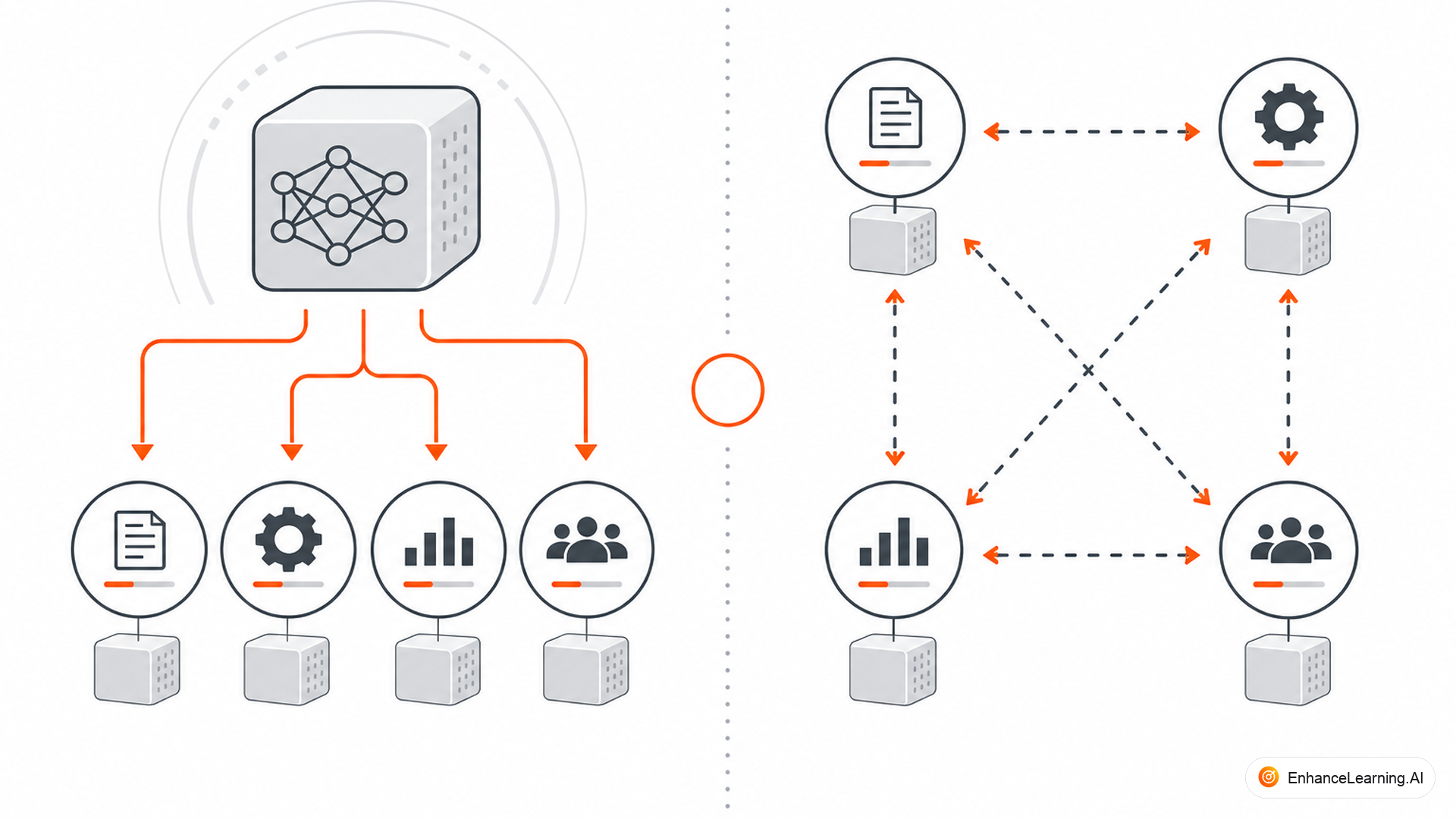
Your architecture diagram shows five agents. The question nobody asks: who decides what happens next? In most production incidents I have seen, the answer is "everyone, eventually" — which means no one owns the outcome. Orchestration and collaboration are two different answers to that question. They solve different coordination problems, fail in different ways, and require different observability. Conflating them produces systems that look modular on a slide and behave like a committee in production.
Two coordination philosophies#
Orchestration is centrally directed execution. One component — call it the orchestrator, supervisor, or conductor — holds the plan, assigns work, accepts results, and decides the next step. Workers do not negotiate with each other; they talk to the center. This mirrors a workflow engine with LLM-shaped steps: predictable control flow, explicit handoff schemas, and a single place to attach budgets and audit trails.
Collaboration is peer-based execution. Agents share a channel — a message bus, shared blackboard, or round-robin debate — and adapt based on what others say. There may be no persistent "boss." A facilitator agent might exist, but it proposes rather than commands. The system discovers the path through interaction: one agent spots a gap, another revises a draft, a third blocks an unsafe tool call.
Both patterns can use multiple model calls. The difference is where authority lives.
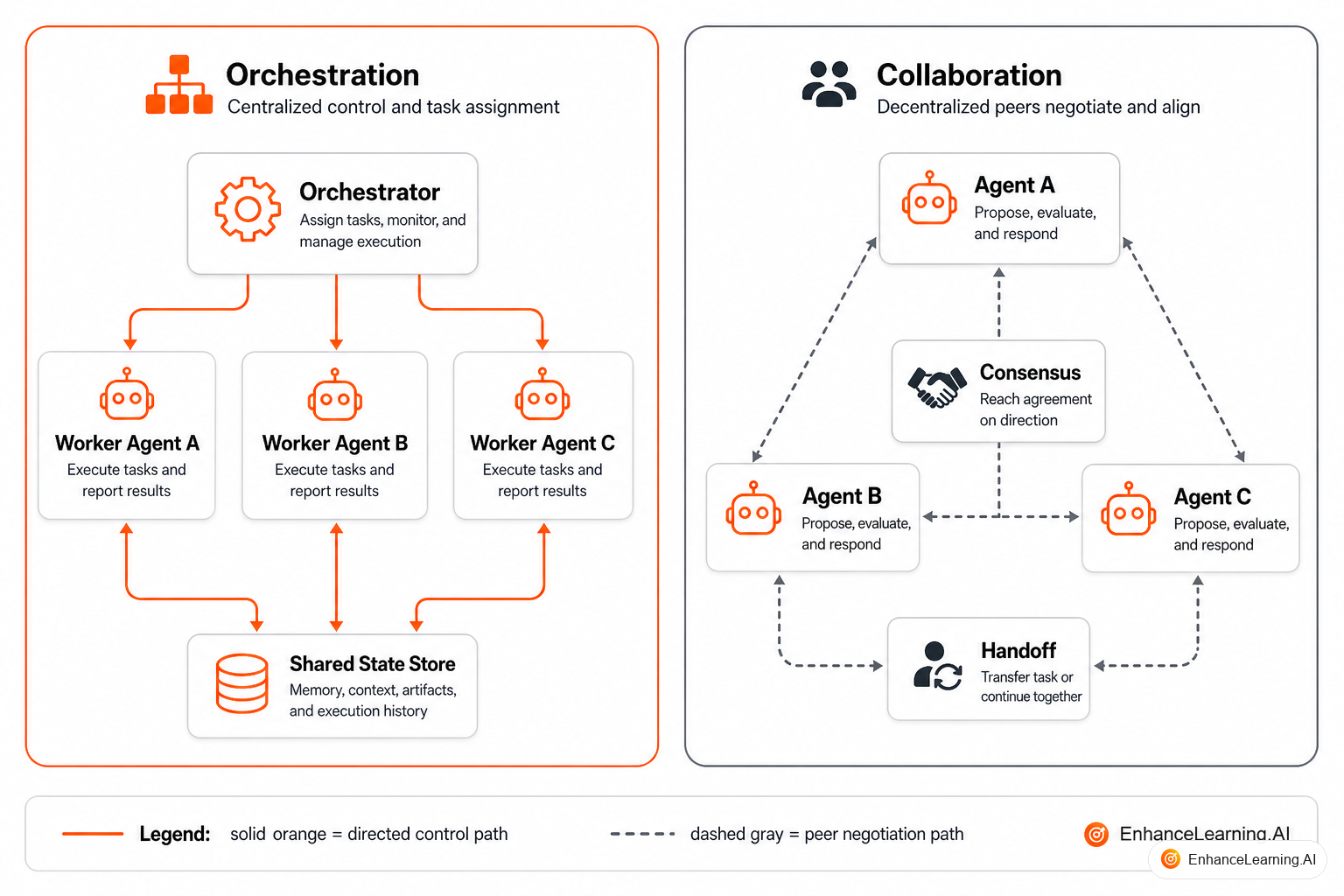
Why architects conflate them#
Framework marketing blurs the line. A library named "multi-agent" might implement a strict supervisor graph while the demo video shows agents chatting like coworkers. Teams copy the demo, ship the graph, and wonder why free-form dialogue creeps in through prompt instructions the orchestrator never enforces.
Another trap: orchestration dressed as collaboration. You have an orchestrator in code, but the prompt tells workers to "discuss until consensus." You pay orchestration complexity — schemas, state machines, merge logic — without getting collaboration's adaptive discovery. You also pay collaboration's failure modes — ping-pong, duplicate work — because nothing actually enforces a single writer.
The fix is to name your authority model in the design doc before you name your agents.
When orchestration is the right default#
Choose orchestration when the job decomposes into known phases with typed contracts between them.
Strong fits:
- Ticket triage → research → draft reply → human review — each phase has inputs, outputs, and a clear owner
- Extract → validate → persist — validation rules are code; the model fills structured slots
- Parallel fan-out over disjoint files — orchestrator merges against a schema, not a conversation
Orchestration shines when you need accountability. Regulators and on-call engineers want one trajectory ID that explains why refund agent B never ran. A central orchestrator with an append-only event log delivers that. Peer chat logs do not — they read like group therapy transcripts.
| Dimension | Orchestration | Collaboration |
|---|---|---|
| Control flow | Declared by supervisor | Emerges from interaction |
| Handoffs | Structured artifacts | Messages, often prose |
| Failure attribution | Usually clear | Often ambiguous |
| Best workloads | Pipeline, fan-out/merge | Open-ended research, debate |
| Latency profile | Predictable steps | Variable rounds |
| Testing | Schema + golden paths | Harder; need interaction evals |
When collaboration earns its complexity#
Collaboration pays off when the decomposition itself is uncertain and discovery is part of the value.
Examples that justify peers:
- Multi-source investigation where no one knows upfront which database holds the answer
- Adversarial review — a proposer and a skeptic that must react to each other's arguments, not fill fixed slots
- Negotiated planning in domains where constraints conflict and trade-offs need explicit surfacing
Even here, constrain the collaboration surface. Peers should not share tool credentials. They should publish claims and artifacts, not raw monologues. A research peer posts {source, excerpt, confidence}; a critic peer posts {objection, severity} — not three pages of reasoning that pollute everyone else's context window.
Production systems often orchestrate the outer job and collaborate inside one phase. Example: orchestrator runs extract → collaborative red-team review → publish. The collaboration is bounded by a step budget and a single merge gate. That is not cheating — it is matching pattern to sub-problem.
Implementation sketch: orchestration with typed handoffs#
from dataclasses import dataclass
from typing import Literal

@dataclass
class Handoff:
    phase: Literal["research", "draft", "review"]
    payload: dict
    correlation_id: str

class Orchestrator:
    def __init__(self, workers: dict, max_steps: int = 12):
        self.workers = workers
        self.max_steps = max_steps
        self.log: list[Handoff] = []

    def run(self, goal: str) -> dict:
        state = {"goal": goal, "artifacts": {}}
        phase = "research"
        for _ in range(self.max_steps):
            worker = self.workers[phase]
            result = worker.run(state)  # returns dict matching phase schema
            self.log.append(Handoff(phase, result, state["correlation_id"]))
            state["artifacts"][phase] = result
            phase = self._next_phase(phase, result)
            if phase == "done":
                return state
        raise RuntimeError("step budget exhausted")

    def _next_phase(self, current: str, result: dict) -> str:
        if current == "research" and result.get("sufficient"):
            return "draft"
        if current == "draft":
            return "review"
        if current == "review" and result.get("approved"):
            return "done"
        return current  # retry or escalate — never silent peer side-channel
Notice what is missing: workers calling each other. The orchestrator is the only routing authority. Retry and escalation are explicit policy, not emergent bickering.
Implementation sketch: bounded collaboration#
type PeerMessage =
  | { kind: "claim"; agent: string; text: string; evidenceRefs: string[] }
  | { kind: "objection"; agent: string; targetClaim: string; severity: "low" | "high" }
  | { kind: "proposal"; agent: string; action: string; rationale: string };

async function collaborativeRound(
  peers: Array<(thread: PeerMessage[]) => Promise<PeerMessage>>,
  seed: PeerMessage[],
  maxRounds: number
): Promise<PeerMessage[]> {
  const thread = [...seed];
  for (let round = 0; round < maxRounds; round++) {
    for (const peer of peers) {
      const msg = await peer(thread);
      thread.push(msg);
      if (msg.kind === "proposal" && !needsMoreDebate(thread)) {
        return thread;
      }
    }
  }
  throw new Error("collaboration round budget exhausted");
}
Peers read the thread; they do not invoke tools on shared infrastructure without a separate orchestrated commit step. Collaboration proposes; orchestration (or deterministic code) commits.
Failure modes by pattern#
Orchestration failures tend to be structural: wrong phase graph, brittle merge schema, orchestrator context overflow from un-summarized worker output, bottleneck latency when everything is sequential.
Collaboration failures tend to be behavioral: two peers duplicate the same web search, a dominant persona steamrolls others, polite agreement hides unresolved objections, debate runs until token budget death.
Mitigations differ. Orchestration wants schema validation at every handoff and single-writer rules per external resource. Collaboration wants round caps, deduplication keys on claims, and dissent capture — require a structured objection before accepting a proposal.
Observability and evals#
For orchestration, test like a workflow: golden paths per phase, property tests on handoff JSON, regression when schemas change.
For collaboration, add interaction evals: given seed messages, does the skeptic ever block an unsafe proposal? Does the system converge within N rounds on fixed scenarios? Track useful disagreement rate — if every run ends in unanimous praise, your critic is theater.
Log authority events separately from model prose. "Phase transition research → draft" is an orchestration event. "Objection raised on claim C14" is a collaboration event. Mixing them in one blob field makes postmortems painful.
Summary#
Orchestration centralizes authority: plans, handoffs, and merges flow through a supervisor with typed contracts. Collaboration distributes authority: peers adapt through messages, and the path emerges. They are not interchangeable, and hybrid systems should document where each sub-pattern starts and stops. Pick orchestration for pipelines and accountability; pick collaboration for discovery inside a budget; never pretend prompt-stage banter is architecture.
Want premium architecture blueprints?
Be among the first to explore interactive reference architectures, implementation playbooks, and premium engineering resources at launch.
Related Articles
Recommended reading based on this topic.
Single-Agent vs Multi-Agent Architectures
When multi-agent systems pay off—and when one bounded agent with good tools is the better production architecture.
Read ArticleWhy Most AI Agents Are Workflows in Disguise
Tell true agentic reasoning from deterministic orchestration in disguise — and assess whether your system chooses next steps or follows scripts.
Read ArticleDesigning Reliable AI Workflows
How to design AI workflows that survive retries, long-running steps, and human approval — with explicit state, idempotency, and failure paths you can operate.
Read Article