
Harness Engineering for Reliable Agents
The agent harness is the real product: tools, permissions, state, stops, and telemetry around a thin model call.

Teams argue about models. Incidents usually blame the harness. The model proposed a tool call; your process ran it with the wrong credentials, no timeout, and no record of why. That is not a reasoning failure. That is scaffolding failure.
Harness engineering is building the runtime around the model: tools, permissions, state, stop conditions, retries, and telemetry. The model is a component. The harness is the product surface that can hurt you.
Thin model, thick harness#
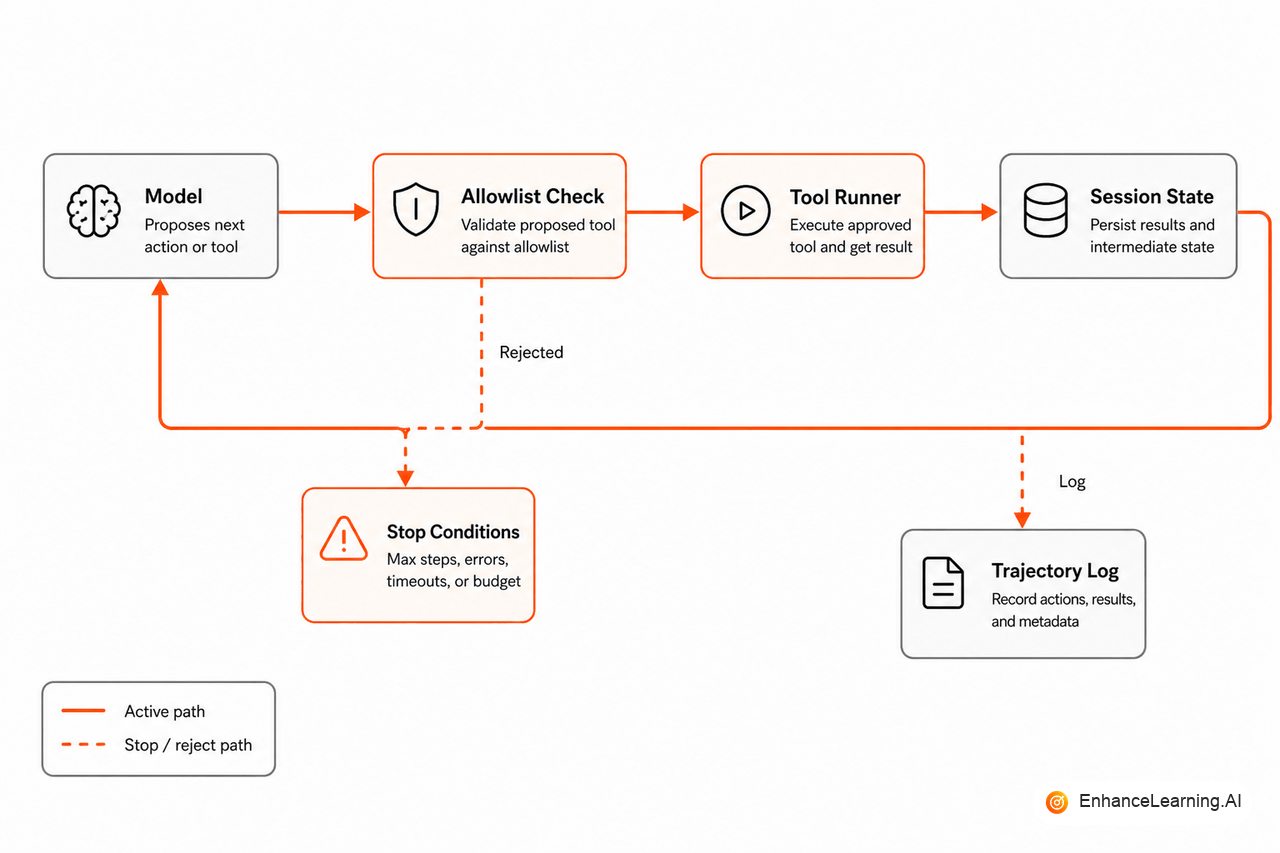
A reliable agent looks boring from the outside:
- The model proposes the next step.
- The harness checks allowlists, schemas, and budgets.
- Typed tools execute side effects.
- Results append to state the next call can see.
- Something deterministic decides when to stop.
If your “agent” is a while-loop that trusts free-form JSON and shell access, you skipped the harness and shipped a demo.
The practical test is simple: can you swap the model behind the same allowlist, timeouts, and trajectory schema without rewriting product code? If the answer is no, the “agent” is really a pile of prompt-coupled scripts. Harness engineering is how you get to yes.
What the harness must own#
| Concern | Harness responsibility |
|---|---|
| Tools | Registered names, JSON schemas, timeouts, idempotency keys |
| Permissions | Per-tenant allowlist; discovery ≠ permission |
| State | Session store the model does not invent |
| Stop Conditions | Max steps, max tokens, max spend, human gate |
| Telemetry | Trajectory, tool args (redacted), latency, errors |
Notice what is missing from that table: “clever system prompt.” Prompts matter. They do not replace tool contracts.
type HarnessConfig = {
  allowTools: Set<string>;
  maxSteps: number;
  maxTools: number;
};

async function step(cfg: HarnessConfig, state: AgentState, proposal: ToolProposal) {
  if (state.steps >= cfg.maxSteps) return { type: "stop" as const, reason: "max_steps" };
  if (!cfg.allowTools.has(proposal.name)) {
    return { type: "reject" as const, reason: "tool_not_allowed" };
  }
  const result = await runTool(proposal.name, proposal.args, { timeoutMs: cfg.maxTools });
  return { type: "ok" as const, result };
}
Reject paths are first-class. Silent “try something else” without logging is how you debug for a week.
When a tool is rejected, return a structured reason the next model call can see — tool_not_allowed, schema_invalid, timeout — not a vague “something went wrong.” Models recover better from named failures. On-call recovers better from named failures too.
Whether you use MCP, an internal gateway, or ad-hoc HTTP tools, permission lives next to execution. A server that advertises admin tools does not get them because the model asked politely.
Failure modes the harness prevents#
- Unbounded loops — no max steps, no wall clock
- Tool sprawl — every internal API exposed “just in case”
- Credential bleed — secrets in prompts or tool outputs the model can echo
- Blind retries — same failing call five times, five bills
Fix those in code. Do not ask the model to “be careful.”
Also watch partial success. A tool that writes a draft record and then times out leaves the world half-updated. Idempotency keys and compensating actions belong in the harness, not in a hope that the next loop iteration “notices.” If you cannot replay a failed step safely, you do not have a production tool — you have a demo button.
Where to start#
- One workflow, five tools, hard allowlist.
- Schema validation on every tool argument.
- Trajectory logging before you add a second agent.
- A degraded mode: smaller tool set or human handoff when the harness trips a budget.
Upgrade the model when the harness already refuses bad plans. Doing it the other way around is how you buy a faster way to call the wrong API.
Harness vs prompt vs workflow#
People mix these up:
- Prompt / context — what the model sees this turn.
- Harness — what code is allowed to run because of what the model said.
- Workflow — durable steps across time (approvals, waits, human gates).
You need all three eventually. Day-one reliability almost always comes from hardening the harness, not from a longer system message. A workflow engine on top of an unsafe tool runner just schedules incidents.
A useful sequencing for a new team: ship one workflow with a strict harness, prove you can stop and audit it, then widen tools. Context budgets and durable workflows come next. Jumping straight to multi-agent orchestration before allowlists and trajectory logs exist is how platforms earn a reputation for “AI that nobody trusts.”
Summary#
Harness engineering makes agents operable. Own tools, permissions, state, stops, and telemetry in deterministic code; keep the model thin and replaceable. If the scaffolding is vague, no frontier checkpoint will save the on-call rotation.
Want premium architecture blueprints?
Be among the first to explore interactive reference architectures, implementation playbooks, and premium engineering resources at launch.
Related Articles
Recommended reading based on this topic.
Loop Engineering for Agentic Systems
How to design agent loops that terminate: observe, decide, act, verify — with budgets, escapes, and feedback that does not spin forever.
Read ArticleWhy Most AI Agents Are Workflows in Disguise
Tell true agentic reasoning from deterministic orchestration in disguise — and assess whether your system chooses next steps or follows scripts.
Read ArticleThe Anatomy of an Agentic AI System
Core parts of a real agentic system—perception, reasoning, planning, action, state, and bounds—and how they fit in production architectures.
Read Article