
Model Benchmarks vs AI System Evals
Leaderboard scores measure model capability in isolation. System evals measure your composed application. Know which layer answers which decision.
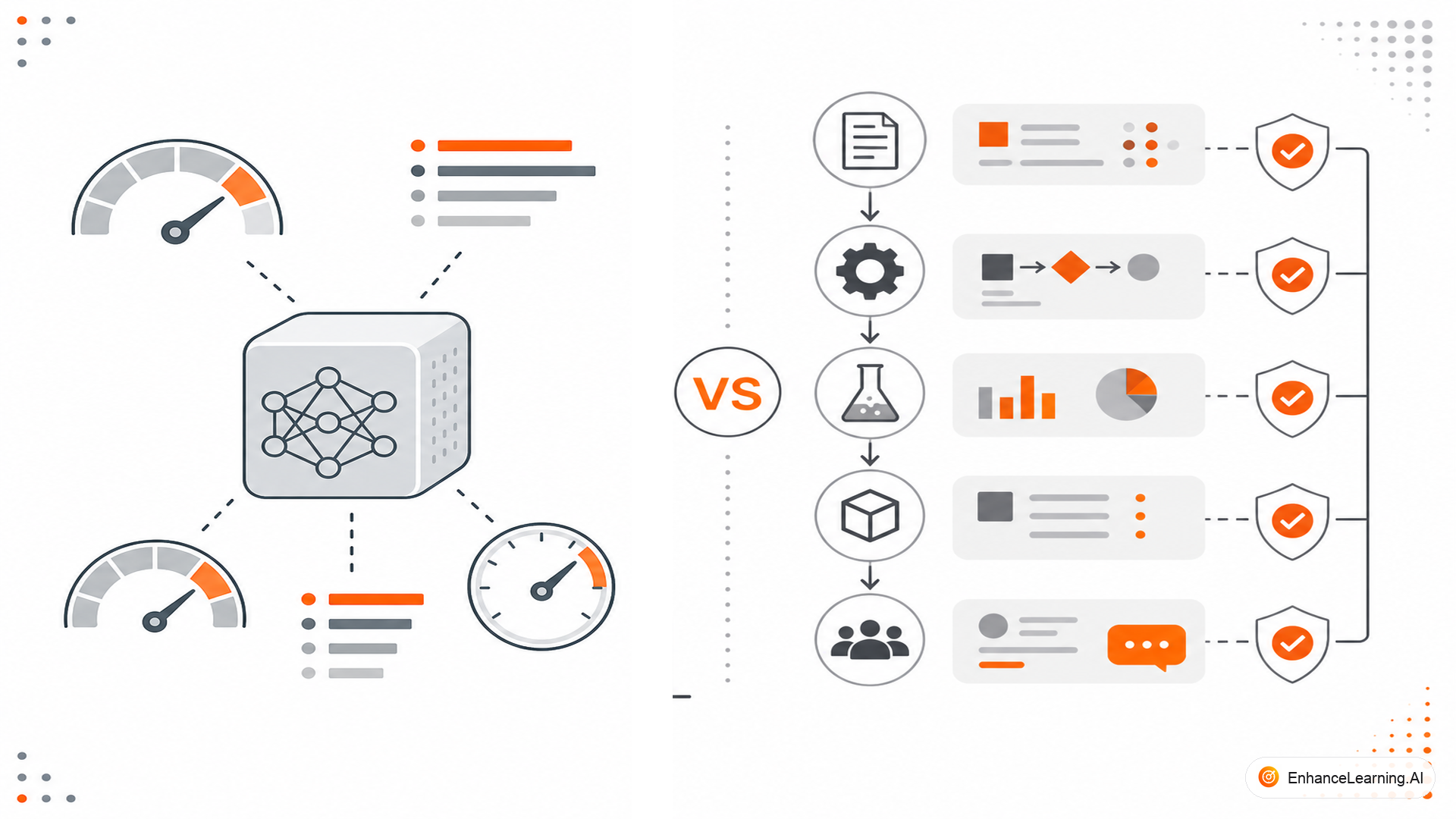
Your platform team proposes migrating from Model A to Model B because B ranks four points higher on a popular reasoning benchmark. Two weeks after cutover, support escalations rise — not because B is worse at reasoning in the abstract, but because B handles your retrieval context differently, ignores a formatting constraint your parser expects, and costs 40% more tokens per successful task. The benchmark answered a question nobody was asking. System evals answer the questions that actually burn you in production.
Two measurement layers, two decisions#
Model benchmarks and system evals both involve running inputs through models and scoring outputs. That surface similarity causes teams to conflate them. They measure different things at different layers of the stack.
Model benchmarks evaluate a model's general capability on standardized tasks: multiple-choice knowledge, coding puzzles, math word problems, instruction following on curated prompts. Scores are comparable across models because the task set is fixed and public. They help you shortlist candidates for a capability gap.
AI system evals evaluate your composed application: chosen model, prompts, retrieval pipeline, tools, guardrails, and orchestration logic on cases that reflect your users, data, and policies. Scores are comparable across your releases, not across vendors' marketing pages. They help you decide whether to ship, promote, or roll back.
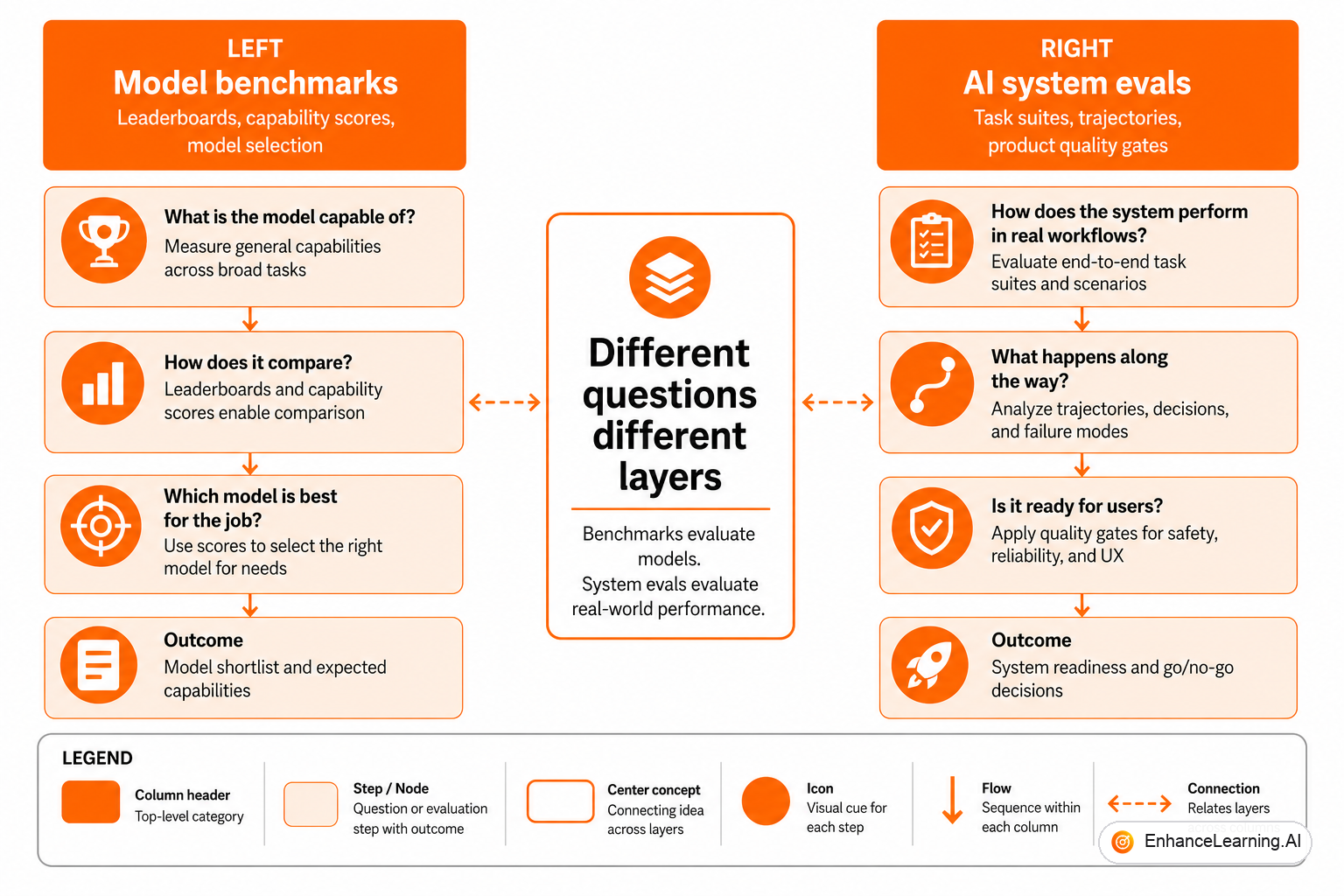
Use benchmarks for model selection. Use system evals for release decisions. Swapping the two is how regressions get executive approval.
What benchmarks actually tell you#
Benchmarks compress capability into a single number or leaderboard rank. That compression is useful early in a procurement cycle — you cannot run full system evals on forty candidate models. Benchmarks answer: does this model roughly have the reasoning, coding, or multilingual skill we need?
They do not answer:
- Does it cite the right chunks from our index after our chunking strategy?
- Does it respect our JSON schema under adversarial user input?
- Does it refuse our policy boundary cases consistently?
- What is cost per successful task in our workflow with our average context size?
A model that excels on GPQA can still fail a tenant-specific compliance summarization job because the failure mode lives in composition, not base capability.
| Question | Benchmark | System eval |
|---|---|---|
| Which models to pilot? | Primary signal | Too early |
| Safe to promote this release? | Irrelevant | Primary signal |
| Vendor A vs B for coding agent | Useful input | Definitive |
| Did reindex break answers? | Silent | Catches it |
| Executive "are we best in class?" | Seductive, misleading | Show job-class metrics |
Why leaderboard scores mislead release gates#
Benchmarks are gamed — intentionally or structurally. Training data contamination, prompt format sensitivity, and benchmark-specific fine-tuning inflate scores without improving your application. Models tuned to leaderboard aesthetics may produce verbose, citation-free prose that judges love and your parsers hate.
Release gates need cases your organization owns. When a golden set case flips from pass to fail, you know exactly which input, which constraint, and which release artifact caused it. When a benchmark score moves two points, you rarely know what changed in your user's experience.
System evals decompose the stack#
System evaluation mirrors system architecture. You score components and outcomes:
- Retrieval — recall@k on labeled queries, chunk attribution accuracy
- Generation — faithfulness to retrieved evidence, format compliance
- Tools — argument validity, success rate, retry behavior
- Orchestration — step budget adherence, correct termination
- Outcome — task success, user repair rate, escalation rate
Benchmarks collapse all of that into one model call on a static prompt. When retrieval degrades after a reindex, your benchmark score on the base model is unchanged. Your system eval fails — if you built one.
interface SystemEvalCase {
  id: string;
  input: string;
  jobClass: string;
  mustCiteDocIds?: string[];
  expectTool?: string;
  expectRefusal?: boolean;
}

interface ComponentScores {
  retrievalRecall: number;
  schemaValid: boolean;
  faithfulness: number;
  toolSuccess: boolean;
}

async function scoreSystemCase(
  evalCase: SystemEvalCase,
  runPipeline: (input: string) => Promise<{ output: unknown; trace: unknown }>
): Promise<ComponentScores> {
  const { output, trace } = await runPipeline(evalCase.input);
  const retrieved = extractRetrievedIds(trace);
  const recall = evalCase.mustCiteDocIds
    ? evalCase.mustCiteDocIds.filter((id) => retrieved.includes(id)).length /
      evalCase.mustCiteDocIds.length
    : 1;
  return {
    retrievalRecall: recall,
    schemaValid: validateOutputSchema(output),
    faithfulness: await judgeFaithfulness(output, trace),
    toolSuccess: evalCase.expectTool
      ? calledTool(trace, evalCase.expectTool)
      : true,
  };
}
Decomposed scores tell you where to fix — swap embedder, tighten schema, change stop condition — instead of blindly swapping models.
When benchmarks still matter#
Benchmarks earn their place upstream of system evals:
- Initial model shortlisting — filter forty models to four without building full harness runs on each
- Capability gap analysis — confirm a smaller model can handle the reasoning depth your agent requires before investing in distillation
- Research and roadmap — track field progress on tasks adjacent to your product bets
Keep the pipelines separate so benchmark tooling never substitutes for owned golden sets.
Building a decision workflow that uses both#
- Define job classes and quality constraints with product and compliance
- Use benchmarks to narrow model candidates for each job class
- Run full system eval on finalists using owned golden sets — at least fifty cases per class
- Compare cost per successful task, not just pass rate
- Promote only on system eval delta; log benchmark scores as context, not gate
- Re-run system evals on every prompt, retrieval, tool, or model change — benchmarks optionally quarterly
Document which decisions each layer informs. New hires and executives otherwise revert to "but we're using the top-ranked model" as an argument that ends discussion.
Summary#
Model benchmarks measure general capability on standardized tasks. AI system evals measure your composed application on owned cases that reflect real users, data, and policies. Benchmarks help you choose candidates; system evals help you ship safely. Conflating the two leads to approved releases that fail in production and rejected models that would have worked fine in your stack. Keep both layers — and know which answer each decision requires.
Want premium architecture blueprints?
Be among the first to explore interactive reference architectures, implementation playbooks, and premium engineering resources at launch.
Related Articles
Recommended reading based on this topic.
How to Evaluate AI Systems in Production
A practical eval stack for production AI: golden sets, trajectory checks, LLM-as-judge pitfalls, online sampling, and regression gates that block bad releases.
Read ArticleWhy Reproducibility Matters in AI Evaluation Pipelines
Eval results you cannot replay are opinions. Seed control, environment pinning, and auditable artifacts make evaluation pipelines trustworthy.
Read ArticleWhy AI Eval Frameworks Need Versioning Just Like Code
Unversioned eval logic, datasets, and judge prompts make regression analysis unreliable. Treat eval artifacts as managed code with semver and changelogs.
Read Article