
What Makes a Workflow AI-Native Rather Than Just Automated
The architectural traits that separate AI-native workflows from script pipelines — probabilistic steps, judgment gates, and context that survives retries.
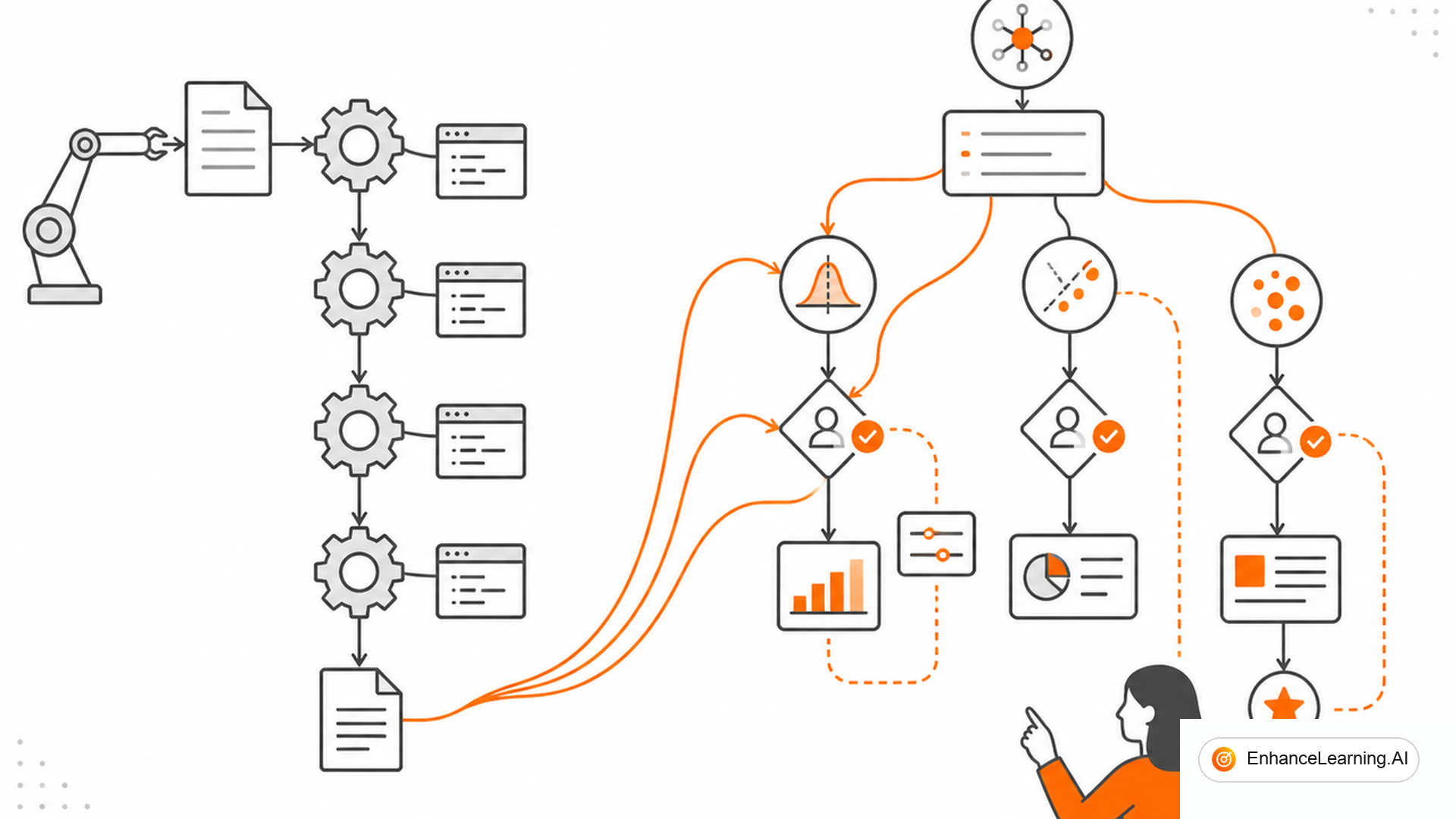
Your team shipped a cron job that calls GPT-5, parses JSON, and posts to Slack. Marketing calls it an AI workflow. Engineering knows it is a script with a model endpoint. The gap is not branding — it is whether the orchestration layer was designed for probabilistic, multi-step AI work or merely bolted onto deterministic automation patterns that predate LLMs.
Automation that predates the model#
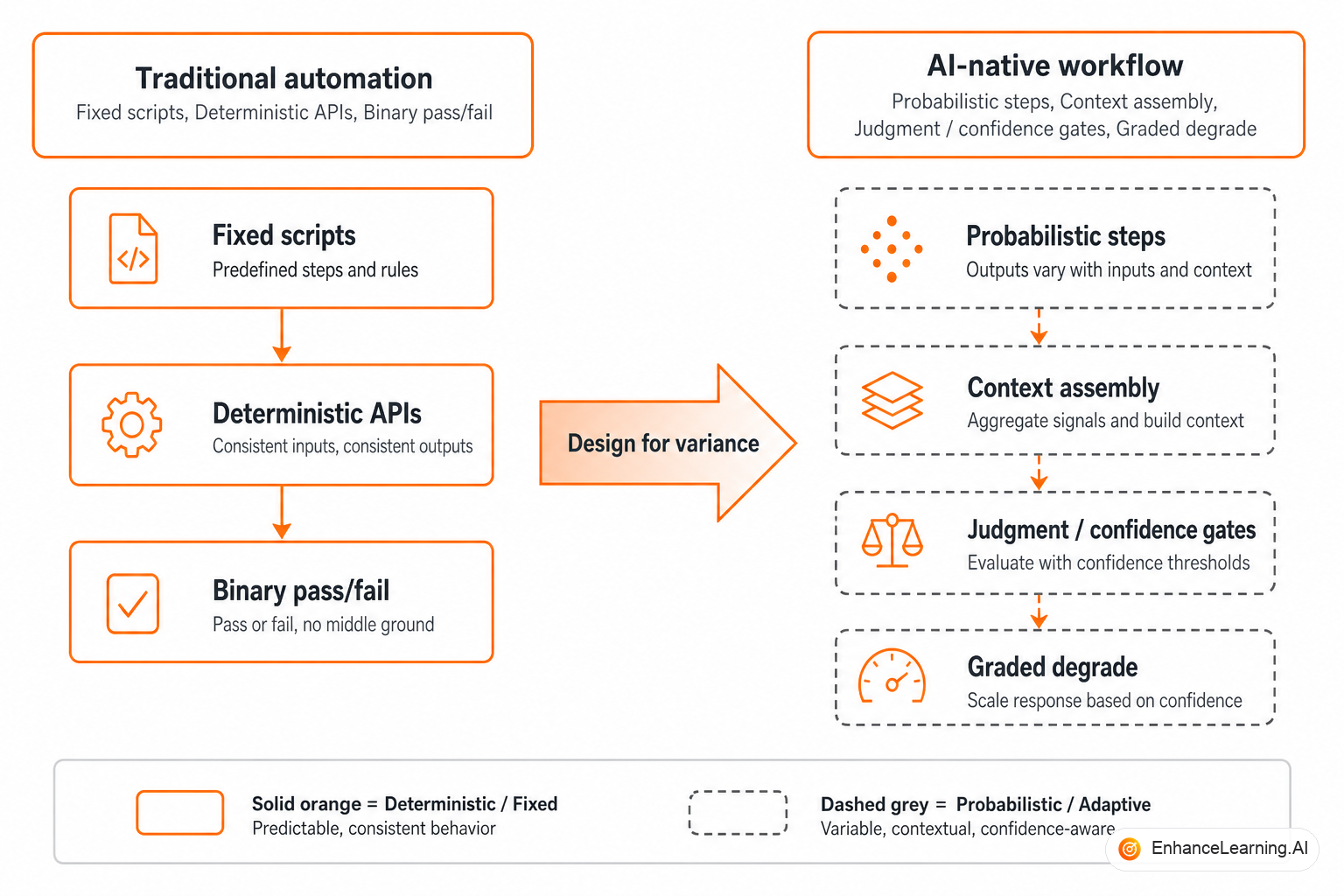
Classic automation assumes predictable inputs, deterministic transforms, and binary success. A webhook arrives, a worker validates a schema, a database row updates, an email sends. Errors are exceptions. Retries are safe because the same input produces the same output.
AI steps break those assumptions. A summarization node may produce a valid but wrong summary. A classification step may flip labels between runs. A tool-calling step may hallucinate parameters that pass JSON schema but fail business rules. If your pipeline treats every model output like a database row — accept or throw — you have automated a call to an LLM, not built an AI-native workflow.
The traits that actually matter#
An AI-native workflow is not defined by how many model calls it contains. It is defined by how the system handles uncertainty across steps, time, and side effects.
| Trait | Traditional automation | AI-native workflow |
|---|---|---|
| Step output | Deterministic or fail | Probabilistic with validation + fallback |
| Branching | Fixed on data fields | May branch on model confidence or human review |
| Context | Passed as typed payloads | Assembled per step with retrieval and memory |
| Failure handling | Retry identical input | Re-prompt, alternate model, escalate |
| Side effects | Idempotent by design | Gated until quality threshold met |
| Observability | Latency and error rate | Trajectory, token cost, judge scores |
If your graph cannot express "this step might need a second attempt with different context," you are still in RPA territory with a language model node.
Probabilistic steps need explicit contracts#
Every model step in an AI-native workflow should declare three things: what good output looks like, what happens when output is malformed, and what happens when output is well-formed but wrong.
A vendor onboarding workflow had a "extract company metadata" step that returned JSON. The schema validated. The company name was hallucinated. Downstream CRM writes propagated the error to 400 accounts before anyone noticed. The fix was not a better prompt — it was a contract: cross-check extracted fields against the source document with a second read-only pass, and block writes when confidence scores diverge.
from dataclasses import dataclass
from enum import Enum
import json
from openai import OpenAI

client = OpenAI()

class StepOutcome(Enum):
    OK = "ok"
    RETRY = "retry"
    ESCALATE = "escalate"

@dataclass
class ExtractResult:
    company: str
    confidence: float
    raw: dict

def extract_metadata(document: str) -> ExtractResult:
    resp = client.chat.completions.create(
        model="gpt-4o",
        response_format={"type": "json_object"},
        messages=[
            {"role": "system", "content": "Extract company metadata. Include confidence 0-1."},
            {"role": "user", "content": document},
        ],
    )
    data = json.loads(resp.choices[0].message.content or "{}")
    return ExtractResult(
        company=data.get("company", ""),
        confidence=float(data.get("confidence", 0)),
        raw=data,
    )

def validate_step(result: ExtractResult, min_confidence: float = 0.85) -> StepOutcome:
    if not result.company:
        return StepOutcome.RETRY
    if result.confidence < min_confidence:
        return StepOutcome.ESCALATE
    return StepOutcome.OK
That validate_step function is the difference between automation and AI-native design. The workflow graph should route RETRY and ESCALATE to different nodes — not collapse them into a generic catch block.
Context assembly is a first-class step#
Traditional pipelines pass structs between functions. AI-native workflows assemble context: system instructions, retrieved documents, prior step outputs (summarized or full), tool results, and policy constraints. Context is not a blob appended to a prompt — it is engineered per node with token budgets.
Teams that skip explicit context assembly end up stuffing everything into one mega-prompt at workflow start. That works for three steps. It fails at twelve, when stale context poisons later decisions and costs spike because every node re-reads the entire history.
Treat context assembly as its own node type in the graph, with versioning and audit. When a workflow resumes after a deploy, you want to know exactly which context snapshot the model saw — not "whatever was in the chat buffer."
Judgment gates, not just error handlers#
Automation uses try/catch. AI-native workflows use judgment gates: human review, rule engines, secondary model judges, and quality thresholds that can pause or redirect flow based on semantic evaluation.
JSON that parses is not the same as output you can ship. An AI-native workflow validates structure and meaning before irreversible side effects.
A content moderation pipeline might auto-publish when a classifier returns "safe" with score > 0.95. An AI-native variant adds a judge model on borderline cases, routes high-risk topics to human review regardless of score, and logs disagreement between classifiers for offline eval. That is architectural behavior traditional automation does not need — and cannot express with a simple if/else on a boolean field.
Multi-step coherence over single-shot cleverness#
The temptation is to solve everything in one enormous prompt: "Read this ticket, classify it, draft a response, check policy, and suggest an action." Single-shot cleverness collapses under edge cases because the model juggles competing objectives without checkpoints.
AI-native workflows decompose objectives into steps with narrow scopes. Each step produces an artifact the next step consumes. Coherence comes from the graph, not from hoping the model remembers fifteen instructions simultaneously.
This is different from agent loops where the model chooses the decomposition. AI-native workflows here means engineer-authored decomposition with model-shaped steps inside — predictable structure, probabilistic execution within each box.
Observability beyond HTTP status codes#
Automation dashboards track success rate and p99 latency. AI-native workflow observability tracks trajectories: which steps retried, which model produced the output, token spend per workflow instance, judge scores over time, and human override frequency.
When quality regresses, you need to diff workflow versions and context assembly changes — not just redeploy and hope. Store step-level metadata: model id, prompt version, retrieval query, validation outcome. This is how you answer "why did refunds spike last Tuesday?" without replaying production traffic manually.
How this differs from reliability engineering alone#
Reliable workflow design — retries, idempotency keys, durable timers — is necessary but not sufficient for AI-native work. You can run a perfectly reliable pipeline that faithfully executes bad model output at scale. AI-native design adds semantic gates between reliable transport and irreversible effects: judges, cross-checks, human review on borderline cases, and explicit fallback paths when the model is uncertain.
The reliability article answers "what happens when step three times out?" This article answers "what happens when step three returns plausible garbage?" Both questions belong in production. Do not assume fixing Temporal configuration makes a workflow AI-native.
Patterns worth adopting#
- Declare step contracts — schema, quality threshold, retry policy, escalation path — in workflow metadata, not scattered in worker code.
- Separate read steps from write steps — maximize retries on reads; gate writes behind validation and approval.
- Version context assembly — treat prompts and retrieval configs as deployable artifacts tied to workflow version.
- Instrument trajectories — log enough to replay a single workflow instance for debugging and eval.
- Design fallbacks explicitly — alternate model, rules-only path, human queue — not an infinite retry loop.
Summary#
AI-native workflows are not traditional automation with an API key. They treat model steps as probabilistic components that need contracts, context engineering, judgment gates, and trajectory-level observability. Teams that skip these traits ship fast and operate blind — retrying the same bad prompt, trusting schema validation as quality assurance, and wondering why "the AI workflow" behaves like a fragile script. Name the difference early. Build for uncertainty on purpose.
Want premium architecture blueprints?
Be among the first to explore interactive reference architectures, implementation playbooks, and premium engineering resources at launch.
Related Articles
Recommended reading based on this topic.
Designing Reliable AI Workflows
How to design AI workflows that survive retries, long-running steps, and human approval — with explicit state, idempotency, and failure paths you can operate.
Read ArticleThe Difference Between Orchestrated AI Workflows and Ad Hoc Scripts
Formal workflow engines versus informal scripted automation — and how to recognize when orchestration infrastructure becomes necessary.
Read ArticleFrom Stateless API Calls to Stateful AI Workflows
Ephemeral API calls versus processes that accumulate context, decisions, and partial results — the baseline vocabulary for workflow design.
Read Article