
Why Context Quality is the Bottleneck in Production AI
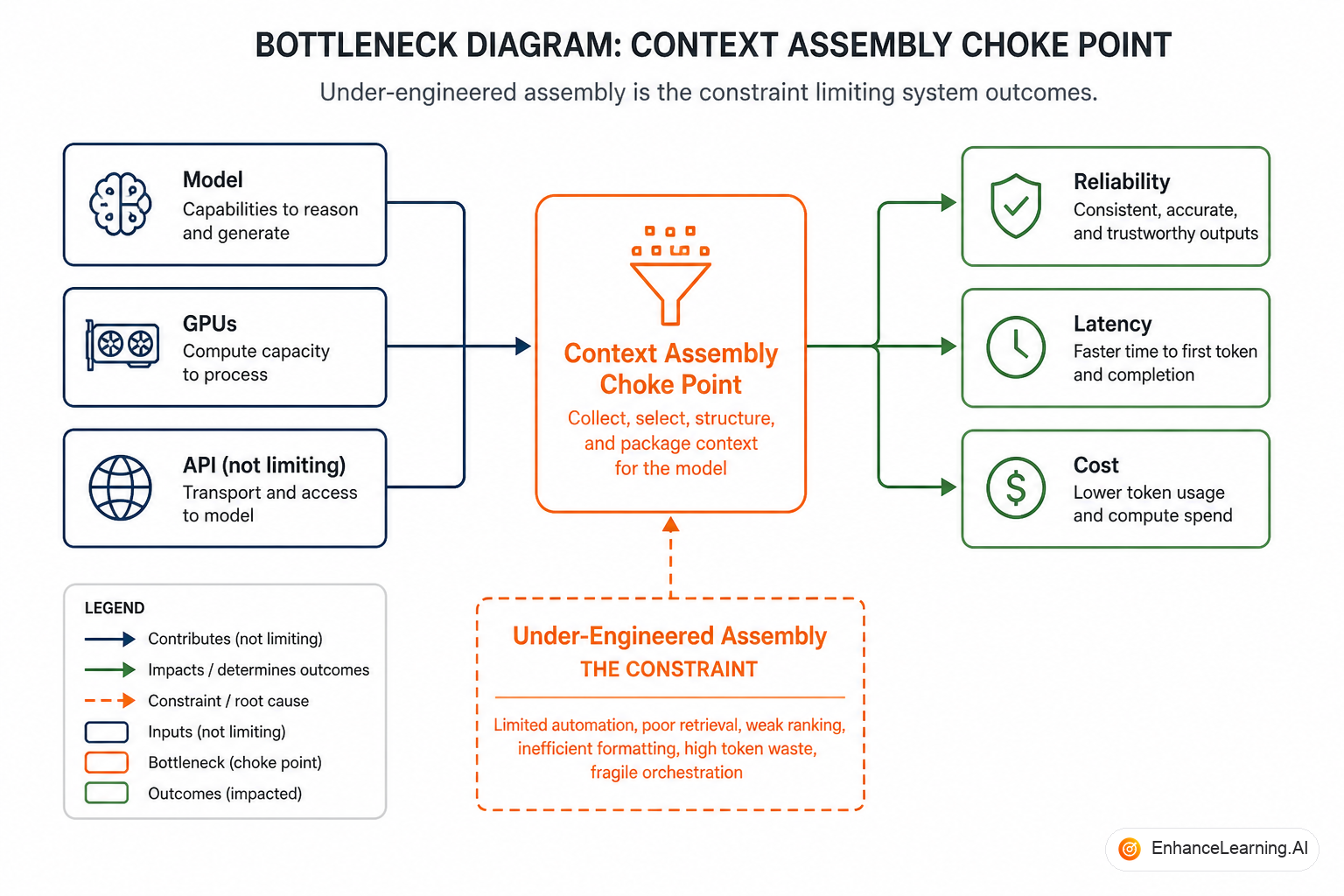
Context assembly — not model size — limits reliability, latency, and cost in production AI. It is the most under-engineered layer in most stacks.

The dashboard shows green: model latency within SLO, error rate flat, spend under budget. Customer trust still erodes. Agents escalate tickets the knowledge base already answered. Generated emails reference policy paragraphs from last year's PDF. The inference stack is healthy. The context pipeline is lying to the model.
Context quality — whether the right information reaches the model, in usable form, with room left to think — is the bottleneck in most production AI systems I review. Not because teams ignore it intentionally. Because context assembly sits in the glue between retrieval, memory, integrations, and prompts, owned by everyone and no one. Until you instrument it, you optimising the wrong layer.
The invisible limiting factor#
Model benchmarks measure capability on curated inputs. Production measures outcomes on assembled inputs. The gap between those two is almost always context.
Three constraints bind simultaneously:
| Constraint | What context quality affects | Typical symptom when ignored |
|---|---|---|
| Reliability | Model sees correct, current evidence | Confident wrong answers with citations |
| Latency | Prompt tokens drive prefill time | p95 spikes as history and retrieval grow |
| Cost | Input tokens billed every request | Spend scales with pack size, not user value |
Teams respond to reliability issues by upgrading models. They respond to latency with faster hardware or shorter max tokens. They respond to cost with caching and smaller tiers. All three levers help — but none fix a pack that ships stale CRM data, duplicate chunks, and an entire chat transcript on every turn.
A B2B onboarding assistant I audited last year consumed 18k input tokens per request while the task instruction occupied 120 tokens. Retrieval returned seven near-duplicate help articles because the vector index lacked deduplication. "Optimising the model" was irrelevant. Trimming evidence to two deduped chunks cut latency forty percent and improved answer accuracy because the task instruction stopped drowning.
Why the context layer stays under-engineered#
Context assembly rarely ships as a named component. It accretes:
- A route handler appends
req.body.context - A retriever returns
top_k=10because ten sounded safe - A tool wrapper dumps full JSON because parsing felt hard
- A PM adds compliance text to the system prompt "temporarily" in March
Six months later, that string is production architecture. No unit tests. No token budget. No owner.
Meanwhile, model selection gets spreadsheets. Inference gets GPU dashboards. Retrieval gets embedding benchmarks. Assembly — the step that combines all of them — gets a TODO comment.
Log input tokens by region on every trace. If you cannot chart policy vs evidence vs history for last week, you cannot claim context is engineered.
Reliability: garbage in, fluent garbage out#
Modern models are excellent at sounding authoritative with incomplete or wrong context. That is a production hazard, not a feature.
Reliability failures from context quality include:
- Stale evidence — indexed documents not re-embedded after policy change
- Missing evidence — retrieval threshold too aggressive; correct doc never surfaces
- Contradictory evidence — two chunks from different policy versions both pass the filter
- Buried instructions — task and policy pushed below low-value history
- Hallucination-friendly gaps — model fills absent facts because assembly omitted required fields
Fixes at the prompt layer ("do not invent") reduce frequency. They do not remove the incentive when the pack is empty or ambiguous. Context engineering closes the gap: required fields, provenance headers, contradiction detection before the call.
from pydantic import BaseModel, Field, model_validator

class EvidenceChunk(BaseModel):
    id: str
    text: str
    score: float
    source_updated_at: str

class ContextPack(BaseModel):
    task: str
    policy_version: str
    chunks: list[EvidenceChunk] = Field(default_factory=list)
    max_evidence_tokens: int = 3500

    @model_validator(mode="after")
    def validate_pack(self) -> "ContextPack":
        if not self.task.strip():
            raise ValueError("task instruction missing — refuse call")
        if self.required_evidence() and not self.chunks:
            raise ValueError("evidence required but retrieval returned empty")
        if estimate_tokens(self.render()) > self.max_evidence_tokens:
            raise ValueError("evidence overflow — run eviction, do not truncate blindly")
        return self

    def required_evidence(self) -> bool:
        return "cite" in self.task.lower() or "document" in self.task.lower()

    def render(self) -> str:
        body = "\n\n".join(f"[{c.id}] {c.text}" for c in self.chunks)
        return f"{self.task}\n\n[policy:{self.policy_version}]\n{body}"
Raising before the provider call beats debugging fluent errors after.
Latency: prefill scales with what you send#
Autoregressive decoding gets the attention for "slow LLM" complaints. Prefill on large prompts is often the hidden p95 killer. Every token in policy, history, and retrieval participates in prefill before the first output token.
Context quality work directly reduces prefill:
- Summarise history instead of replaying verbatim
- Retrieve fewer, higher-precision chunks
- Move stable policy to cached prefix slots where your provider supports prompt caching
- Strip formatting noise from HTML and PDF extraction
If your pack grows linearly with product surface area — every new integration appends another paragraph — latency grows linearly too. No chip upgrade fixes unbounded input.
Cost: input tokens are a recurring tax#
Output tokens get attention in cost reviews because they are visible in completions. Input tokens are silent and repeated every request. A 2k-token bloat in the system message multiplied by ten million monthly calls is a line item nobody forecast.
Context quality reduces cost without dumbing down the model:
- Dedupe retrieval results
- Store large tool outputs externally; pass references
- Tier assembly: cheap model summarises evidence; expensive model decides
- Enforce per-region budgets in code, not by "asking nicely" in the prompt
Cost and reliability align here. Smaller, cleaner packs are cheaper and easier for the model to use.
How to invest in the under-engineered layer#
Visibility - Add context_tokens_by_region to traces. Sample fifty production requests. Rank by total input tokens. Open the top ten packs manually. You will spot wasted tokens within a few hours.
Gates - Block provider calls when required regions are empty or over budget. Return a structured error to retry retrieval or route to human queue — not a best-effort model guess.
Ownership - Name a context owner for each product surface. They approve changes to assembly logic, not just prompt text. They review integration PRs that append new fields to payloads.
Evals on assembly - Golden sets should vary retrieval fixtures while holding prompts fixed. Track citation accuracy and policy version match as first-class metrics alongside ROUGE or LLM-judge scores.
When model choice still matters#
Context quality is the bottleneck most of the time, not all of the time. Model upgrades remain correct when:
- Clean packs still fail multi-step reasoning tasks
- Structured output violates schema despite explicit contracts and few-shots
- Tool-use loops misparse valid instructions with minimal noise
Run the freeze test: take a failing trace, hand-curate the pack in a notebook, rerun. If quality recovers, context owns the roadmap. If not, model or prompt levers apply.
Operational signals on dashboards#
Add these charts beside model latency:
- Empty evidence rate — retrieval returned nothing when citations required
- Budget violation rate — assembly refused or evicted before call
- Policy version mismatch — evidence from superseded policy index
- p95 evidence tokens — creeping growth predicts latency incidents
When empty evidence spikes after a deploy, check the retriever and index — not the system prompt. When p95 evidence tokens jump, inspect the most recent integration that started appending payload fields.
Context quality work is boring on green dashboards and heroic on red ones. Instrument while green.
Summary#
Production AI fails quietly at the assembly layer: wrong evidence, unbounded history, duplicated policy, no room for the task. Reliability, latency, and cost all worsen while model dashboards stay green. Context quality is the bottleneck because it is the least formalised discipline in the stack — and the one every integration touches. Instrument the pack, enforce budgets, assign ownership, and many "model problems" disappear without a single GPU upgrade.
Want premium architecture blueprints?
Be among the first to explore interactive reference architectures, implementation playbooks, and premium engineering resources at launch.
Related Articles
Recommended reading based on this topic.
Why More Context Doesn't Improve LLM Output Quality
Stuffing the context window with more text often hurts LLM output — irrelevant tokens add noise, latency, and cost. Curation beats volume in production.
Read ArticleThe Trade-off Between Context Richness and LLM Latency
Richer LLM context improves answers until prefill latency hurts UX. Measure the trade-off between context size, inference time, and product responsiveness.
Read ArticleThe Anatomy of a Production-Ready RAG Pipeline
End-to-end RAG reference architecture: ingestion through chunking, indexing, retrieval, reranking, context assembly, generation, citation, and eval.
Read Article