
The Trade-off Between Context Richness and LLM Latency
Richer LLM context improves answers until prefill latency hurts UX. Measure the trade-off between context size, inference time, and product responsiveness.

Product wants richer context: full ticket history, more retrieved articles, tool summaries, compliance footnotes. Engineering knows p95 latency crossed three seconds last sprint. Both sides cite user research. Neither side has a graph of input tokens vs time-to-first-token for the workflow users actually hit.
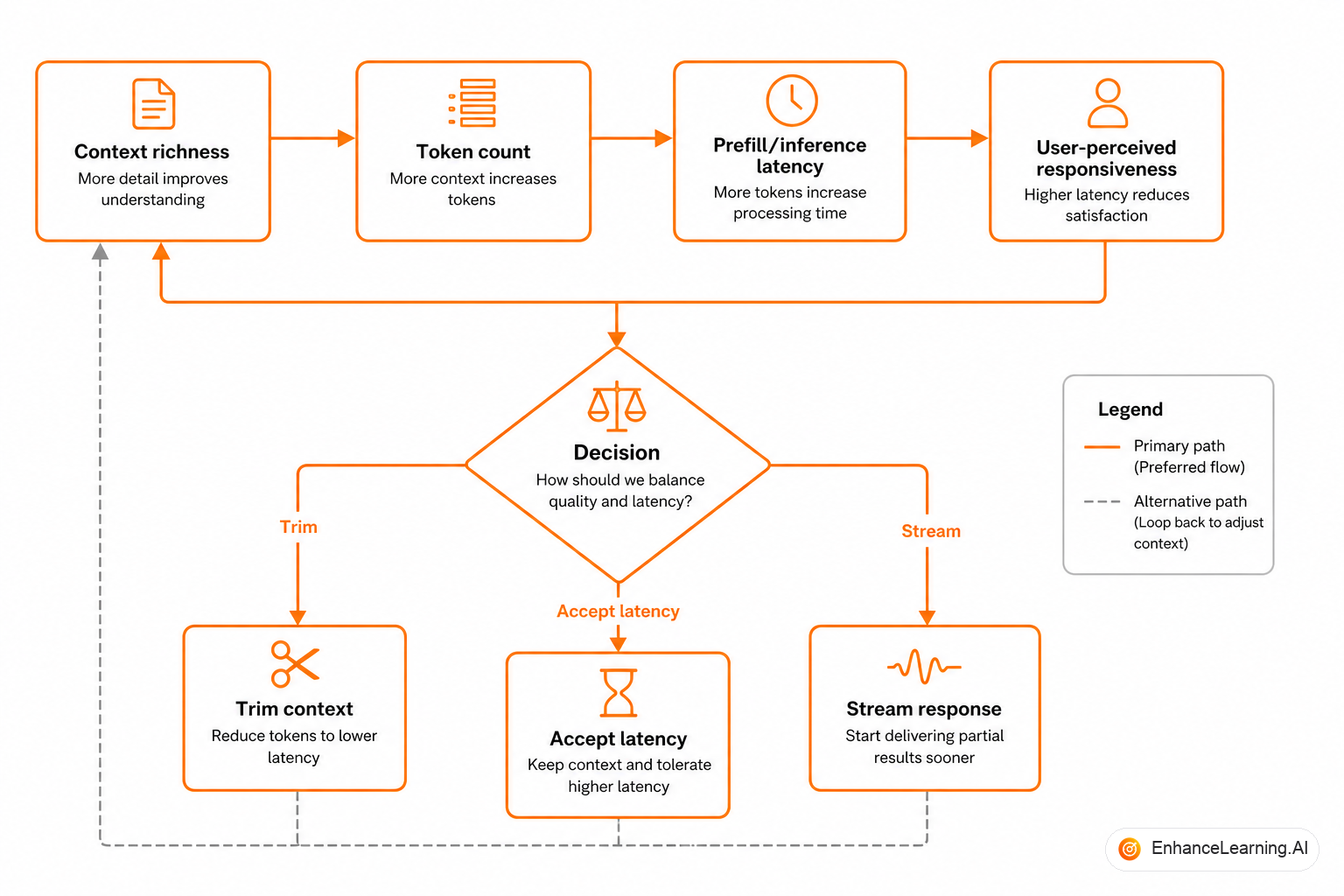
Context richness and LLM latency are coupled variables, not independent knobs. Every token you add participates in prefill before the model emits a single character. In interactive products, that delay is felt UX — not a benchmark number on a GPU spec sheet. The trade-off is measurable, ownable, and often mis-managed because teams optimise retrieval recall without measuring end-to-end responsiveness.
Prefill is the hidden UX tax#
Autoregressive generation dominates conversations about "slow models," but users wait during prefill too — processing the entire prompt. Provider latency roughly scales with input size, model width, and batch contention. Doubling evidence tokens often moves time-to-first-token (TTFT) more than doubling output max_tokens.
Rough mental model for planning — validate on your provider and model tier:
| Input tokens (approx.) | Typical TTFT impact trend |
|---|---|
| < 2k | Often sub-second on hosted APIs |
| 2k–8k | Linear climb; caching helps stable prefixes |
| 8k–32k | Noticeable in chat UX; agent loops multiply |
| > 32k | Batch or async unless users expect wait |
Numbers vary by hardware and queue depth. The direction does not: richer context slows first token unless you architect around it.
Richness has diminishing UX value#
Extra context improves answer quality only when it adds non-redundant signal. Past that point, users pay latency for noise.
An internal IT copilot tracked both TTFT and thumbs-down rate across pack sizes. Quality plateaued around 3.5k input tokens. Packs at 9k tokens added two seconds TTFT with no statistically significant quality gain — users simply abandoned before reading the answer. The product cost of "more context" was measurable abandonment, not a line on the inference bill alone.
Measure richness against outcomes per second, not tokens per request:
- Task success within SLA
- User continuation rate after first reply
- Escalation rate to human support
- Validator pass rate on structured outputs
Architectural levers on the trade-off curve#
Curation before call — fewer, stronger chunks beat comprehensive dumps. Same richness signal, fewer tokens.
Tiered assembly — cheap fast model compresses history; expensive model receives summary + fresh evidence. Pays two calls but cuts prefill on the slow tier.
Prompt caching — stable system and policy prefix cached; per-request tokens limited to task + evidence delta.
Async surfaces — batch jobs and email drafts tolerate 10k-token packs; in-app chat does not. Split workflows by UX contract.
Streaming with honest loading states — streaming helps perceived latency after first token; it does not remove prefill. Do not stream your way out of 20k-token packs in a live copilot.
import time
import httpx
from openai import OpenAI

client = OpenAI(http_client=httpx.Client(timeout=60.0))

def measure_prefill_latency(messages: list[dict[str, str]], model: str) -> float:
    """Time until first streamed token — proxy for prefill + queue."""
    start = time.perf_counter()
    stream = client.chat.completions.create(
        model=model,
        messages=messages,
        max_tokens=1,
        stream=True,
    )
    for event in stream:
        if event.choices[0].delta.content:
            return time.perf_counter() - start
    raise RuntimeError("no token received")

def richness_sweep(
    base_messages: list[dict[str, str]],
    evidence_variants: list[str],
    model: str,
) -> list[tuple[int, float]]:
    """Plot token count vs TTFT for product discussions."""
    results: list[tuple[int, float]] = []
    for evidence in evidence_variants:
        messages = inject_evidence(base_messages, evidence)
        tokens = count_tokens(messages)
        ttft = measure_prefill_latency(messages, model)
        results.append((tokens, ttft))
    return results
Run richness_sweep monthly when retrieval or policy regions change. Bring the chart to prioritisation meetings instead of opinions.
A five-step agent with 6k tokens per step pays prefill five times. Richness per step is a multiplier, not an average. Budget agent context aggressively or decompose workflows.
Product-facing budgets for responsiveness#
Define UX tiers with numeric limits:
| Surface | Target TTFT | Implied input budget (starting point) |
|---|---|---|
| Live chat copilot | < 1.2s | Tight evidence cap; summarise history |
| Form assistant (debounced) | < 2.5s | Moderate pack; cache policy prefix |
| Background summariser | < 30s | Larger pack acceptable; async job |
| Batch report generation | Minutes | Full context within model limit |
Engineering maps tiers to region budgets in assembly config. Product cannot append "one more paragraph" without moving the workflow to a slower tier or accepting SLO breach.
When to choose richness over speed#
Prefer richer context when:
- Errors are high-stakes — legal, medical, financial with audit requirements
- Users explicitly request thoroughness ("full analysis") on async surfaces
- Evals show a specific missing fact causes costly failures worth seconds of wait
- Downstream automation requires citations only present in longer source text
Even then, richness should be labeled and bounded — not unbounded paste. Offer a "detailed mode" that switches assembly profile and sets user expectation.
When to choose speed over richness#
Prefer lean context when:
- Interaction is synchronous and conversational
- Users compare you to sub-second search experiences
- Agent loops already multiply latency
- Validator catches most errors from missing nuance — missing fact is detectable, slow wrong answer is not
Default interactive paths lean. Opt-in paths enrich.
Observability both teams can trust#
Log on every request:
input_tokenstotal and by regionttft_msor provider-reported prefill where availablecompletion_tokensand total durationpack_profile(interactivevsdeep)
Dashboard: scatter plot tokens vs TTFT coloured by thumbs-down. Clusters appear quickly. Debates end.
Negotiating the trade-off without stalemates#
Framework for product/engineering alignment:
- Pick the UX surface tier and TTFT SLO
- Measure current token distribution at p50 and p95
- Run richness sweep — find knee in quality vs tokens
- Set region budgets at knee point, not max retrieval
- Revisit when model tier, caching, or retrieval changes
Case study: sales email drafter#
A revenue team shipped an email drafter inside Salesforce. v1 pasted the full opportunity record, last five emails, and eight retrieved battle cards — roughly 11k input tokens. Median TTFT exceeded four seconds; reps said the spinner "felt broken" and reverted to templates.
v2 kept battle cards but capped at three with dedupe, summarised email thread into twelve bullet lines, and moved static positioning copy to a cached system prefix. Input dropped to 3.2k tokens. Median TTFT fell under 1.1 seconds. Win-rate on sent emails did not change statistically — the removed tokens were not carrying decision signal.
The product lesson: when latency rose, reps treated the tool as unreliable — even though draft quality was unchanged. Extra context they abandon waiting for delivers no value.
Caching changes the curve, not the trade-off#
Prompt caching shifts TTFT down for stable prefixes — policy, tool definitions, long examples. It does not remove the cost of volatile evidence. Architecture should still cap per-request deltas.
Track cache hit ratio alongside tokens. A high hit ratio with growing evidence region means you are caching the cheap half while the expensive half still scales linearly. That is fine if understood; dangerous if mistaken for "latency solved."
For multi-region packs, order matters: put stable content first in the system message to maximise cache eligibility; append volatile evidence in user role after metadata lines.
Summary#
Context richness improves LLM answers until prefill latency erodes responsiveness — and agent loops multiply the penalty. Treat the trade-off as a product architecture decision: tier surfaces, curate packs, cache stable prefixes, and measure tokens against time-to-first-token on real workflows. The right context window is not the largest you can fit; it is the richest pack that still meets the UX contract users actually experience.
Want premium architecture blueprints?
Be among the first to explore interactive reference architectures, implementation playbooks, and premium engineering resources at launch.
Related Articles
Recommended reading based on this topic.
Why Context Quality is the Bottleneck in Production AI
Context assembly — not model size — limits reliability, latency, and cost in production AI. It is the most under-engineered layer in most stacks.
Read ArticleThe Difference Between Prompt Engineering and Context Engineering
Prompt engineering shapes model behaviour; context engineering orchestrates what the model sees. Know where wording ends and assembly begins.
Read ArticleWhat Context Engineering Means for AI-Native Systems
Context engineering is a first-class discipline for AI-native systems — not ad hoc prompt writing. Context quality often beats model choice in production.
Read Article