
What Context Engineering Means for AI-Native Systems
Context engineering is a first-class discipline for AI-native systems — not ad hoc prompt writing. Context quality often beats model choice in production.

Your team upgraded to a frontier model last quarter. Accuracy on the eval set barely moved. Support tickets still complain that the copilot "forgot" policy, cited the wrong document, or hallucinated a clause that was never in the ticket. The model was not the bottleneck. The context was.
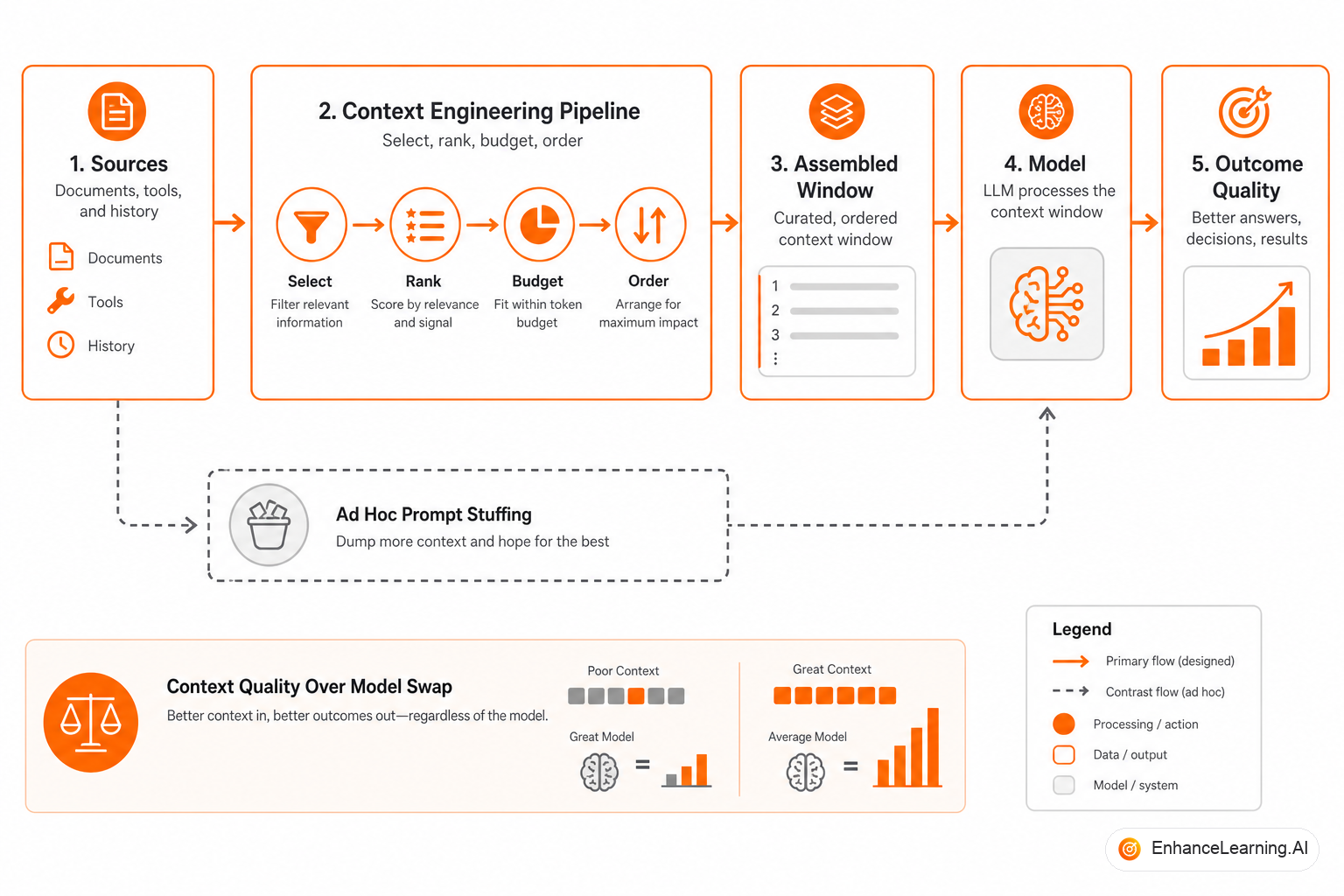
Context engineering is the discipline of deciding what information enters an LLM call, in what structure, under what token budget, and with what fallback when something must be dropped. It is not a synonym for prompt writing. Prompts tell the model how to behave. Context engineering tells the system what the model is allowed to know when it behaves. In AI-native architectures, that distinction is the difference between a demo and a product that survives Monday traffic.
Why context became a first-class concern#
Traditional software passes explicit data through typed APIs. An AI-native system passes assembled narrative — policy text, retrieved chunks, tool results, conversation history, metadata — through a fixed window with hard limits. The assembly layer is where most production failures hide.
Consider a contract-review assistant at a mid-size legal tech company. Engineers spent three sprints comparing GPT-4 class models against Claude and an open-weight alternative. Latency and cost varied. Quality on a fifty-document golden set varied by less than four points. Then someone audited what actually shipped in production: full PDF extracts pasted into the user message, a system prompt that grew every time compliance added a rule, and retrieval that returned eight chunks when two would suffice. The "model comparison" was measuring noise. Fixing chunk selection and splitting policy into a stable system region moved customer-reported accuracy more than any model swap.
That pattern repeats across domains. RAG pipelines fail because retrieval packs garbage. Agent loops fail because tool outputs flood the window. Multi-turn chat fails because history is appended without summarisation policy. These are context problems wearing prompt hats.
Context engineering vs ad hoc prompt writing#
Ad hoc prompt writing treats the context window as a textarea. You paste what seems useful, tweak wording when output drifts, and hope the model prioritises correctly. Context engineering treats the window as engineered state with owners, budgets, and observability.
| Practice | Ad hoc prompt writing | Context engineering |
|---|---|---|
| Ownership | Whoever touched the prompt last | Named owner per region (policy, evidence, memory) |
| Change control | Git diff on a string | Versioned assembly pipeline with hashes in traces |
| Failure mode | "Try a different phrasing" | Measurable: which region overflowed, what was evicted |
| Success metric | Subjective "looks better" | Citation hit rate, policy compliance, token efficiency |
Prompt writing still matters. Instructions must be clear. Output contracts must be unambiguous. But instructions without curated inputs produce confident wrong answers. Context engineering owns the inputs.
What context engineering owns in production#
A mature context layer includes:
- Region design — fixed slots for policy, task, evidence, memory, and output contract
- Assembly logic — code that fills each region under budget, not string concatenation in a route handler
- Eviction policy — explicit rules for what drops when evidence exceeds its ceiling
- Provenance — chunk IDs, retrieval scores, and source timestamps attached to evidence the model sees
- Observability — per-request breakdown of tokens by region in your trace store
None of this lives in a system prompt alone. The prompt describes behaviour. The assembly pipeline enforces information discipline.
from dataclasses import dataclass, field
from typing import Literal

Region = Literal["policy", "task", "evidence", "memory", "output_contract"]

@dataclass
class ContextAssembly:
    policy: str
    task: str
    evidence: list[str] = field(default_factory=list)
    memory: str = ""
    output_contract: str = ""
    provenance: dict[str, list[str]] = field(default_factory=dict)

    def to_messages(self, budgets: dict[Region, int]) -> list[dict[str, str]]:
        """Pack each region under budget before the provider call."""
        system = self._pack("policy", self.policy, budgets["policy"])
        system += "\n\n" + self._pack("output_contract", self.output_contract, budgets["output_contract"])
        user = self._pack("task", self.task, budgets["task"])
        user += "\n\n" + self._pack_evidence(self.evidence, budgets["evidence"])
        if self.memory:
            user += "\n\n[memory]\n" + self._pack("memory", self.memory, budgets["memory"])
        return [
            {"role": "system", "content": system.strip()},
            {"role": "user", "content": user.strip()},
        ]

    def _pack(self, region: Region, text: str, max_tokens: int) -> str:
        # Production code uses tiktoken or provider tokenizer — enforce ceiling
        if estimate_tokens(text) <= max_tokens:
            return text
        raise ContextBudgetError(f"{region} overflow: {estimate_tokens(text)} > {max_tokens}")
The ContextBudgetError is intentional. Silent truncation is how teams lose task instructions without noticing.
Swapping models without fixing assembly often reshuffles failure modes without improving reliability. A stronger model may hallucinate more convincingly from the same noisy pack.
Why context quality beats model choice#
Model selection matters for capability ceilings — reasoning depth, tool use, structured output compliance. Context quality matters for floor behaviour: does the model see the right facts, in the right order, with room left to complete the task?
In production triage, I rank incidents this way:
- Context failure — wrong chunks, stale memory, policy buried under history → fix assembly
- Prompt failure — ambiguous instruction, missing output schema → fix wording
- Model failure — task exceeds capability even with clean context → change model or decompose task
Most teams skip straight to model failure. That is expensive and slow.
A healthcare documentation startup proved the point accidentally. They routed complex cases to the largest available model. Simple cases used a smaller tier. p95 latency for "simple" cases was higher than complex ones because the small-tier path stuffed entire encounter transcripts into context while the large-tier path summarised first. The model tier was irrelevant. The assembly path was not.
When your org needs context engineering#
You need a named discipline when:
- More than one team appends text to the same prompt without coordination
- Nobody can answer "how many tokens did retrieval use last Tuesday for ticket #8842?"
- Quality regressions correlate with feature launches that added "just one more paragraph" to the system message
- Eval improvements in notebooks do not reproduce in production
Assign context engineering to the same engineers who own retrieval, memory, and agent orchestration — not only to whoever writes the system prompt. The assembly code is software. It deserves design reviews, unit tests on packing logic, and dashboards.
Building the practice#
Start with an audit, not a rewrite. Pick ten failed production traces. For each, label what the model saw: policy, evidence, task, noise. Count tokens per region if your provider exposes usage metadata. You will find patterns within a day.
Then codify regions in your assembly module — not in Notion. Document eviction rules the way you document retry policy. Add context_pack_hash to every trace so you can diff assembly changes against quality metrics.
Finally, stop treating context bugs as prompt bugs in incident reviews. When the model cites a document that was not in the pack, that is retrieval or assembly. When it ignores a rule that was in the pack but below eight irrelevant paragraphs, that is budget and ordering. Naming the layer correctly speeds fixes.
Where this shows up in architecture reviews#
Ask these questions in every AI feature design review:
- Who owns assembly for this workflow — by name, not by team acronym?
- What is the token budget per region, and where is it enforced in code?
- What is the failure mode when retrieval returns empty or oversized payloads?
- Does the trace include
context_pack_hashso we can diff last good vs bad request?
If any answer is "we'll figure it out in beta," you are shipping ad hoc prompt writing at scale. Beta users will find the edge cases; your on-call engineer will find them at 2 a.m.
Summary#
Context engineering is how AI-native systems control what the model knows at decision time. It sits between your data plane and your model call, and it is under-invested in most organisations still optimising model choice. Treat context as engineered state with budgets, owners, and traces — and you will find that many "model problems" were assembly problems all along. Prompt craft shapes behaviour; context engineering shapes the evidence behaviour runs on. Both are required.
Want premium architecture blueprints?
Be among the first to explore interactive reference architectures, implementation playbooks, and premium engineering resources at launch.
Related Articles
Recommended reading based on this topic.
The Hidden Coupling Between Prompts and AI System Architecture
Prompt length, role structure, and tool definitions leak into service boundaries, data flows, and API contracts — coupling teams thought was decoupled.
Read ArticleWhy Context Quality is the Bottleneck in Production AI
Context assembly — not model size — limits reliability, latency, and cost in production AI. It is the most under-engineered layer in most stacks.
Read ArticleThe Trade-off Between Context Richness and LLM Latency
Richer LLM context improves answers until prefill latency hurts UX. Measure the trade-off between context size, inference time, and product responsiveness.
Read Article