
Why Enterprise AI Operating Models Need Periodic Redesign
Enterprise AI operating models must evolve with capability, maturity, and priorities — not stay frozen after a one-time setup.
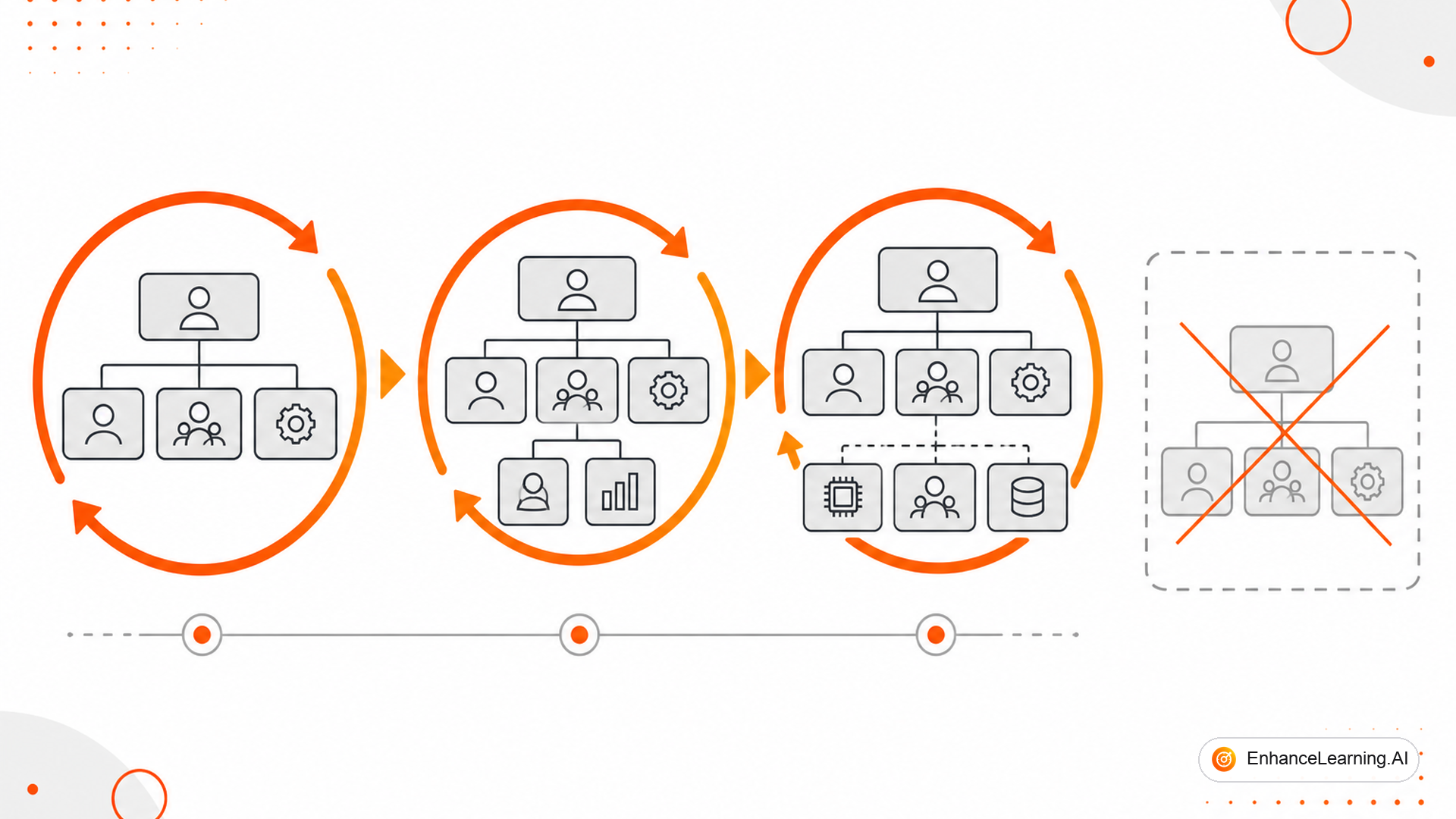
Enterprises treat operating models like furniture: buy once, place in the org chart, forget. AI operating models decay faster than that. Model capabilities shift quarterly, tool interfaces standardize, eval practice matures, and your portfolio moves from read-only drafts to write-enabled agents. An operating model designed for "chat over PDFs" in 2024 will block agentic workflows in 2026 — not because anyone was negligent, but because set-and-forget governance assumes a static technology curve.
Periodic redesign is not reorganization theater. It is scheduled maintenance on the control plane.
Why one-time setup fails#
The first operating model version solves the problems visible at launch: shadow API keys, missing logging, pilot sprawl. It rarely anticipates:
- Autonomy expansion — read-only retrieval → structured writes → multi-step tool loops
- Cost dynamics — cheap small models making large-model-only budgets obsolete
- Interface shifts — MCP-style tool registries replacing bespoke integrations
- Maturity — domains that no longer need hand-holding but still hit central gates sized for beginners
- Portfolio mix — three workflows become thirty; review SLAs sized for three choke
When the model stays frozen, teams route around it. That looks like innovation. It is governance debt.
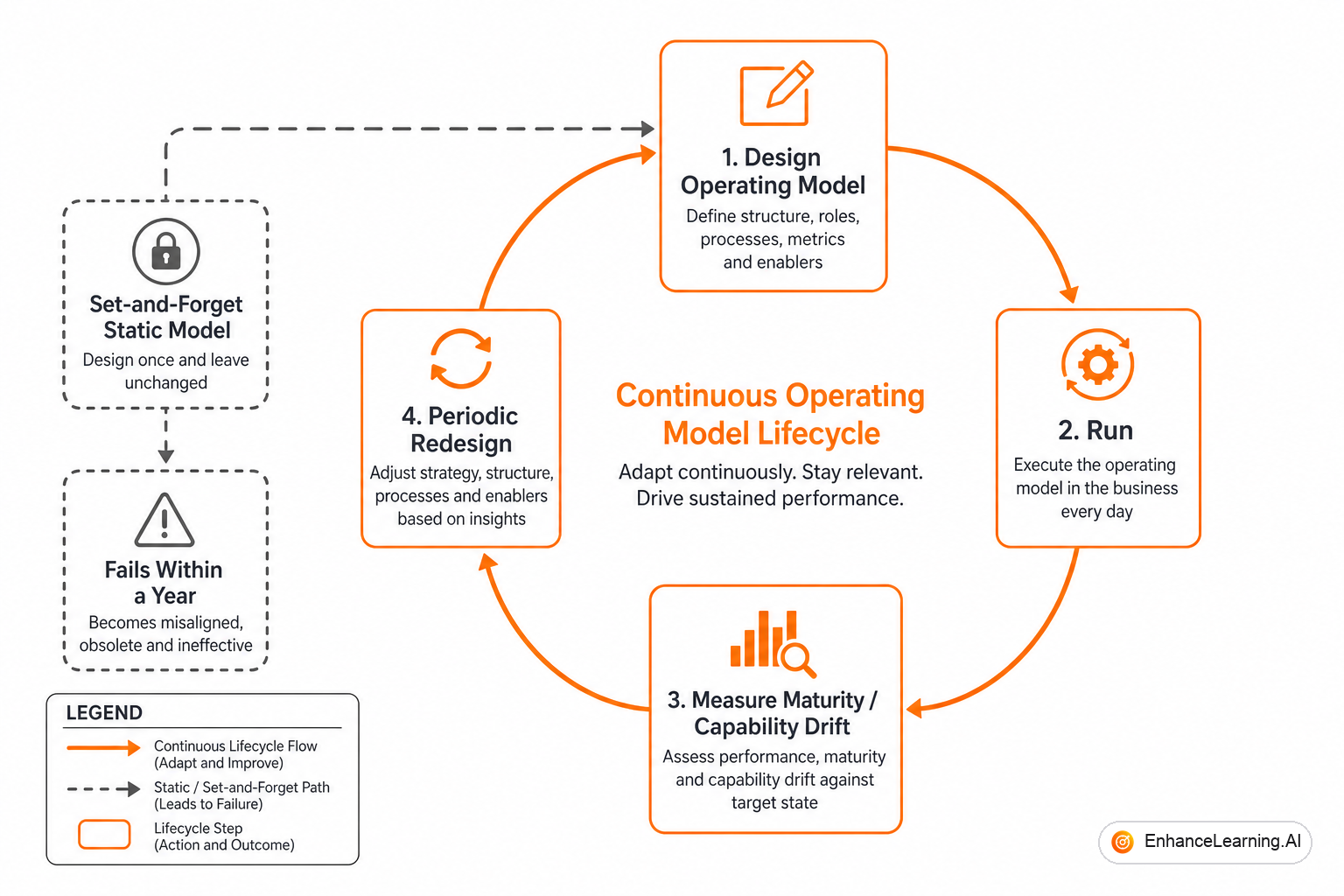
Redesign means revisiting gates, roles, SLAs, and shared services — not necessarily moving boxes on a chart. A quarterly "control plane review" beats an annual reorg memo.
Signals that redesign is overdue#
| Signal | What it usually means | Redesign lever |
|---|---|---|
| Shadow API keys rising | Platform path slower than bypass | Cut time-to-prod; enforce at network edge |
| Same review checklist for all workflows | Risk process not tiered | Job-class-based review templates |
| CoE bottleneck on every PR | Enablement became approval factory | Push standards into CI; shrink review scope |
| Evals exist but nobody blocks releases | Gates without teeth | Tie deploy keys to eval regression |
| Platform team fighting fires only | No capacity for roadmap | Fund platform from duplicated spend saved |
| Executives ask "why can't we do agents?" | Model advanced; policy did not | Autonomy tiers with explicit write policies |
If three or more rows feel familiar, you are not "not ready for AI." You are running an outdated control plane.
Redesign triggers you should calendar#
Do not wait for crisis. Schedule explicit reviews when:
- Major model capability shift — reliable structured output, long context, or tool use at scale changes what workflows are feasible
- Portfolio threshold — e.g., every +10 production workflows, rebalance platform capacity and review tiers
- Incident class repeat — two similar privilege-escalation near-misses mean policy lag, not bad luck
- Regulatory change — new AI Act obligations, sector rules on automated decisions
- Cost envelope breach — token spend doubles while task success flatlines — pricing model for internal chargeback may need update
Attach redesign outputs to these dates: updated gate definitions, revised SLAs, deprecated patterns with migration deadlines.
Maturity-aware operating models#
Early maturity needs heavy enablement: golden-path templates, paired shipping, centralized eval examples. Late maturity needs federation: domain-owned golden sets, platform-enforced minimums, fast-track for proven job classes.
from dataclasses import dataclass
from enum import Enum

class MaturityStage(str, Enum):
    EMERGING = "emerging"       # first prod workflows
    EXPANDING = "expanding"     # portfolio growing
    FEDERATED = "federated"     # domains self-serve on rails

@dataclass
class OperatingModelProfile:
    stage: MaturityStage
    central_review_required: bool
    domain_owned_evals: bool
    max_autonomy_tier: int  # 0=read, 1=draft, 2=writes with approval, 3=bounded auto

PROFILES = {
    MaturityStage.EMERGING: OperatingModelProfile(
        stage=MaturityStage.EMERGING,
        central_review_required=True,
        domain_owned_evals=False,
        max_autonomy_tier=1,
    ),
    MaturityStage.EXPANDING: OperatingModelProfile(
        stage=MaturityStage.EXPANDING,
        central_review_required=True,  # tiered, not universal
        domain_owned_evals=True,
        max_autonomy_tier=2,
    ),
    MaturityStage.FEDERATED: OperatingModelProfile(
        stage=MaturityStage.FEDERATED,
        central_review_required=False,
        domain_owned_evals=True,
        max_autonomy_tier=3,
    ),
}

def recommend_redesign(current: MaturityStage, prod_workflows: int) -> str | None:
    if current == MaturityStage.EMERGING and prod_workflows >= 3:
        return "Shift to EXPANDING: introduce domain-owned evals, tiered risk review"
    if current == MaturityStage.EXPANDING and prod_workflows >= 15:
        return "Shift to FEDERATED: CI-enforced minimums, fast-track for repeat job classes"
    return None
Running EMERGING gates at FEDERATED scale frustrates domains. Running FEDERATED permissiveness at EMERGING scale invites incidents. Redesign is matching profile to reality.
Running a redesign cycle without chaos#
A lightweight quarterly cycle:
- Metrics review — prod workflows, eval pass trends, incidents, shadow bypass attempts, cost per task
- Friction survey — domain leads: what gate added latency without reducing risk?
- Draft delta — list gate changes, not a 40-page policy rewrite
- Pilot new rules — one domain on updated tier for 30 days
- Publish version —
operating-model/v2026.2with changelog; train risk partners on diffs only
Executive steering should approve version bumps, not every workflow. Micromanagement does not scale; versioned control planes do.
Case study: frozen 2024 gates in a 2026 agent portfolio#
A global insurer wrote its AI operating model when the portfolio was three read-only summarization workflows. Central architecture review was mandatory for every deploy. Risk used one 40-item checklist. That worked at three workflows.
By 2026 the portfolio had eighteen production paths, including tool-backed claim triage with structured writes. Domains waited six weeks for review slots sized for beginners. Two BUs deployed agent loops on shadow keys because the sanctioned path could not meet product deadlines. Incidents did not spike — yet — but audit found unscanned tool permissions and duplicated spend.
Redesign v2026.2 tiered review: Tier 0 read-only search fast-tracked in five days; Tier 2 write paths kept full review; repeat job classes reused prior approvals as templates. Shadow key detections dropped 70% in two quarters without lowering write-path scrutiny. Same platform team. Different operating model version.
Internal chargeback and economic redesign#
Operating models also encode who pays for tokens and platform. Early programs centralize cost — easy budgeting, weak domain discipline. Mature programs introduce showback or chargeback tagged by workflow, forcing domains to optimize context and model choice.
When small models became viable for draft steps, one enterprise's frozen budget still assumed frontier pricing everywhere. Domains had no incentive to route simple tasks to cheaper aliases because central IT absorbed the bill. Redesign added spend tags in the gateway and quarterly review of cost-per-successful-task by job class. Token spend flattened while output volume grew — an economic redesign, not a model breakthrough.
Linking redesign to autonomy tiers#
Autonomy tiers should be explicit in every operating model version: Tier 0 read, Tier 1 draft-with-human-commit, Tier 2 writes with approval, Tier 3 bounded auto within policy. Capabilities advance faster than executive comfort with Tier 3 — redesign reconciles them.
When tool use became reliable, domains asked for Tier 3 on low-risk internal workflows. Frozen policy treated all tool calls as Tier 2, creating review backlog. Redesign mapped job classes to tiers with evidence requirements: Tier 3 required six months of Tier 2 eval pass rate above threshold plus incident-free run. Policy caught up to capability without opening write access everywhere on faith.
Summary#
Enterprise AI operating models are living control planes, not one-time setup projects. Capabilities, portfolio size, and organizational maturity outgrow early gates — and teams route around stale rules. Calendar redesign triggers, match operating profiles to maturity stage, preserve non-negotiable safety rails, and publish versioned changes with changelogs. The goal is not perpetual reorganization. It is keeping the path to production faster than the path to shadow IT as AI capabilities advance.
Want premium architecture blueprints?
Be among the first to explore interactive reference architectures, implementation playbooks, and premium engineering resources at launch.
Related Articles
Recommended reading based on this topic.
Building an Enterprise AI Operating Model
How enterprises adopt AI through job classes, shared platforms, eval gates, and controls — instead of scattered chat pilots.
Read ArticleAI Transformation Starts With the Organization, Not the Model
Workflow redesign, ownership, and incentives determine AI outcomes more than model selection — challenge the tech-first assumption.
Read ArticleWhat AI Security Actually Covers Beyond Model Safety
AI security spans identity, permissions, data flows, and runtime policy — not just model alignment and output filters. A scope map for architects.
Read Article