
AI Transformation Starts With the Organization, Not the Model
Workflow redesign, ownership, and incentives determine AI outcomes more than model selection — challenge the tech-first assumption.
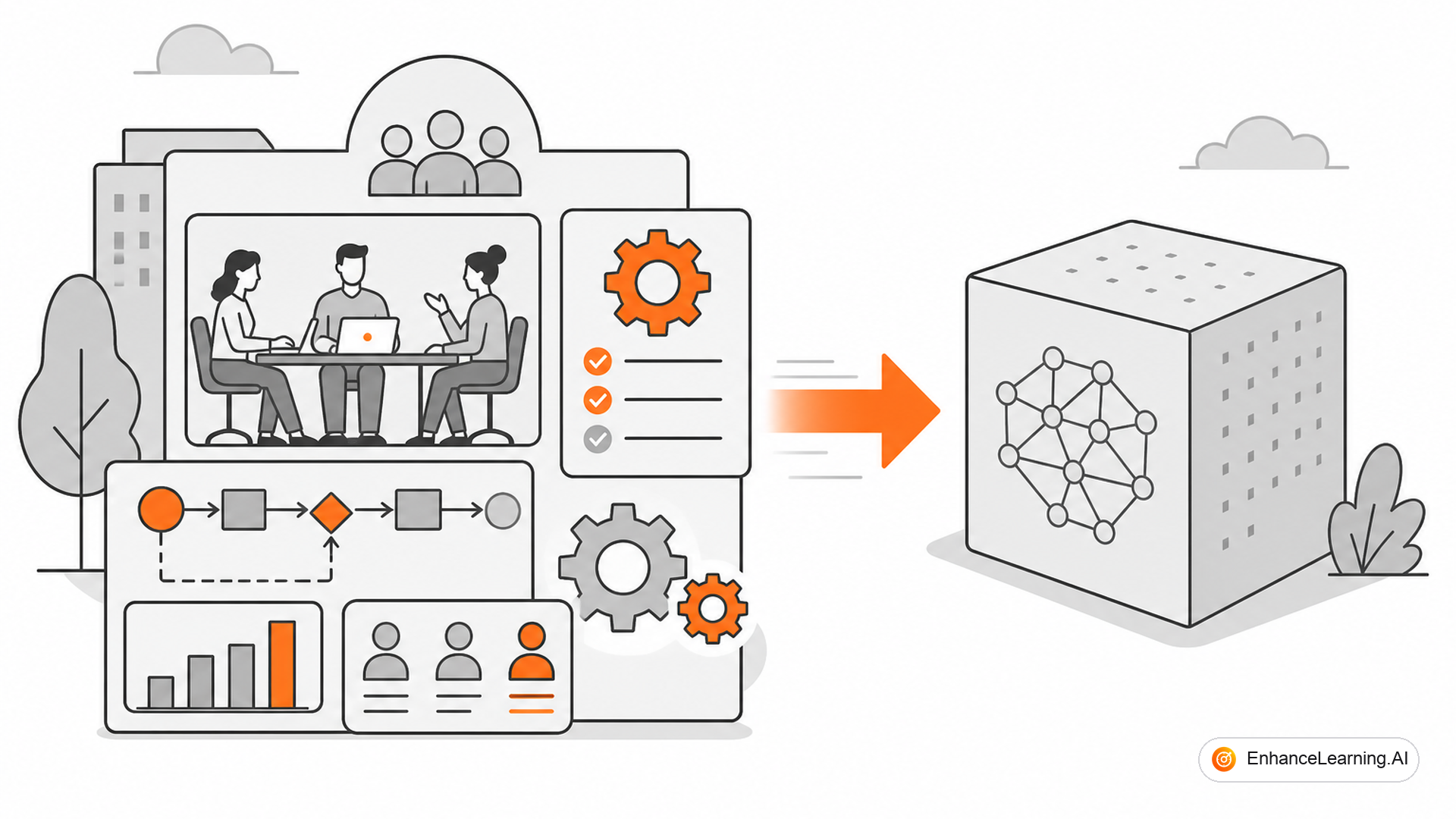
The default enterprise AI playbook opens with a model bake-off and closes with a transformation slide. Twelve months later the bake-off winner sits in a gateway nobody uses, while teams that ignored the playbook shipped three workflows on last year's stack. AI transformation is an organizational problem before it is a technology problem — not because models do not matter, but because org design decides whether any model reaches production with real users and real controls.
Tech-first transformation is a category error#
"Transformation" implies the primary object of change is the technology stack. In practice the object of change is how work gets done: who approves a draft, what happens when the model is wrong, which systems a workflow may touch, and how success is measured. Models are interchangeable components in that story. Operating models are not.
Consider two teams given the same gateway and the same model alias:
| Dimension | Team A (tech-first) | Team B (org-first) |
|---|---|---|
| Starting point | Vendor shortlist | Job class + metric |
| First milestone | POC accuracy on sample prompts | Prod path with eval gate |
| Owner | "AI champion" (part-time) | Named product + eng + risk |
| Failure handling | Tune prompts | Change workflow + escalation |
| Year-one outcome | Impressive demo | One workflow on-call |
Same technology budget. Different org design. Different result.
Workflow redesign beats model upgrades#
Most productivity gains come from removing steps, not from smarter completions. A contract review workflow that still requires attorneys to re-read every clause in a 200-page PDF — because nobody trusted the retrieval boundaries — will not be saved by a frontier model. Redesign so attorneys approve exceptions flagged by a structured extract with citations. That is organizational change: different default, different liability posture, different UI.
Engineers feel this tension daily. Product asks for "GPT on the page." Architecture asks "what decision does this automate?" If the answer is "none — it just summarizes," you have a feature, not transformation. Transformation changes who acts, not who reads faster.
Ownership determines whether AI sticks#
Technology transformations fail when they are owned by a central "innovation" function with no P&L authority and no production on-call. Business units accept demos; they do not accept pager duty for a system they did not choose.
Durable pattern:
- Domain owns the workflow outcome — deflection, error rate, cycle time
- Platform owns shared rails — gateway, logging, eval patterns, tool registry
- Risk owns privilege expansion — with SLAs, not veto-by-default
When domain owners can ship without platform, you get shadow IT. When platform owns workflows, you get bottleneck. When risk has no SLA, you get stall. All three are org design failures visible as "technology risk."
Incentive alignment is the hidden architecture#
People ship what they are measured on. Common misalignments:
- Speed vs safety — engineers rewarded for shipping fast; security rewarded for saying no without a path to yes
- Pilots vs production — BU leaders credited for launching AI experiments, not for retiring failed ones
- Seat count vs outcome — procurement buys licenses; nobody owns workflow ROI
- Central cost vs local benefit — platform funded centrally; savings accrue to domains that bypass it
Fix incentives before you fix prompts. Tie a portion of leadership variable comp to production workflows with published eval thresholds. Fund platform from duplicated spend eliminated — domains see a reason to join rails.
Data and access are organizational contracts#
"We need better data for AI" often means "seventeen teams own seventeen access processes." The organizational fix is a minimum data contract per job class: which systems, which fields, retention, redaction in logs. Deliver that per workflow; expand shared data products when patterns repeat. Technology can enforce contracts — but someone must sign them with a deadline.
Sequencing transformation work#
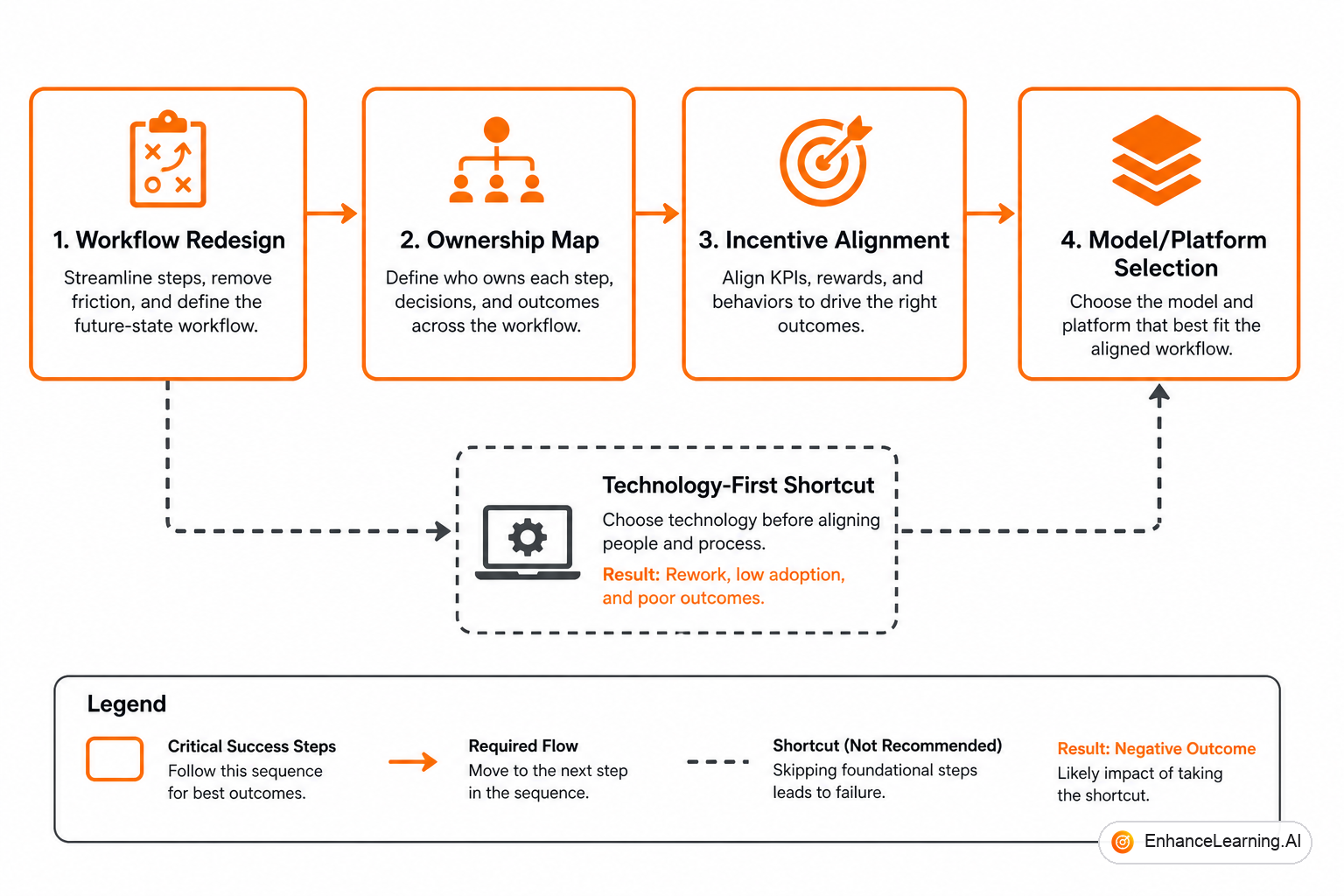
Use this order deliberately. Skipping steps recreates tech-first failure.
type TransformationPhase =
  | "job_class_frozen"
  | "workflow_redesigned"
  | "owners_named"
  | "minimum_controls"
  | "model_on_rails"
  | "scale_portfolio";

interface GateCheck {
  phase: TransformationPhase;
  requiredEvidence: string[];
}

const GATES: GateCheck[] = [
  {
    phase: "job_class_frozen",
    requiredEvidence: ["primary metric", "kill criteria", "data systems list"],
  },
  {
    phase: "workflow_redesigned",
    requiredEvidence: ["human steps removed or changed", "escalation path"],
  },
  {
    phase: "owners_named",
    requiredEvidence: ["product owner", "prod eng owner", "risk partner SLA"],
  },
  {
    phase: "minimum_controls",
    requiredEvidence: ["gateway logging", "eval regression", "tool allowlist"],
  },
  {
    phase: "model_on_rails",
    requiredEvidence: ["one workflow on-call", "incident runbook"],
  },
  {
    phase: "scale_portfolio",
    requiredEvidence: ["graduation template reused", "shadow IT declining"],
  },
];

function canAdvance(current: TransformationPhase, evidence: string[]): boolean {
  const gate = GATES.find((g) => g.phase === current);
  if (!gate) return false;
  return gate.requiredEvidence.every((item) => evidence.includes(item));
}
Model selection belongs after minimum_controls, not at slide one. If your steering committee discusses vendors before owners_named, you are not transforming — you are shopping.
Measuring transformation, not activity#
Replace activity metrics with outcome metrics tied to org change:
| Metric | Activity proxy (avoid) | Transformation signal (prefer) |
|---|---|---|
| Adoption | Prompts typed | Tasks completed with eval pass |
| Progress | Models evaluated | Workflows redesigned with fewer human steps |
| Risk | Policies published | Incidents with traced root cause + fix |
| Speed | Hackathons held | Median days from design review to prod on rails |
Summary#
AI transformation fails when enterprises treat it as a technology replacement program. Workflow redesign, named ownership, aligned incentives, and sequenced gates determine whether any model reaches production safely. Pick the job class, change how work flows, name who owns outcomes — then select and pin models on shared rails. Tech-first ordering feels faster in quarter one and stalls in quarter four. Org-first ordering feels slow until the first workflow is on-call; then it compounds.
Want premium architecture blueprints?
Be among the first to explore interactive reference architectures, implementation playbooks, and premium engineering resources at launch.
Related Articles
Recommended reading based on this topic.
Why Enterprise AI Operating Models Need Periodic Redesign
Enterprise AI operating models must evolve with capability, maturity, and priorities — not stay frozen after a one-time setup.
Read ArticleBuilding an Enterprise AI Operating Model
How enterprises adopt AI through job classes, shared platforms, eval gates, and controls — instead of scattered chat pilots.
Read ArticleModel Selection Framework for Enterprise AI
A practical framework for choosing enterprise models: task fit, context and tool needs, cost-latency envelopes, eval gates, and when to use routers instead of one frontier model.
Read Article