
Model Selection Framework for Enterprise AI
A practical framework for choosing enterprise models: task fit, context and tool needs, cost-latency envelopes, eval gates, and when to use routers instead of one frontier model.
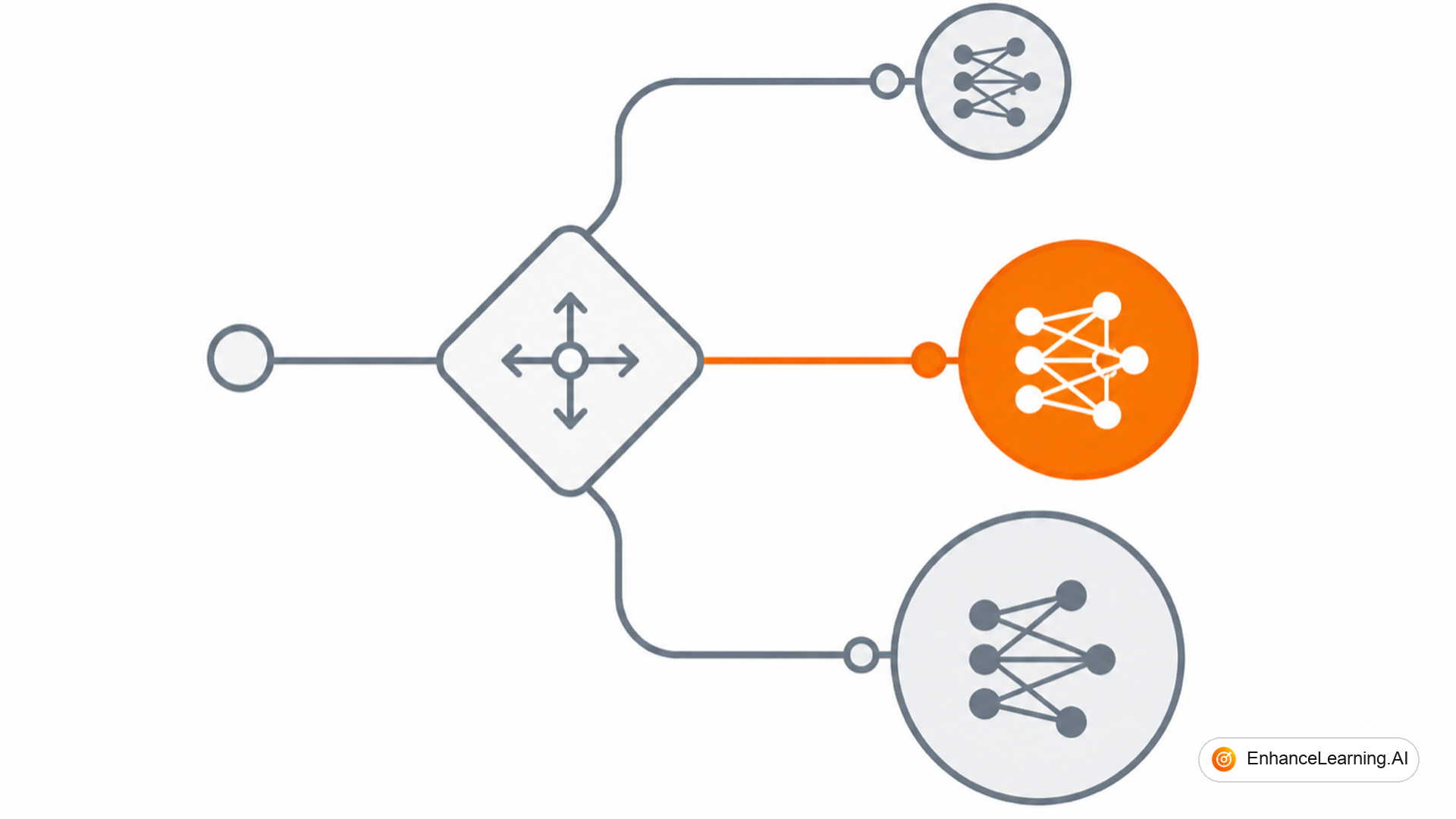
Enterprise model selection often collapses into a bake-off: three vendors, one demo prompt, a slide with latency numbers, and a winner that fails on the second production workflow. Models are not interchangeable CPUs. They differ in reasoning depth, instruction following, long-context behavior, tool-calling reliability, multimodal support, data handling terms, and price curves. A framework beats a bake-off because it forces you to name the job before you name the model.
Start from jobs, not leaderboards#
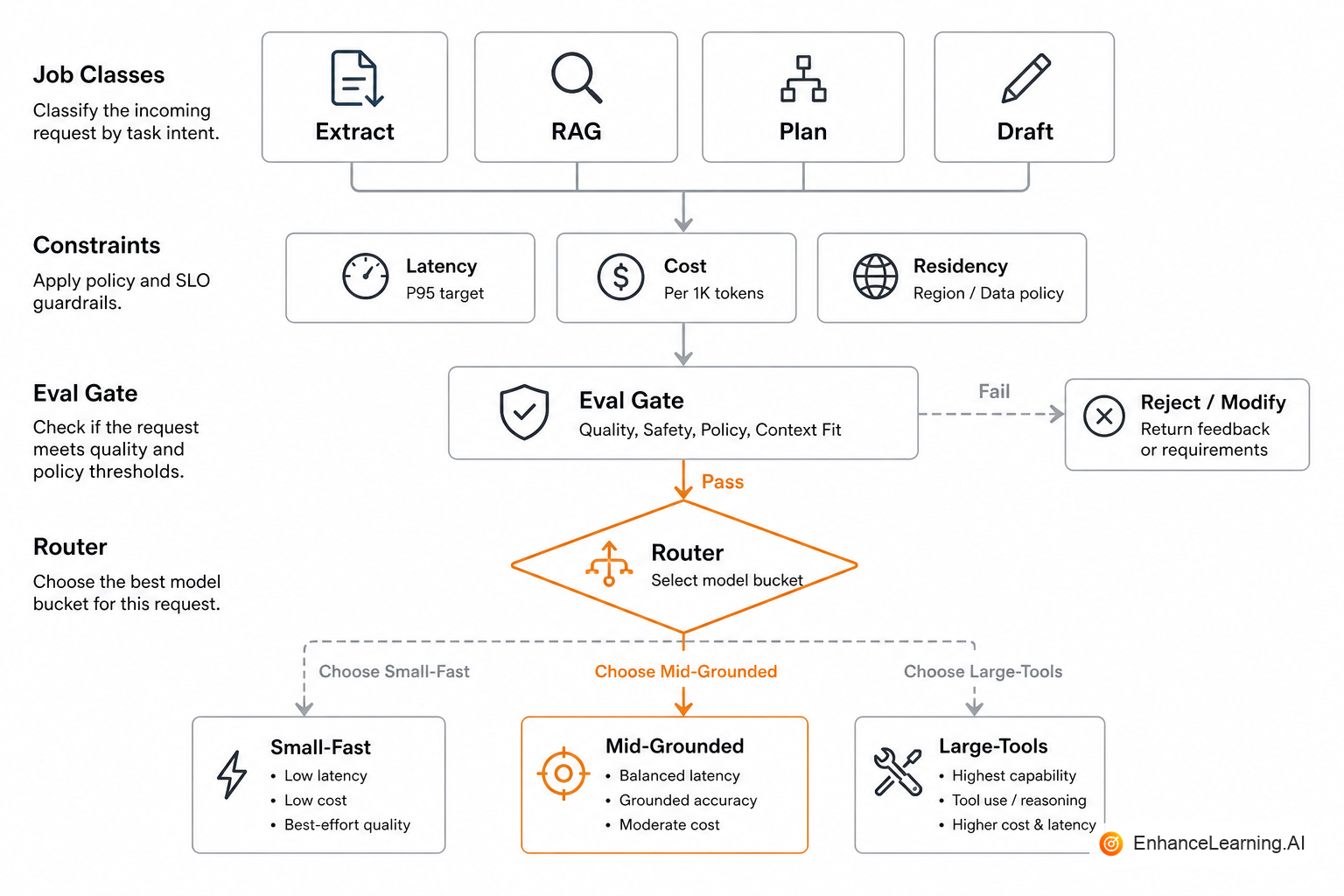
Leaderboards answer “who scores highest on a public suite.” Your question is “which model completes our jobs inside our constraints.” Split work into job classes early:
- Extraction / classification — short context, strict schemas, high volume
- Grounded answering (RAG) — long evidence, citation discipline, refusal quality
- Planning / tool use — multi-step, function calling, recovery from tool errors
- Long-form drafting — style control, brand constraints, human edit loops
- Code / structured transformation — compile-or-validate feedback available
One frontier model for everything is convenient and usually expensive. Many enterprises end with a small roster: a cheap workhorse, a stronger planner, and occasionally a specialist (code, OCR, or on-prem).
The decision axes that matter#
1. Quality on your eval set#
Build a per-job golden set before procurement theater. Fifty to two hundred labeled examples beat a vendor’s marketing deck. Score what the product cares about: exact field match for extraction, faithfulness for RAG, trajectory success for tools. If legal will not let you share prompts externally, run evals in your tenant or on a scrubbed set — but run them.
2. Context length you will actually fill#
Advertised context windows are not free performance. Quality often degrades as you stuff the window. Measure accuracy at the context sizes your architecture will use (8k, 32k, 100k+), not on short demo prompts. If your design needs 200k tokens of raw dump, revisit the design before you buy a long-context SKU to paper over missing retrieval.
3. Tool calling and structured output reliability#
For agentic workflows, a model that “reasons well” in chat but drops required JSON fields or invents tool names is unusable. Test with your real tool schemas and validators. Count retries needed to get a valid call. Retries are latency and cost.
4. Latency and cost envelopes#
Map each job to a budget: p95 latency, cost per thousand requests, and peak QPS. A model that wins quality by 3% and blows the envelope is not a win. Include embedding models and rerankers in the bill; RAG stacks fail cost reviews when people only price the final completion.
5. Deployment and data constraints#
Data residency, VPC / on-prem requirements, retention policies, and whether prompts are used for training are hard gates. A slightly weaker model you are allowed to use beats a frontier model stuck in legal review.
A compact selection matrix#
| Job class | Optimize for | Typical pattern | Avoid |
|---|---|---|---|
| High-volume extract | Cost, schema validity | Small/cheap model + validator | Frontier for every field |
| RAG answer | Faithfulness, refusal | Mid/large + strong retrieval | Long-context dump without rerank |
| Tool planning | Valid tool calls, recovery | Strong tool-calling model, tight allowlist | Chat-only models |
| Drafting | Style, edit distance | Mid model + human review | Auto-send without review |
| Regulated data | Residency, audit | Approved region / self-host | Shadow IT APIs |
Router pattern: one entry point, several models#
Once you have more than one model in production, hide them behind a router keyed by job class and optional difficulty signals (document length, risk tier, customer tier). Keep the router boring: deterministic rules first, learned routers later if metrics justify them.
from enum import Enum

class Job(Enum):
    EXTRACT = "extract"
    RAG = "rag"
    PLAN = "plan"

ROUTE = {
    Job.EXTRACT: "vendor.small-fast",
    Job.RAG: "vendor.mid-grounded",
    Job.PLAN: "vendor.large-tools",
}

def select_model(job: Job, risk: str) -> str:
    if risk == "high" and job != Job.EXTRACT:
        return "vendor.large-tools"  # pay for headroom on irreversible actions
    return ROUTE[job]
Promote models the way you promote services: pin versions, canary a percentage of traffic, compare eval deltas, then widen. “Latest” as a production tag is how quality cliffs appear on a Tuesday.
Before the next vendor meeting, freeze three artifacts: job definitions, eval sets with scoring rubrics, and non-negotiable constraints (latency, residency, logging). Every candidate runs the same kit. If a vendor cannot run inside those constraints, they are not a candidate — regardless of arena Elo.
When fine-tuning actually helps#
Fine-tune when you have stable task distribution, enough labeled data, and a clear gap that prompting and retrieval cannot close — typically format idiosyncrasies or domain jargon at high volume. Do not fine-tune to fix bad chunking, missing tools, or absent evals. Those are system problems wearing a model costume.
Also separate embedding model choice from completion model choice. A weak embedding model with excellent reranking can beat a fashionable embedding model with naive top-k. Bake-offs that only swap the chat model while leaving retrieval frozen often misattribute gains.
Multimodal and specialist models#
If the job starts as a PDF scan, a screenshot, or an audio call, the first decision is whether you need a multimodal model end-to-end or a pipeline (OCR / ASR → text model). Pipelines are easier to evaluate piece by piece; end-to-end multimodal can win when layout or diagram understanding is the task. Make that choice explicitly. “We’ll just use the model that accepts images” is not a strategy if 90% of your volume is clean HTML.
Vendor lock-in vs operational reality#
Abstracting every provider behind an internal interface is healthy. Pretending switching models is free is not. Prompts, tool schemas, and eval thresholds drift toward the incumbent’s quirks. Budget time for re-tuning when you change families. Dual-running two providers for the same job class is insurance; it is also complexity. Buy insurance where downtime or policy risk is real, not as a default architecture flex.
A selection checklist for architecture review#
- Job classes named and volume-estimated
- Eval sets exist per class with owners
- Latency/cost envelopes written as numbers
- Data residency and retention signed off
- Tool schemas tested for structured-call reliability
- Version pinning and rollback path defined
- Router or explicit single-model choice documented
- Embedding / rerank choices justified with retrieval metrics, not vibes
If item 2 is missing, stop. You are choosing a brand, not a model.
Summary#
Enterprise model selection is a systems problem: match job classes to quality metrics, envelopes, and deployment constraints, then keep a small roster behind a router with pinned versions and eval gates. Leaderboards inform; they do not decide. The organizations that struggle longest are usually the ones that picked a single “best” model before they could say what “best” meant on their own traffic.
Want premium architecture blueprints?
Be among the first to explore interactive reference architectures, implementation playbooks, and premium engineering resources at launch.
Related Articles
Recommended reading based on this topic.
Why Enterprise AI Operating Models Need Periodic Redesign
Enterprise AI operating models must evolve with capability, maturity, and priorities — not stay frozen after a one-time setup.
Read ArticleAn Enterprise AI Maturity Model You Can Actually Use
Assess enterprise AI readiness across people, process, data, and operating model — a diagnostic for sequencing capability building.
Read ArticleModel Distillation: Teaching Smaller Models to Match Larger Ones
Distillation trains a smaller model to reproduce a larger LLM's behavior. Learn when it cuts cost, when quality collapses, and how to eval the trade-off.
Read Article