
Model Distillation: Teaching Smaller Models to Match Larger Ones
Distillation trains a smaller model to reproduce a larger LLM's behavior. Learn when it cuts cost, when quality collapses, and how to eval the trade-off.
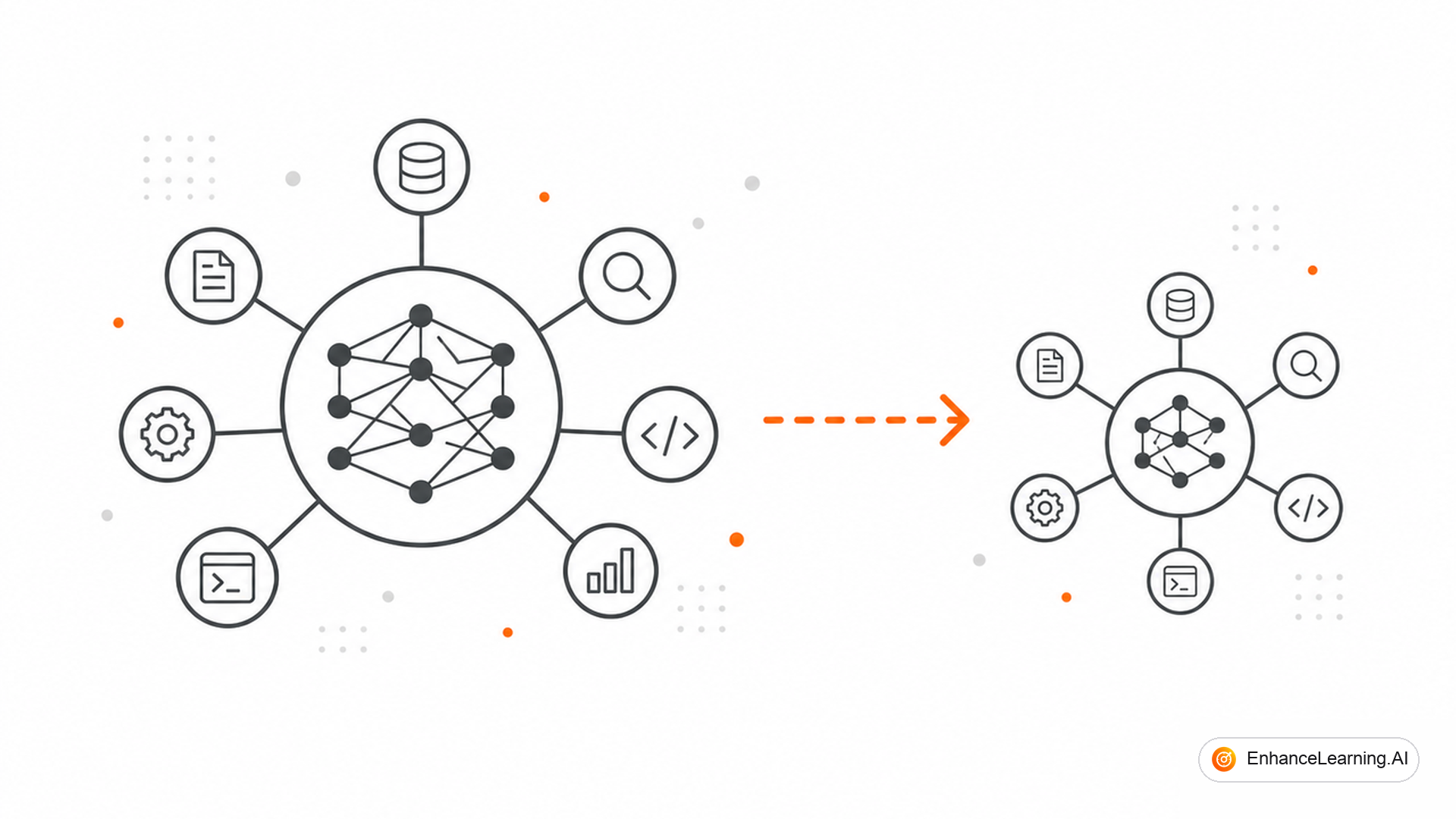
Running a frontier model on every request works until the invoice arrives and p95 latency kills the UX. Model distillation is the deliberate path out: train a smaller model to reproduce a larger model's behavior on the tasks you actually ship. Done well, you keep most of the quality at a fraction of the cost. Done poorly, you compress the mistakes into a faster package and call it optimization. Distillation is a production strategy, not a lab trick.
Teacher-student distillation in plain terms#
Classic knowledge distillation (Hinton et al.) trains a small network to match a large network's soft probability distributions, not just hard labels. In LLMs, the idea extends:
- Teacher — large model (or ensemble) producing target outputs, logits, or rankings
- Student — smaller architecture or same family with fewer parameters / quantized weights
- Transfer signal — token-level cross-entropy on teacher outputs, KL divergence on logits, or curated synthetic datasets of teacher completions
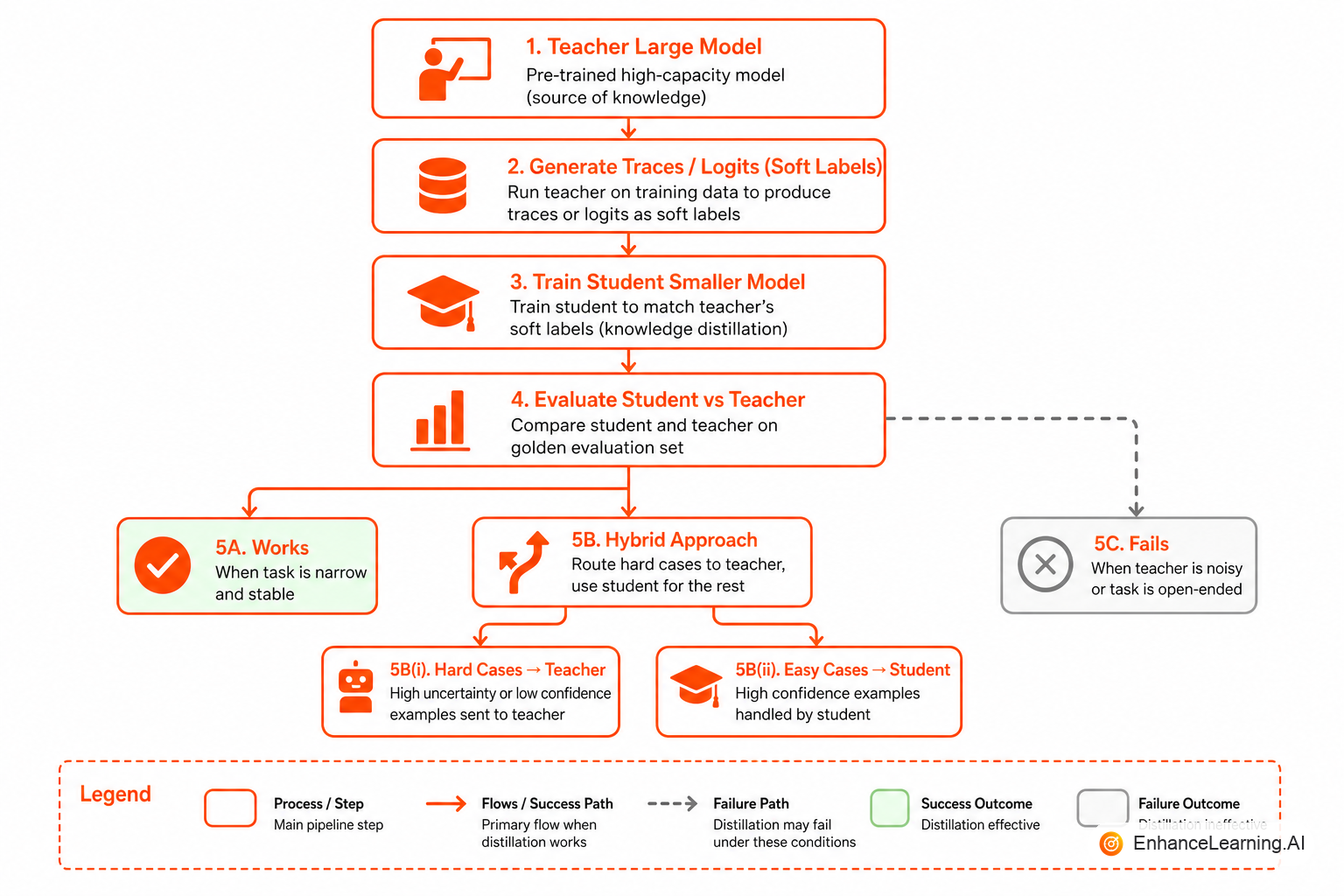
The student learns behavioral traces of the teacher on the training distribution. It does not inherit full reasoning capacity or world knowledge — it approximates responses the teacher would give on similar prompts.
Distillation differs from generic fine-tuning: the supervision signal comes primarily from the teacher's outputs (or internals), not only human labels. It differs from prompt compression: weights change, not just prompts.
When distillation works#
Distillation earns its keep under specific conditions:
Stable, narrow task distribution. Support ticket tagging, product description formatting, internal code review comments with fixed rubric — the teacher defines "good enough" on thousands of examples.
High teacher volume at inference. If teacher calls already exceed budget, distillation amortizes cost over many future student inferences.
Latency-sensitive paths. Mobile edge, real-time copilots, high-RPS APIs where small models meet SLAs teachers cannot.
Clear eval against teacher. You can measure student–teacher agreement and task metrics on held-out prompts.
Organizational tolerance for drift. Student will diverge on out-of-distribution prompts; you accept fallbacks or escalation.
Teams see 5–20× inference cost reduction with modest quality loss when tasks are shallow-to-medium depth and datasets reflect production.
When distillation fails#
Broad open-domain chat. Students collapse on questions outside teacher training mix — fluent nonsense faster than before.
Multi-step tool agents. Teacher success depends on long trajectories; naive distillation on single-turn pairs loses recovery behavior.
Rapidly shifting product. Teacher labels stale weekly; student permanently behind until retrain pipeline exists.
Teacher is already wrong. Distillation amplifies systematic teacher biases, hallucinations, or policy gaps.
Data too thin. A few hundred prompts overfit; student memorizes phrasing, not task.
Reasoning-heavy tasks with small margin. Math, legal analysis, safety-critical classification — 2% teacher gap becomes unacceptable incident rate at scale.
If your teacher only wins by 3% on eval and errors are costly, distillation is the wrong lever. Fix retrieval, tools, or task decomposition first.
| Signal | Distillation likely viable | Distillation risky |
|---|---|---|
| Task breadth | Narrow, templated | Open-ended chat |
| Teacher-student gap on eval | <5% on golden set | >10% or safety misses |
| OOD handling | Escalation path exists | Must handle anything |
| Label volume | 10k+ diverse teacher traces | <1k examples |
| Update cadence | Monthly retrain OK | Daily product changes |
Practical distillation pipeline#
- Freeze task scope — document in-scope intents and explicit exclusions
- Sample production prompts — stratified by difficulty, language, failure modes
- Generate teacher outputs — temperature and decoding fixed for consistency
- Filter — validators, human spot-check, dedupe near-identical prompts
- Train student — SFT on teacher completions; optional logit KL if you control stack
- Eval — task metrics, teacher agreement, refusal/safety regression, latency/cost
- Deploy with fallback — route low-confidence or OOD to teacher or human
import json
from pathlib import Path
from openai import OpenAI

client = OpenAI()
TEACHER = "gpt-5.1"
STUDENT_DATA = Path("distill/train.jsonl")

def teacher_complete(prompt: str) -> str:
    resp = client.chat.completions.create(
        model=TEACHER,
        messages=[{"role": "user", "content": prompt}],
        temperature=0.2,
    )
    return resp.choices[0].message.content or ""

def build_dataset(prompts: list[str]) -> None:
    with STUDENT_DATA.open("w") as f:
        for p in prompts:
            out = teacher_complete(p)
            row = {
                "messages": [
                    {"role": "user", "content": p},
                    {"role": "assistant", "content": out},
                ]
            }
            f.write(json.dumps(row) + "\n")
Downstream, feed train.jsonl into your platform's fine-tune job for the student base. The architecture choice of student (same family vs smaller vendor) affects portability — same tokenizer lineage simplifies transfer.
Teacher-generated training rows inherit hallucinations. Run schema validators, citation checks, and human review on high-risk slices before they become student supervision. Garbage distills faster than wisdom.
Logit vs sequence-level distillation#
Sequence-level (completion matching) — most API-first teams can do this. Train student to predict teacher tokens in responses. Simple, vendor-agnostic.
Logit-level — requires access to teacher logits or internal APIs. Richer signal, better sample efficiency, rare in closed APIs.
Rank / preference distillation — teacher ranks candidate answers; student learns preferences (related to DPO). Useful when multiple valid formats exist.
Pick the strongest signal your infrastructure allows. Do not block shipping on logit access if completion distillation clears eval.
Operational concerns after launch#
Version coupling. Teacher upgrades change optimal student. Pin teacher version used for label generation; re-distill on schedule.
Monitoring student–teacher divergence. Sample live traffic; periodically re-run teacher on same prompts; alert when agreement drops.
Escalation economics. Hybrid routing (student default, teacher on uncertainty) balances cost and quality — measure escalation rate; if >30%, student is too small or dataset too narrow.
Security. Distillation datasets stored with same sensitivity as production prompts. Students can memorize secrets from teacher traces — scrub PII before training.
Distillation vs other cost paths#
| Approach | What changes | Best for |
|---|---|---|
| Distillation | Student weights | Stable tasks, high volume |
| Prompt optimization | Prompt tokens | Quick wins, no ML platform |
| Quantization (INT8/4) | Inference precision | Same model, hardware savings |
| Caching | Repeated prefixes | Static system prompts |
| Smaller commercial SKU | Vendor switch | Good-enough tier exists |
Combine where sensible: distilled student plus INT8 plus prompt caching beats any single lever alone.
Ethical and licensing footnotes#
Teacher API terms may restrict using outputs to train competing models. Read vendor agreements before distillation at scale. Internal teachers on owned weights avoid some restrictions but carry infra cost.
Measuring success after distillation#
Track four metrics in the first 30 days:
- Task quality vs pre-distillation baseline — not vs teacher unless teacher was production
- Teacher escalation rate — should stabilize; climbing means OOD creep
- Cost per successful task — includes escalations and validator retries
- Incident count on student-only path — safety and PII regressions show here first
Set rollback triggers before launch: e.g., escalation >25% or safety miss rate >2× baseline.
Hybrid deployment pattern#
Production distillation rarely runs student alone on day one. Common pattern:
- Canary 5% student, 95% teacher with shadow comparison logging
- Promote when quality within agreed margin for two weeks
- Default student, teacher on low confidence score or high customer tier
- Quarterly re-distill when teacher version bumps
The hybrid phase is where you learn OOD boundaries without customer-facing cliffs.
Relation to quantization and hardware#
Distillation shrinks behavioral capacity into fewer parameters; quantization shrinks numerical precision of those parameters. They compose: a distilled 7B model at INT4 may hit your cost target where either lever alone failed. Eval after every combined change — quantization can disproportionately hurt tasks relying on subtle logit margins copied from the teacher.
Hardware choice matters too. A distilled model that fits on a single L4 may beat a teacher on A100 economics even if raw quality is slightly lower — total cost includes idle GPU, orchestration, and network hops to a remote API.
Building an internal business case#
Finance approves distillation when you show teacher spend trajectory, projected student inference cost, one-time label generation cost, and retrain cadence. Include escalation economics: a student with 10% teacher fallback may still save 70% if the teacher was only used on hard cases.
Without that narrative, distillation looks like ML science project. With it, distillation is capacity planning — same category as reserved instances and autoscaling policies.
Summary#
Model distillation trains a smaller student to reproduce a larger teacher on tasks you define — trading general capacity for cost and speed on known workloads. It works on narrow, stable, high-volume paths with rigorous filtering and eval; it fails on open-ended agents, shifting products, and bad teachers. Treat distillation as a measured migration with fallback and retrain discipline, not a one-time hack to avoid reading the inference bill.
Want premium architecture blueprints?
Be among the first to explore interactive reference architectures, implementation playbooks, and premium engineering resources at launch.
Related Articles
Recommended reading based on this topic.
Model Selection Framework for Enterprise AI
A practical framework for choosing enterprise models: task fit, context and tool needs, cost-latency envelopes, eval gates, and when to use routers instead of one frontier model.
Read ArticleModel Architecture Still Shapes Your System, Even Behind an API
API access hides weights, not architecture. Transformer design shapes context limits, failure modes, multimodal gaps, and what your system can build.
Read ArticleWhy Model Size is the Wrong Default for AI-Native Design
Parameter count is not product quality. Right-size models against task depth, latency envelopes, eval scores, and failure blast radius — not leaderboard rank.
Read Article