
Model Architecture Still Shapes Your System, Even Behind an API
API access hides weights, not architecture. Transformer design shapes context limits, failure modes, multimodal gaps, and what your system can build.
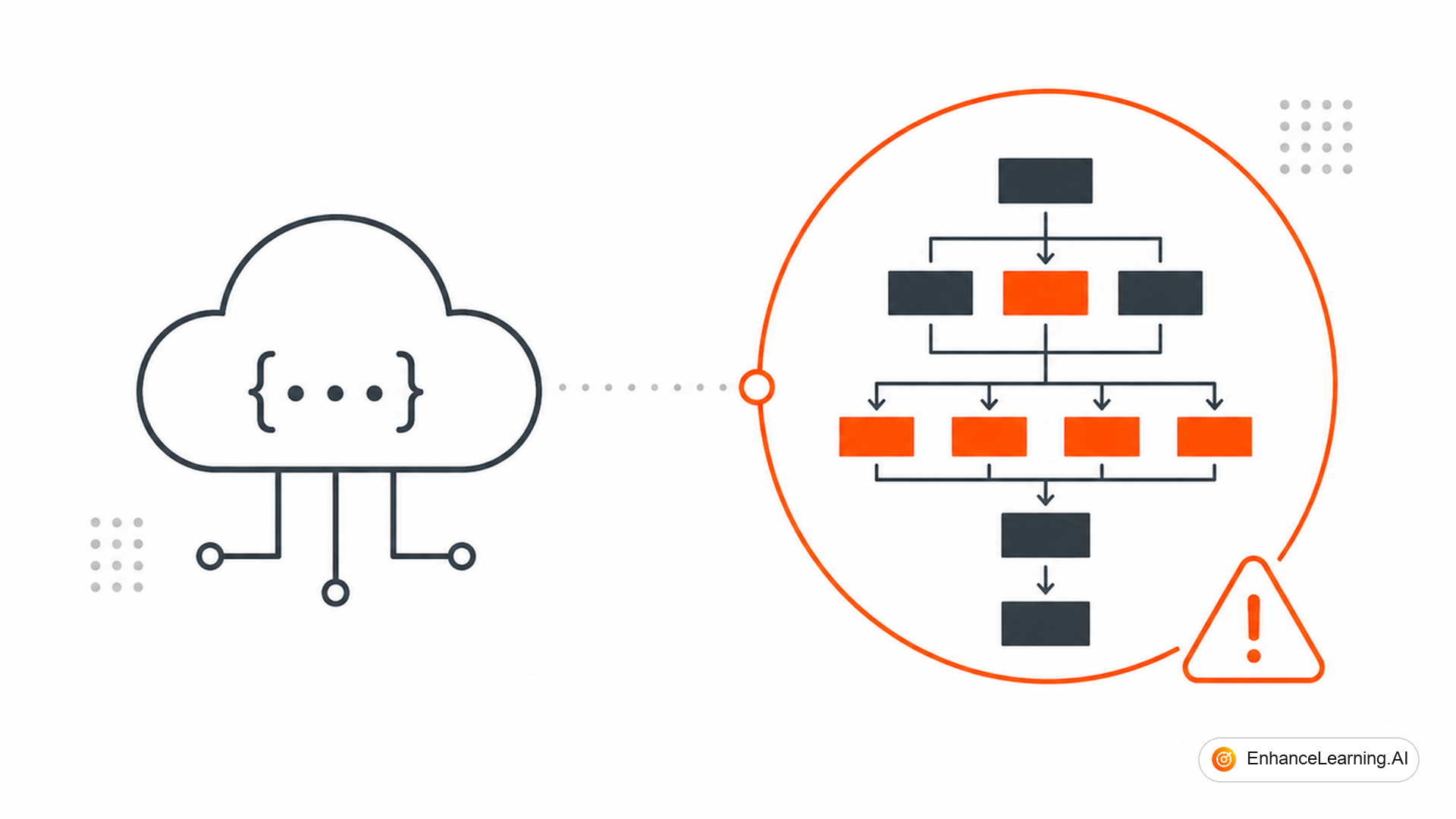
You can call a model through a REST endpoint without ever downloading weights, yet your system still inherits its architectural constraints. Teams that treat every API as a black-box text function discover those limits in production: context that silently truncates, reasoning that degrades past a certain window fill, multimodal endpoints that accept images but miss layout, and failure modes that look like prompt bugs but are structural. Architecture literacy is not academic nostalgia — it is how you set honest capability expectations before you commit to a design.
The API abstracts infra, not architecture#
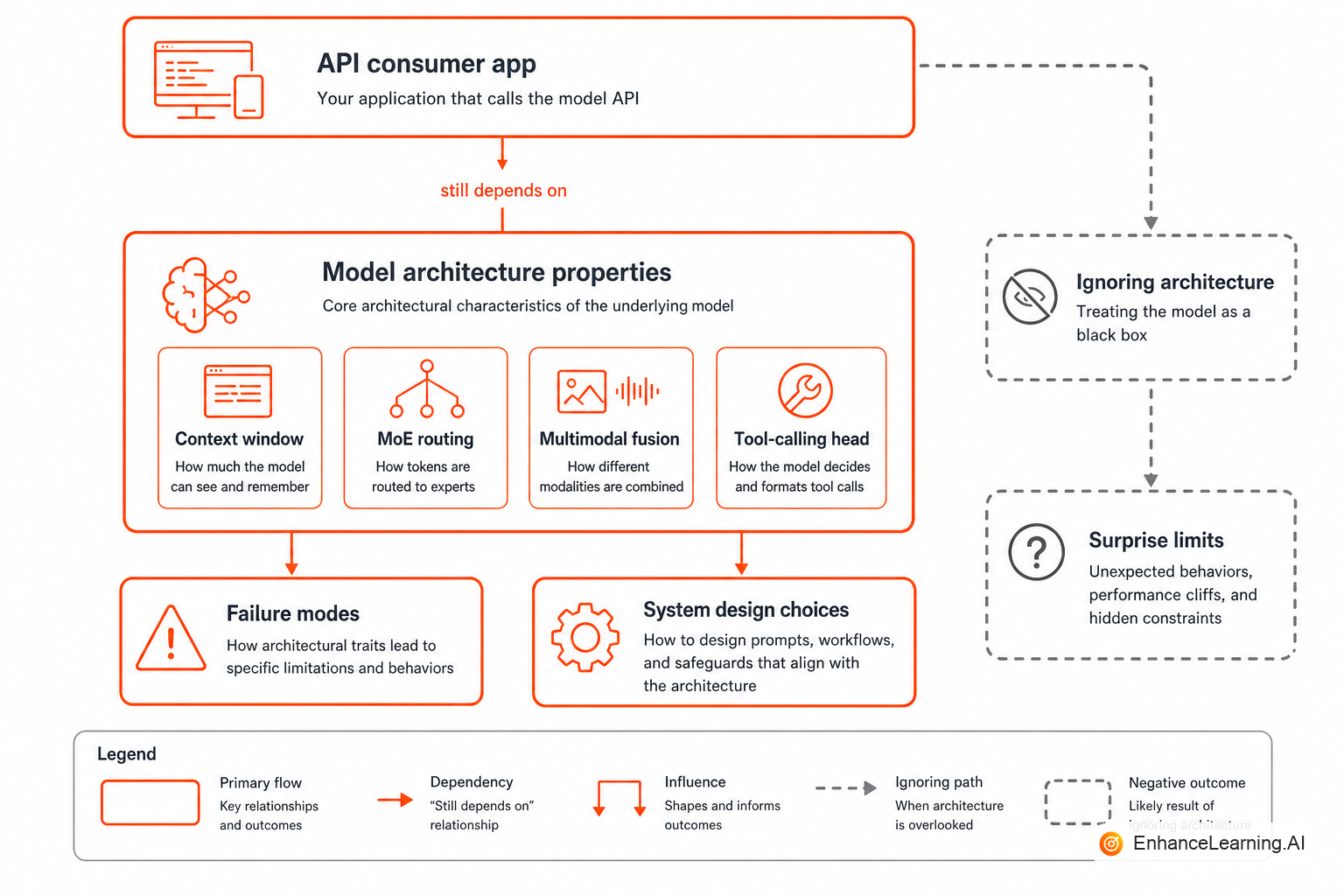
Vendor APIs abstract three things well: hardware, scaling, and weight updates. They do not abstract the model family’s inductive biases, attention patterns, or training objective. A dense decoder-only transformer behaves differently from a mixture-of-experts stack even when both return JSON over HTTPS.
When architects skip this layer, they over-promise. Product asks for "compare these two 200-page contracts side by side." Engineering picks the SKU with the largest advertised context window. Quality collapses at page 80 because positional encoding and training distribution never supported reliable long-range dependency — not because someone wrote a bad system prompt.
The fix is not to become a ML researcher. The fix is to know which architectural facts change system design:
- Context mechanism — sliding window, ring attention, or full quadratic attention at a cost
- Modality fusion — early fusion in one stack vs late fusion through separate encoders
- Output structure — autoregressive token stream vs constrained decoding support in the serving stack
- Training mix — code-heavy, dialogue-heavy, or document-QA-heavy pretraining shows up in edge behavior
Decoder-only transformers and the completion contract#
Most production chat APIs expose decoder-only models: GPT-style stacks that predict the next token given everything to the left. That design choice ripples outward.
Decoder-only models excel at open-ended continuation. They are weaker at bidirectional understanding unless instruction tuning and retrieval compensate. If your pipeline assumes the model "read the whole document equally," you may need explicit chunking, reranking, or a separate encoder model — architecture pushed the problem to your orchestration layer.
Attention is the other hidden bill. Full self-attention scales quadratically with sequence length. Vendors ship long-context variants, but "fits in the window" is not the same as "uses the whole window well." Many teams hit a cliff where accuracy on needle-in-haystack tests drops once past 32k tokens even though the API accepts 128k. That is an architecture-and-training artifact, not a bug you patch with temperature.
Mixture-of-experts and routing you do not control#
MoE architectures activate a subset of parameters per token. Users see one model name; internally, different experts handle math, dialogue, or code-ish patterns. You do not pick the expert. You inherit routing stability.
For system designers, MoE shows up as inconsistent latency and occasional capability whiplash: the same prompt class sometimes gets a fast cheap path, sometimes a slow one, depending on token patterns. p95 latency budgets need headroom. Eval flakiness on borderline prompts is often routing noise, not nondeterminism in sampling alone.
MoE also complicates cost forecasting. List prices per million tokens assume average activation. Bursty workloads with code snippets, JSON, and natural language in one session can skew bills. Architecture literacy here means measuring your token mix, not trusting a single benchmark FLOPs estimate.
Multimodal architecture is never "just another field"#
Adding vision or audio is not a flag on the same transformer. Architectures differ on where images enter: cross-attention layers, early patch embedding fused with text tokens, or separate vision towers with projection layers. Each pattern has trade-offs.
Late-fusion pipelines (OCR → text model) give you inspectable intermediate artifacts. End-to-end multimodal models win when layout, charts, or spatial relationships matter — but failures are opaque. A model that reads captions well but misreads table structure will fail RAG over scanned PDFs even if marketing says "multimodal."
When you design around hosted model APIs, ask concrete questions:
| Design question | Why architecture matters |
|---|---|
| Do we need pixel-level layout? | Patch-based vision transformers differ in resolution handling |
| Is audio streaming or batch? | Streaming ASR + LLM is a different stack than native audio tokens |
| Can we fall back to text-only? | Some APIs degrade silently when image MIME types change |
| Where do embeddings live? | Shared embedding space vs modality-specific breaks cross-modal retrieval |
If you cannot answer these from vendor docs, run architecture-aware evals: scanned tables, rotated screenshots, low-contrast forms. Prompt tuning will not fix a vision encoder trained mostly on natural photos.
Failure modes that look like application bugs#
Several production incidents trace back to architecture, misdiagnosed as bad prompts:
Context truncation without loud errors. Some APIs truncate middle sections or oldest turns. Your agent "forgets" tool results. Fix: explicit summarization and external memory — architectural limit moved to your state layer.
Reasoning drift on long tool chains. Decoder-only models trained primarily on single-turn QA lose thread in ten-step agent loops. Fix: shorter loops, state machines, or models with training emphasis on multi-step trajectories — not "try again with more emphasis."
Structured output fragility. Autoregressive generation was not born to emit valid JSON. Architecture plus inference-time constraints (grammar, schema-guided decoding) determines reliability. If the serving stack lacks constrained decoding, your validator retries are paying for a missing architectural feature.
Language and script imbalance. Tokenization and pretraining mix determine multilingual quality. A model strong in English and Python may mangle legal Japanese because byte-pair encoding and data coverage — architectural and data choices — not because your locale string was wrong.
Knowing the pattern saves weeks. You stop A/B testing temperature on a problem that needs a different model class or a pipeline split.
How architecture literacy shapes system design#
Once you accept that API access does not erase structure, design decisions get clearer.
Context budgeting becomes explicit. You architect for 8k effective context even when the API allows 200k — because your eval proved degradation. Retrieval, compression, and hierarchical summaries are first-class, not afterthoughts.
Modality boundaries stay sharp. You do not send every PDF page as an image because the multimodal endpoint exists. You route clean text through text models and reserve vision for layout-heavy pages — architecture-aware routing without a fancy ML team.
Failure isolation improves. When JSON breaks, you check decoding support and schema constraints before rewriting prompts. When long documents fail, you check positional limits before buying a bigger SKU.
Vendor comparison gets honest. Two APIs with similar benchmark scores may differ in attention implementation, fine-tuning data, or tool-call training. Architecture notes in your internal runbook beat leaderboard screenshots in procurement.
import { z } from "zod";
import OpenAI from "openai";

const client = new OpenAI();

/** Probe effective context: mid-document loss often precedes hard errors. */
const NeedleSchema = z.object({
  secretCode: z.string(),
  foundAtChunk: z.number().int(),
});

async function needleInHaystack(
  chunks: string[],
  needle: string,
  model: string
): Promise<z.infer<typeof NeedleSchema>> {
  const haystack = chunks.join("\n\n---\n\n");
  const prompt = [
    "Document:",
    haystack,
    "",
    `Return JSON with secretCode and foundAtChunk for: ${needle}`,
  ].join("\n");

  const response = await client.chat.completions.create({
    model,
    messages: [{ role: "user", content: prompt }],
    response_format: { type: "json_object" },
  });

  const raw = response.choices[0]?.message?.content ?? "{}";
  return NeedleSchema.parse(JSON.parse(raw));
}
Run this at 8k, 32k, and 100k filled tokens on your document shapes. The drop-off point is architectural signal your product manager should see before launch.
Treat maximum context length as a hard ceiling, not a target operating point. Teams that design for full-window prompts routinely pay more and score worse than teams that retrieve, compress, and keep active context under an eval-proven threshold — often well below the API limit.
What to document in your architecture review#
You do not need parameter counts. You need decisions your on-call engineer can use:
- Model family and modality stack — text-only, native multimodal, or pipeline
- Effective context threshold — measured, not marketed
- Structured output path — native schema mode vs prompt-and-parse
- Known weak domains — languages, numeric reasoning, table extraction
- Latency variance drivers — MoE routing, image resolution, long completions
- Fallback model class — when architecture makes primary choice fail closed
Pair this with job-level requirements. Model selection frameworks tell you which model wins a bake-off. Architecture literacy tells you why certain designs were never on the table — and why some incidents will repeat if you swap vendors without swapping assumptions.
Summary#
Calling models through an API removed the need to host GPUs, not the need to understand what you are calling. Transformer variants, context mechanisms, modality fusion, and decoding constraints flow into every agent loop, RAG pipeline, and multimodal workflow you ship. Teams that learn this once build systems with realistic envelopes and faster incident triage. Teams that ignore it keep paying frontier prices to solve problems architecture already defined — and keep blaming prompts when the structure was never going to comply.
Want premium architecture blueprints?
Be among the first to explore interactive reference architectures, implementation playbooks, and premium engineering resources at launch.
Related Articles
Recommended reading based on this topic.
Model Selection Framework for Enterprise AI
A practical framework for choosing enterprise models: task fit, context and tool needs, cost-latency envelopes, eval gates, and when to use routers instead of one frontier model.
Read ArticleModel Distillation: Teaching Smaller Models to Match Larger Ones
Distillation trains a smaller model to reproduce a larger LLM's behavior. Learn when it cuts cost, when quality collapses, and how to eval the trade-off.
Read ArticleWhy Model Size is the Wrong Default for AI-Native Design
Parameter count is not product quality. Right-size models against task depth, latency envelopes, eval scores, and failure blast radius — not leaderboard rank.
Read Article