
Why Model Size is the Wrong Default for AI-Native Design
Parameter count is not product quality. Right-size models against task depth, latency envelopes, eval scores, and failure blast radius — not leaderboard rank.
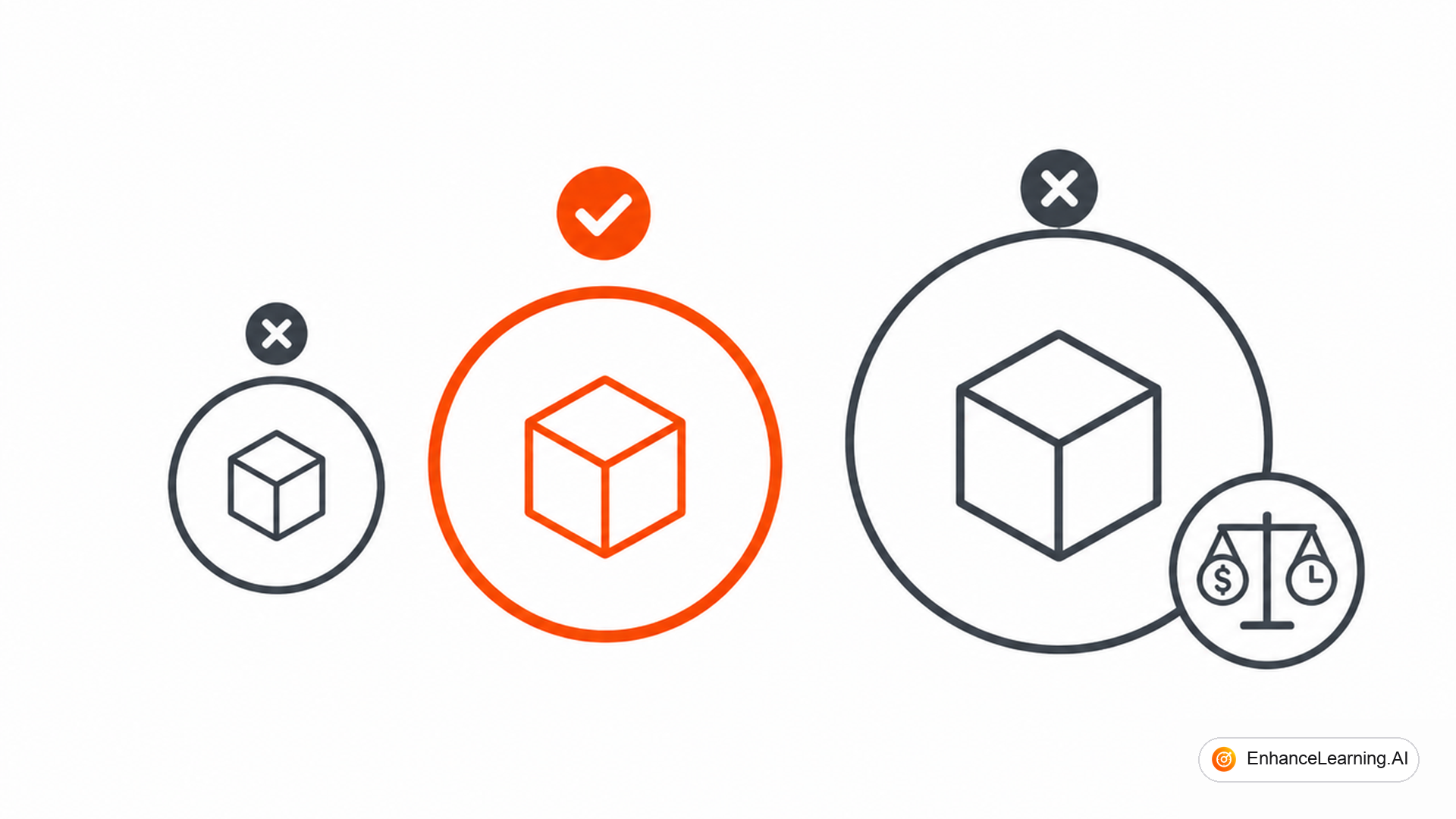
The default reflex in enterprise AI is to buy the biggest model the budget allows. It feels safe: more parameters, more intelligence, fewer embarrassing mistakes. In production, that reflex burns money, adds latency, and sometimes reduces reliability — larger models hallucinate with more confidence, over-elaborate simple extractions, and tempt teams to skip retrieval because "the big model will figure it out." Right-sizing is not settling. It is engineering.
Capability scales unevenly with size#
Doubling parameters does not double utility on every task. Gains concentrate in hard reasoning, nuanced instruction following, and broad zero-shot coverage. They diminish on narrow pattern-matching jobs you could solve with validators and small models.
Rough production pattern:
| Task shape | Size sensitivity | Notes |
|---|---|---|
| Binary classification / tagging | Low | Small models + good features win |
| JSON field extraction with schema | Low–medium | Validators matter more than 70B |
| Multi-hop research synthesis | High | Larger models help if retrieval is solid |
| Tool planning with recovery | High | But tool training quality beats raw scale |
| Creative long-form drafting | Medium | Style prefs; human review either way |
| Code generation in familiar stack | Medium | Domain match beats sheer size |
Leaderboards mix these tasks. Your traffic usually does not.
Where big models hurt#
Cost curves that do not bend#
Frontier SKUs price per token. High-volume extractors sending millions of rows through a 100B-class model pay frontier bills for commodity work. Finance notices. Teams throttle features — the product degrades because sizing was wrong, not because AI failed.
Latency and concurrency#
Larger models run slower per token and often queue longer on shared APIs. Interactive agents feel sluggish; batch pipelines miss SLAs. Vertical scale hits physics; horizontal scale hits rate limits and spend caps.
Confident wrong answers#
Larger instruct models produce polished, authoritative hallucinations. For factual Q&A without retrieval, size increases fluency more than faithfulness. Users trust wrong answers faster — higher incident severity.
Architectural laziness#
"We have GPT-XL" becomes the design for skipping chunking, eval, and tool boundaries. Systems become monolithic prompt blobs. When the model fails, nothing isolates cleanly.
Operational fragility#
Single frontier dependency means one vendor outage or policy change stops the company. Right-sized multi-model designs absorb shocks — not because small models are smarter, but because workloads are partitioned.
A right-sizing framework (not a leaderboard lookup)#
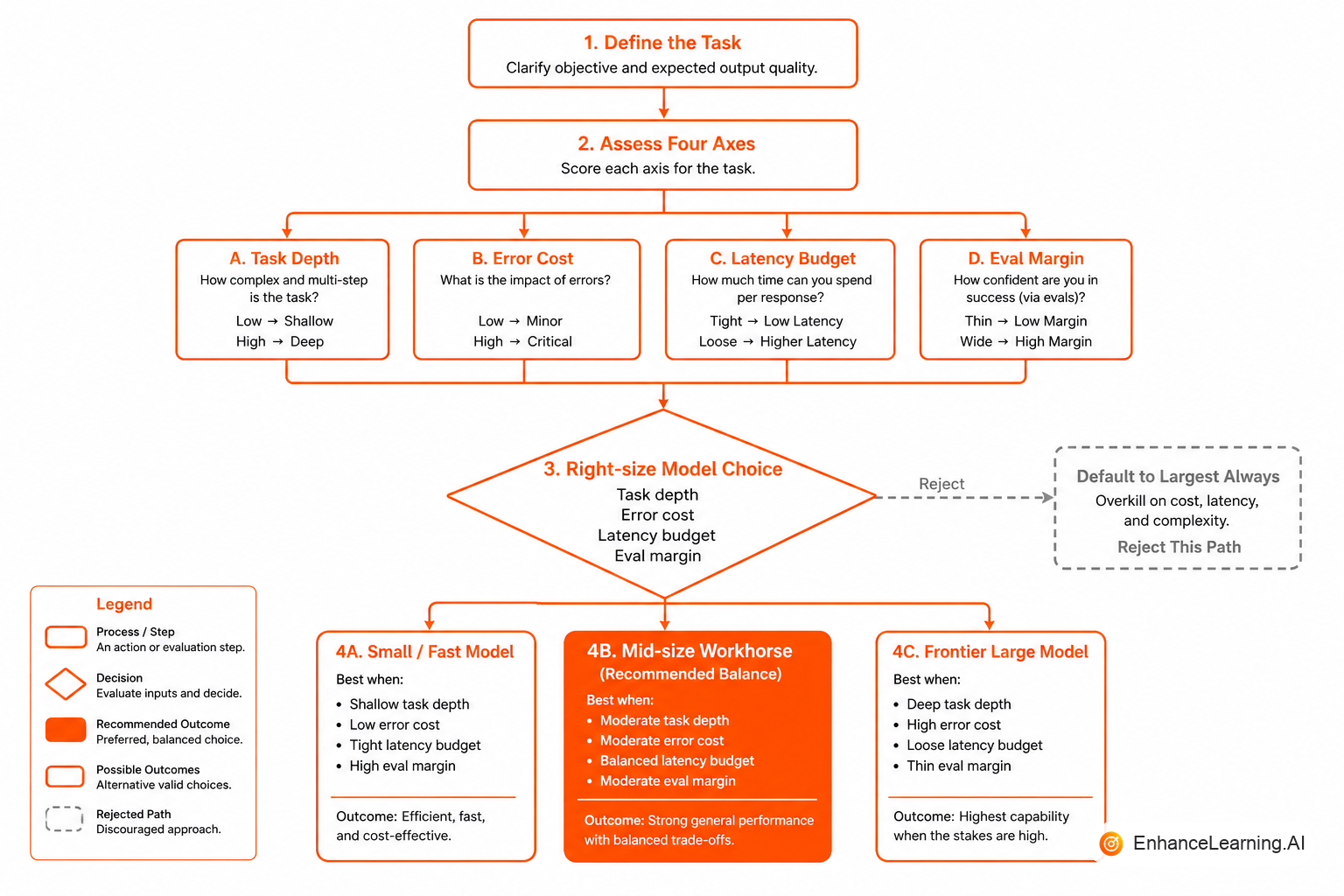
This is model literacy, not the job-class router from enterprise selection playbooks. Use four axes before anyone says "we need the large one."
1. Task depth#
Shallow: pattern match, transform, classify with clear rubric.
Deep: multi-step reasoning, ambiguous goals, novel tool combinations.
Shallow tasks get the smallest model that passes eval with margin. Deep tasks earn larger models — or decomposed workflows where only one step is large.
2. Error cost#
Ask: if this output is wrong, what happens?
- Wrong emoji suggestion → low cost → small model
- Wrong loan denial reason → high cost → larger model plus human review, not large model alone
High error cost sometimes means more guardrails, not bigger weights.
3. Latency and throughput envelope#
Write numbers: p95 < 800ms? 10k RPM? Batch overnight?
Pick the largest model that fits inside the envelope at expected concurrency. Exceeding envelope is a hard no regardless of benchmark glitter.
4. Eval margin, not eval pass#
Passing 91% with a 3B model beats 93% with a 70B model when the task is low-risk and volume is millions — 2% may not justify 20× cost. Conversely, failing safety refusals on a small model is not fixable by pricing — you step up or redesign.
Document stop rules: if small model within 1 point of large on golden set, small ships.
from dataclasses import dataclass

@dataclass
class SizingDecision:
    task_depth: str  # "shallow" | "deep"
    error_cost: str  # "low" | "medium" | "high"
    p95_latency_ms: int
    small_score: float
    large_score: float
    cost_ratio: float

def recommend(decision: SizingDecision) -> str:
    margin = decision.large_score - decision.small_score
    if decision.task_depth == "shallow" and margin < 0.03:
        return "small"
    if decision.error_cost == "high" and margin > 0.05:
        return "large_with_review"
    if decision.p95_latency_ms < 500 and margin < 0.08:
        return "small"
    return "large" if margin > 0.10 else "small"
Replace thresholds with your governance. The function forces explicit trade-offs instead of vibes.
Large models buy headroom on hard prompts and messy inputs. They do not replace retrieval, schema validation, or eval. If your system only works with the largest SKU, your architecture is under-specified — not under-powered.
Patterns that work in AI-native systems#
Tiered defaults. Small model first; escalate to large on low confidence, high risk tier, or user opt-in. Escalation must be measured — if it triggers 40% of the time, your router is theater.
Decompose before upsizing. Break "one giant prompt" into retrieve → extract (small) → plan (medium) → draft (large if needed). Total tokens and latency often beat one monolithic call.
Specialists over universal giants. Embedding models, rerankers, OCR, and code linters are not parameter competitions. A modest LLM with excellent retrieval beats a leviathan with none.
Pin and regression-test size changes. Moving from medium to large changes tone and tool behavior. Treat as migration with eval diffs.
When bigger actually is better#
Pay for large models when eval shows:
- Material quality gap on high-value tasks not fixable by decomposition
- Tool-use reliability cliff between tiers on your schemas
- Long-context reasoning that smaller models fail even with RAG — and you measured it
- Regulatory or brand risk where false economy backfires
Also when prototyping unknown problem spaces — explore with large, then distill or downsize once tasks stabilize (distillation is the intentional path from large to small).
Anti-patterns to reject in architecture review#
- "We might need reasoning someday" on a CSV column mapper
- Single model SKU because procurement is easier
- No eval comparing tiers — only vendor demo
- Ignoring embedding/rerank quality while upsizing completion model
- Autoscaling spend without autoscaling task difficulty
Worked economics: when size stops paying#
Suppose extraction on 5M monthly rows costs $0.004 per call on a frontier model and $0.0004 on a small instruct model. Quality: 97.2% vs 96.1% field-level accuracy with schema validation catching half the delta. The frontier premium is ~$18k/month for 1.1 points — before latency-induced timeouts add hidden cost.
Run the spreadsheet with your volume, validator coverage, and incident cost. Numbers change minds faster than parameter counts.
Interaction with retrieval and memory#
Large models tempt teams to skip retrieval — "just put everything in context." That doubles the problem: you pay frontier token rates on bloated windows and hit effective context cliffs tokenization makes worse. Right-sizing often means smaller completion model + better retrieval beats larger model + naive dump.
External memory systems (vector stores, conversation summaries) pair naturally with small and medium models. They are not compensation for "cheap" alone — they are architecture that makes smaller models viable on hard tasks.
Team process: size reviews in architecture guild#
Add a standing agenda item: model tier justification. New features declare task depth, error cost, envelope, and eval margin between tiers before infra approves API keys. Prevents shadow frontier usage from prototype code reaching production unchanged.
Reviewers should ask for evidence, not intent: golden-set scores, token-cost projections, and incident class if the tier is wrong. Prototypes may use large models; production promotion requires a written tier choice. That single gate catches most oversizing early.
Capacity planning without parameter obsession#
Forecast QPS and sequence length first; map to vendor SKU tiers second. A "small" model at 8k concurrent agents with 4k-token contexts may cost more than a "medium" model at half the concurrency because of retry storms. Size interacts with architecture — batching, caching, and retrieval — not just parameter count on a slide.
When finance asks to cut spend 30%, tier down per job class instead of slashing one global model. Mixed-tier systems survive budget cuts; monolithic frontier dependencies do not. Document which job classes moved down and re-run eval — savings without measurement is how quality incidents start.
Summary#
Bigger LLMs add capacity on hard, ambiguous tasks — not automatic product quality. AI-native systems right-size against task depth, error cost, latency envelopes, and eval margins between tiers. The goal is not the smallest model; it is the smallest model that meets your bar with operational room to spare. Everything else is vanity spend that latency and finance will expose under real traffic.
Want premium architecture blueprints?
Be among the first to explore interactive reference architectures, implementation playbooks, and premium engineering resources at launch.
Related Articles
Recommended reading based on this topic.
Model Selection Framework for Enterprise AI
A practical framework for choosing enterprise models: task fit, context and tool needs, cost-latency envelopes, eval gates, and when to use routers instead of one frontier model.
Read ArticleWhy Context Quality is the Bottleneck in Production AI
Context assembly — not model size — limits reliability, latency, and cost in production AI. It is the most under-engineered layer in most stacks.
Read ArticleThe Trade-off Between Context Richness and LLM Latency
Richer LLM context improves answers until prefill latency hurts UX. Measure the trade-off between context size, inference time, and product responsiveness.
Read Article