
Why Most Enterprise AI Initiatives Fail Before Reaching Production
Enterprise AI stalls in pilots because ownership, incentives, and governance are misaligned — not because the model is wrong.
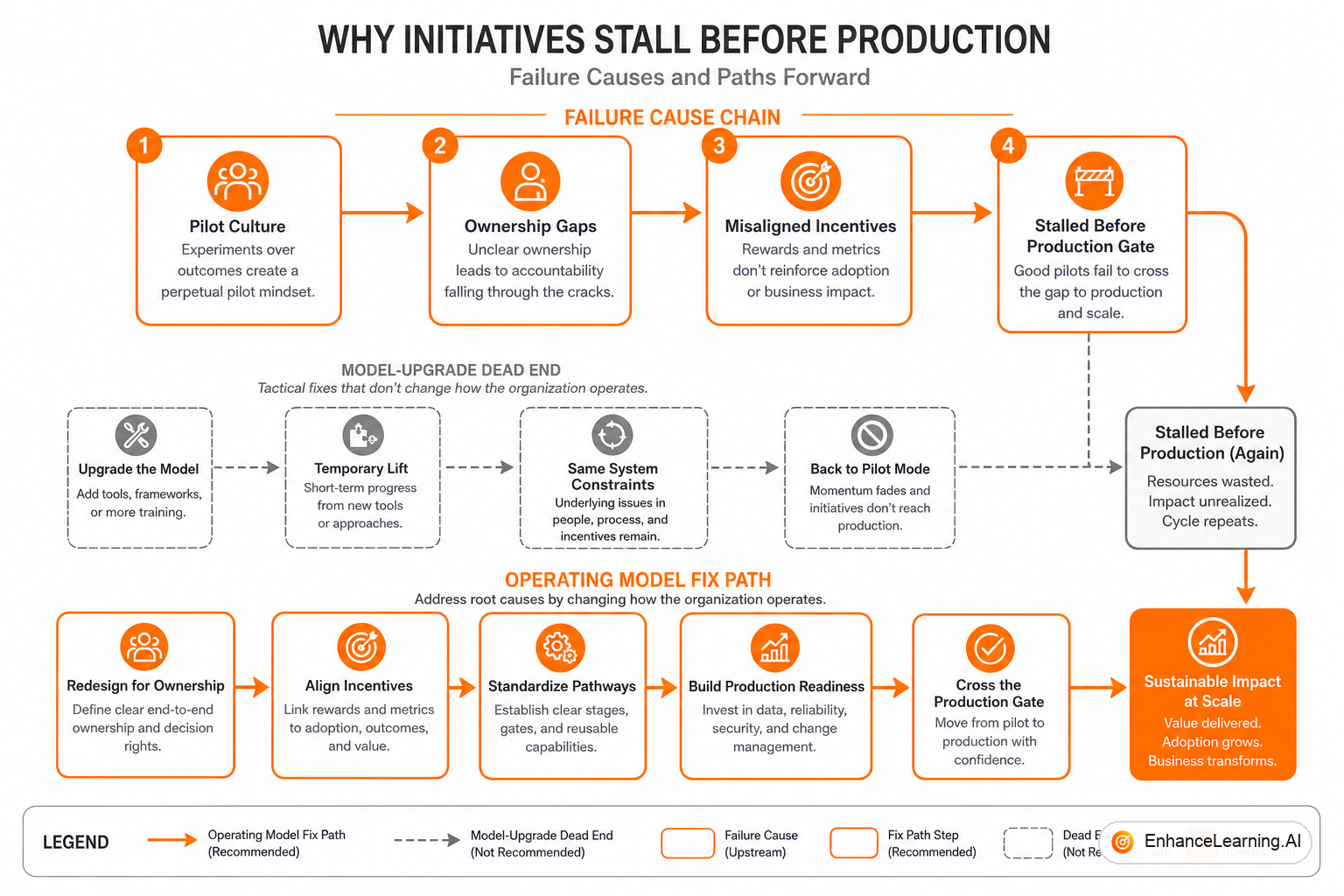
Your team shipped a retrieval demo that impressed the board. Six months later it still runs on a laptop, the product owner moved to another division, and the "AI lead" is a consultant whose contract ended in March. The model was fine. The org chart was not. Most enterprise AI initiatives die before production because nobody owns the boring work between demo and on-call — and nobody gets promoted for finishing it.
This is not a technology failure dressed up as culture. It is a systemic pattern you can diagnose and fix if you stop treating every stall as a model-selection problem.
The pilot trap is a funding model, not a maturity stage#
Enterprises love pilots because they defer hard decisions. A pilot needs a slide deck and a sandbox API key. Production needs data contracts, eval gates, incident response, and a named owner when quality drops at 2 a.m. Budget cycles reward the first and punish the second.
Watch how initiatives are scored:
| Signal executives track | What it actually measures | What production needs |
|---|---|---|
| Number of AI pilots launched | Activity | Workflows with SLAs |
| Hackathon participation | Morale event | Repeatable delivery path |
| Vendor POC completion | Procurement motion | Eval pass rate on golden sets |
| "Innovation" OKRs | Narrative | Cost per successful task |
When the scoreboard counts demos, you get demos. When nobody loses budget for a pilot that never graduates, pilots become the terminal state.
Ownership gaps kill handoffs#
Production AI needs three owners who disagree productively: a workflow owner who cares about user outcomes, an engineering owner who cares about reliability, and a risk partner with review SLAs measured in days. In most enterprises those roles exist on paper and vanish at handoff.
Typical failure sequence:
- Innovation lab builds a demo with synthetic data
- Business unit "adopts" it without engineering headcount
- Security asks for logging standards the lab never implemented
- Platform team refuses to support a one-off stack
- Demo runs in a VM until the VM owner leaves
The fix is not "more CoE oversight." It is naming owners before funding and tying their goals to production metrics, not presentation dates.
Incentive misalignment is louder than model quality#
Engineers optimize for what gets reviewed. If performance reviews reward greenfield prototypes and punish maintenance on eval harnesses, you will get prototypes. If business units keep headcount when they launch pilots but lose it when they operationalize, they will hoard pilots.
A regional bank had twelve "AI initiatives" and zero in production. Every BU lead had a KPI for "AI exploration." None had a KPI for "workflow in prod with eval regression in CI." Realigning two KPIs — production workflow count and eval pass rate — collapsed the portfolio to four serious bets within a quarter. Three shipped. The model vendor did not change once.
Innovation labs without exit criteria become permanent demos#
Central labs compress learning when domains lack AI engineering depth. They become a failure mode when success is "demos delivered" rather than "workflows transferred." Set exit criteria when funding a lab engagement: named domain engineering owner by week four, production data access plan by week eight, eval harness forked into the domain repo by week twelve. Without exit criteria, the lab becomes a hospitality function hosting executive tours.
The technology excuse hides organizational debt#
When a program stalls, the post-mortem often blames "hallucinations" or "RAG quality." Dig deeper and you usually find:
- No authorized access to the systems the workflow needs
- No shared gateway — every team holds its own API keys
- No eval set — quality arguments happen in meetings
- No on-call — "it's still a pilot" means nobody wakes up
These are operating-model gaps, not model gaps. Swapping GPT-4 for Claude does not fix missing ownership. Fine-tuning does not fix incentives that reward demos.
A diagnostic you can run#
Score each active initiative 0–2 on five dimensions. Zero means absent; two means documented and staffed.
from dataclasses import dataclass
from enum import IntEnum

class Score(IntEnum):
    ABSENT = 0
    PARTIAL = 1
    OPERATIONAL = 2

@dataclass
class InitiativeDiagnostic:
    name: str
    workflow_owner: Score
    prod_engineering_owner: Score
    eval_regression: Score
    risk_review_sla_days: int | None  # None if no SLA
    graduation_deadline: str | None

    @property
    def org_score(self) -> int:
        base = (
            int(self.workflow_owner)
            + int(self.prod_engineering_owner)
            + int(self.eval_regression)
        )
        sla_bonus = (
            2
            if self.risk_review_sla_days is not None
            and self.risk_review_sla_days <= 10
            else 0
        )
        deadline_bonus = 2 if self.graduation_deadline else 0
        return base + sla_bonus + deadline_bonus

    def likely_stalls(self) -> bool:
        return self.org_score < 6 or self.workflow_owner == Score.ABSENT

    def status(self) -> str:
        flag = "STALL RISK" if self.likely_stalls() else "on track"
        return f"{self.name}: org_score={self.org_score} -> {flag}"


clause_assist = InitiativeDiagnostic(
    name="Contract clause assist",
    workflow_owner=Score.OPERATIONAL,
    prod_engineering_owner=Score.PARTIAL,
    eval_regression=Score.PARTIAL,
    risk_review_sla_days=14,
    graduation_deadline="2026-Q4",
)

exec_chatbot = InitiativeDiagnostic(
    name="Exec chatbot",
    workflow_owner=Score.PARTIAL,
    prod_engineering_owner=Score.ABSENT,
    eval_regression=Score.ABSENT,
    risk_review_sla_days=None,
    graduation_deadline=None,
)

print(clause_assist.status())
print(exec_chatbot.status())
Anything with likely_stalls() == True should not receive incremental model spend until org_score improves. That feels harsh. It is cheaper than another year of pilot theater.
What actually unblocks production#
These moves are operationally dull — and they work:
- One workflow, end to end — pick the highest-value job class and fund platform + risk + product together until it is on-call
- Graduation criteria published — eval threshold, logging, owner, kill date; no criteria means no production
- Incentive realignment — reward production workflows and shared platform adoption, not pilot count
- Executive reporting swap — replace "AI activities" with "workflows in prod, quality vs baseline, incidents"
- Refuse orphan pilots — no new POC without a named prod engineering owner
Summary#
Enterprise AI initiatives fail before production because organizations fund exploration without funding ownership, align incentives to demos, and treat operating-model gaps as model problems. The technology is often good enough to ship; the handoffs, scoreboards, and review paths are not. Diagnose org_score before you diagnose embeddings — and kill pilots that refuse to graduate.
Want premium architecture blueprints?
Be among the first to explore interactive reference architectures, implementation playbooks, and premium engineering resources at launch.
Related Articles
Recommended reading based on this topic.
Why Enterprise AI Operating Models Need Periodic Redesign
Enterprise AI operating models must evolve with capability, maturity, and priorities — not stay frozen after a one-time setup.
Read ArticleBuilding an Enterprise AI Operating Model
How enterprises adopt AI through job classes, shared platforms, eval gates, and controls — instead of scattered chat pilots.
Read ArticleWhat AI Security Actually Covers Beyond Model Safety
AI security spans identity, permissions, data flows, and runtime policy — not just model alignment and output filters. A scope map for architects.
Read Article