
Why most RAG Systems Fail in Production
Where production RAG breaks: chunking mistakes, retrieval that looks fine in demos, missing reranking, and evaluation that never measures answer faithfulness.
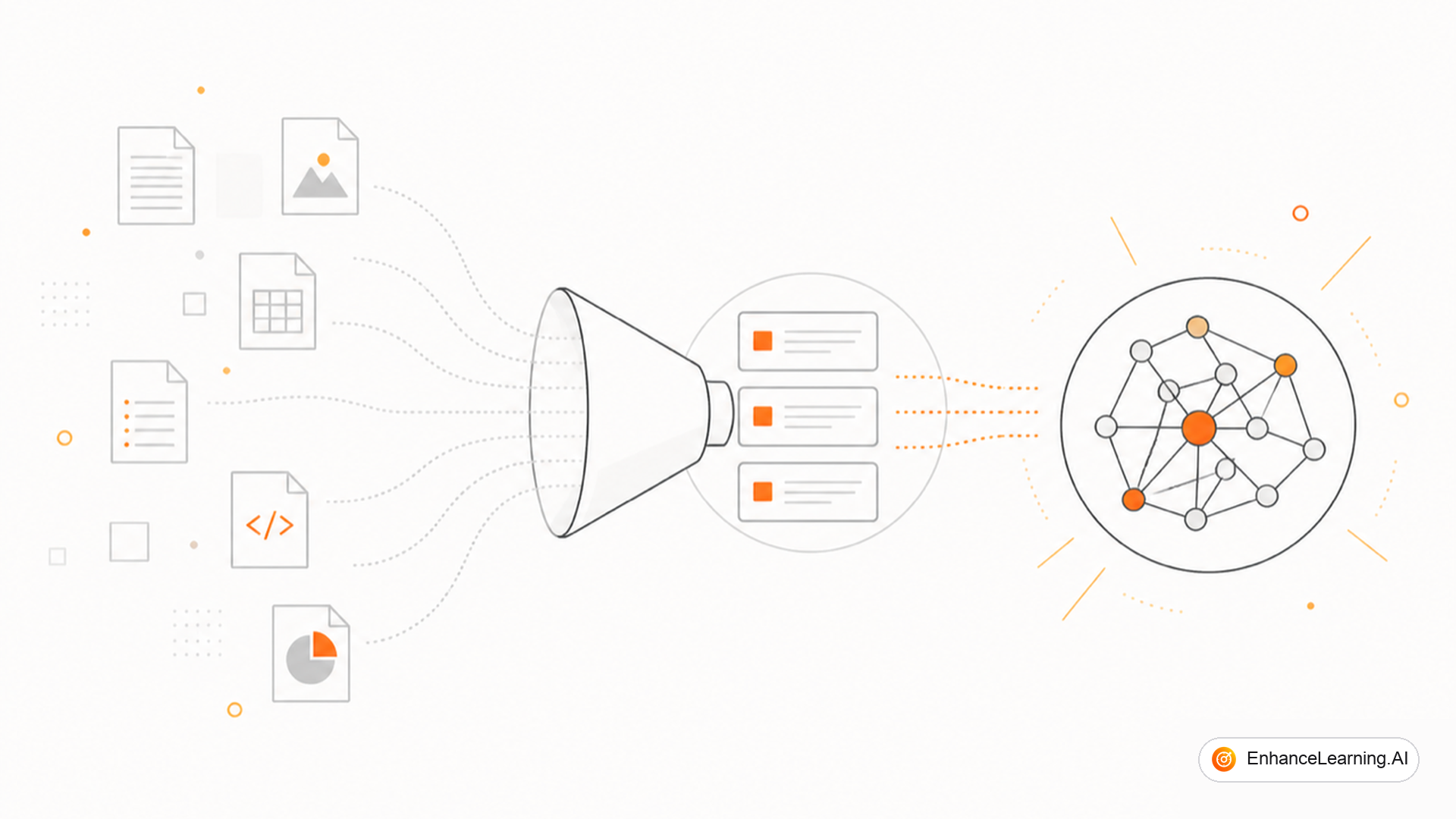
The first RAG demo is almost always convincing. You drop a PDF into a notebook, embed the chunks, ask a question the document answers in plain English, and the model quotes it back. Then you put the same pipeline on a real corpus — policies that contradict each other, tickets with half-finished sentences, product docs rewritten three times — and the answers start sounding confident while being wrong. That failure mode is not mysterious. Most RAG systems fail for the same handful of engineering reasons, and they fail quietly because the UI still returns fluent text.
What “working” usually means in a demo#
A demo corpus is small, clean, and written for the question you plan to ask. Chunk boundaries line up with section headings. There is one canonical answer. Latency does not matter. Nobody asks what happens when two retrieved passages disagree.
Production corpora are the opposite. They are large, messy, and full of near-duplicates. The question the user types is rarely the question your embedding model was tuned to match. “Working” in that world means: retrieve the right evidence often enough, refuse when evidence is thin, and show operators why an answer was produced. If your pipeline only optimizes for “the model said something,” you have a chatbot with a vector database attached — not a retrieval system.
Where pipelines actually break#
Chunking that destroys meaning#
Fixed 512-token windows with a small overlap are the default because tutorials use them. They also split procedures mid-step, orphan table headers from their rows, and bury the one sentence that contains the policy exception. Retrieval then surfaces fragments that look related by embedding distance but cannot support a correct answer.
Better chunking is domain-shaped. Keep a procedure together. Keep a FAQ question with its answer. Prefer structure-aware splits (headings, list items, code blocks) over raw token counts. Measure chunk quality the boring way: sample fifty questions and read the top chunks yourself before you tune the LLM.
Retrieval that ranks “similar” instead of “sufficient”#
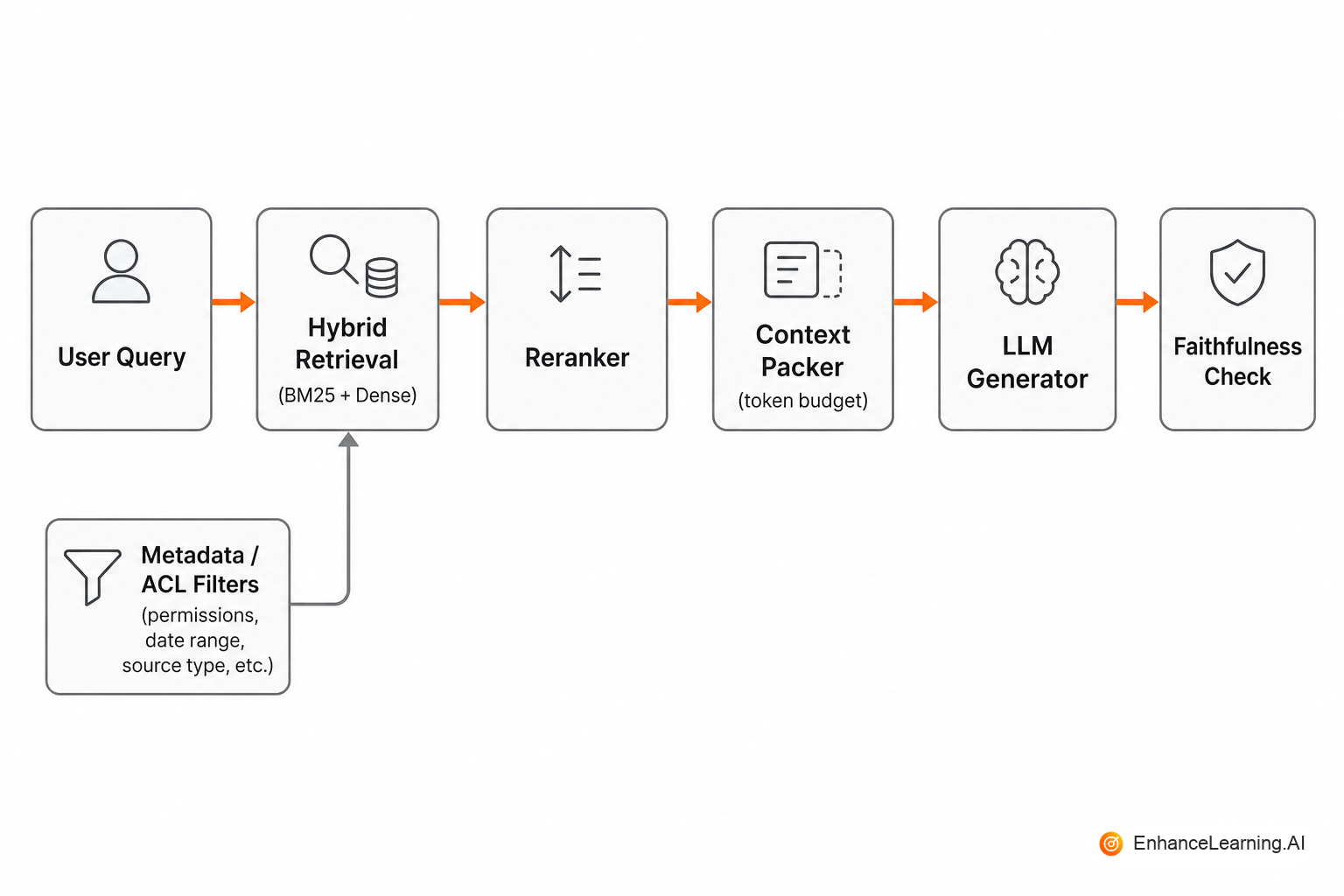
Cosine similarity on embeddings answers a different question than “does this passage contain the facts I need?” Lexical cues matter — error codes, SKU names, statute numbers — and pure dense retrieval drops them. Hybrid search (BM25 + dense) is not a sophistication flex; it is how you stop missing exact identifiers.
Even hybrid top-k is incomplete without a second stage. A cross-encoder reranker over the top 20–50 candidates regularly fixes cases where the right paragraph sat at rank 12. Skipping rerank because “embeddings are good enough” is how you ship answers grounded in the wrong neighbor.
Context packing without a budget#
Stuffing eight chunks into the prompt because “more context helps” often hurts. Models overweight early or late tokens depending on the family; contradictory chunks create hedged nonsense; long contexts raise cost and latency for little gain. Treat the window like memory pressure: score chunks, enforce a token budget, and drop low-value passages deliberately.
Generation that ignores evidence#
The model will fill gaps. If your prompt says “answer helpfully” and never says “cite only the provided passages; say you don’t know when they don’t support an answer,” you will get fluent invention. Groundedness is a prompt contract and an evaluation target, not a vibe.
Evaluation that never leaves the happy path#
Teams celebrate that “answers sound good.” They do not measure retrieval recall@k on a labeled set, answer faithfulness against retrieved text, or refusal quality when nothing relevant is found. Without those, every prompt change is a coin flip, and regressions ship unnoticed.
A RAG system that returns a wrong answer with a confident tone is worse than a 404. Users act on it. Instrument refusals and low-confidence paths as first-class outcomes, not error conditions you paper over with warmer wording.
A failure map you can use in design reviews#
| Failure mode | What you see in prod | First fix to try |
|---|---|---|
| Bad chunks | Answers miss steps or mix sections | Structure-aware chunking; keep atomic units intact |
| Weak retrieval | Right doc exists, never surfaces | Hybrid search + metadata filters |
| No rerank | Almost-right neighbors win | Cross-encoder over top-n candidates |
| Overstuffed context | Hedging, contradiction, high cost | Token budget + relevance cutoff |
| Ungrounded generation | Fluent lies | Strict grounding prompt + citation requirement |
| No eval harness | “It worked last week” | Golden Q&A set + faithfulness scoring |
A minimal retrieval path that fails less often#
The sketch below is deliberately small. It makes the control points explicit: hybrid candidates, rerank, budgeted packing, then generation with a hard grounding rule.
from dataclasses import dataclass

@dataclass
class Chunk:
    id: str
    text: str
    score: float

def answer(query: str, corpus, embedder, sparse, reranker, llm, token_budget: int = 1800):
    dense_hits = corpus.search_dense(embedder.encode(query), k=40)
    sparse_hits = sparse.search(query, k=40)
    merged = fuse_rrf(dense_hits, sparse_hits)  # reciprocal rank fusion
    ranked = reranker.rerank(query, merged)[:12]

    packed, used = [], 0
    for chunk in ranked:
        cost = estimate_tokens(chunk.text)
        if used + cost > token_budget:
            break
        packed.append(chunk)
        used += cost

    if not packed or ranked[0].score < 0.15:
        return {"answer": None, "reason": "insufficient_evidence"}

    prompt = (
        "Answer using ONLY the passages below. "
        "If they do not support an answer, say you cannot tell.\n\n"
        + format_passages(packed)
        + f"\n\nQuestion: {query}"
    )
    return {"answer": llm.complete(prompt), "citations": [c.id for c in packed]}
Notice what is not here: a magical “agent that decides how to retrieve.” Start with a deterministic pipeline you can evaluate. Add routing later if measurements say you need it.
Metadata and access control are not optional extras#
Enterprise corpora are not flat bags of text. Documents have owners, regions, product lines, and retention rules. If retrieval ignores metadata filters, you will surface a deprecated policy or a document the caller is not allowed to see. That is both a quality bug and a security incident waiting for a ticket.
Index pipelines should carry ACLs (or equivalent attributes) next to embeddings. Query time should intersect retrieval with the caller’s entitlements before generation. Reranking a forbidden chunk into the prompt and hoping the model “doesn’t use it” is not a control.
Freshness is the sibling problem. When the source changes and the index lags, RAG becomes an authoritative-sounding cache of the past. Track document versions, delete tombstones, and measure index lag the same way you measure queue lag on any other data product.
What to do before you add another library#
- Build a golden set of 50–100 questions with expected source passages, not just expected answers.
- Read top-k for twenty failures before changing models. Chunk and retrieval bugs dominate.
- Add hybrid + rerank before you fine-tune embeddings, unless you already measured a clear embedding gap.
- Score faithfulness on every meaningful prompt or index change.
- Define refusal behavior and test it — empty evidence should not become creative writing.
- Enforce metadata filters on every query path that can touch restricted content.
A useful diagnostic ritual: take ten production complaints, reconstruct the retrieved set, and classify each miss as chunking, recall, ranking, packing, or generation. You will usually find one or two buckets own most of the pain. Fix those buckets before you renegotiate your model contract.
Summary#
Most RAG systems fail because retrieval is treated as a solved embedding call and generation is left unsupervised. Chunking, hybrid search, reranking, context budgets, grounding contracts, access-aware indexing, and evaluation are the actual product. Fix those in order, with evidence from a labeled set, and the “our RAG is unreliable” conversation usually turns into a short list of measurable defects instead of a vague sense that “the model isn’t good enough.”
Want premium architecture blueprints?
Be among the first to explore interactive reference architectures, implementation playbooks, and premium engineering resources at launch.
Related Articles
Recommended reading based on this topic.
Why Vector Similarity isn't the Same as Relevance in RAG
Cosine similarity measures embedding neighborhood, not user-meaningful relevance. Why RAG quality degrades silently when teams treat them as identical.
Read ArticleThe Anatomy of a Production-Ready RAG Pipeline
End-to-end RAG reference architecture: ingestion through chunking, indexing, retrieval, reranking, context assembly, generation, citation, and eval.
Read ArticleWhat Retrieval-Augmented Generation Solves in AI-Native Systems
Why RAG exists: parametric model knowledge is stale and incomplete. Where retrieval sits in the AI-native stack and what problems it actually fixes.
Read Article