
What Retrieval-Augmented Generation Solves in AI-Native Systems
Why RAG exists: parametric model knowledge is stale and incomplete. Where retrieval sits in the AI-native stack and what problems it actually fixes.
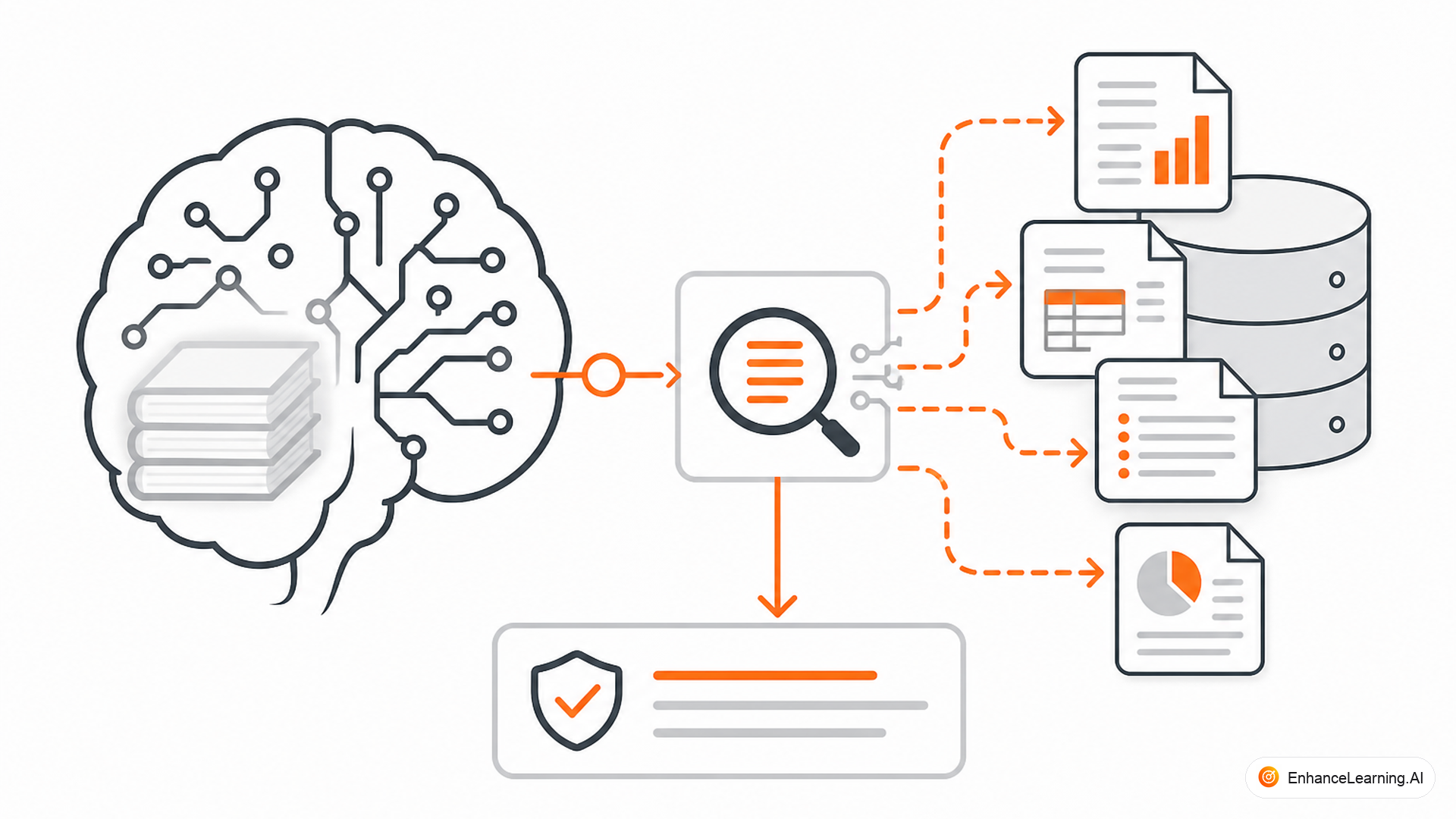
A foundation model knows a compressed snapshot of the public internet frozen at training time. It does not know your pricing page as of this morning, the clause in a customer contract signed last week, or the runbook your on-call team edited after last month's incident. You can fine-tune or prompt all day, but you cannot make parametric weights carry authoritative, versioned facts about your systems without paying for retraining, accepting staleness, or both. Retrieval-augmented generation exists because the gap between "the model can talk convincingly" and "the system must answer from current evidence" is an architecture problem, not a prompt problem.
The parametric knowledge ceiling#
Everything a base or instruction-tuned model "knows" lives in weights. That knowledge is broad, fuzzy, and undated. It merges conflicting sources. It forgets rare facts. It hallucinates plausible details when the true answer was never in the training mix or was drowned out by more common patterns.
For open-domain trivia, that trade-off is tolerable. For AI-native products — support bots tied to product docs, internal copilots over wikis and tickets, compliance assistants over policy corpora — it is not. Users do not experience "the model's best guess." They experience "your product lied about our refund policy."
RAG does not replace the model. It changes what the model is allowed to treat as fact for this request: passages retrieved from systems you control, at query time, with identifiers you can audit.
If you cannot name the document version that supported an answer, you are not grounded — you are hoping the model remembered correctly. RAG makes the evidence path explicit before generation starts.
Where retrieval sits in the AI-native stack#
Think of an AI-native request path in layers. At the bottom: identity, authorization, rate limits — the same platform concerns as any service. Above that: orchestration — which workflow runs, which tools are allowed, token budgets. The model sits in the middle as a reasoning and language engine. Retrieval is the bridge between durable organizational knowledge and that engine.
Without retrieval, the stack looks like chat over a general model. With retrieval, the stack becomes: query → retrieve from indexed corpora → assemble context → generate with constraints → cite sources. Memory systems, tool calling, and agents may sit alongside retrieval, but retrieval answers a specific question: "What text from our knowledge base is relevant right now?"
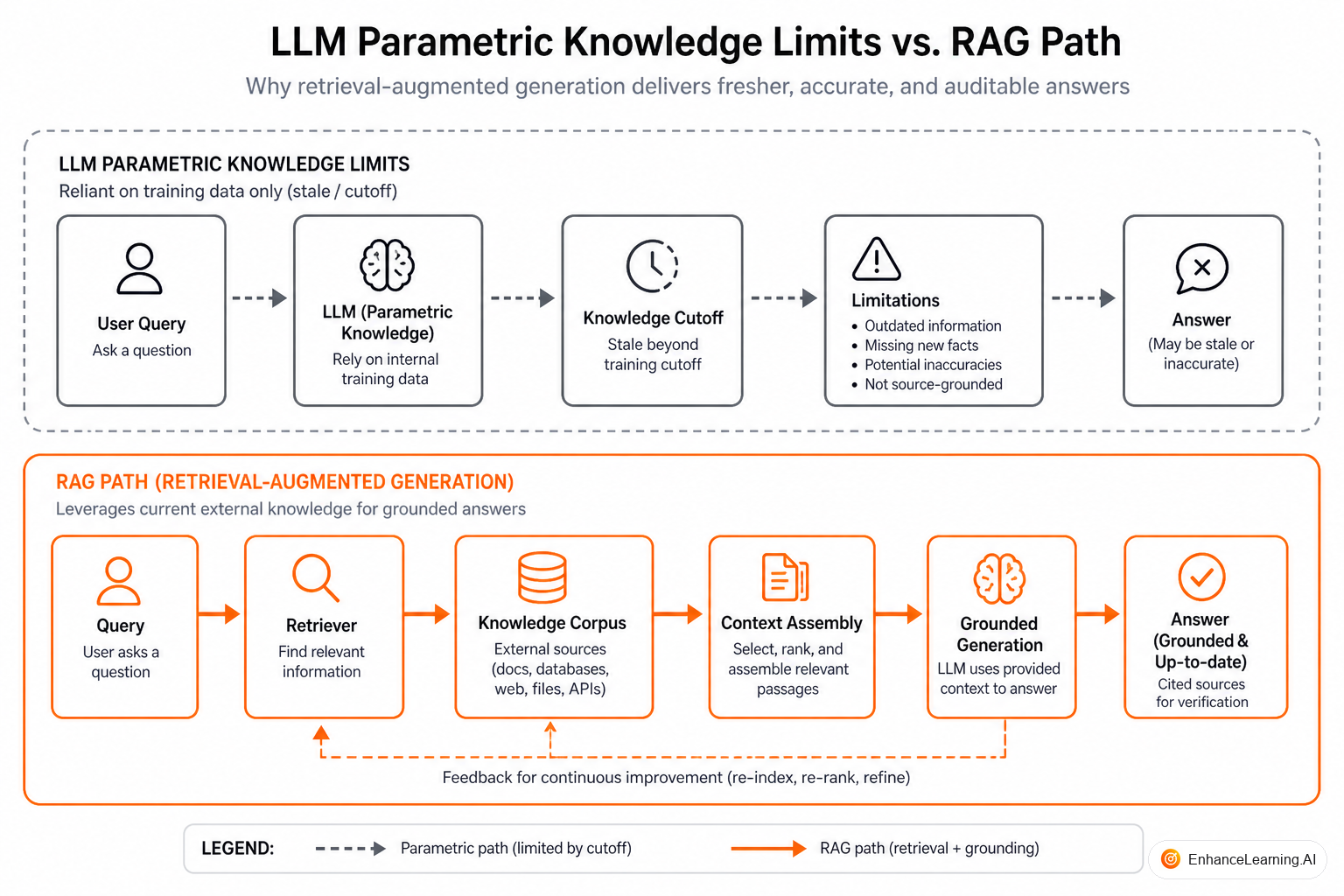
That placement matters for ownership. Search infrastructure, document pipelines, and embedding indexes are data-engineering products. Prompt templates and model routing are ML platform concerns. Treating retrieval as "something the frontend team bolted on" splits accountability and guarantees stale indexes nobody monitors.
Problems RAG solves that prompting alone does not#
Staleness and change frequency#
Product docs, APIs, and policies change faster than you retrain models. Retrieval decouples knowledge freshness from model release cycles. Update the index when the source changes; the next query sees the new text. The model version can stay pinned for months.
Private and proprietary knowledge#
Your codebase, customer data summaries, and internal runbooks were never in public pretraining (or should not have been). RAG is how you bring proprietary text into the context window without exposing it to training pipelines you do not control.
Traceability and audit#
Regulated industries and enterprise buyers ask: "Why did the system say that?" Parametric answers have no citation. RAG pipelines can attach chunk IDs, document versions, and retrieval scores to each response. That is not perfect provenance, but it is inspectable — which parametric generation is not.
Cost and context discipline#
Stuffing entire manuals into fine-tuning is expensive and slow to update. Retrieval loads only what the query needs, within a token budget. You pay for relevant bytes, not for memorizing the whole corpus in weights.
What RAG does not solve#
Being honest about scope prevents the "we added a vector DB so we're done" trap.
| Problem | RAG helps? | What actually helps |
|---|---|---|
| Model cannot follow format | Partially | Structured output, validators, retries |
| Wrong chunk retrieved | No | Chunking, hybrid search, reranking |
| User asks out-of-scope question | Partially | Refusal prompts, confidence thresholds |
| Model ignores retrieved text | No | Grounding contracts, faithfulness evals |
| Toxic or biased base behavior | No | Safety layers, policy filters, human review |
RAG supplies evidence. It does not guarantee the model uses it correctly, that retrieval picked the right evidence, or that the evidence was chunked sensibly. Those are downstream engineering problems — but they are easier to measure once retrieval exists.
A minimal stack map#
The diagram above is conceptual. In code, the boundary between "retrieval service" and "generation service" should be a typed contract:
from dataclasses import dataclass
from typing import Sequence

@dataclass(frozen=True)
class RetrievedPassage:
    chunk_id: str
    document_id: str
    document_version: str
    text: str
    score: float

@dataclass(frozen=True)
class RetrievalResult:
    query: str
    passages: Sequence[RetrievedPassage]
    index_snapshot_id: str  # which index build answered this query

def build_grounded_prompt(query: str, retrieval: RetrievalResult) -> str:
    if not retrieval.passages:
        return (
            f"No relevant documents were found for: {query}\n"
            "Respond that you cannot answer from available sources."
        )
    blocks = []
    for p in retrieval.passages:
        blocks.append(
            f"[{p.chunk_id} v{p.document_version} score={p.score:.3f}]\n{p.text}"
        )
    evidence = "\n\n---\n\n".join(blocks)
    return (
        "Use ONLY the passages below. Cite chunk IDs. "
        "If evidence is insufficient, say so.\n\n"
        f"{evidence}\n\nQuestion: {query}"
    )
Notice index_snapshot_id. When someone disputes an answer six weeks later, you need to know which index generation ran — not just which model version.
RAG vs adjacent patterns#
Teams confuse RAG with fine-tuning, with long-context "just paste the doc," and with agent memory. Quick distinctions:
- Fine-tuning shifts model behavior and style; it is a poor primary store for facts that change weekly.
- Long context works for small, static bundles; it does not scale to enterprise corpora or per-user ACLs.
- Memory persists user-specific state across sessions; retrieval pulls organizational knowledge per query. Both may feed the same context window, but the lifecycle and privacy model differ.
In a mature AI-native architecture, retrieval is often the first external knowledge integration because it is read-only, auditable, and incrementally improvable without retraining.
Design choices that follow from the problem#
Once you accept that parametric knowledge is insufficient, several decisions become obvious:
- Treat the index as a product. SLAs, lag metrics, reindex on source change, tombstones for deleted docs.
- Separate retrieval from generation in your service graph. Different teams, different deploy cadences, shared contract.
- Version everything. Document version, chunk schema, embedding model, index build ID — tied to logs for each answer.
- Plan for empty retrieval. "No evidence" is a valid outcome; do not let the model freestyle.
- Filter before you embed. ACLs and metadata belong in the query path, not as an afterthought.
These are architectural commitments. They are not toggles you flip after the chat UI ships.
How this connects to the rest of your system#
Retrieval feeds context engineering: what enters the window, in what order, under what budget. It feeds evaluation: you can score whether answers are supported by retrieved passages. It feeds observability: retrieval recall and citation coverage become product metrics, not ML research curiosities.
Agents that "decide whether to search" still depend on a retrieval subsystem underneath. The agent adds routing; it does not replace indexed corpora. If your agent loop has no retrieval service behind it, you have tool calls to APIs — which is valid — but that is not the same as RAG over a document corpus.
Summary#
Retrieval-augmented generation exists because language models alone cannot carry authoritative, current, proprietary knowledge at the fidelity production systems require. RAG places a query-time evidence layer between your indexed knowledge and the generator, making freshness, privacy, and traceability engineering problems you can own. It does not fix bad chunking, weak ranking, or ungrounded generation — but it gives you the architectural hook to fix them with measurement instead of hope. In an AI-native stack, retrieval belongs next to orchestration and inference as a first-class path, not as a demo notebook you promote to production unchanged.
Want premium architecture blueprints?
Be among the first to explore interactive reference architectures, implementation playbooks, and premium engineering resources at launch.
Related Articles
Recommended reading based on this topic.
Why most RAG Systems Fail in Production
Where production RAG breaks: chunking mistakes, retrieval that looks fine in demos, missing reranking, and evaluation that never measures answer faithfulness.
Read ArticleThe Hidden Coupling Between Prompts and AI System Architecture
Prompt length, role structure, and tool definitions leak into service boundaries, data flows, and API contracts — coupling teams thought was decoupled.
Read ArticleWhy More Context Doesn't Improve LLM Output Quality
Stuffing the context window with more text often hurts LLM output — irrelevant tokens add noise, latency, and cost. Curation beats volume in production.
Read Article