
Task complexity
1
Single-shot or one tool hop
Classify, extract fields, rewrite tone
2
Multi-step but mostly known
Policy-grounded reply, multi-field enrichment
3
Open-ended / discovery-heavy
Investigation, research, novel troubleshooting
Match AI design patterns to task complexity, risk, latency budget, and operational maturity — so you stop defaulting to planners, critics, and ensembles.
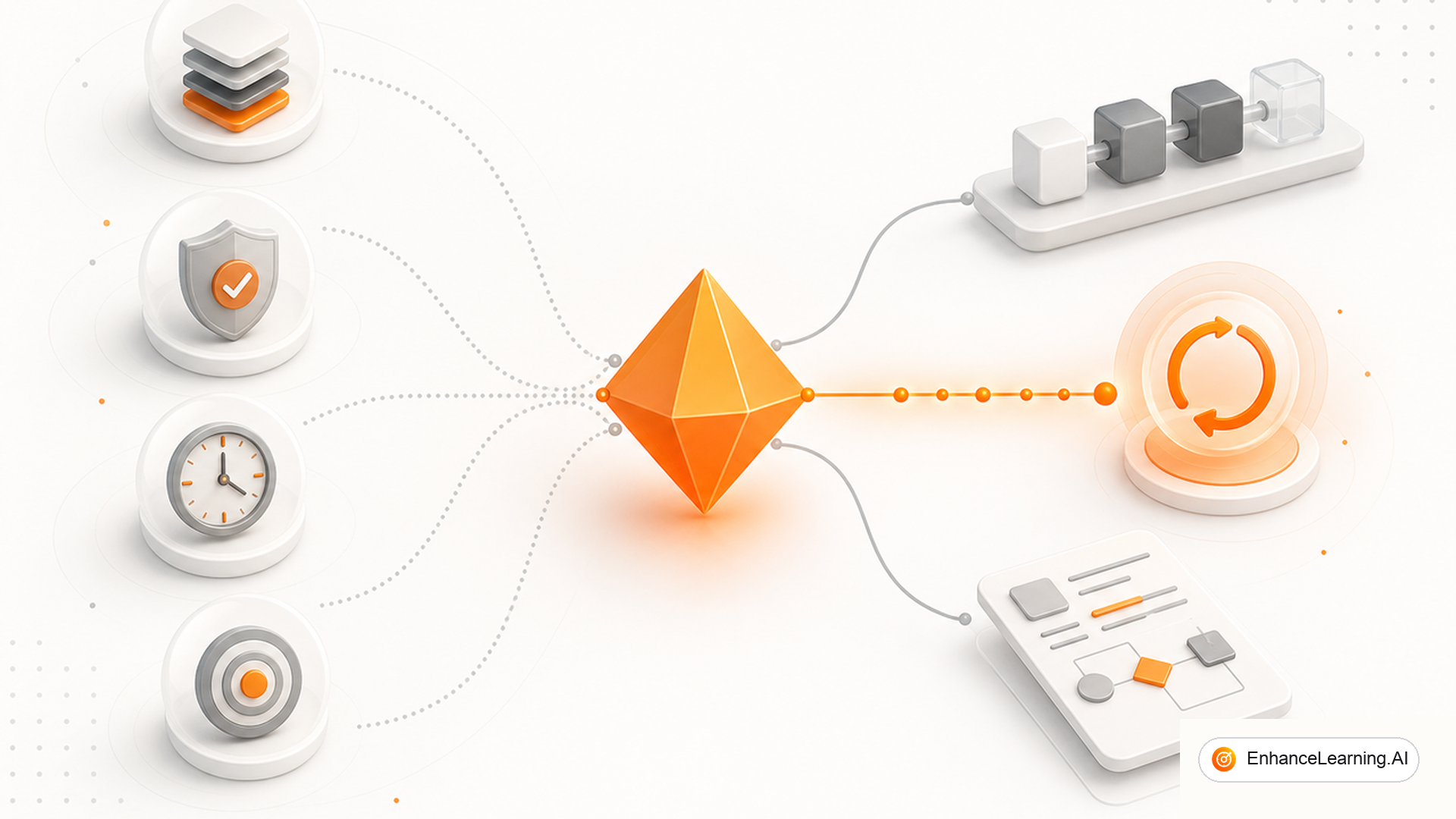
Not every task needs a planner, a critic, and an ensemble. Pattern fashion is how teams burn latency and money on structure they cannot operate. A decision framework forces the boring questions first: how complex is the job, how bad is a wrong action, how tight is the latency budget, and how mature is the team’s harness and eval practice? Answer those, then pick a pattern — not the other way around.
Demo culture rewards visible machinery. A Planner–Executor with Reflection and three specialist agents looks serious in a review. On a form-fill extraction job, it is theatre. Over-patterning creates failure modes you did not have: plan thrash, critic disagreement, handoff loss, and dashboards that cannot attribute cost to a stage.
Under-patterning is the opposite failure: a model with just tools and hope. The framework below exists to land between those poles.
Score each AI feature on four axes before you name a pattern. Use a simple 1–3 scale so debates stay short.
Score 1–3 on each axis
4 axes
Single-shot or one tool hop
Classify, extract fields, rewrite tone
Multi-step but mostly known
Policy-grounded reply, multi-field enrichment
Open-ended / discovery-heavy
Investigation, research, novel troubleshooting
Low blast radius
Draft suggestions, internal summaries
Reversible mistakes or customer-visible text
Support replies without money movement
Irreversible or regulated
Payments, access changes, medical / legal advice
Tight interactive (<3s feel; few model calls)
Conversational (several seconds OK)
Batch / async (minutes OK)
Early: weak evals, ad-hoc prompts, limited tracing
Intermediate: golden sets, basic budgets, allowlists
Mature: trajectory evals, versioned patterns, on-call runbooks
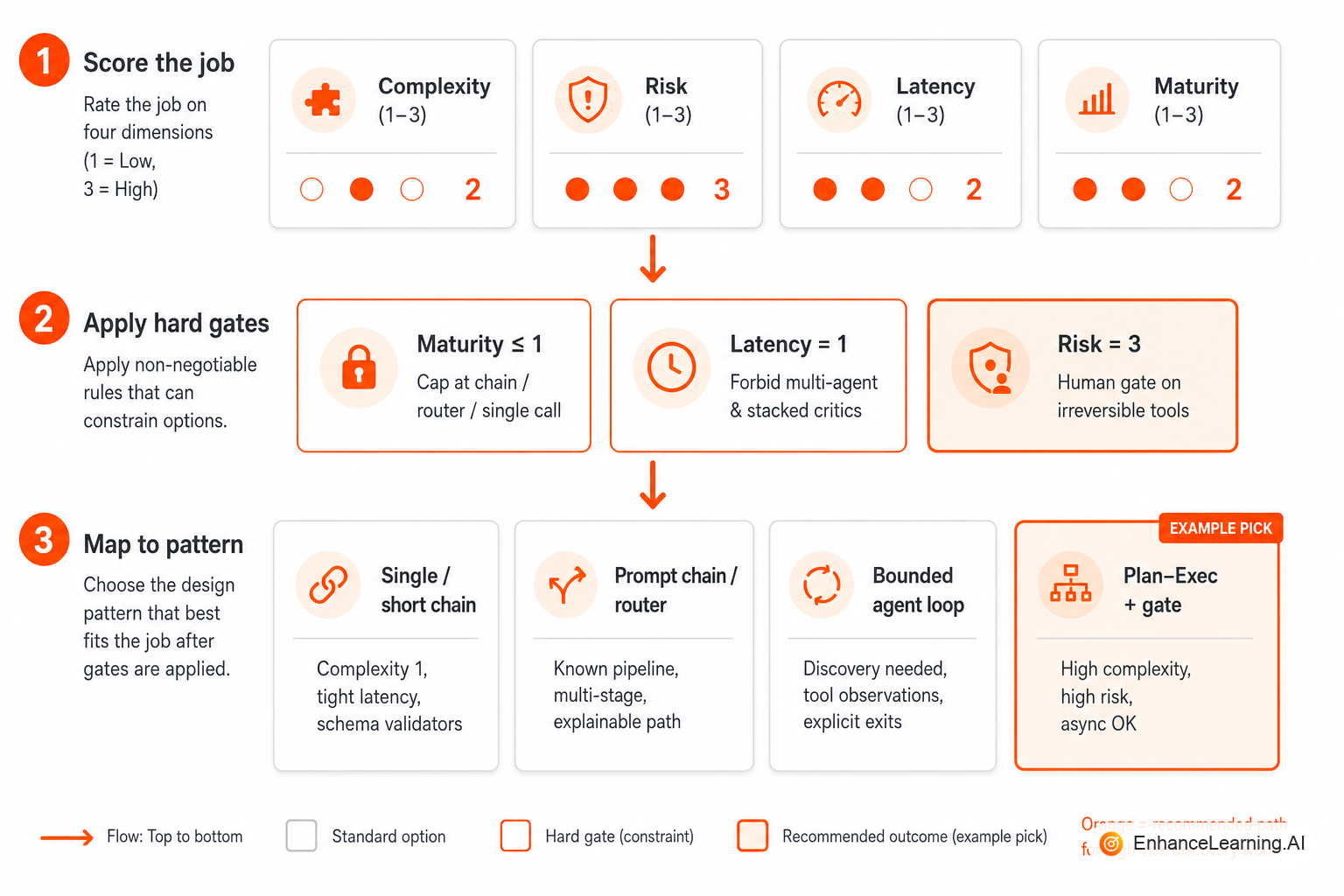
These are defaults, not laws. Override with a written reason.
| Situation | Prefer | Avoid |
|---|---|---|
| Complexity 1, any risk | Single call or thin prompt chain + validators | Agent loops, multi-agent |
| Complexity 2, risk ≤2, latency ≤2 | Prompt chain or Router → specialists | Full Planner–Executor |
| Complexity 2–3, discovery needed | Bounded agent loop (ReAct-style) | Unbounded “just explore” |
| Complexity 3, risk 3, latency 3 | Planner–Executor + human gate on writes | Auto-commit tools |
| High-stakes draft quality (risk 3, latency ≥2) | Chain or plan, then Reflection/critic pass | Critic-only systems with no base pattern |
| Maturity 1 | Chains, routers, hard allowlists | Multi-agent, deep ensembles |
| Maturity 3, clear specialization | Multi-agent only with shared contracts | Agents for prestige |
If operational maturity is 1, do not pick a maturity-3 pattern because the task is hard. Simplify the task boundary, add humans, or invest in harness and evals first. Pattern ambition cannot substitute for operational guts.
Scored walkthroughs
4 cases
Recommendation
Single model call with structured output + schema validator. Optional tiny chain: OCR/normalize → extract → validate.
Why
Low complexity and tight latency kill loops and planners. Risk is handled by validation and a human exception queue for low-confidence fields — not by a critic committee.
Recommendation
Prompt chain — classify → retrieve → draft → policy check. Router if channels or product lines differ.
Why
The path is known. A loop would rediscover the same three steps at higher variance. Add Reflection only if faithfulness failures dominate your evals.
Recommendation
Planner–Executor with human approval before any account freeze or payout tool. Bounded repairs only. Trajectory evals required.
Why
Discovery is real; actions are irreversible; async is acceptable. A plain chain cannot enumerate every investigative branch. A ReAct loop without a reviewable plan is hard to defend in risk review.
Recommendation
Do not pick one pattern for the product. Split job classes. Router in front; each class gets its own pattern and budgets.
Why
One mega-agent is how cost and failure modes become unattributable. The framework applies per job class, not per brand name on the box.
Decision procedure
7 steps
Score complexity, risk, latency, maturity (1–3 each).
If maturity = 1 → cap pattern ambition at chain / router / single call.
If complexity = 1 → single call or short chain; stop.
If discovery is required → bounded loop or planner; else prefer chain.
If risk = 3 → require human gate on irreversible tools; add Reflection for drafts.
If latency = 1 → forbid multi-agent and stacked critics.
Write the pattern card (name, decider, stops, forbidden tools) before coding.
def recommend(complexity: int, risk: int, latency: int, maturity: int) -> str:
    if maturity <= 1:
        return "chain_or_single" if complexity <= 2 else "human_led_with_model_assist"
    if complexity == 1:
        return "single_or_short_chain"
    if latency == 1 and complexity >= 3:
        return "defer_or_async_loop"  # do not fake deep work in <3s
    if complexity >= 3 and risk >= 3:
        return "planner_executor_with_human_gate"
    if complexity >= 3:
        return "bounded_agent_loop"
    if risk >= 3:
        return "chain_plus_reflection_and_gate"
    return "prompt_chain_or_router"
Keep the function boring. The value is forcing the four scores into the design doc where product and risk can argue with them.
Vendor logos, model leaderboard rank, and “agentic” marketing do not appear as axes. Those belong in model selection and procurement — adjacent problems. A weak pattern with a strong model still fails operations. A strong pattern with a mid-tier model often ships.
Choose AI design patterns with a four-axis score: complexity, risk, latency, and maturity. Default to the simplest pattern that clears the score. Escalate to loops, planners, critics, and multi-agent only when the axes demand it — and only when the team can operate what they drew. The framework’s job is to make “we need a planner and a critic” a claim you have to earn, not a default costume for every LLM feature.
Be among the first to explore interactive reference architectures, implementation playbooks, and premium engineering resources at launch.
Recommended reading based on this topic.
Which AI design patterns persist, simplify, or fade as LLMs improve—and how to design control shapes that survive capability jumps without endless rewrites.
Read ArticleAI design patterns cost more than tokens—latency, maintenance, observability, and cognitive load. Price the full pattern tax before you add another planner.
Read ArticleMulti-agent AI overlaps with distributed systems but is not the same. Import idempotency and tracing; do not treat LLM handoffs like RPC.
Read Article