
Why Every AI Pattern Has Hidden Costs Beyond Compute
AI design patterns cost more than tokens—latency, maintenance, observability, and cognitive load. Price the full pattern tax before you add another planner.
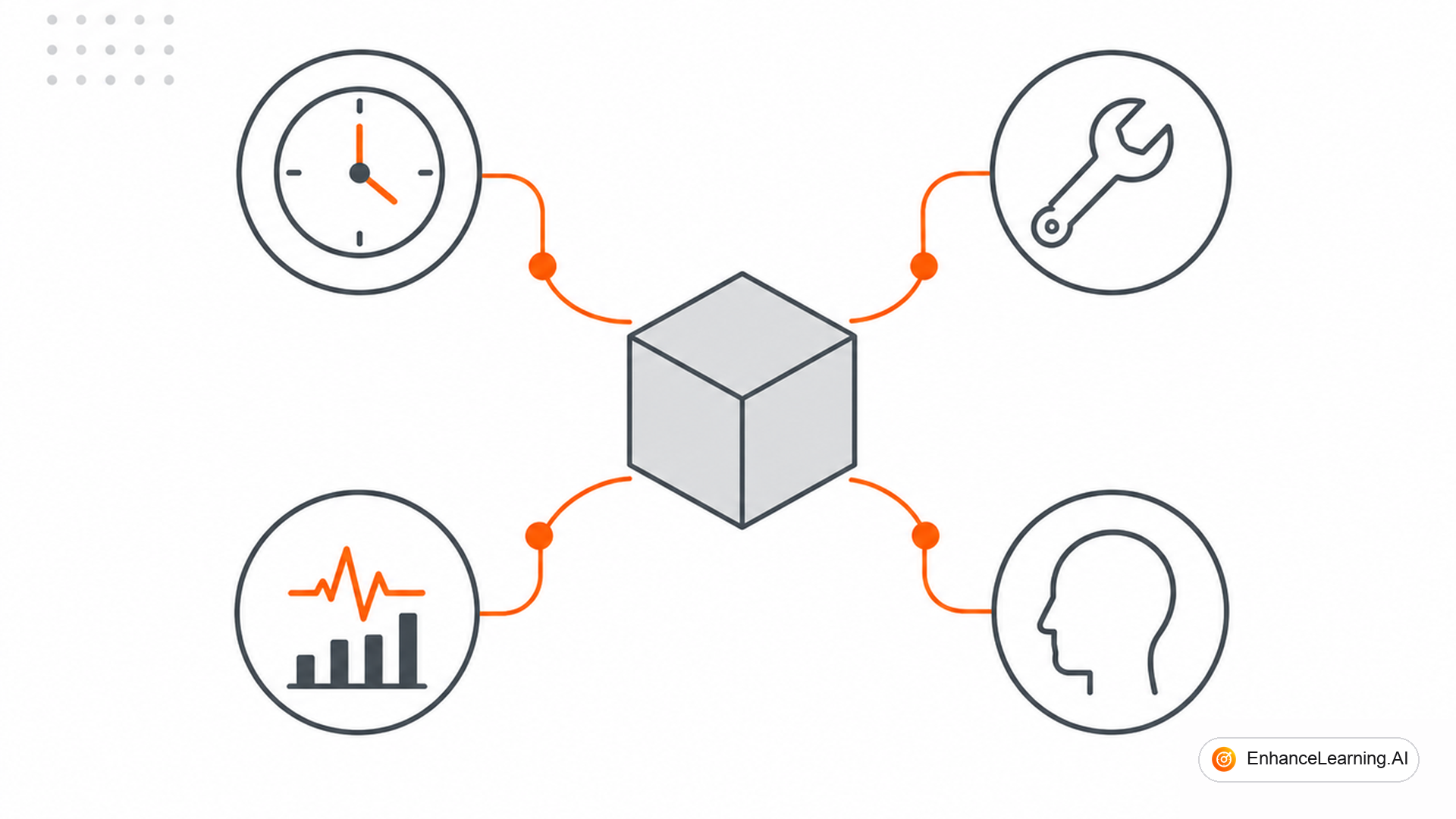
Token invoices get the drama. The quieter bill for AI design patterns shows up as extra round trips, brittle graphs nobody wants to own, dashboards that cannot attribute a failure, and engineers who need a week to reason about a change that used to take an afternoon. If you only compare patterns on model spend, you will keep shipping structure you cannot operate.
Compute is the easy line item#
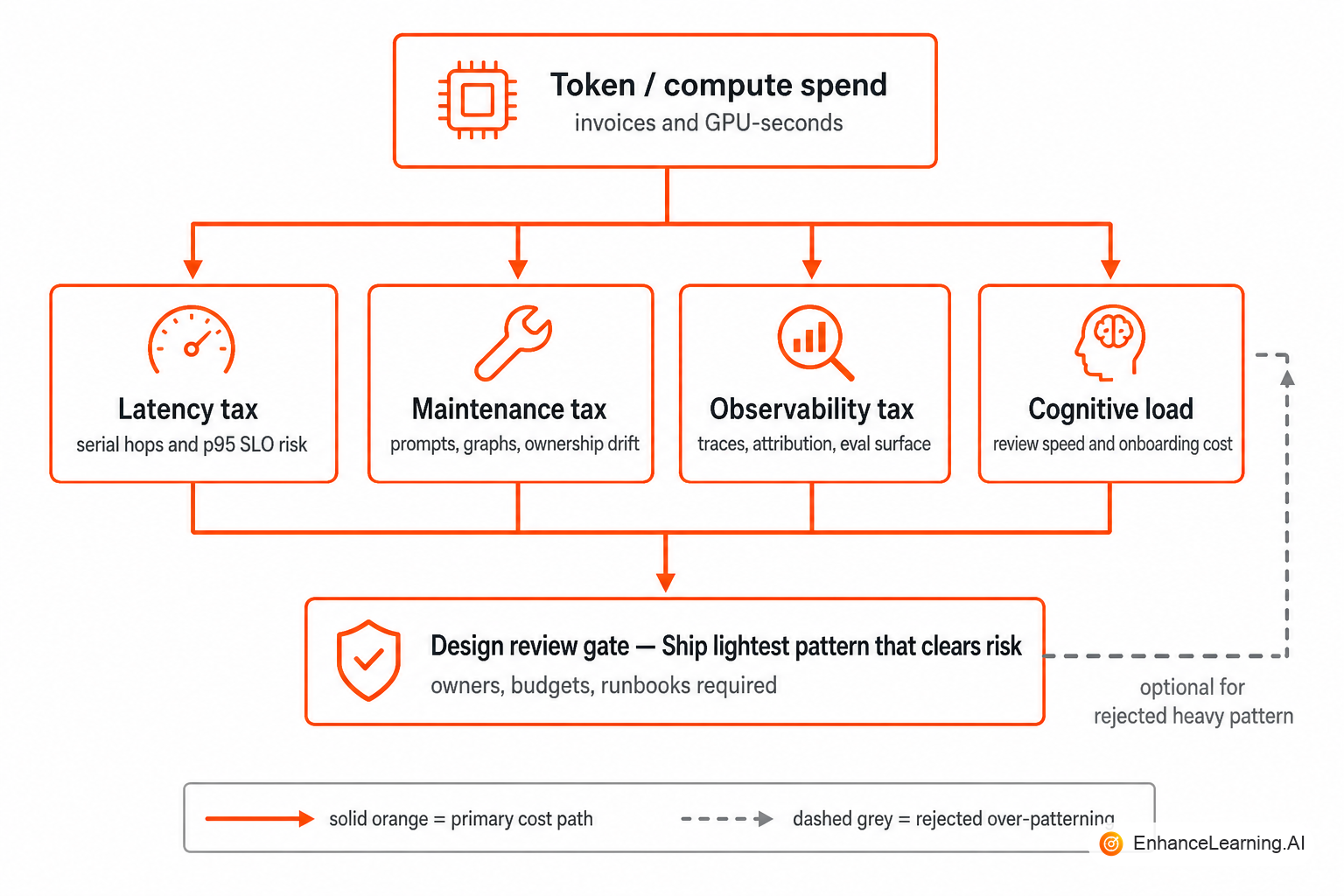
Tokens and GPU-seconds are measurable. Finance already has a place for them. Pattern cost is different: it is mostly system cost — time in the critical path, people cost to keep the control shape honest, and operational cost to see what the shape actually did.
A Router that fires one cheap classification call is cheap on paper. A Planner–Executor with Reflection and three tool hops can be 10–40× the tokens of a single draft. Both still fit on a spreadsheet. What does not: the on-call engineer who cannot tell whether the planner thrash or the critic disagreement caused last Tuesday’s timeout.
Treat every named pattern as a product with a bill of materials: latency budget, owners, eval surface, and runbook entries. If you cannot fill those four, you are not ready to adopt the pattern.
The four costs that sit next to compute#
1. Latency tax#
Patterns stack serial work. Prompt chaining adds stages. ReAct loops add observe → decide → act rounds. Planner–Executor adds plan time before any useful tool call. Reflection adds a second model pass that may reject good work.
Each hop pays network overhead, tool cold starts, and queueing. A pattern that looks elegant in a whiteboard demo often blows a p95 latency SLO once real tools and retries enter the path.
| Pattern shape | Typical latency tax | What you buy |
|---|---|---|
| Single-shot / light Router | Low | Fast path, weak adaptability |
| Fixed prompt chain | Medium | Predictable stages, harder mid-run repair |
| Bounded ReAct / agent loop | Medium–high | Adaptivity, variable hop count |
| Planner–Executor + Reflection | High | Structure and critique, more failure modes |
Rule of thumb: if your product budget is under ~2s interactive, prefer Router or a short fixed chain. Save deep loops for async jobs or human-gated workflows.
2. Maintenance tax#
Patterns are living contracts. Prompts, schemas, stop conditions, and graph edges drift. A Reflection critic that worked on last quarter’s rubric silently vetoes good answers after the product policy changes. A Planner that emits five-step plans for three-step jobs burns budget forever until someone rewrites the planner prompt.
Ownership matters. If “the agent graph” has no named owner, the maintenance tax compounds as tribal knowledge. Pattern literacy without ownership is just vocabulary.
3. Observability tax#
Every decision point you add is a place you must instrument. For a chain: stage latency, stage success, schema validation failures. For a loop: step count, tool allowlist denials, budget stops, retry reasons. For multi-agent: handoff payloads and which worker produced the bad claim.
Without that, you cannot attribute cost or failures. Teams then “fix” patterns by rewriting prompts in production — the most expensive debugging mode available.
4. Cognitive load tax#
This one rarely shows up in architecture reviews. A senior engineer reading a unfamiliar Planner–Executor + Critic + Ensemble stack pays a tax on every incident. Reviews get slower. Onboarding stretches. People start inventing private shortcuts around the official graph.
Cognitive load is why pattern catalogues exist: a small set of named shapes beats a zoo of bespoke “smart agents.”
A worked example: “just add a critic”#
Support drafting: a single model call drafts a reply; a human sends it. Latency ~800ms. Eval set of 200 golden tickets. Cheap.
Someone adds Reflection “for quality.” Now every reply pays a second model call. p95 jumps past 2.5s. The critic rejects ~12% of drafts — some correctly, some because the rubric still mentions an obsolete refund policy. On-call gets a new failure class: “critic loop.” Product asks why ticket handle time went up.
Tokens rose maybe 1.8×. The real costs were latency SLO miss, a new eval suite for the critic, and two engineers arguing about rubric ownership. That is pattern tax.
from dataclasses import dataclass

@dataclass
class PatternCost:
    """Rough scorecard before adopting a control shape."""
    name: str
    extra_model_calls: int
    expected_p95_ms: int
    owners: list[str]
    eval_surfaces: list[str]  # what must be golden-tested
    runbook_entries: list[str]

def ready_to_ship(c: PatternCost, latency_budget_ms: int) -> bool:
    if not c.owners:
        return False
    if c.expected_p95_ms > latency_budget_ms:
        return False
    if len(c.eval_surfaces) < 1:
        return False
    return len(c.runbook_entries) >= 1

critic = PatternCost(
    name="draft + reflection",
    extra_model_calls=1,
    expected_p95_ms=2600,
    owners=["support-ai"],
    eval_surfaces=["draft_quality", "critic_false_reject"],
    runbook_entries=["critic-timeout", "critic-false-reject"],
)

assert ready_to_ship(critic, latency_budget_ms=2000) is False
How to budget pattern cost in design review#
Ask these before you approve a pattern change:
- Latency: What is the new hop count on the happy path and the worst allowed path?
- Ownership: Who updates prompts, schemas, and stop conditions when policy changes?
- Evals: Which new failure modes need golden cases (false reject, plan thrash, tool denial)?
- Attribution: Can traces show which stage spent tokens and time?
- Cognitive load: Can a new engineer draw the boxes in five minutes from the runbook?
If any answer is vague, shrink the pattern. Router beats Planner. Fixed chain beats open loop. One critic with a crisp rubric beats an ensemble of vague judges.
Shared agent platforms still pay latency and cognitive load per feature that enables deep loops. Platform ownership does not erase product-level pattern cost — it only moves the invoice.
When a heavier pattern is still worth it#
Hidden costs are not arguments for never using Planner–Executor or Reflection. They are arguments for paying deliberately.
Pay the tax when:
- Risk is high and a wrong action is expensive (payments, access, regulated advice)
- Task complexity is genuinely open-ended and a fixed chain keeps failing evals
- Work runs async, so latency tax is tolerable
- You already have harness maturity: budgets, allowlists, traces, golden sets
Refuse the tax when the job is classify / extract / rewrite and a Router or single-shot already clears evals.
Anti-patterns that inflate the bill#
- Trend-chasing patterns — copying last quarter’s conference talk graph onto a form-fill job
- Unowned critics — Reflection with no rubric owner and no false-reject eval
- Invisible hops — tools and model calls not broken out in traces
- Nested ensembles — agents calling agents calling critics with no budget
- Prompt-only ops — fixing production by editing system prompts without changing evals
Summary#
AI design patterns are control products. Their price is more than tokens: serial latency, ongoing maintenance, observability surface, and the cognitive load of operating the shape. Score those four next to compute before you add a planner, a critic, or another loop. Ship the lightest pattern that clears risk and evals — and make someone own the tax you chose to pay.
Want premium architecture blueprints?
Be among the first to explore interactive reference architectures, implementation playbooks, and premium engineering resources at launch.
Related Articles
Recommended reading based on this topic.
How AI Design Patterns Evolve as LLM Capabilities Improve
Which AI design patterns persist, simplify, or fade as LLMs improve—and how to design control shapes that survive capability jumps without endless rewrites.
Read ArticleA Decision Framework for Choosing AI Design Patterns
Match AI design patterns to task complexity, risk, latency budget, and operational maturity — so you stop defaulting to planners, critics, and ensembles.
Read ArticleMulti-Agent AI Systems vs Classical Distributed Systems
Multi-agent AI overlaps with distributed systems but is not the same. Import idempotency and tracing; do not treat LLM handoffs like RPC.
Read Article