
Multi-Agent AI Systems vs Classical Distributed Systems
Multi-agent AI overlaps with distributed systems but is not the same. Import idempotency and tracing; do not treat LLM handoffs like RPC.
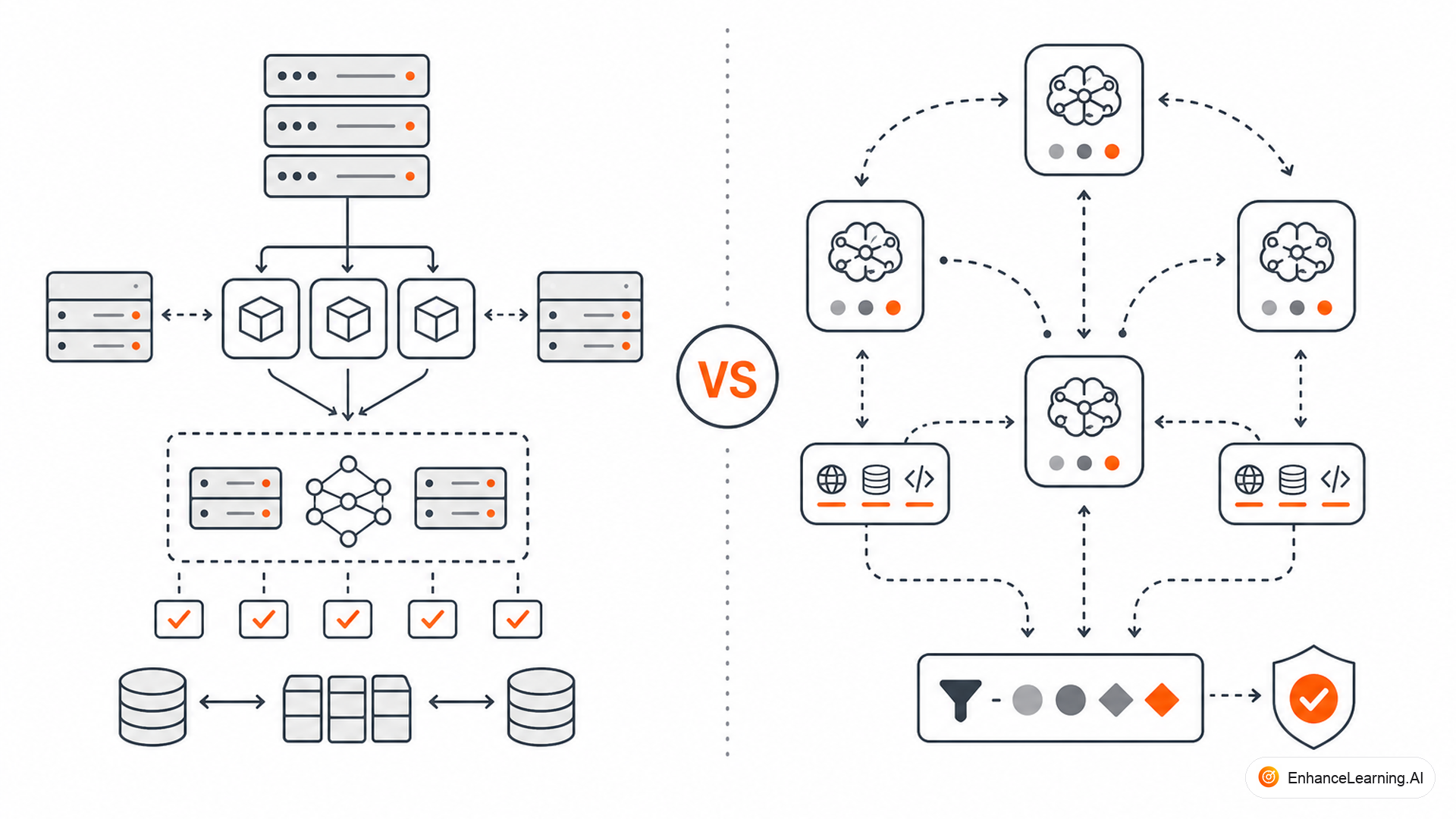
If you have shipped microservices, you already know half of multi-agent architecture — and the half you know will mislead you on the other half. Classical distributed systems assume deterministic components talking over typed protocols with replayable failure modes. Multi-agent AI systems add nondeterministic planners that negotiate in natural language, often with soft schemas and graded correctness. Import the operational discipline from distributed computing. Do not import the mental model wholesale.
What genuinely overlaps#
Several hard-won distributed lessons transfer without modification:
Single writer per aggregate. Two services — or two agents — must not concurrently mutate the same record without coordination. Use leases, queues, or orchestrator-assigned ownership.
Idempotency keys on side effects. Retries are guaranteed once you have timeouts, partial failures, and model stochasticity. Every external write carries a key the downstream API understands.
Timeouts and bulkheads. One slow or looping agent must not exhaust the pool. Cap steps per agent and per job.
Observability with correlation IDs. Propagate a trace ID across handoffs the way you would across HTTP headers. Without it, you cannot reconstruct why the billing agent fired twice.
Explicit contracts. Service boundaries need request/response shapes. Agent handoffs need schemas — JSON, protobuf, or rigid markdown tables — not vibes.
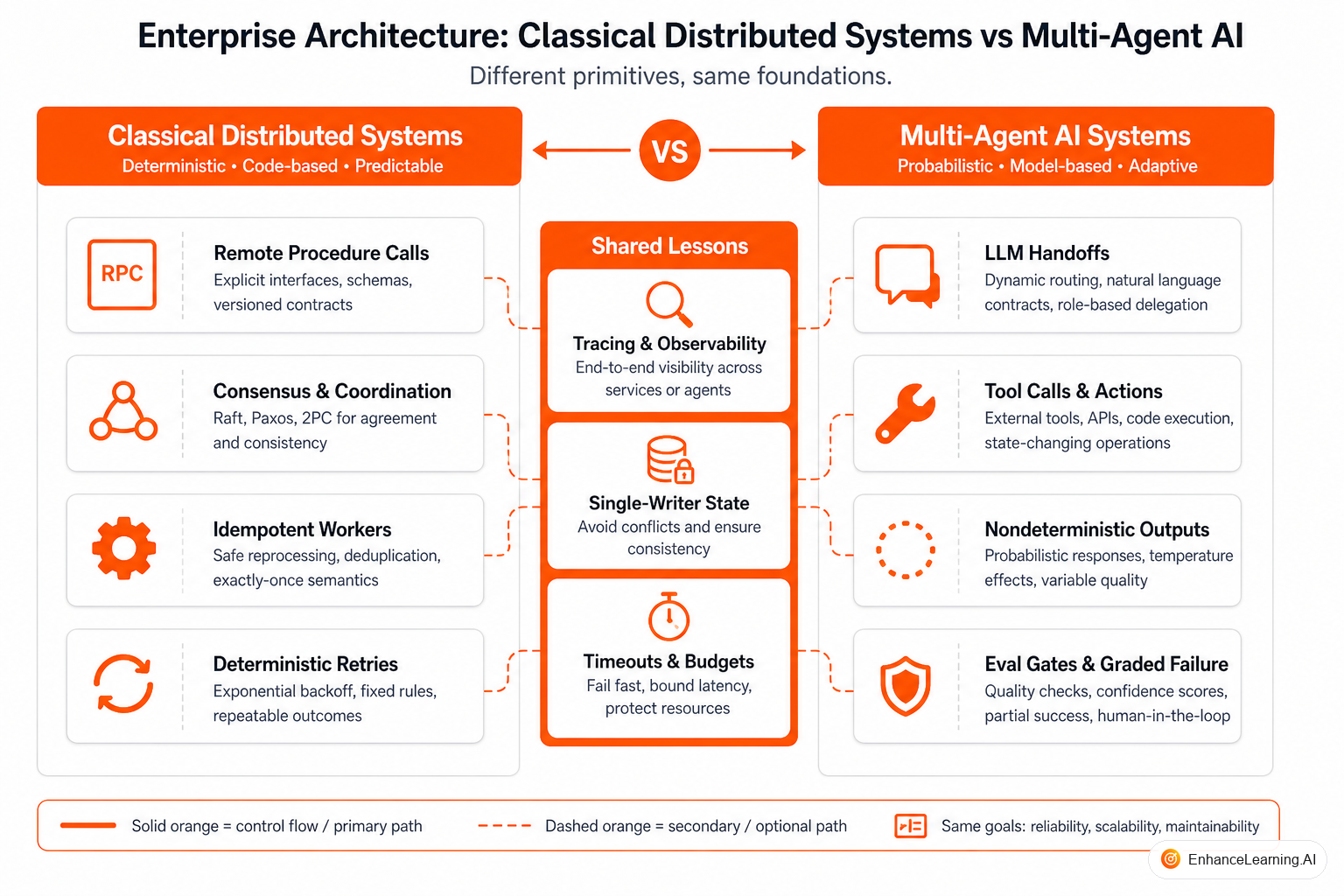
These are not "AI best practices." They are systems best practices that AI multiplies the cost of ignoring.
Where the analogy breaks#
Nondeterminism is a first-class concern. Two calls to the same microservice with the same input return the same output (modulo intentional randomness). Two calls to the same agent with the same prompt may not — temperature, provider drift, context truncation, tool ordering. Distributed systems optimize for availability under deterministic semantics. Multi-agent systems optimize for useful behavior under bounded nondeterminism. That shift breaks assumptions baked into classic integration tests.
Handoffs are not RPC. An RPC passes bytes; the callee parses; errors are typed. An LLM handoff passes interpreted prose or semi-structured text. The receiver re-parses meaning. Fields drop. Implicature leaks. Confidence is unstated. Treating agent-to-agent messages like internal REST calls — fire and forget — is how teams lose auditability.
Failure is graded, not binary. A microservice returns 503; you retry or circuit-break. An agent returns fluent wrongness with HTTP 200 in your wrapper. Partial success — two of three tool writes applied — looks like progress to the orchestrator if you only check string length.
State is volatile context, not just databases. Distributed systems persist in stores with defined consistency models. Agents also carry ephemeral context windows that are lossy, expensive, and poisonable. Your "distributed state" includes whatever survived summarization into the next prompt.
| Concern | Classical distributed | Multi-agent AI |
|---|---|---|
| Component behavior | Deterministic (mostly) | Stochastic, version-sensitive |
| Interface | Typed API / schema | Prompt + tool policy + soft schema |
| Correctness test | Assert equality | Eval + judge + thresholds |
| Retry semantics | Safe with idempotency | Changes output; may amplify loops |
| Debugging | Logs + traces | Traces + prompts + retrieved chunks |
| Scaling knob | Replicas, partitions | Agents, tools, context budget |
Lessons to import#
Design for failure paths first. Assume handoffs arrive incomplete. Validate against schema; reject; escalate to human or narrower agent — do not forward garbage because the orchestrator prompt says "be helpful."
Prefer orchestrator-worker over peer mesh for production paths that touch money or PII — same reason you prefer a BFF or saga coordinator over every service calling every service.
Use queues for async fan-out. If you would use SQS or Kafka between services, do not replace that with an in-memory agent chat loop. Let the queue be the contract; let agents be consumers with clear ack/nack.
Version everything. Service contracts get semver. Agent handoff schemas, tool manifests, and eval baselines should too. A "prompt tweak" is a deployment event.
async function invokeWorkerWithDistributedDiscipline(
  workerId: string,
  handoff: WorkerRequest,
  ctx: { traceId: string; idempotencyKey: string; deadlineMs: number }
): Promise<WorkerResponse> {
  const validated = WorkerRequestSchema.safeParse(handoff);
  if (!validated.success) {
    return { status: "rejected", errors: validated.error.flatten(), traceId: ctx.traceId };
  }

  const controller = new AbortController();
  const timer = setTimeout(() => controller.abort(), ctx.deadlineMs);

  try {
    const raw = await workerRuntime.run(validated.data, {
      signal: controller.signal,
      traceId: ctx.traceId,
    });
    const parsed = WorkerResponseSchema.safeParse(raw);
    if (!parsed.success) {
      // do NOT coerce bad LLM JSON into success — fail like a 502 you can retry
      return { status: "malformed_response", traceId: ctx.traceId };
    }
    return parsed.data;
  } finally {
    clearTimeout(timer);
  }
}
This is RPC-shaped discipline without pretending the worker's interior is deterministic.
Lessons to leave behind#
"Smart endpoints, dumb pipes" for agent prose. Dumb pipes work when payloads are typed. Natural-language payloads need validation gates at every hop — dumb pipes become sewer pipes.
Exactly-once illusion. You get at-most-once or at-least-once with idempotency. Agents that "remember" doing something because the prompt says they did are not transactional memory.
Symmetric peer networks as default. Full mesh service graphs are already hard to reason about. Full mesh agent graphs add semantic drift. Default to hub-and-spoke orchestration unless discovery is the product.
Chaos testing without eval baselines. Randomly killing pods tests recovery code. Randomly swapping model versions or truncating context tests nothing useful unless you have golden evals that detect quality collapse.
Long-running distributed transactions use sagas with compensating actions. Multi-agent jobs that touch multiple systems should adopt the same shape: orchestrated steps, explicit compensations, human escalation on unrecoverable branches — not five agents independently "fixing" state they partially understand.
LLM handoffs vs RPC: a concrete contrast#
RPC:
# classical — callee semantics stable, parser strict
response = billing_client.refund(
    RefundRequest(order_id="O-1", amount_cents=500, idempotency_key="k-9")
)
assert response.status in {"applied", "already_applied"}
LLM handoff (anti-pattern):
# fragile — meaning travels as prose; receiver re-interprets
draft = writer_agent.run("Summarize refund rationale for order O-1, $5.00")
billing_agent.run(f"Process this: {draft}")  # amount format?, idempotency?, authority?
LLM handoff (disciplined):
proposal = writer_agent.run_structured(
    task="refund_rationale",
    schema=RefundProposal,
    context={"order_id": "O-1", "amount_cents": 500},
)
if not RefundProposal.model_validate(proposal).approved_by_policy:
    raise HandoffRejected("policy")
billing_agent.apply_refund(proposal.to_billing_request(idempotency_key="k-9"))
The model may still err inside structured slots — that is what evals are for — but you have parse boundaries like a real API.
Observability: distributed traces plus AI forensics#
Keep OpenTelemetry-style spans across agent boundaries. Add AI-specific attributes: model version, prompt template hash, retrieval set IDs, tool allowlist version, token counts. On-call should answer both "which service failed?" and "which context assembly produced the bad tool args?"
Store decision artifacts, not full chain-of-thought, for compliance. The distributed systems equivalent is audit logs, not packet dumps of every internal memo.
Consistency models and merge semantics#
Distributed systems teach CAP trade-offs explicitly. Multi-agent merges often hide consistency behind a cheerful "synthesizer agent." If two workers produce conflicting customer commitments, last-writer-wins prose is not a strategy. Pick:
- Orchestrator tie-break with rules
- Human review queue
- Domain-specific CRDT-like merge for lists of facts, not opinions
Name your consistency expectation per job type. Strong for billing. Eventual for draft bullet points. Unknown is a production incident waiting to happen.
Testing strategy across both worlds#
Keep contract tests on handoff schemas and tool adapters — pure distributed testing. Add eval suites on end-to-end trajectories — AI testing. Do not replace unit tests with vibes; do not assume unit tests alone catch quality regressions when the planner changes.
Canary agent deployments the way you canary services: small traffic slice, compare eval metrics, rollback on threshold breach. "Deploy" includes prompt, tools, and retrieval config — not just container image.
Organizational parallel#
Microservice boundaries often mirror team boundaries. Multi-agent boundaries should mirror permission and corpus boundaries, not org-chart cosplay. Separate deployable with separate credentials beats separate persona sharing one god-key.
Platform teams should supply the coordination substrate — trace propagation, schema registry, idempotency middleware, eval gates — the way they supply service meshes. Application teams supply domain agents with narrow allowlists.
Summary#
Multi-agent AI systems inherit coordination problems from distributed computing and add nondeterminism, soft interfaces, and graded failure on top. Import idempotency, timeouts, single-writer rules, queues, and correlation IDs. Reject the fiction that LLM handoffs are RPCs or that more autonomous peers reduce operational burden. Build orchestrated sagas with typed artifacts, validate at every boundary, and measure with evals the way distributed systems measure with SLOs — knowing that correctness itself is probabilistic in the middle and deterministic only at the edges you enforce in code.
Want premium architecture blueprints?
Be among the first to explore interactive reference architectures, implementation playbooks, and premium engineering resources at launch.
Related Articles
Recommended reading based on this topic.
How AI Design Patterns Evolve as LLM Capabilities Improve
Which AI design patterns persist, simplify, or fade as LLMs improve—and how to design control shapes that survive capability jumps without endless rewrites.
Read ArticleWhy Every AI Pattern Has Hidden Costs Beyond Compute
AI design patterns cost more than tokens—latency, maintenance, observability, and cognitive load. Price the full pattern tax before you add another planner.
Read ArticleThe Difference Between MCP and Agent-to-Agent (A2A) Protocols
MCP standardizes tool and context access for model hosts; A2A protocols coordinate agents — conflating them leads to wrong architecture choices.
Read Article