The Difference Between MCP and Agent-to-Agent (A2A) Protocols
MCP standardizes tool and context access for model hosts; A2A protocols coordinate agents — conflating them leads to wrong architecture choices.
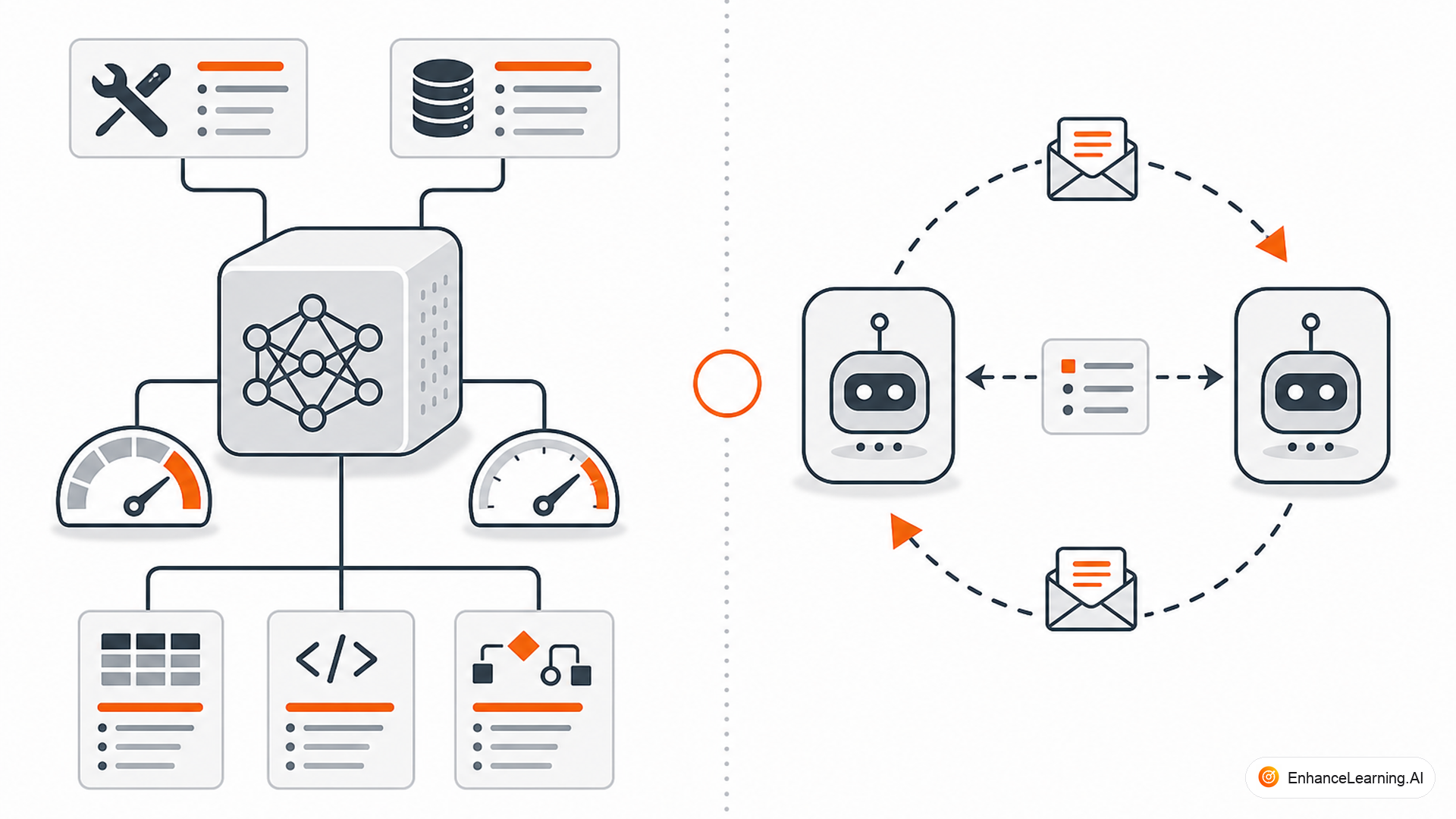
Your platform team standardizes on MCP for Jira and docs. A product team wants two agents — researcher and writer — to negotiate task handoffs, share partial plans, and delegate subtasks. Someone asks: "Can we use MCP for agent-to-agent messaging?" Wrong layer. MCP answers how a host attaches tools and resources to a model session. Agent-to-agent (A2A) protocols answer how autonomous agents coordinate work, delegate, and report outcomes. Conflating them produces agents that treat each other like API endpoints or, worse, tools the model can invoke blindly.
Two different boundaries#
MCP boundary: model host ↔ capability provider (filesystem, ticket system, database reader, search index).
A2A boundary: agent runtime ↔ agent runtime (planner ↔ executor, buyer ↔ validator, internal agent ↔ partner agent).
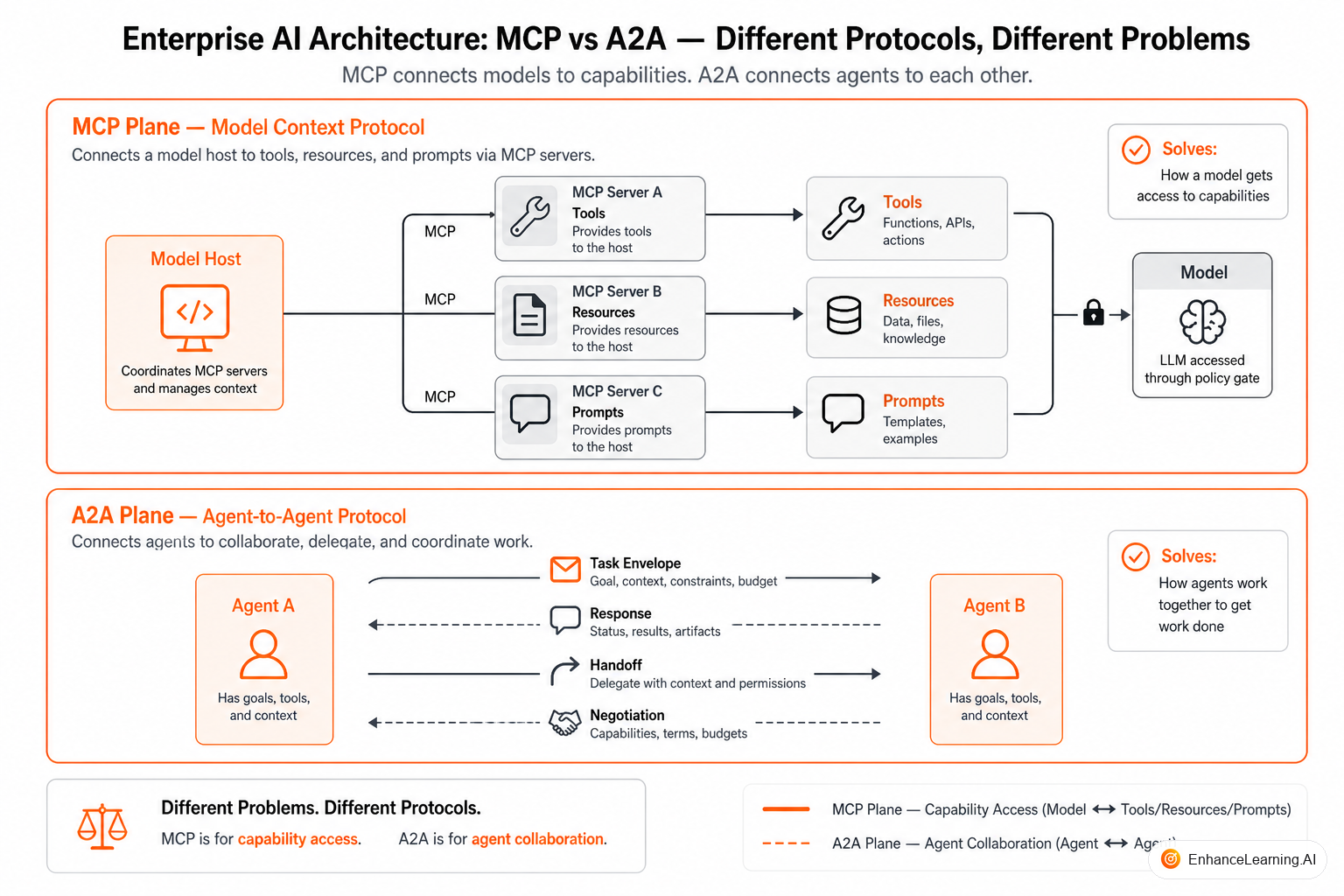
The model may sit inside each agent, but the protocol concerns differ:
| Dimension | MCP | A2A-style coordination |
|---|---|---|
| Primary consumer | Model host | Agent orchestrator / peer agent |
| Unit of exchange | Tools, resources, prompts | Tasks, messages, status, artifacts |
| Discovery | Capability catalog for session | Agent cards, skills, availability |
| Trust model | Host allowlists server tools | Inter-agent auth, delegation scopes |
| Failure handling | Tool error to model loop | Task rejection, retry, escalation |
| Typical transport | stdio, SSE, org-hosted HTTP | HTTP, message bus, workflow engine |
Using MCP to expose "Agent B" as a tool named call_writer_agent is a hack that collapses delegation into a single synchronous function call — no task lifecycle, no partial results, no cancellation.
What MCP is optimized to do#
MCP standardizes:
- Listing tools with JSON Schema inputs
- Invoking tools and returning structured content
- Fetching resources by URI for context injection
- Optional prompt templates from servers
It assumes a host mediates between one model session and external capabilities. It does not define:
- Long-running task IDs with state machines
- Agent capability negotiation ("I can research but not deploy")
- Multi-hop delegation chains with accountability
- Human-in-the-loop checkpoints between agents
Those are orchestration concerns. Frameworks (Temporal, custom buses, emerging A2A specs) address them at a different layer.
What A2A protocols address#
A2A-oriented designs (including Google's Agent2Agent direction and similar industry efforts) focus on:
- Agent identity — who is acting, on whose behalf
- Task contracts — inputs, expected outputs, deadlines, cancellation
- Streaming progress — partial artifacts, not one-shot tool responses
- Discovery — which agents exist in an ecosystem and what they accept
Example mental model: a researcher agent receives a task envelope, produces a structured brief, and signals completion. A writer agent subscribes to completed research tasks — not via MCP call_tool, but via a task protocol both runtimes understand.
# A2A-style task handoff (illustrative — not MCP)
from dataclasses import dataclass
from enum import Enum

class TaskState(Enum):
    PENDING = "pending"
    IN_PROGRESS = "in_progress"
    COMPLETED = "completed"
    FAILED = "failed"

@dataclass
class AgentTask:
    task_id: str
    from_agent: str
    to_agent: str
    objective: str
    constraints: dict
    state: TaskState
    artifact_uri: str | None = None

async def delegate_research(task: AgentTask, a2a_client) -> AgentTask:
    accepted = await a2a_client.submit(task)
    return await a2a_client.wait_for_state(accepted.task_id, TaskState.COMPLETED)
MCP might still supply each agent's tools (search docs, query CRM). A2A carries work between agents.
Choosing the right protocol for the job#
- Is the callee a capability or a colleague? Jira search is a capability (MCP). "Research this competitor and deliver a brief" is a colleague task (A2A).
- Is the interaction synchronous and bounded? Yes → tool-shaped (possibly MCP). No → task-shaped (A2A).
- Who enforces policy? Host allowlists for MCP tools; orchestrator + inter-agent trust for A2A.
- Does the caller need progress events? MCP tool results are typically final; A2A expects streaming status.
Integration architecture that respects both#
A sound multi-agent platform:
- MCP catalog for enterprise data and actions — tickets, repos, policy docs
- Orchestrator (workflow engine or agent supervisor) for task routing
- A2A interfaces between agent runtimes for delegation and callbacks
- Shared identity — same user context propagated; neither MCP nor A2A replaces authz
Each agent's host runs an MCP client for tools. The orchestrator speaks A2A (or your workflow DSL) to assign work. Docs and diagrams should show both edges — not one protocol pretending to be the whole system.
Side-by-side session flows#
A concrete comparison helps in design reviews:
MCP session (tool access): host opens session → list_tools → model selects search_tickets → host validates args → server executes → structured result returns to model loop. Entire interaction is request-response scoped to one host-model turn sequence.
A2A session (agent coordination): orchestrator publishes task → researcher agent accepts → progress events stream → artifact lands in shared store → writer agent picks up completed task → orchestrator marks workflow done. Multiple agent lifetimes, explicit task state, cancellation mid-flight.
Neither flow replaces the other. A researcher agent in the A2A flow still uses MCP to search tickets while executing its task.
Testing implications differ too#
MCP servers get contract tests: schema validation, auth scoping, idempotent writes, error shape. A2A interfaces need workflow tests: task rejection, timeout escalation, partial failure recovery, duplicate delivery. Teams that test MCP tools with unit fixtures but test multi-agent flows only in manual demos will discover coordination bugs in production — usually as duplicate work or stuck tasks, not wrong JSON fields.
Summary#
MCP standardizes how model hosts discover and invoke tools and resources from capability servers. A2A protocols standardize how agents delegate tasks, exchange progress, and coordinate multi-step work. They operate at different boundaries; conflating them leads to agent-as-tool hacks, timeout chaos, and unclear accountability. Build with both layers where needed — MCP at the tool edge, A2A at the collaboration edge — and refuse one-size-fits-all protocol rhetoric.
Want premium architecture blueprints?
Be among the first to explore interactive reference architectures, implementation playbooks, and premium engineering resources at launch.
Related Articles
Recommended reading based on this topic.
Why Agent Interoperability Depends on MCP Protocol Maturity
Interoperability follows adoption breadth, consistent implementations, and ecosystem health — not spec compliance alone.
Read ArticleMCP and Agent Portability Across Model Providers
A standard tool protocol decouples agent hosts from model vendors — how MCP reduces rewrite cost when you swap or multi-home models.
Read ArticleMulti-Agent AI Systems vs Classical Distributed Systems
Multi-agent AI overlaps with distributed systems but is not the same. Import idempotency and tracing; do not treat LLM handoffs like RPC.
Read Article