
Why Agent Interoperability Depends on MCP Protocol Maturity
Interoperability follows adoption breadth, consistent implementations, and ecosystem health — not spec compliance alone.
Two MCP hosts connect to the same server. One lists tools correctly; the other drops resource support and mishandles error payloads. A vendor ships "MCP compatible" connectors that diverge on auth headers. Your catalog has thirty servers; twelve are unmaintained forks. That is interoperability in theory, fragmentation in practice. Agent interoperability does not follow from publishing a spec. It follows from protocol maturity — adoption breadth, consistent implementations, and an ecosystem that punishes drift.
Interoperability is an outcome, not a checkbox#
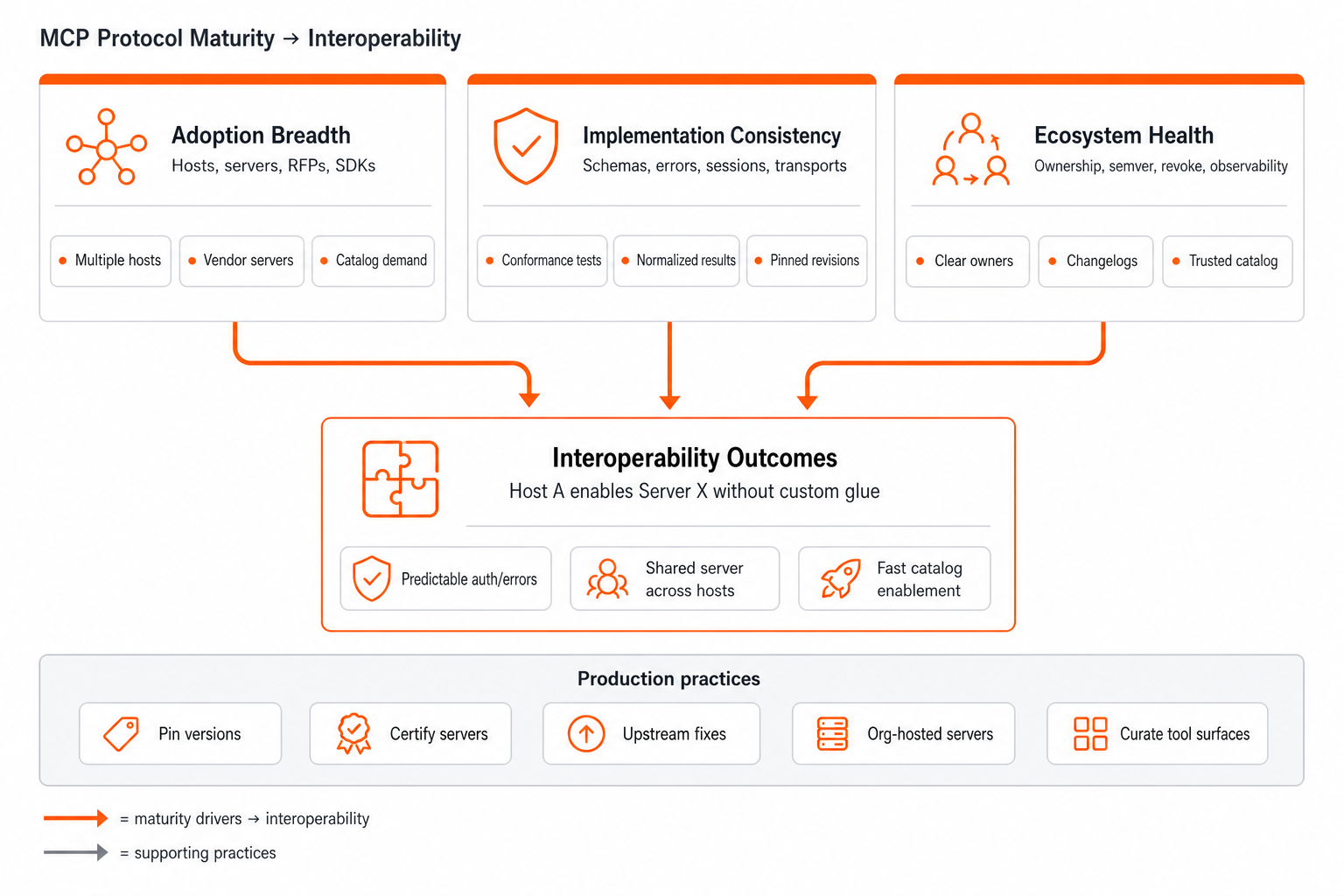
Real interoperability means Host A enables Server X without custom glue; server 1.4 works with hosts pinned to protocol revision Y; auth and errors behave predictably across vendors; third-party servers enter the catalog without a six-week project.
MCP supplies the wire format. Maturity determines whether those abstractions compose in the wild. Three dimensions drive it: adoption breadth, implementation consistency, and ecosystem health. Production practices — pinning, certification, upstream fixes, org-hosted servers, curated tools — turn those dimensions into outcomes hosts can trust.
Dimension 1: adoption breadth#
Protocols mature when independent parties have skin in the game:
| Signal | Immature | Maturing |
|---|---|---|
| Hosts | One in-house agent | IDEs, desktop apps, vendor agents |
| Servers | Internal only | SaaS vendors, OSS, partners |
| Demand | Pilot team | MCP appears in RFPs |
| Tooling | Hand-rolled clients | SDKs, debug proxies, catalogs |
Without breadth you built a private standard with extra steps. Publish reference servers, document enablement for popular hosts, and require MCP for shared internal capabilities. Waiting for vendors alone cedes the timeline.
Dimension 2: implementation consistency#
Spec ambiguity becomes vendor variance. High-friction drift points:
- Tool result shapes — text vs structured content vs embedded resources
- Error propagation — whether hosts surface server errors cleanly to the model
- Resource subscriptions — supported, ignored, or broken per host
- Session lifecycle — reconnect, capability re-negotiation, timeouts
- Transport choice — stdio vs SSE vs streamable HTTP with different auth assumptions
from dataclasses import dataclass

@dataclass
class NormalizedToolResult:
    ok: bool
    text: str
    structured: dict | None
    server_error: str | None

def normalize_tool_result(raw: dict) -> NormalizedToolResult:
    content = raw.get("content") or []
    text_parts = [c.get("text", "") for c in content if c.get("type") == "text"]
    is_error = raw.get("isError", False)
    return NormalizedToolResult(
        ok=not is_error,
        text="\n".join(text_parts).strip(),
        structured=raw.get("structuredContent"),
        server_error=raw.get("error") if is_error else None,
    )
Normalize at the host until the ecosystem converges. Run conformance suites against reference servers before certifying connectors. Without them, "MCP server" is a label, not a guarantee.
HTTP exists; APIs still break. MCP fragments unless maintainers version aggressively, SDKs encode best practices, and enterprises reject uncertified servers.
Dimension 3: ecosystem health#
Healthy ecosystems show clear ownership and security contacts, semver discipline, public changelogs, fast revoke across hosts, and shared observability fields (tool name, server version, latency). Unhealthy ones accumulate orphan servers, duplicate SaaS connectors, and unaudited stdio binaries with admin scopes. Interoperability dies in catalogs nobody trusts.
What to do in production#
- Pin protocol and server versions —
@latestbelongs in sandboxes - Certify new servers (schema, auth, call fixtures) before catalog publish
- Contribute upstream when hosts mishandle errors — local wrappers multiply dialects
- Prefer org-hosted remote servers for shared capabilities over local stdio sprawl
- Curate tool surfaces — fewer clear tools beat OpenAPI dumps; test against two hosts before launch
Measuring maturity#
Track quarterly: certified vs orphan servers; hosts sharing the same server without forks; mean time to enable a new host; cross-host incidents from schema mismatch; vendor-published servers adopted vs reimplemented. Flat metrics mean protocol labels, not interoperability.
MCP maturity unlocks tool interoperability first. Multi-agent coordination (A2A, workflows) builds on reliable capability access. Immature MCP forces orchestrators to embed bespoke glue — defeating higher-level agent standards. Stabilize tool and context edges, then expand agent-to-agent surfaces.
Treat spec updates like any dependency: classify impact, run conformance in staging, roll hosts and servers on a schedule with rollback — never both at once without a path back. Prefer upstream clarification over private dialects ("our MCP plus custom headers").
Summary#
Agent interoperability through MCP depends on protocol maturity — wide adoption, consistent implementations, and a governed ecosystem — not merely choosing the spec. Fragmentation is the default. Drive maturity with catalogs, certification, defensive host normalization, and upstream contribution. Measure shared-server success across hosts, not server count alone. Interoperability is earned over quarters, not declared at launch.
Want premium architecture blueprints?
Be among the first to explore interactive reference architectures, implementation playbooks, and premium engineering resources at launch.
Related Articles
Recommended reading based on this topic.
MCP and Agent Portability Across Model Providers
A standard tool protocol decouples agent hosts from model vendors — how MCP reduces rewrite cost when you swap or multi-home models.
Read ArticleThe Difference Between MCP and Agent-to-Agent (A2A) Protocols
MCP standardizes tool and context access for model hosts; A2A protocols coordinate agents — conflating them leads to wrong architecture choices.
Read ArticleThe Hidden Cost of Custom Tool Integrations Without MCP
Schema drift, broken contracts, and duplicated auth turn bespoke agent integrations into compounding debt — failure modes teams ignore until prod breaks.
Read Article