
The Hidden Cost of Custom Tool Integrations Without MCP
Schema drift, broken contracts, and duplicated auth turn bespoke agent integrations into compounding debt — failure modes teams ignore until prod breaks.
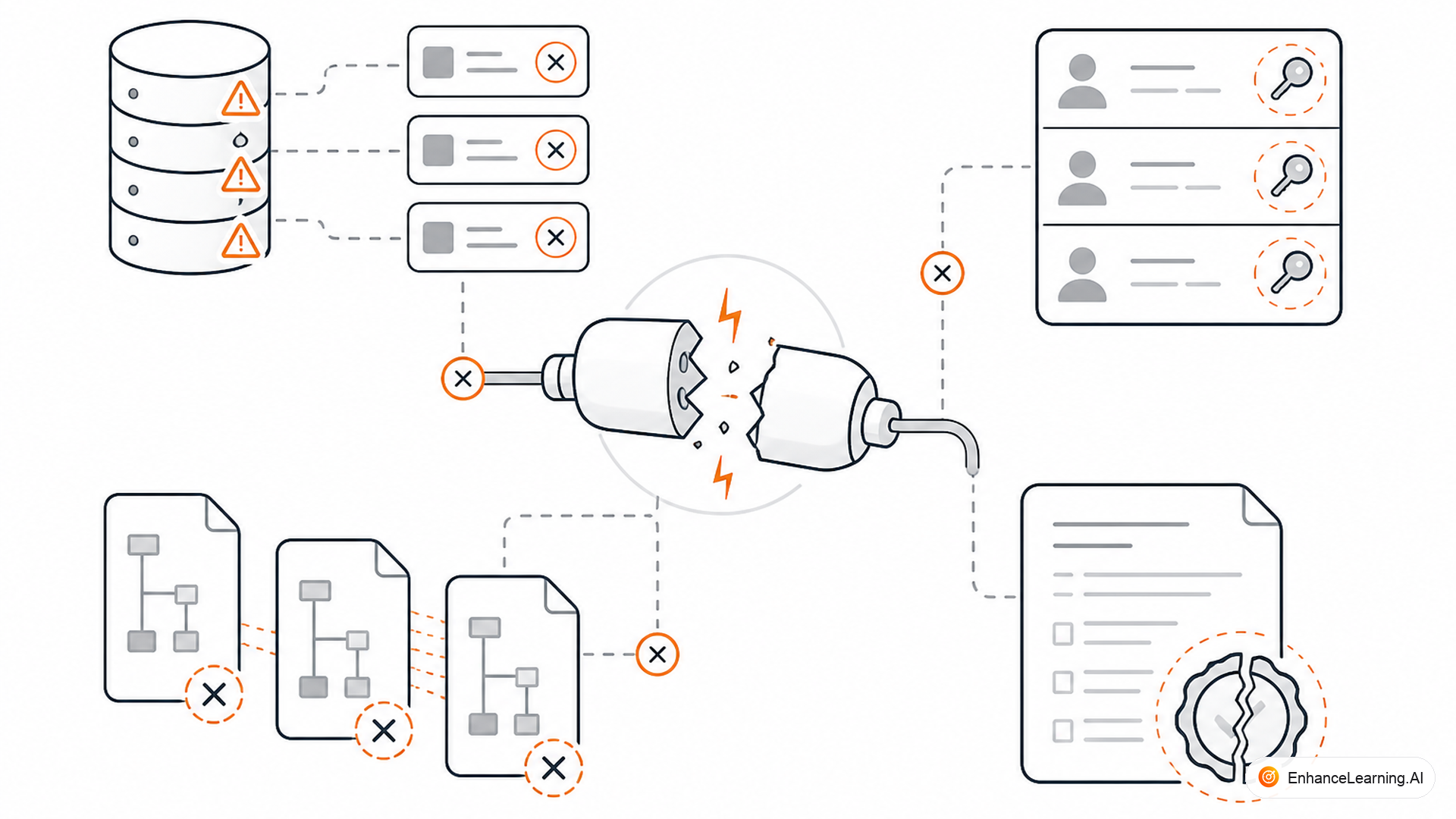
The demo worked. Tools returned JSON. The model called them sensibly. Six months later, on-call gets paged because the copilot started filing duplicate tickets — same title, same assignee, three times in four minutes. Root cause: a schema field silently deprecated upstream, your adapter still mapped priority to an enum the API no longer accepts, and the model learned to retry on vague errors. Nobody planned for that failure. Bespoke integrations accumulate exactly this kind of debt until something expensive breaks.
Debt you cannot see in the backlog#
Custom tool stacks rarely track integration debt as a line item. It hides in:
- Prompt text that documents APIs better than the code does
- JSON Schema copies pasted from OpenAPI snapshots taken last quarter
- OAuth refresh logic duplicated in three repos with slightly different expiry handling
- Eval fixtures that pass while production schemas diverged two sprints ago
Unlike a deprecated REST endpoint that returns 410 and fails CI, agent integrations fail soft: the model improvises, users lose trust, and logs look like "model hallucination" instead of "contract violation."
Schema drift: the silent killer#
Backend teams evolve APIs. Software clients break loudly in tests. Agent adapters often lack contract tests at the tool boundary.
Typical drift sequence:
- API adds required field
request_sourcewith default only in docs, not server-side - Adapter schema still marks three fields optional
- Model omits
request_source; API returns 400 with generic message - Model retries with guessed values; one succeeds, two create partial records
- Support ticket: "AI is reckless" — engineering ticket: "fix prompt"
// Fragile: schema lives only in host repo, decoupled from API owner
const createTicketTool = {
  name: "create_ticket",
  parameters: {
    type: "object",
    properties: {
      title: { type: "string" },
      project: { type: "string" },
      priority: { type: "string", enum: ["P1", "P2", "P3"] }, // stale enum
    },
    required: ["title", "project"],
  },
};
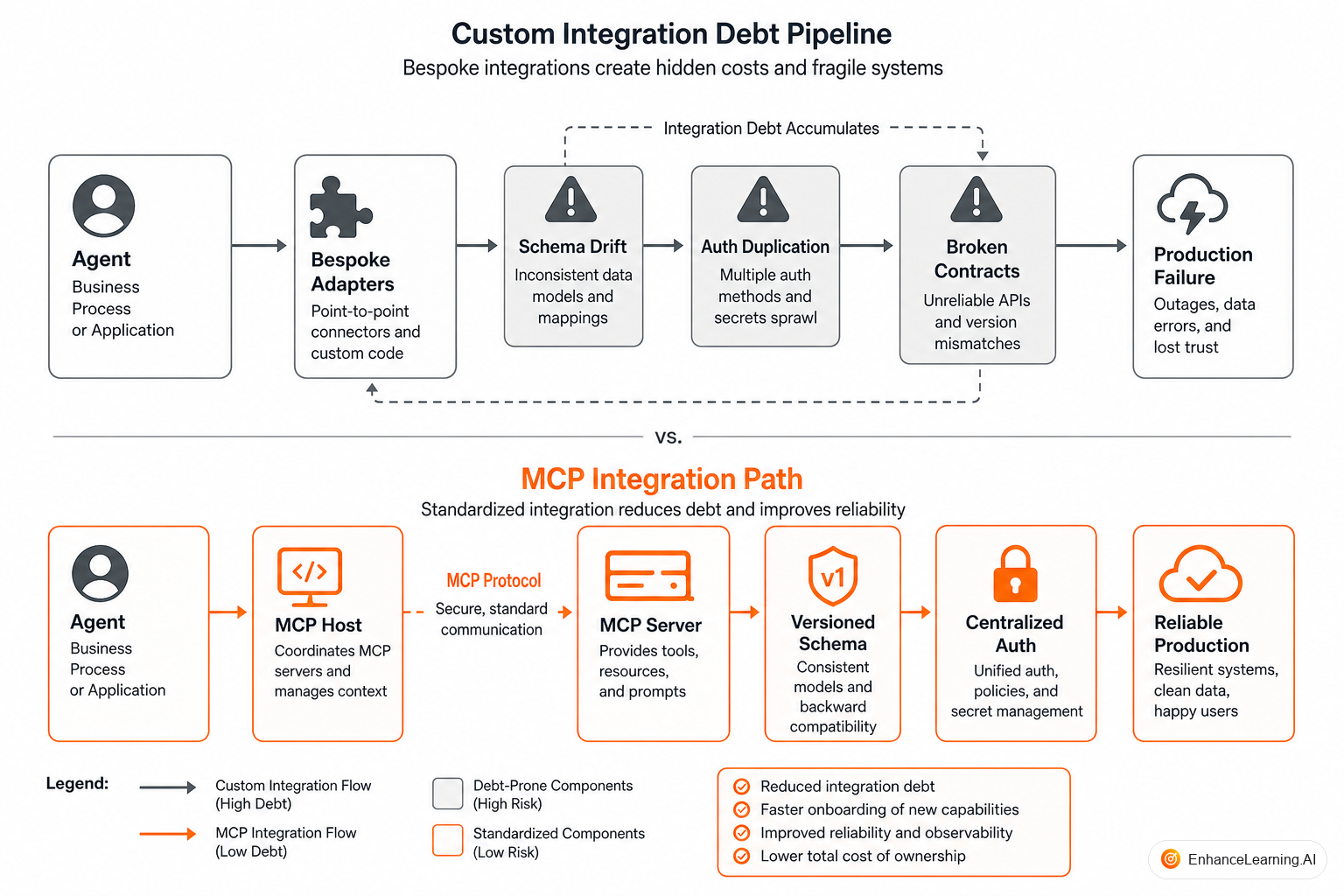
MCP does not magically prevent drift. It centralizes the contract in a versioned server whose changelog and semver are visible to every host. Drift becomes a server release problem, not a scatter of one-off prompt and adapter fixes.
Broken contracts at the model boundary#
Models consume tool definitions as part of their reasoning context. When the definition lies — optional field that is required, enum values that no longer exist — the model cannot self-correct reliably. You get:
- Argument thrashing — multiple tool calls burning tokens on validation errors
- Wrong-tool selection — similar schemas for
search_usersvssearch_customers - Silent truncation — adapter drops fields the model supplied because the handler was never updated
| Failure mode | Symptom | Bespoke stack response | Protocol-aligned response |
|---|---|---|---|
| Schema drift | Intermittent 400s | Patch prompt; hope | Server semver bump + host pin |
| Auth expiry | Sudden total tool failure | Manual token refresh per host | Server-side credential rotation |
| Duplicate side effects | Retries without idempotency | Blame model temperature | Idempotency keys in server tool impl |
| Shadow tools | Undocumented internal endpoints exposed | Security audit surprise | Catalog review before enable |
Duplicated auth: the recurring incident#
Every custom integration reinvents:
- Where refresh tokens live (env var, vault, user's laptop)
- Whether the model sees bearer tokens in traces (it should not)
- Scope reduction for read-only agent modes
- Audit attribution — which human owns an action the model triggered
Duplication guarantees inconsistency. One host rotates secrets on schedule; another embeds long-lived PATs in config. Incident response becomes forensic work across repos instead of disabling one server in a catalog.
A well-run MCP deployment concentrates credentials in the server process (or a sidecar your platform controls). Hosts pass user identity context; servers map to scoped tokens. Same pattern every time — easier to review, easier to revoke.
Read-only agents tolerate drift longer. Write-capable agents pay interest immediately. Every auto-apply workflow without idempotent tools and versioned schemas is a loan against your on-call rotation.
Observability gaps that hide the real bug#
Bespoke stacks log "tool call failed." Useful traces need:
- Published schema version vs validated arguments
- Upstream API request/response (redacted)
- Whether the host or server rejected the call
- Retry count within the model loop
Without that, postmortems conclude "model misbehaved" and ship prompt tweaks that mask structural debt. MCP-aligned hosts can standardize trace shape across servers: tool.name, server.version, validation_stage, upstream_status.
Migrating to MCP in phases#
Paying down integration debt is incremental — not a big-bang rewrite:
# Phase 1: wrap the worst offender — write-capable tool with drift history
# Server owns schema + handler; hosts switch discovery source
from mcp.server import Server
from mcp.types import Tool

server = Server("tickets")

@server.list_tools()
async def list_tools() -> list[Tool]:
    return [
        Tool(
            name="create_ticket",
            description="Create a ticket. Idempotent on client_request_id.",
            inputSchema={
                "type": "object",
                "properties": {
                    "title": {"type": "string"},
                    "project_key": {"type": "string"},
                    "client_request_id": {"type": "string"},
                },
                "required": ["title", "project_key", "client_request_id"],
            },
        )
    ]
- Pick the highest-blast-radius tool — writes, payments, PII — not read-only search
- Extract server with explicit semver — document breaking changes
- Add contract tests — fixture args validated against published schema before deploy
- Run host and legacy adapter in parallel — compare traces in shadow mode
- Retire bespoke schema copies — single source in server repo
Skipping shadow comparison is how teams "migrate" and keep the same bugs.
The cost of "just fix the prompt"#
When incidents trace to integration debt, the cheapest-looking fix is often a prompt edit: "never retry on 400," "always include request_source." Prompt patches accumulate like CSS overrides — each one addresses a symptom while the schema lie remains. Within a few sprints the system prompt reads like an internal wiki for APIs that should be enforced in code. MCP does not eliminate prompt engineering; it stops prompts from being the only place your tool contract lives.
Summary#
Custom tool integrations without a standard protocol accumulate hidden debt: drifting schemas, duplicated auth, broken model-facing contracts, and traces too thin to debug. Failures surface as "model errors" while the root cause is unmaintained adapter glue. MCP centralizes contracts in versioned servers and standardizes host mediation — not as magic, but as a place to enforce idempotency, credential policy, and observable tool lifecycles. Pay the debt on write paths first; read-only search can wait.
Want premium architecture blueprints?
Be among the first to explore interactive reference architectures, implementation playbooks, and premium engineering resources at launch.
Related Articles
Recommended reading based on this topic.
Why Tool Calling Without a Standard Protocol Doesn't Scale in Agent Systems
Bespoke tool integrations compound into N×M maintenance — why agent platforms need a shared protocol layer as tool counts and hosts grow.
Read ArticleThe Difference Between MCP and Traditional API Integration
MCP is not a thin REST wrapper — it mediates tool discovery, schema contracts, and host policy between models and external capabilities.
Read ArticleHarness Engineering for Reliable Agents
The agent harness is the real product: tools, permissions, state, stops, and telemetry around a thin model call.
Read Article