
The Difference Between MCP and Traditional API Integration
MCP is not a thin REST wrapper — it mediates tool discovery, schema contracts, and host policy between models and external capabilities.
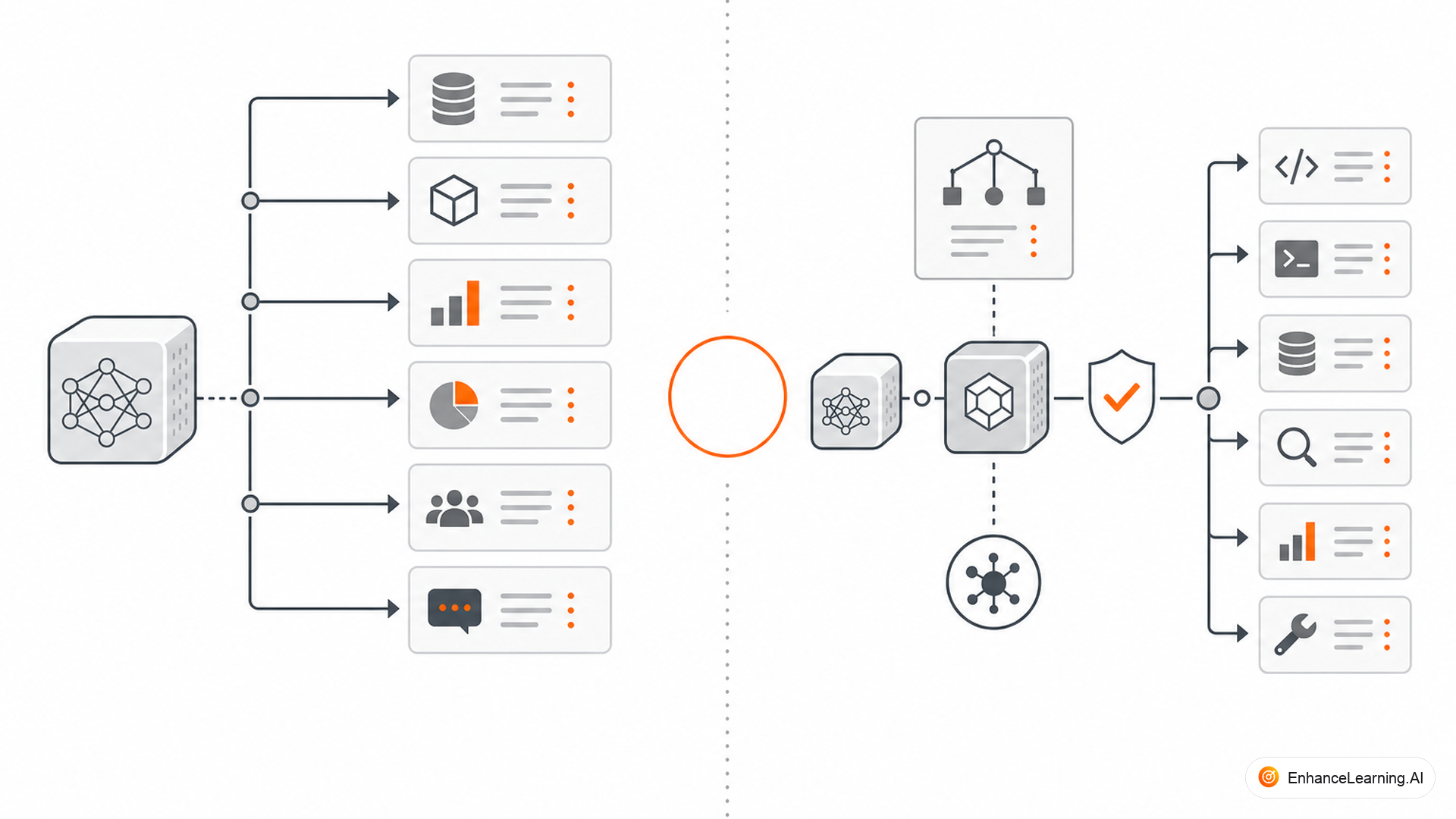
Your agent already calls REST endpoints. The HTTP client works. OpenAPI docs exist. So why add Model Context Protocol at all? Because the problem MCP solves is not "how does software talk to an API" — it is how a model host discovers, describes, and mediates access to capabilities across sessions, vendors, and policy boundaries. Treating MCP as a thin wrapper around REST misses the architecture.
What traditional API integration optimizes for#
Direct API integration assumes a known client: your service, a mobile app, a batch job. You compile or configure against a contract. The caller owns retry logic, auth token refresh, rate limits, and error parsing. The API does not advertise itself to unknown consumers at runtime.
That model is correct for software-to-software traffic. A payments service does not need to explain its endpoints to every process on the network. Your gateway handles auth. Your SDK wraps HTTP. Done.
Agent systems break that assumption. The "client" is a model loop inside a host application. Tool lists change per session. Schemas must be model-readable. Permissions vary by user and workspace. The host must filter what the model sees without rewriting your entire backend.
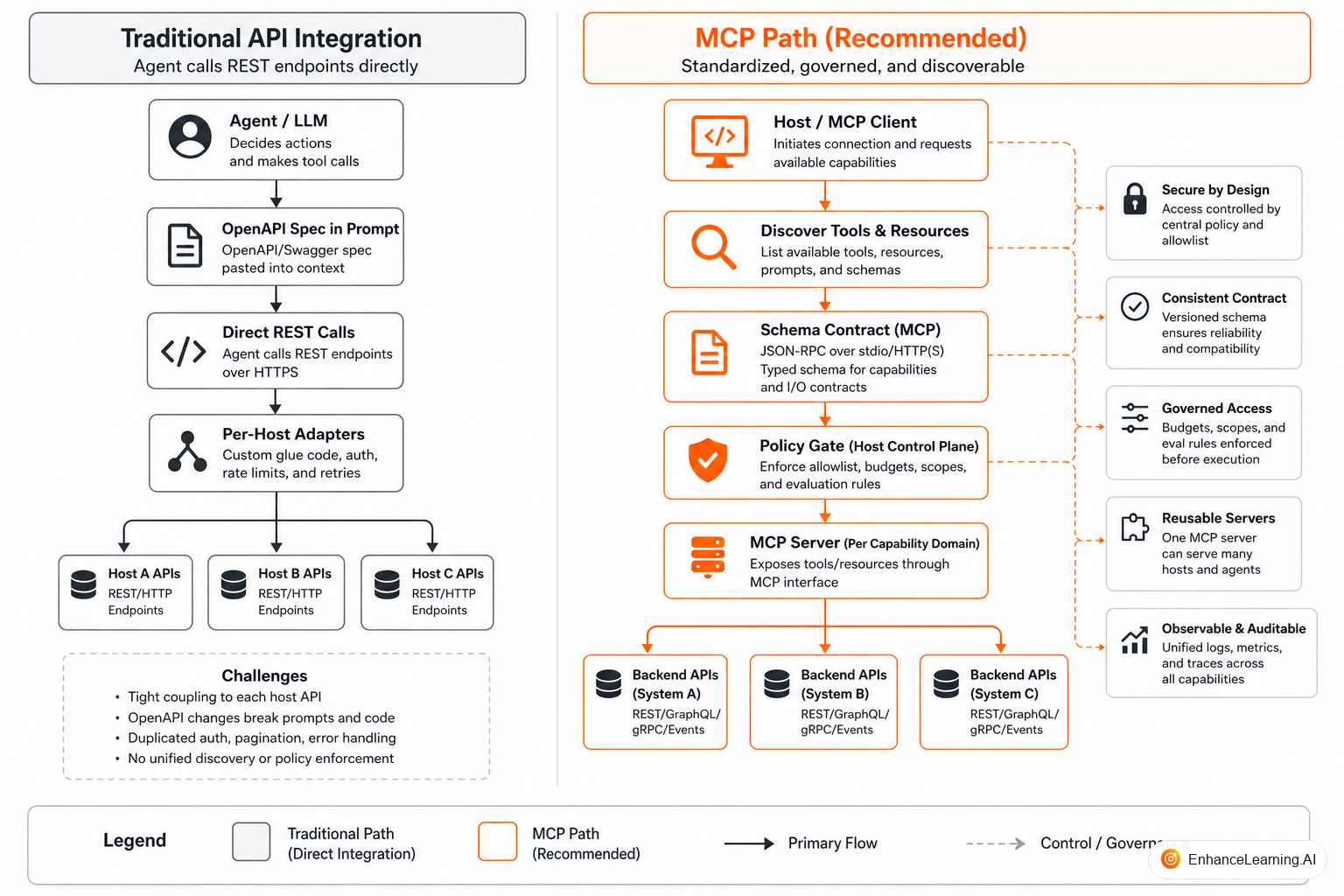
Protocol-mediated access vs direct calls#
In a traditional stack, your agent code imports a client:
# Direct integration: your code owns the contract
import httpx
from myapp.auth import get_service_token

async def fetch_open_tickets(project: str) -> list[dict]:
    token = await get_service_token("jira")
    resp = await httpx.AsyncClient().get(
        f"https://jira.example.com/rest/api/2/search",
        params={"jql": f"project={project} AND status=Open"},
        headers={"Authorization": f"Bearer {token}"},
    )
    resp.raise_for_status()
    return resp.json()["issues"]
You then write a tool definition that wraps this function, hand-craft JSON Schema for the model, and embed descriptions in the system prompt. When Jira changes a field name, you update code, schema, and prompt text. When a second host (IDE assistant, desktop agent) needs the same capability, you fork the adapter.
MCP inverts part of that flow. A server exposes tools with machine-readable schemas. The host discovers them at session start, applies allowlists, and forwards calls. Your Jira logic still lives in the server implementation — but discovery and the tool contract are protocol-native, not copy-pasted into each host's prompt.
Discovery is not a REST feature#
OpenAPI describes an API for humans and codegen tools. It does not participate in a live session where a host asks "what can I call right now?" MCP's list-tools handshake is designed for that moment: the host queries available capabilities, receives schemas, and presents a curated subset to the model.
That distinction matters in production:
| Concern | Direct API + custom tools | MCP-mediated access |
|---|---|---|
| Contract source | Hand-maintained in each host | Server-published, host-discovered |
| Schema drift | Silent until runtime failure | Versioned server; hosts can pin |
| Multi-host reuse | N adapters for N hosts | One server, many hosts |
| Policy enforcement | Scattered in each integration | Centralized at host boundary |
| Context (resources) | Separate fetch logic per source | First-class resource URIs in protocol |
REST gives you endpoints. MCP gives you a session-level capability catalog with a consistent calling convention.
Host mediation is the architectural hinge#
The most common misconception is that MCP replaces your API gateway. It does not. MCP sits between the model host and capability providers. The host still decides:
- Which discovered tools enter the model context
- Whether a call proceeds after the model proposes arguments
- How credentials are injected (never into the model's view)
- What gets logged for audit and eval replay
// Host mediation: discovery ≠ permission
async function resolveToolsForSession(
  session: McpClientSession,
  policy: ToolPolicy,
): Promise<ModelTool[]> {
  const catalog = await session.listTools();
  const allowed = catalog.filter((t) => policy.isAllowed(t.name));
  return allowed.map((t) => ({
    name: t.name,
    description: t.description,
    parameters: t.inputSchema,
  }));
}
Without that mediation layer, you have exposed APIs with a chat UI on top — which is how teams accidentally give models write access to production admin endpoints.
When direct API integration is still right#
Not every capability belongs behind MCP. Keep direct HTTP for:
- Deterministic batch pipelines where no model chooses the call path
- High-throughput internal services with existing SDKs and strict latency SLOs
- Single-host agents with five stable tools that will never be shared
Reach for MCP when a capability must be discoverable, reusable, and policy-gated across multiple hosts or vendor clients. The crossover point is usually the second consumer, not the tenth API endpoint.
Wrapping REST behind MCP without lying to the model#
Most enterprise MCP servers wrap existing HTTP APIs. The anti-pattern is exposing raw OpenAPI one-to-one: fifty tools with cryptic field names and no guidance. The productive pattern is a curated MCP surface:
- Fewer tools with clearer names (
search_tickets, notGET /rest/api/2/search) - Tighter schemas — enums instead of free strings where possible
- Errors translated into model-actionable messages
- Read-only variants split from write-capable tools
Your REST API remains the system of record. MCP is the assistant-facing façade with schemas shaped for tool calling, not for a React frontend.
In direct integration, each host owns the tool schema. In MCP, the server owns the published contract and the host owns permission. That split is the whole point — one team maintains Jira semantics once; every host consumes the same discovery handshake.
Failure modes when you conflate the two#
Teams that "add MCP" by auto-generating tools from OpenAPI often ship:
- Schema overload — models pick wrong tools because fifty options differ subtly
- Leaked implementation detail — internal IDs and pagination tokens in required fields
- Auth sprawl — each host stores OAuth tokens differently instead of centralizing in the server
- False equivalence — assuming MCP transport security replaces API authz review
Protocol compliance without curation produces a standardized mess. Direct API discipline (scopes, least privilege, idempotency) still applies inside the server implementation.
Summary#
Traditional API integration connects known software clients to known endpoints with statically configured contracts. MCP connects model hosts to capability servers through runtime discovery, protocol-native schemas, and host-side policy mediation. You will still use REST inside many MCP servers. You should not pretend that calling httpx.get from an agent script is the same architectural problem. MCP is the interface layer for probabilistic clients that need inventories, not just URLs.
Want premium architecture blueprints?
Be among the first to explore interactive reference architectures, implementation playbooks, and premium engineering resources at launch.
Related Articles
Recommended reading based on this topic.
The Hidden Cost of Custom Tool Integrations Without MCP
Schema drift, broken contracts, and duplicated auth turn bespoke agent integrations into compounding debt — failure modes teams ignore until prod breaks.
Read ArticleWhy Tool Calling Without a Standard Protocol Doesn't Scale in Agent Systems
Bespoke tool integrations compound into N×M maintenance — why agent platforms need a shared protocol layer as tool counts and hosts grow.
Read ArticleHarness Engineering for Reliable Agents
The agent harness is the real product: tools, permissions, state, stops, and telemetry around a thin model call.
Read Article