
Why Tool Calling Without a Standard Protocol Doesn't Scale in Agent Systems
Bespoke tool integrations compound into N×M maintenance — why agent platforms need a shared protocol layer as tool counts and hosts grow.
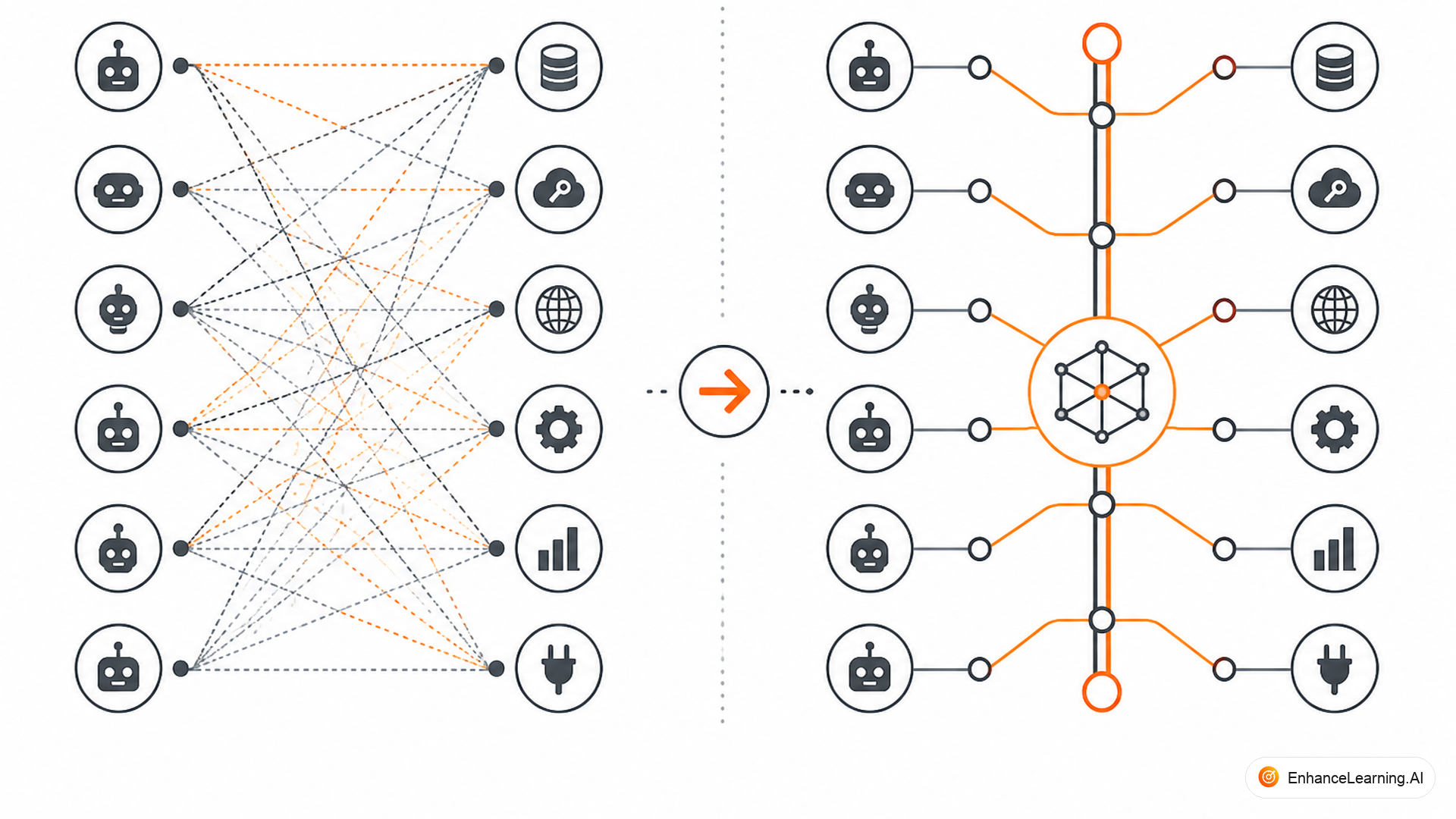
Three agents, twelve tools, two model providers. Your first demo ships in a week. Six months later you have seven agent surfaces — Slack bot, IDE plugin, internal web app, customer-facing copilot, cron-driven batch agent, vendor sandbox, mobile prototype — and forty-one integrations maintained by four teams who do not share code. Every new SaaS connector gets rewritten from scratch. That is not a tooling problem. It is an economics problem that a standard protocol is meant to address.
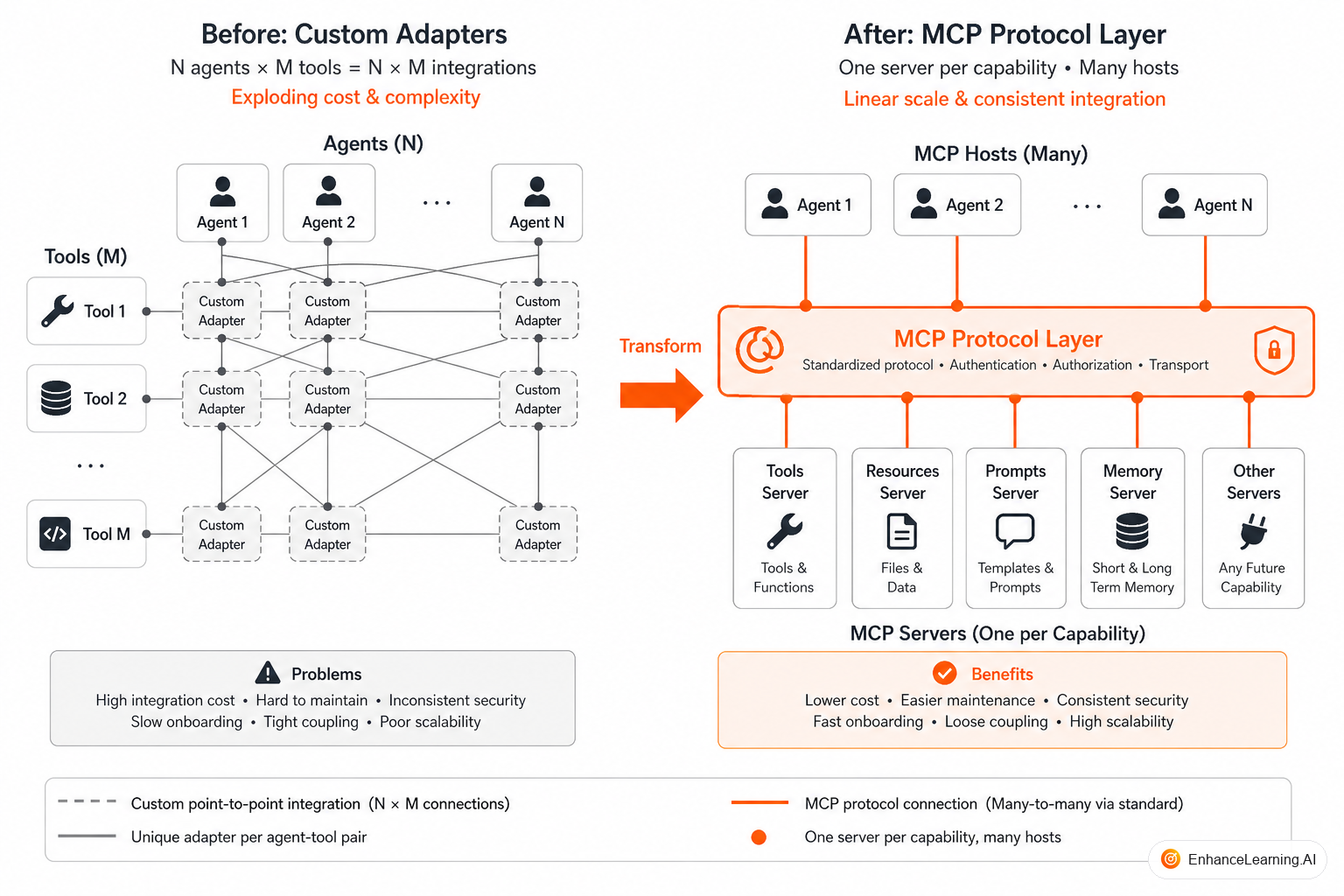
The N×M integration tax#
Without a shared protocol, each host (the application running the model loop) implements its own:
- Tool schema format and validation
- Auth handoff and token storage
- Discovery mechanism (usually: hardcoded list in repo)
- Error translation for the model
- Logging and replay format for evals
Each capability (Jira, GitHub, internal CRM) gets adapted per host. The math is brutal:
| Hosts (H) | Capabilities (C) | Bespoke adapters (worst case) |
|---|---|---|
| 3 | 10 | 30 |
| 5 | 20 | 100 |
| 8 | 35 | 280 |
Even at 50% reuse through internal libraries, you are still paying coordination cost: versioning, breaking changes, and "which adapter is canonical?" meetings. A protocol does not reduce C. It collapses the adapter surface toward C servers + H thin hosts instead of H×C forks.
Why internal SDKs stop scaling#
Mature teams build @corp/agent-tools and declare victory. It works until:
- A vendor host (Cursor, Claude Desktop, a partner's agent runtime) cannot import your private npm package
- Python agents fall behind because the SDK is TypeScript-first
- Tool schemas embed host-specific assumptions (your web app's session model, not theirs)
- Security review wants per-host allowlists the SDK was never designed to express
Internal SDKs solve code reuse inside your repo. They do not solve cross-host interoperability — which is exactly where agent systems are heading as models spread across IDEs, ops consoles, and customer channels.
Compounding maintenance you do not forecast#
The hidden line items in a bespoke stack:
Schema drift. Backend team renames assignee_id to owner_id. Your Slack bot adapter updates on Tuesday. The IDE plugin still sends the old field until someone notices in prod evals.
Prompt-documented tools. Tool descriptions live in system prompts copied across repos. Updating "how to call search" means a PR in five places and a missed one causes tool-selection regression.
Auth duplication. Each host stores OAuth refresh tokens differently. Rotating a client secret becomes a multi-app fire drill.
Eval fragmentation. Replay logs from one host do not match another's format. You cannot compare tool-success rates platform-wide.
Onboarding tax. Every new engineer learns your custom tool abstraction before they learn the business domain.
A standard protocol does not erase these costs. It names the seams: discovery, call, resource fetch — so platforms invest once in host infrastructure.
Engineering economics of protocol adoption#
Treat protocol adoption as a build-vs-buy on interface stability:
# Bespoke: every host reimplements discovery + call semantics
class LegacyToolRegistry:
    def __init__(self):
        self._tools: dict[str, ToolSpec] = {}

    def register(self, name: str, fn: callable, schema: dict):
        self._tools[name] = ToolSpec(name=name, fn=fn, schema=schema)

    def for_model(self) -> list[dict]:
        return [{"name": t.name, "parameters": t.schema} for t in self._tools.values()]

# Protocol-aligned: host delegates catalog to MCP session
async def tools_for_model(session: McpSession, allowlist: set[str]) -> list[dict]:
    discovered = await session.list_tools()
    return [
        {"name": t.name, "description": t.description, "parameters": t.inputSchema}
        for t in discovered
        if t.name in allowlist
    ]
The second path front-loads work: MCP client in the host, server implementations for capabilities, catalog governance. The return appears when host #3 ships in days instead of quarters because it inherits discovery, call routing, and schema parsing.
Break-even usually lands between two and four hosts sharing ten or more capabilities — earlier if external vendor hosts must connect without your SDK.
What "scale" means here (and what it does not)#
Scaling agent tool integrations is not about QPS through a gateway. It is about:
- Organizational scale — more teams shipping agents without a platform bottleneck
- Surface scale — more places the same capability must appear with consistent policy
- Vendor scale — third-party hosts and servers entering your ecosystem
- Lifecycle scale — schema versions, deprecations, and security patches propagated predictably
A single-team agent with five cron jobs does not need MCP tomorrow. An enterprise building an agent platform for dozens of internal products does — not for hype, but to avoid becoming the permanent adapter factory.
Adoption path that respects the math#
- Inventory hosts and overlapping capabilities. If only one host needs a tool, defer MCP wrapping.
- Extract the first shared server where two hosts already duplicate code — tickets read-only is a common win.
- Invest in host-side policy once — allowlists, audit logging, schema validation before model exposure.
- Publish a catalog with owners, SLAs, and semver for tool schemas.
- Migrate hosts incrementally — bespoke registry and MCP discovery can coexist during transition.
- Measure adapter count over time. The metric should fall or flatten as servers grow.
Summary#
Tool calling without a standard protocol scales poorly because every new host multiplies integration work against every capability. Internal SDKs help until cross-language, cross-vendor, and cross-team boundaries appear. MCP trades upfront platform investment for a stable discovery-and-call contract that servers implement once and hosts consume thinly.
Want premium architecture blueprints?
Be among the first to explore interactive reference architectures, implementation playbooks, and premium engineering resources at launch.
Related Articles
Recommended reading based on this topic.
The Hidden Cost of Custom Tool Integrations Without MCP
Schema drift, broken contracts, and duplicated auth turn bespoke agent integrations into compounding debt — failure modes teams ignore until prod breaks.
Read ArticleThe Difference Between MCP and Traditional API Integration
MCP is not a thin REST wrapper — it mediates tool discovery, schema contracts, and host policy between models and external capabilities.
Read ArticleHarness Engineering for Reliable Agents
The agent harness is the real product: tools, permissions, state, stops, and telemetry around a thin model call.
Read Article