
The Difference Between Prompt Craft and AI Engineering
Prompt craft shapes model behaviour; AI engineering ships durable features with validation, fallbacks, and ops. Know where demos end and production begins.
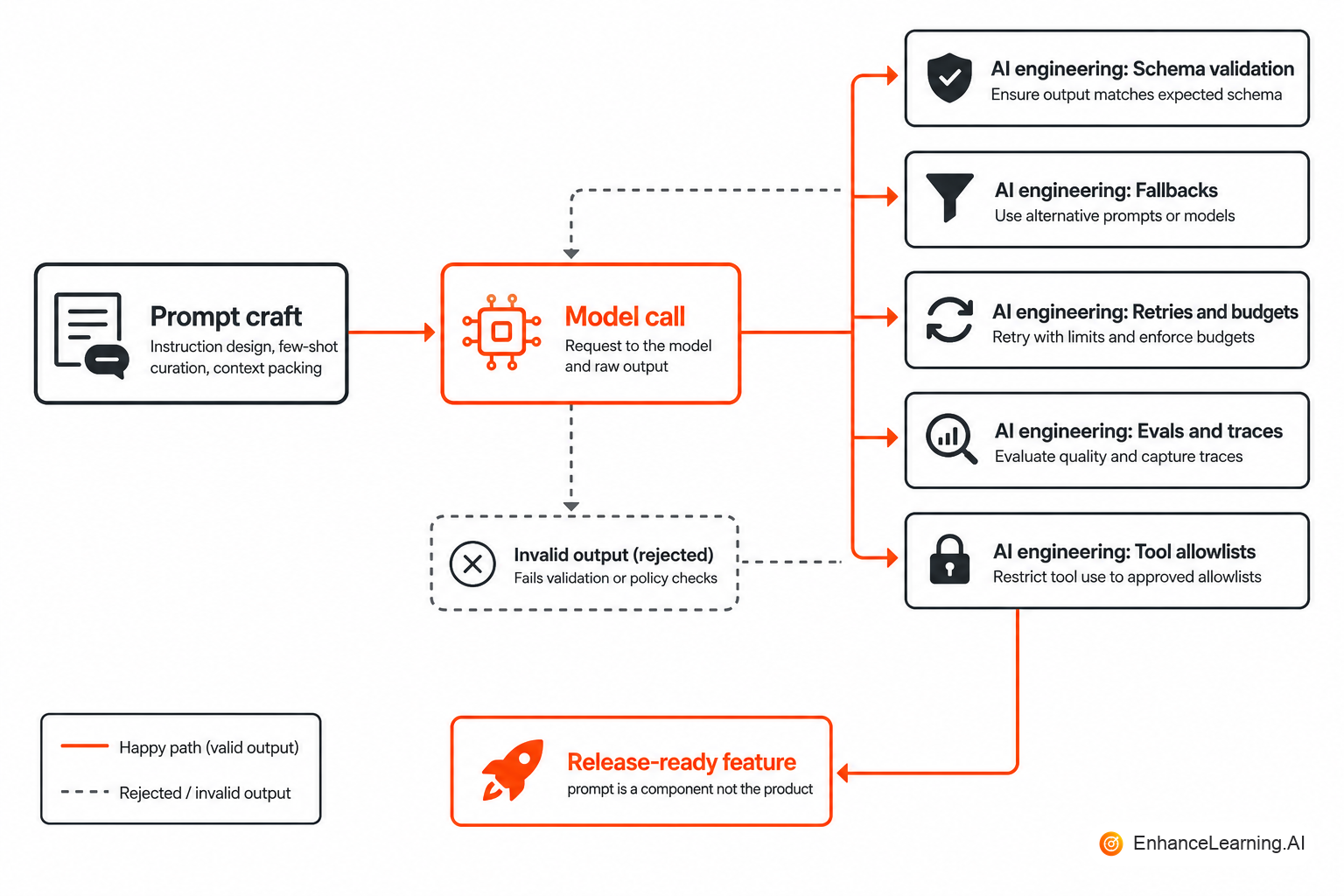
A clever prompt can win a demo. It cannot own a feature. Prompt craft is the craft of getting useful text (or structured text) out of a model. AI engineering is the discipline of putting that behaviour inside a system that validates outputs, fails safely, retries without burning money, and leaves an audit trail someone can trust on Monday morning.
The distinction matters because teams conflate the two constantly. A product manager sees a polished demo and assumes the feature is eighty percent done. An engineer spends two weeks tuning a system prompt and discovers the real work — schema validation, fallback routing, eval harnesses — was never scoped. Six months later, the "AI feature" still breaks on schema drift, tool denials, and silent quality regressions that no prompt edit can fix.
Where teams get confused#
Many organisations hire for "prompt engineers" and discover six months later that their AI features still break on schema drift, tool denials, and silent quality regressions. The confusion is understandable: both jobs touch the model. Only one owns the product boundary.
Prompt craft asks: what do I say to the model so it behaves?
AI engineering asks: what surrounds the model so the product survives when the model misbehaves?
If you only invest in the first question, you get a prompt museum — a collection of clever instructions that work in isolation but collapse under real traffic. If you only invest in the second without craft, you get brittle pipelines that ignore what the model is actually good at. You need both — sequenced correctly. Craft first, to find the behaviour. Engineering second, to make it shippable.
Consider a real scenario: a fintech startup builds a "smart expense categoriser." The prompt engineer nails the instruction — ninety-two percent accuracy on a hundred hand-picked receipts in a spreadsheet. Engineering was never scoped. On launch day, the model returns category: "Meals & Entertainment" for one receipt and category: "meals_and_entertainment" for the next. The downstream accounting API rejects both formats inconsistently. Finance opens a Sev-2. The prompt was fine. The system was not.
Prompt craft: what it actually covers#
Prompt craft includes:
- Role and instruction design that survive paraphrased user input
- Few-shot selection that does not leak confidential examples
- Output contracts phrased clearly enough that the model usually complies
- Context budgets: what goes in, what stays out, what gets summarised
- Model-specific tuning: knowing that model A needs explicit JSON delimiters while model B handles schema hints natively
It is real work. Bad prompts create bad systems. A vague instruction produces vague outputs. A few-shot set that includes PII leaks PII at scale. But a prompt is not a release unit. It is a component inside a larger machine — like a SQL query inside a transaction handler. You would not ship the query without the handler.
AI engineering#
AI engineering owns everything that makes the prompt safe to ship:
- Input and output contracts — schemas, allowlists, typed tool args
- Validation gates — reject or repair before side effects
- Fallbacks — rule path, cached answer, human queue, graceful refuse
- Retries with policy — retriable parse failures vs prompt/schema bugs
- Evals and traces — prove the feature still works after a model bump
- Budgets and stops — tokens, steps, wall clock, spend caps
Each item is a production requirement, not a nice-to-have. Skip validation and you ship fluent lies. Skip fallbacks and a timeout becomes a blank screen. Skip evals and a model upgrade silently degrades quality over a weekend. Skip budgets and one runaway agent loop becomes a five-figure invoice.
A worked boundary: support reply drafting#
Prompt craft alone: a system prompt that "writes empathetic replies grounded in the knowledge base." Demo looks great on five tickets. Replies are warm, cite the right articles, and resolve the issue in one pass.
AI engineering adds:
- Retrieval pack with citation IDs the model must quote
- Schema:
{reply, citation_ids[], confidence} - Validator: citations must exist in the pack; confidence below threshold → human queue
- Fallback: template reply if the model times out
- Eval set: 200 tickets with expected cite behaviour
- Trace: every draft linked to prompt version + retrieval pack hash
Same model. Completely different product risk. Without engineering, a support agent copies a fluent reply that cites article #847 — an ID the model invented. The customer follows a dead link. With engineering, the validator catches the missing citation ID, routes the draft to a human queue, and logs the failure for the prompt owner to investigate.
Here is how the ownership split plays out in a weekly incident review:
| Symptom | Likely owner | First action |
|---|---|---|
| Replies sound robotic or miss tone | Prompt craft | Revise instruction + few-shots |
| Replies cite articles not in the pack | AI engineering | Fix validator + add eval case |
| p95 latency doubled after model bump | AI engineering | Check token budgets + routing |
| Model ignores new policy language | Prompt craft | Update instruction + eval diff |
| Retry rate spiked to 18% | AI engineering | Classify failures; fix schema or prompt contract |
People can wear both hats on a small team. Organisations should still name which hat owns the incident. Ambiguous ownership means nobody fixes the validator because everyone assumes the prompt person will handle it.
Skills by discipline#
| Prompt craft | AI engineering |
|---|---|
| Instruction clarity | Schema + validation |
| Example curation | Tool allowlists and auth |
| Tone and format | Retry / circuit / fallback design |
| Context packing | Tracing, budgets, release gates |
| Model-specific quirks | Model-routing with eval proof |
| Evaluating output quality by eye | Evaluating output quality by golden set |
If your "AI feature" cannot name its schema, fallback, and eval owner, you still have prompt craft dressed as a roadmap item.
How to staff both sides#
Small teams: one engineer owns craft and engineering for a job class, but the checklist above is still mandatory. You are not exempt from validation because you are a team of three. Larger orgs: craft specialists improve instructions and few-shots; platform engineers own validators, gateways, and eval harnesses. Do not let "the prompt person" become the unspoken owner of retries and refunds.
Summary#
Prompt craft makes the model useful. AI engineering makes the feature operable. Treat prompts as components, not products. Ship only when validation, fallbacks, retries, budgets, and evals surround the call — and when someone can explain those pieces without opening slack history.
The next time someone says "we just need a better prompt," ask what happens when the model returns fluent nonsense. If the answer is a validation gate, a fallback path, and a trace ID — you have engineering. If the answer is "we'll tweak the instruction" — you have craft, and you are not ready for side effects.
Want premium architecture blueprints?
Be among the first to explore interactive reference architectures, implementation playbooks, and premium engineering resources at launch.
Related Articles
Recommended reading based on this topic.
Engineering Principles for Reliable AI-Native Products
Structured outputs, tool reliability, layered guardrails, and predictable failure — the principles that separate durable AI-native products from fragile demos.
Read ArticleBuilding Retry Logic for LLM Structured Output Failures
Retry structured LLM outputs without burning cost or latency. Separate retriable parse failures from schema bugs that need a fix, not another loop.
Read ArticleWhy Schema Validation is Non-Negotiable for AI Outputs
Make schema validation a hard gate before any LLM output reaches another system — catch fluent mistakes before they become tickets or refunds.
Read Article