
Engineering Principles for Reliable AI-Native Products
Structured outputs, tool reliability, layered guardrails, and predictable failure — the principles that separate durable AI-native products from fragile demos.
Fragile AI products share a pattern: a strong model demo, a thin wrapper, and faith. Reliable AI-native products share a different pattern: structured outputs, boring tool contracts, layered guardrails, and failure modes you can name before they happen. This is a principle-level checklist — not a vendor tour — for teams scoring their engineering maturity.
The difference shows up under load. A fragile product works beautifully for the first two hundred users, then someone asks a question outside the happy path and the agent loops for forty seconds before returning a confident wrong answer. A reliable product refuses early, explains why, and routes to a fallback in under three seconds. Same model. Different engineering.
Principle 1 — Structured outputs are the default interface#
Free-form prose is for humans. Machines need schemas. Every hop that triggers tools, writes to a database, or fans out to another service must produce validated structure.
- Prefer JSON Schema (or equivalent) over "return JSON please"
- Validate before side effects
- Version schemas like APIs — with changelogs and deprecation notices
If a feature cannot fail closed on schema errors, it is not ready for irreversible actions. This sounds obvious until you audit a codebase and find six model calls where the output flows directly into a json.loads() and then into a database write.
Production example: a hiring platform uses a model to extract skills from resumes. The fragile version sends the resume to the model and stores whatever comes back. The reliable version requires {skills: string[], years_experience: int, confidence: float}. Skills must be from a controlled vocabulary. years_experience must be 0–50. Confidence below 0.7 routes to manual review. Schema violations increment a metric and skip the write. Same feature, but only one version survives a bad model day.
Principle 2 — Tools are unreliable until proven otherwise#
Tool calling fails: timeouts, partial writes, auth expiry, vendor 500s. Engineering means:
- Idempotency keys on side-effecting tools
- Timeouts shorter than user patience
- Clear distinction between denials (policy) and outages (infra)
- Allowlists that shrink, never grow casually
A tool catalogue without these properties is a demo accessory. In production, assume every tool call will fail at least once per thousand invocations. Design for that rate at scale.
| Tool failure type | Fragile response | Reliable response |
|---|---|---|
| Timeout | Retry indefinitely | Bounded retry → degrade → log |
| Auth expiry | Opaque 500 to user | Refresh token or route to fallback |
| Partial write | Assume success | Verify post-condition before continuing |
| Policy denial | Model retries same call | Surface denial to user with reason |
| Vendor 500 | Crash the agent loop | Circuit break + cached fallback |
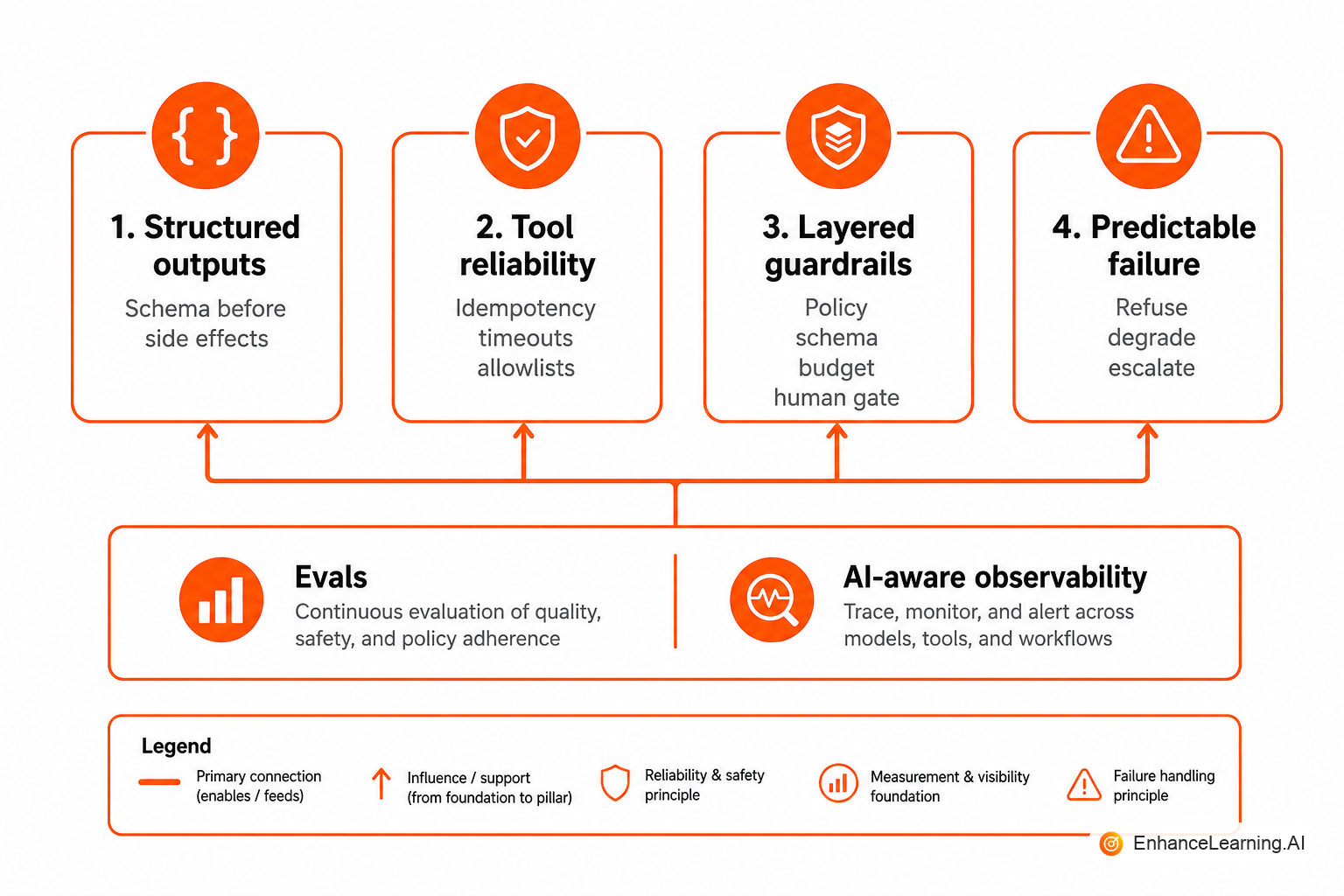
Principle 3 — Guardrails are layered, not a single prompt#
One system prompt is not a control plane. Layer:
- Policy — what the product may attempt
- Schema — what shapes are legal
- Allowlist — which tools and args may run
- Budget — tokens, steps, money, wall clock
- Human gate — irreversible or regulated actions
- Eval gate — release and regression checks
Remove any layer and you inherit a known class of incident. Removing policy means the agent attempts things your product should not do. Removing schema means garbage enters your database. Removing allowlist means one prompt injection grants access to every tool. Removing budget means a loop runs until someone notices the invoice. Removing human gate means irreversible actions happen without oversight. Removing eval gate means quality rots silently.
Principle 4 — Failure must be predictable#
Design the degraded paths while the feature still works — not after the first outage.
| Failure | Designed response |
|---|---|
| Schema invalid after N retries | Escalate / clarify / safe template |
| Tool timeout | Idempotent retry then degrade |
| Low confidence | Human queue, not silent ship |
| Budget stop | Partial result + explicit stop reason |
| Judge regression | Block release |
| Model unavailable | Cached response or graceful refuse |
Unpredictable failure is what users call "random." Predictable failure is what ops can page on. When a user hits a failure path, they should understand what happened and what to do next — not stare at a spinner that eventually returns nonsense.
Consider a customer-facing Q&A bot. Unpredictable failure: the model times out, the UI shows nothing for eight seconds, then displays a hallucinated answer. Predictable failure: the model times out, the UI shows "I couldn't find a reliable answer — here is a link to our help centre" within two seconds. The fallback was designed, tested, and logged. Ops has a metric for fallback rate. Product knows the degradation path exists.
Mature teams can list their top five AI failure modes and point to code paths that handle each. Immature teams list "hallucination" and shrug.
Principle 5 — Evals are part of the product, not a side quest#
Reliable products treat golden sets and graders as versioned artefacts. Model upgrades are migrations: run evals, compare cost and quality, then cut over. Vibes are not a gate.
A golden set for a support reply feature might include:
- Twenty tickets where the model must cite a specific article
- Ten tickets where the model must refuse (out of scope)
- Five tickets with adversarial input (prompt injection attempts)
- Five tickets where the correct answer requires multi-step reasoning
- Five edge cases discovered in production last quarter
Each case has an expected outcome — not "looks good," but {must_cite: ["KB-123"], must_not_call: ["refund_tool"]}. When a prompt change drops citation accuracy from 94% to 81%, the eval gate blocks the deploy. That is reliability engineering, not bureaucracy.
Principle 6 — Observability must see the AI path#
Logs that only say 200 OK hide token blowups and tool storms. Emit stage latency, token counts, validation failures, denials, retries, and stop reasons. Tie them to a trajectory ID.
Minimum viable AI observability for any production feature:
| Signal | Why it matters |
|---|---|
| Prompt version hash | Reproduce any bad output |
| Input token count | Catch context overflow early |
| Output validation result | Distinguish model failure from schema failure |
| Tool calls (name, args, result, latency) | Debug agent loops |
| Retry count and classification | Spot broken contracts |
| Budget remaining at completion | Forecast cost at scale |
| Fallback path taken | Measure degradation frequency |
If you cannot reconstruct a bad response from logs alone, your observability is not AI-aware — it is web-app observability with a model call hidden inside.
Putting the principles on a scorecard#
Score 0–2 on each principle: structured I/O, tool reliability, layered guardrails, predictable failure, eval maturity, AI-aware observability.
- 0 — Not implemented; failure mode is unhandled
- 1 — Partially implemented; works on happy path only
- 2 — Implemented, tested, and owned
Total under 6: demo risk. 6–9: early production. 10–12: operable. Use the score in design review, not as a vanity badge. A team that scores 11 but ignores the lowest-scoring principle will learn about that gap from customers.
From principles to practice#
Principles without application are posters. Here is a concrete sequence for the next feature your team ships:
- Define the output schema before writing the prompt
- List every tool the feature might call; remove any without a clear need
- Write three failure scenarios and implement the degraded path for each
- Create a golden set of at least thirty cases before the first deploy
- Add trace fields for prompt version, validation result, and retry count
- Run the scorecard in retrospective after thirty days in production
Reliable products are not built in one sprint. They are built by applying these principles on every feature until the patterns become infrastructure.
Summary#
Reliable AI-native products are built on structured interfaces, hardened tools, layered guardrails, and failure you can rehearse. Use these principles as a maturity lens: if a feature cannot point to each layer in code, it is still a fragile demo wearing a product URL.
The goal is not perfection on day one. The goal is naming the gaps, scoring them honestly, and closing the worst one before the next feature ships. Reliability is a practice, not a launch-day checkbox.
Want premium architecture blueprints?
Be among the first to explore interactive reference architectures, implementation playbooks, and premium engineering resources at launch.
Related Articles
Recommended reading based on this topic.
The AI Engineering Stack: Where Reliability, Tools, and Outputs Meet
Map structured outputs, tool calling, guardrails, and reliability controls into one stack — how AI engineering decisions connect across an AI-native feature.
Read ArticleThe Architecture of Fallback in AI-Native Systems
When models fail or confidence drops, AI-native systems need layered fallbacks — rule engines, cached answers, human queues — not generic error messages.
Read ArticleWhy AI-Native Systems Need Different Failure Models
AI-native failures are graded — partial outputs, silent errors, confident wrong answers. Binary failure models miss the damage until trust is gone.
Read Article