
Why AI-Native Systems Need Different Failure Models
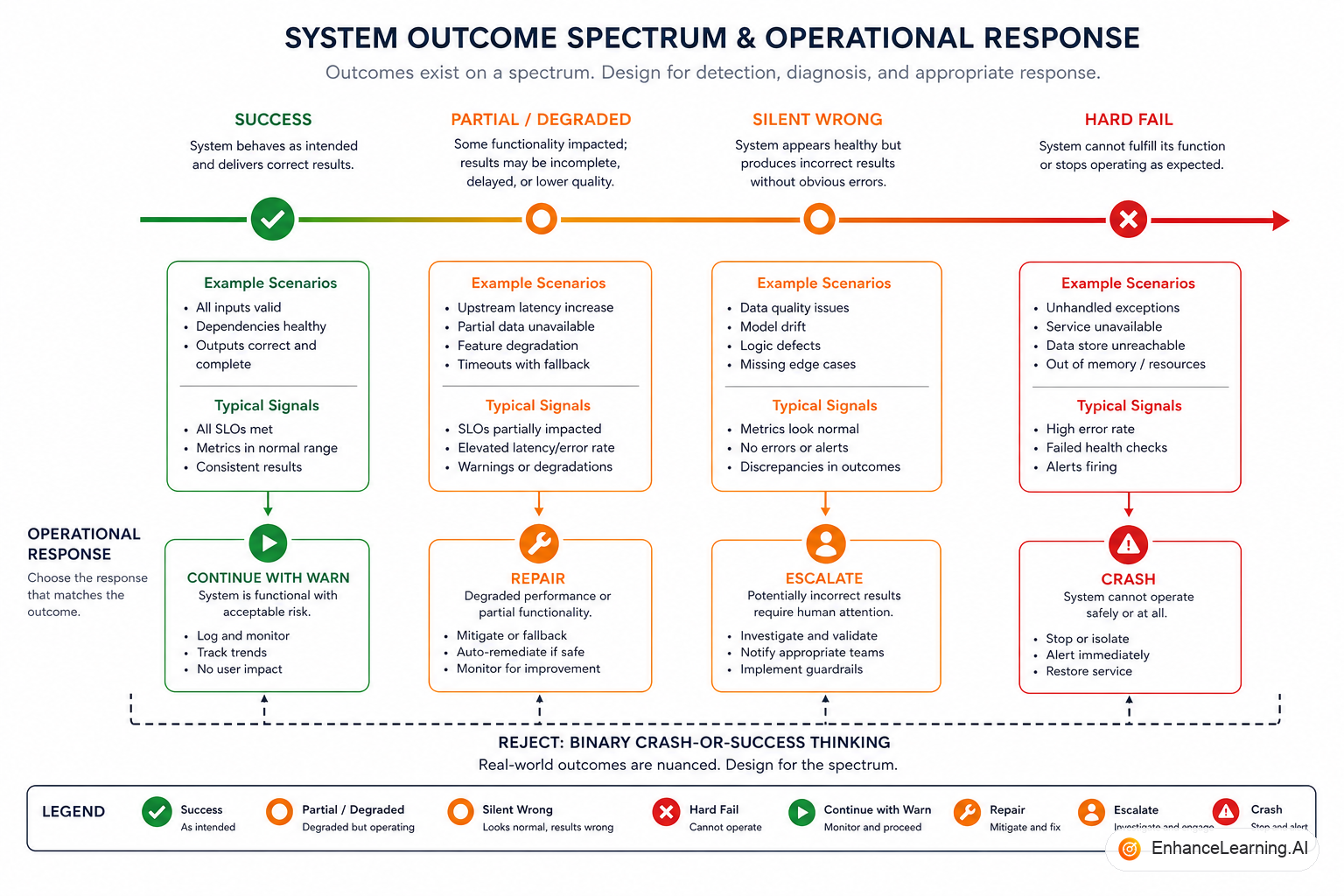
AI-native failures are graded — partial outputs, silent errors, confident wrong answers. Binary failure models miss the damage until trust is gone.
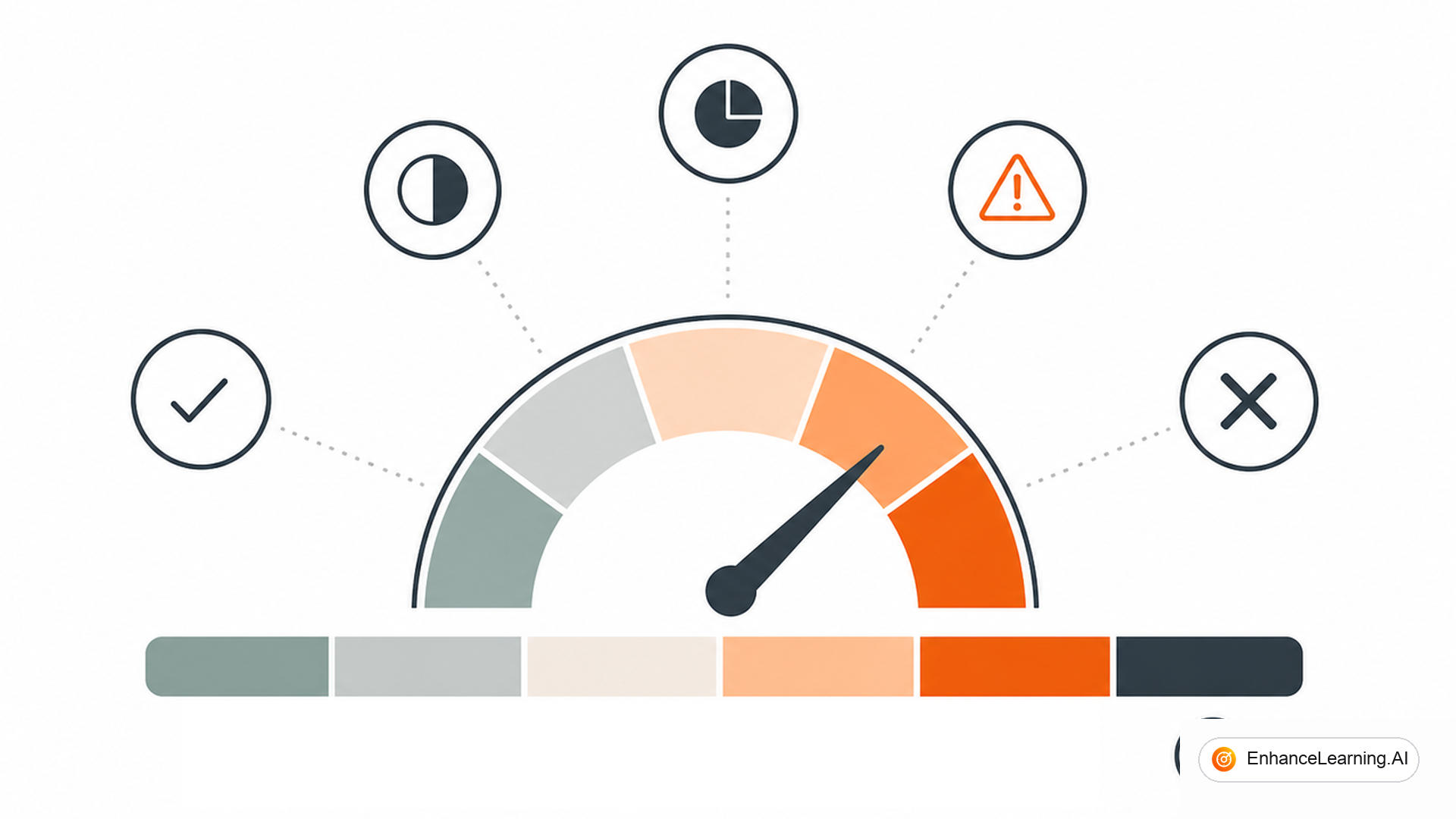
Your monitoring stack is green. Error rate is flat. p99 latency looks fine. Meanwhile support tickets climb because the assistant started citing refund policies from the wrong country — three days ago, after a retrieval index refresh, with HTTP 200 on every response. Classical failure models treat success as status codes and exceptions. AI-native systems fail on a spectrum: partial correctness, silent misrouting, confident nonsense, and slow quality erosion that never trips a threshold.
Until you redesign failure as graded outcomes — not boolean crashes — you will discover problems from customers, not from dashboards.
Binary failure was never complete — but it was enough#
Traditional services fail loudly or not at all. Timeouts, connection resets, validation errors, constraint violations — operators see spikes, roll back, fix forward. Users learn to retry when they see an error screen.
Model-shaped failures often succeed at the transport layer:
- Valid JSON with wrong entity IDs
- Plausible summaries of documents that were not retrieved
- Tool calls that execute against the wrong tenant because the model paraphrased an identifier
- Answers that meet length and format checks but fail policy
These are not edge cases. They are the dominant incident class in mature AI deployments. Runbooks written for "check the 5xx graph" waste the first thirty minutes of every Sev-2.
Failure as a spectrum#
Useful AI-native failure taxonomy spans at least four axes:
| Axis | Classical signal | AI-native signal |
|---|---|---|
| Availability | 5xx rate | Model/provider outages + degraded modes |
| Correctness | Assertion failures | Faithfulness, task completion, policy adherence |
| Completeness | Transaction rollback | Partial tool chains, truncated loops |
| Confidence | N/A (deterministic) | Calibrated uncertainty, refusal quality |
A single request can score poorly on correctness while scoring perfectly on availability. Your incident severity should reflect product harm, not socket state.
Partial outputs are failures, not successes#
Agent loops stop for many reasons: step budget, token cap, user cancel, tool timeout. The user often receives something — a half-filled form suggestion, two of three required fields, a summary missing the liability section.
Classical APIs would return 422 or roll back. AI UX often streams partial work and marks the request complete. Downstream systems persist incomplete state because "the model finished."
Architectural responses:
- Post-condition checks before commit — same as distributed transactions
- Explicit incomplete status in the response contract, not buried in prose
- Idempotent resume — user or system can continue from last validated step
A legal-tech team shipped clause extraction that returned {clauses: [...]} without a coverage score. Attorneys trusted empty arrays on short contracts. Adding coverage: float and blocking auto-apply below 0.85 cut silent misses more than any prompt tweak.
Silent errors: the expensive category#
Silent errors pass validation, pass schema checks, and fail humans. They include:
- Stale retrieval — correct syntax, outdated policy text
- Wrong grounding — answer supported by a tangential chunk
- Over-refusal — safe but unusable; users work around the bot
- Identity confusion — merged context from adjacent sessions (rare, catastrophic)
Detection requires outcome-oriented telemetry: human thumbs-down, downstream correction rate, tool reversal counts, eval judge scores sampled in production. Logs of prompts alone are necessary, not sufficient.
from dataclasses import dataclass
from enum import Enum
import httpx

class OutcomeGrade(Enum):
    SUCCESS = "success"
    PARTIAL = "partial"
    LOW_CONFIDENCE = "low_confidence"
    POLICY_BLOCK = "policy_block"
    HARD_FAIL = "hard_fail"

@dataclass
class GradedResult:
    grade: OutcomeGrade
    payload: dict
    trace_id: str

async def finalize_agent_run(
    trace_id: str,
    draft: dict,
    confidence: float,
    required_fields: list[str],
) -> GradedResult:
    missing = [f for f in required_fields if f not in draft or draft[f] in (None, "")]
    if missing:
        return GradedResult(OutcomeGrade.PARTIAL, draft, trace_id)
    if confidence < 0.7:
        return GradedResult(OutcomeGrade.LOW_CONFIDENCE, draft, trace_id)

    async with httpx.AsyncClient(timeout=5.0) as client:
        resp = await client.post(
            "https://internal.example/evals/sample",
            json={"trace_id": trace_id, "draft": draft},
        )
    if resp.status_code != 200 or resp.json().get("pass") is False:
        return GradedResult(OutcomeGrade.LOW_CONFIDENCE, draft, trace_id)

    return GradedResult(OutcomeGrade.SUCCESS, draft, trace_id)
The grading function is the failure model made concrete. HTTP still returns 200 for PARTIAL and LOW_CONFIDENCE — but downstream routing reads grade and escalates.
Graded degradation beats hard stops#
Users prefer a slower, narrower answer to a total outage. Classical systems call this graceful degradation — read replicas, cached responses, feature flags.
AI-native degradation needs richer levels:
- Full model path — tools, retrieval, synthesis
- Model without tools — answer from context only, with disclaimer
- Retrieval-only — show sources, minimal synthesis
- Rule-based fallback — templates, decision trees, static FAQ
- Human queue — preserve trace for the agent
Each level should be automatically selectable based on confidence, latency budget, or provider health — not a manual switch thrown during incidents.
Returning 500 for low-confidence outputs trains clients to retry blindly — doubling cost and chaos. Return 200 with an explicit grade field, or use 422 only when the client sent bad input. Reserve 5xx for true platform failure. Product logic lives in the body.
Operating graded failures#
On-call runbooks should include:
- Eval regression — golden set score drop after deploy
- Retrieval freshness — index lag, bad chunk dominance
- Tool error mix — policy denials vs infra timeouts
- Correction rate — humans fixing model output per thousand requests
SLOs can coexist with quality budgets: "95% of refund proposals pass policy validation without human edit" is as measurable as latency when you instrument outcomes.
PagerDuty should fire on quality budget burn, not only on pod restarts. That requires product and platform agreeing on thresholds — uncomfortable work that separates production AI from pilot AI.
Incident shapes you should rehearse#
The successful wrong answer. HTTP 200, valid schema, incorrect policy citation. Detection: sampled judge flags spike; user corrections cluster on a topic. Response: disable auto-send, roll back retrieval index version, not just app deploy.
The partial chain. Three tools planned; second times out; model summarizes anyway. Detection: post-condition missing fields. Response: mark incomplete, block commit, offer resume — not silent save.
The slow bleed. Model version bump, no code change, faithfulness down 4 points over two weeks. Detection: weekly eval trend, not alarms. Response: pin model, investigate diff dataset, adjust retrieval.
Tabletop these before they happen. Classical failure drills rehearse region failovers; AI-native drills should rehearse quality regressions while every dashboard stays green.
Contracting with downstream consumers#
If other services consume model output as truth, publish a grade enum in the API contract — not prose confidence. Downstream can branch: auto-apply on SUCCESS, queue on LOW_CONFIDENCE, reject on PARTIAL for write paths.
Hiding grades inside natural language ("I think maybe...") forces consumers to parse English for control flow. That is a failure model exported to every client.
Mapping grades to user experience#
Users should not need to understand your internal enum — but UX should reflect it. LOW_CONFIDENCE might add a confirmation step. PARTIAL should show what is missing and offer next actions. POLICY_BLOCK should cite the rule in plain language, not model apology filler.
Design these UX branches when you design the grade model — not after support complains users "do not trust the bot."
Regression budgets in CI#
Treat quality like performance: define thresholds in CI eval suites. A deploy that drops faithfulness below 0.82 on the golden set fails the pipeline — same as a latency regression. This is how graded failure becomes engineering discipline instead of postmortem vocabulary.
Pair offline eval gates with canary sampling online: 1% of production trajectories scored async; auto-rollback hooks if scores diverge from baseline beyond sigma. Infra teams already know canaries; AI-native teams must apply them to outcomes.
Ownership and accountability#
Graded failure models fail organizationally when no team owns outcome quality. Platform owns uptime; product owns UX; who owns faithfulness? Without a named owner, quality budgets become optional dashboards.
Assign outcome SLO owners the same way you assign latency SLO owners. Review weekly with incident examples — not only averages. Averages hide silent errors; exemplars teach the org what "partial" looks like in the wild.
Summary#
AI-native systems need failure models that treat correctness, completeness, and confidence as first-class signals alongside availability. Binary success — request completed, no exception — hides the failures users actually experience. Partial outputs, silent wrong answers, and slow drift demand graded outcomes, explicit post-conditions, degradation ladders, and telemetry tied to human correction — not just prompt and latency logs. Rebuild your runbooks and SLOs around that spectrum before scaling traffic. Green dashboards mean little when trust is red.
Want premium architecture blueprints?
Be among the first to explore interactive reference architectures, implementation playbooks, and premium engineering resources at launch.
Related Articles
Recommended reading based on this topic.
The Architecture of Fallback in AI-Native Systems
When models fail or confidence drops, AI-native systems need layered fallbacks — rule engines, cached answers, human queues — not generic error messages.
Read ArticleWhat Context Engineering Means for AI-Native Systems
Context engineering is a first-class discipline for AI-native systems — not ad hoc prompt writing. Context quality often beats model choice in production.
Read ArticleThe Hidden Coupling Between Prompts and AI System Architecture
Prompt length, role structure, and tool definitions leak into service boundaries, data flows, and API contracts — coupling teams thought was decoupled.
Read Article