
The Architecture of Fallback in AI-Native Systems
When models fail or confidence drops, AI-native systems need layered fallbacks — rule engines, cached answers, human queues — not generic error messages.
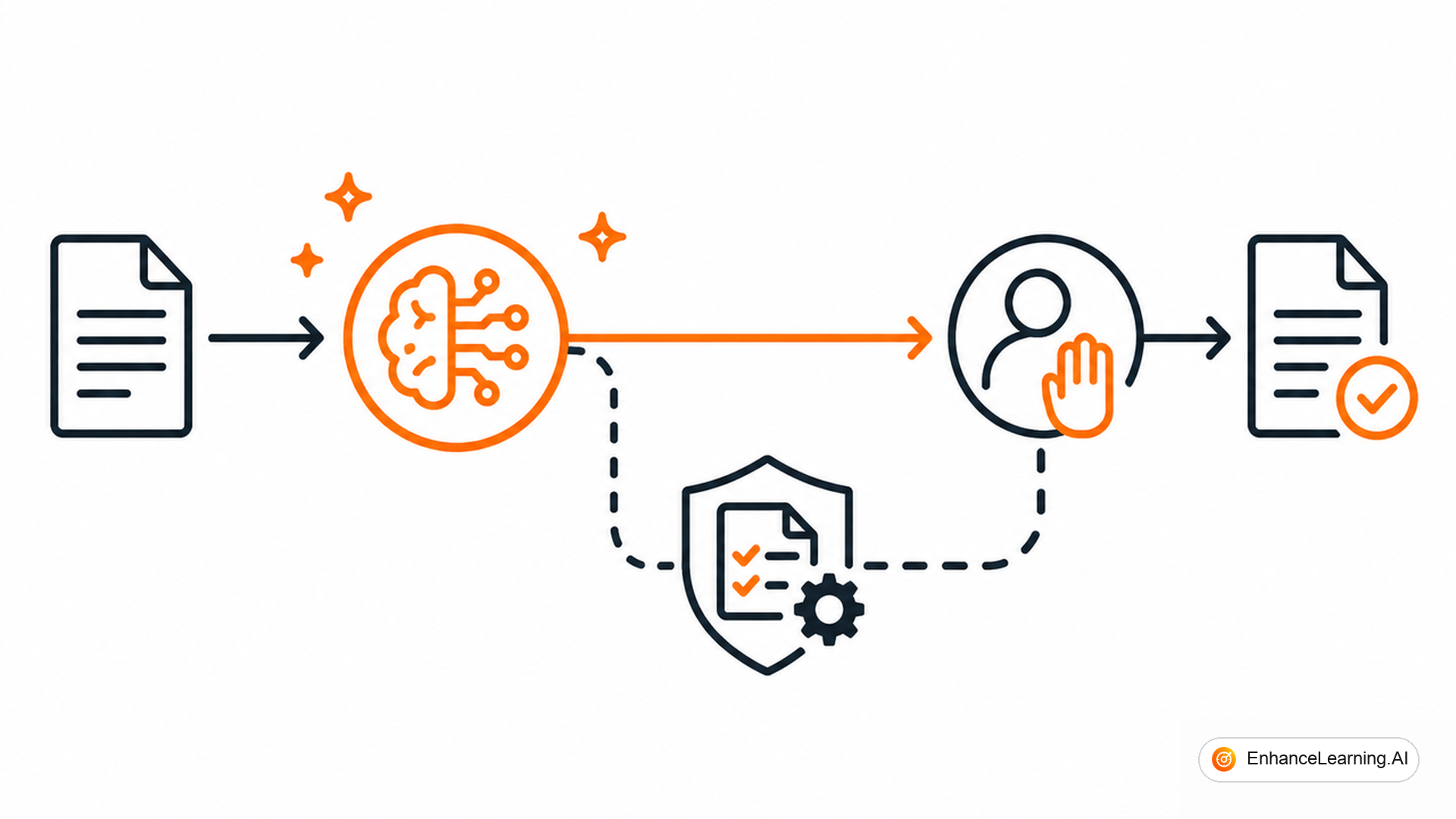
The model timed out. The user stares at a spinner, then at "Something went wrong. Try again." They try again. The model loops. They open a ticket. Your AI feature just became a support cost center. Fallback is not an apology string at the bottom of a catch block. In AI-native systems, fallback is a designed layer — multiple degraded modes with explicit triggers, contracts, and ownership — so failure reduces capability instead of destroying the workflow.
Teams that treat fallback as an afterthought ship brittle copilots. Teams that architect it ship systems that stay useful on bad model days, bad retrieval days, and bad network days.
Fallback triggers: more than exceptions#
Classical fallbacks trigger on errors: timeout, 503, parse failure. AI-native fallbacks also trigger on quality signals:
- Model confidence below threshold
- Schema validation failure after bounded retries
- Retrieval miss or low relevance score
- Tool policy denial
- Eval judge rejection in production sampling
- Cost or latency budget exhaustion
Each trigger should map to a specific degraded mode, not a generic handler. Mapping belongs in configuration you can test, not tribal knowledge in the on-call channel.
| Trigger | Bad fallback | Good fallback |
|---|---|---|
| Provider 503 | Infinite client retry | Cached answer or rule path + incident flag |
| Low confidence | Show guess anyway | Clarifying question or human queue |
| Schema failure after 2 retries | Empty 500 | Template response with partial safe fields |
| Retrieval empty | Model improvises | "No sources found" + search tips + ticket link |
| Step budget hit | Truncate mid-sentence | Summarize progress + offer continue or escalate |
Layers of the fallback stack#
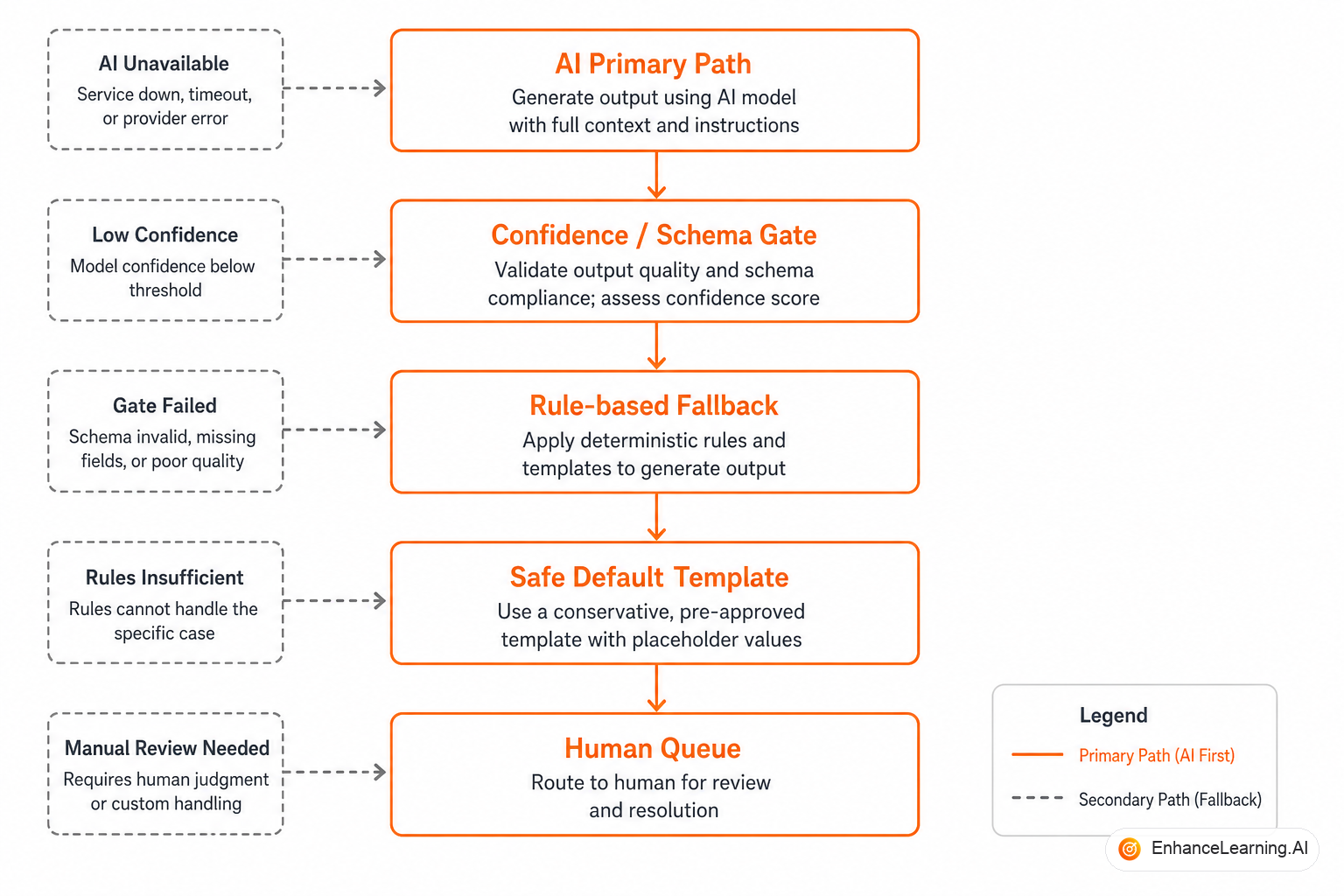
Think of fallback as a ladder. Climb down deliberately:
Layer 1 — Retry with repair. Same model, tightened prompt, schema error fed back. Cap at two attempts. This is not fallback yet; it is recovery. Uncapped retries are cost leaks.
Layer 2 — Smaller or alternate model. Cheaper model for classification; local classifier for routing only. Trade quality for availability with explicit UX labeling when appropriate.
Layer 3 — Retrieval-only mode. Return ranked sources with minimal synthesis. Users still get value; hallucination surface shrinks.
Layer 4 — Rule-based path. Decision tables, regex guards, static templates for high-volume intents. Boring, auditable, fast.
Layer 5 — Human queue. Preserve full trajectory, pre-fill agent screen, SLA for pickup. The user is not stuck; the AI bowed out gracefully.
Skipping layers — jumping from Layer 1 failure straight to "error" — wastes options that would have satisfied the user.
Safe defaults and fail-closed writes#
Fallback architecture must distinguish read paths from write paths.
Reads can degrade generously: show FAQ, show last cached summary, show sources.
Writes must fail closed: no refund, no access grant, no record update unless confidence and validation pass. A safe default for writes is often "do nothing and escalate" — not "best effort."
import { z } from "zod";
const RefundProposal = z.object({
orderId: z.string().uuid(),
amountCents: z.number().int().positive(),
reasonCode: z.enum(["damaged", "late", "duplicate"]),
confidence: z.number().min(0).max(1),
});
type FallbackRoute =
| { mode: "auto_apply"; proposal: z.infer<typeof RefundProposal> }
| { mode: "human_review"; draft: unknown; traceId: string }
| { mode: "deny"; message: string };
export function routeRefund(proposal: unknown, traceId: string): FallbackRoute {
const parsed = RefundProposal.safeParse(proposal);
if (!parsed.success) {
return { mode: "human_review", draft: proposal, traceId };
}
const p = parsed.data;
if (p.confidence < 0.85 || p.amountCents > 10_000) {
return { mode: "human_review", draft: p, traceId };
}
if (p.reasonCode === "duplicate" && p.amountCents > 5_000) {
return { mode: "human_review", draft: p, traceId };
}
return { mode: "auto_apply", proposal: p };
}
Policy thresholds live in code. The model proposes; the router disposes. Fallback for writes means human review with context — not silent auto-apply with lower confidence.
Degraded mode is a product surface#
Degraded UX patterns that work:
- Label the mode — "Quick answer from our help library" vs "Personalized analysis"
- Offer escalation — one tap to human with trace attached
- Preserve partial work — draft saved when the loop aborts
- Set time expectations — "An agent will continue this within 4 hours"
Hiding degradation breeds distrust when users compare answers across sessions. Transparency is cheaper than reputation repair.
If your integration tests always mock a successful model response, your fallback ladder rots. Add fixtures for timeout, schema failure, empty retrieval, and low confidence. Assert the routed mode, not just HTTP 200. Fallback code paths without tests are production incidents waiting for a provider blip.
Caching as fallback, not fraud#
Cached responses are legitimate fallback for stable, low-risk content: policy snippets, shipping FAQs, product specs. Cache keys must include locale, product version, and authorization scope — not just user question hash.
Never cache personalized write proposals or medical/legal advice without explicit TTL and review. A stale cached summary of return policy is fine. A stale cached eligibility decision is not.
Observability for the ladder#
Log every fallback transition with:
- Trigger reason (enum, not free text)
- Layer selected
- Latency and cost saved vs full path
- User continuation (accepted degraded answer vs escalated)
Dashboards should show fallback rate by layer — spikes in Layer 5 mean model or retrieval pain; spikes in Layer 4 alone might mean confidence thresholds miscalibrated.
Anti-patterns#
- Fallback = same prompt, higher temperature — chaos is not redundancy
- Silent switch to rules — users trust uniform UX; label when behavior changes materially
- Human queue as black hole — no SLA, no trace attachment, angry users
- One global fallback function — different workflows need different ladders
Coordinating fallbacks across teams#
When retrieval, orchestration, and tool services belong to different teams, fallback ladders break at handoffs. Document cross-service fallback contracts: if retrieval returns empty, orchestrator must not call synthesis with force=true; if gateway marks provider degraded, orchestrator skips Layer 1 retry and jumps to Layer 3.
An incident Slack thread is not a handoff contract. Typed return codes and integration tests are.
Cost-aware fallback#
Cheaper paths are not only for outages. High-volume workflows should route low-risk queries to rules first, promoting to model only when rules abstain — inverse fallback, sometimes called a cascade. That architecture cuts cost without eliminating AI where it matters.
Track spend saved per fallback layer. Finance and engineering should agree that Layer 4 handling 30% of traffic is success, not failure — if those queries were low-value classification.
Fallback configuration as code#
Encode ladders in versioned config — not scattered if-statements:
from dataclasses import dataclass
from enum import Enum

class FallbackLayer(Enum):
    RETRY = 1
    SMALL_MODEL = 2
    RETRIEVAL_ONLY = 3
    RULES = 4
    HUMAN = 5

@dataclass
class LadderStep:
    layer: FallbackLayer
    trigger: str  # e.g. "provider_503", "confidence_lt_0.7"
    max_latency_ms: int

DEFAULT_LADDER: list[LadderStep] = [
    LadderStep(FallbackLayer.RETRY, "schema_fail", 4000),
    LadderStep(FallbackLayer.RETRIEVAL_ONLY, "retrieval_empty", 2000),
    LadderStep(FallbackLayer.RULES, "confidence_lt_0.7", 500),
    LadderStep(FallbackLayer.HUMAN, "always", 0),
]
Review ladder changes like API changes — because they are user-visible behavior changes.
Fallback drills#
Schedule quarterly fallback drills the same way you drain databases or fail AZs. Inject provider 503, force empty retrieval, drop confidence scores in staging, verify the ladder produces labeled degraded UX and correct routing to humans.
Drills expose missing config — orchestrator that throws because RULES path was never wired — before customers find it. Document drill results; stale ladders are a lifecycle problem, not a one-time design problem.
Product and legal alignment on degraded copy#
Legal teams sometimes block degraded-mode copy that admits uncertainty — "I am not sure" feels off-brand. Architecture needs pre-approved fallback phrase libraries for each layer, same as error strings in classical apps. Negotiate them before launch, not during an outage when counsel is asleep and marketing is paging you.
Summary#
Fallback architecture in AI-native systems is a stack of degraded modes — retries, alternate models, retrieval-only, rules, humans — each triggered by explicit signals beyond HTTP errors. Safe defaults fail closed on writes, generous on reads. Degraded mode is part of the product experience, not an engineering secret. Design the ladder before you need it, test it in CI, and instrument transitions so you know which fallback layer users land on when models fail. A copilot that gracefully steps aside beats one that confidently lies or vanishes.
Want premium architecture blueprints?
Be among the first to explore interactive reference architectures, implementation playbooks, and premium engineering resources at launch.
Related Articles
Recommended reading based on this topic.
Why AI-Native Systems Need Different Failure Models
AI-native failures are graded — partial outputs, silent errors, confident wrong answers. Binary failure models miss the damage until trust is gone.
Read ArticleThe Hidden Coupling Between Prompts and AI System Architecture
Prompt length, role structure, and tool definitions leak into service boundaries, data flows, and API contracts — coupling teams thought was decoupled.
Read ArticleEngineering Principles for Reliable AI-Native Products
Structured outputs, tool reliability, layered guardrails, and predictable failure — the principles that separate durable AI-native products from fragile demos.
Read Article