
The AI Engineering Stack: Where Reliability, Tools, and Outputs Meet
Map structured outputs, tool calling, guardrails, and reliability controls into one stack — how AI engineering decisions connect across an AI-native feature.
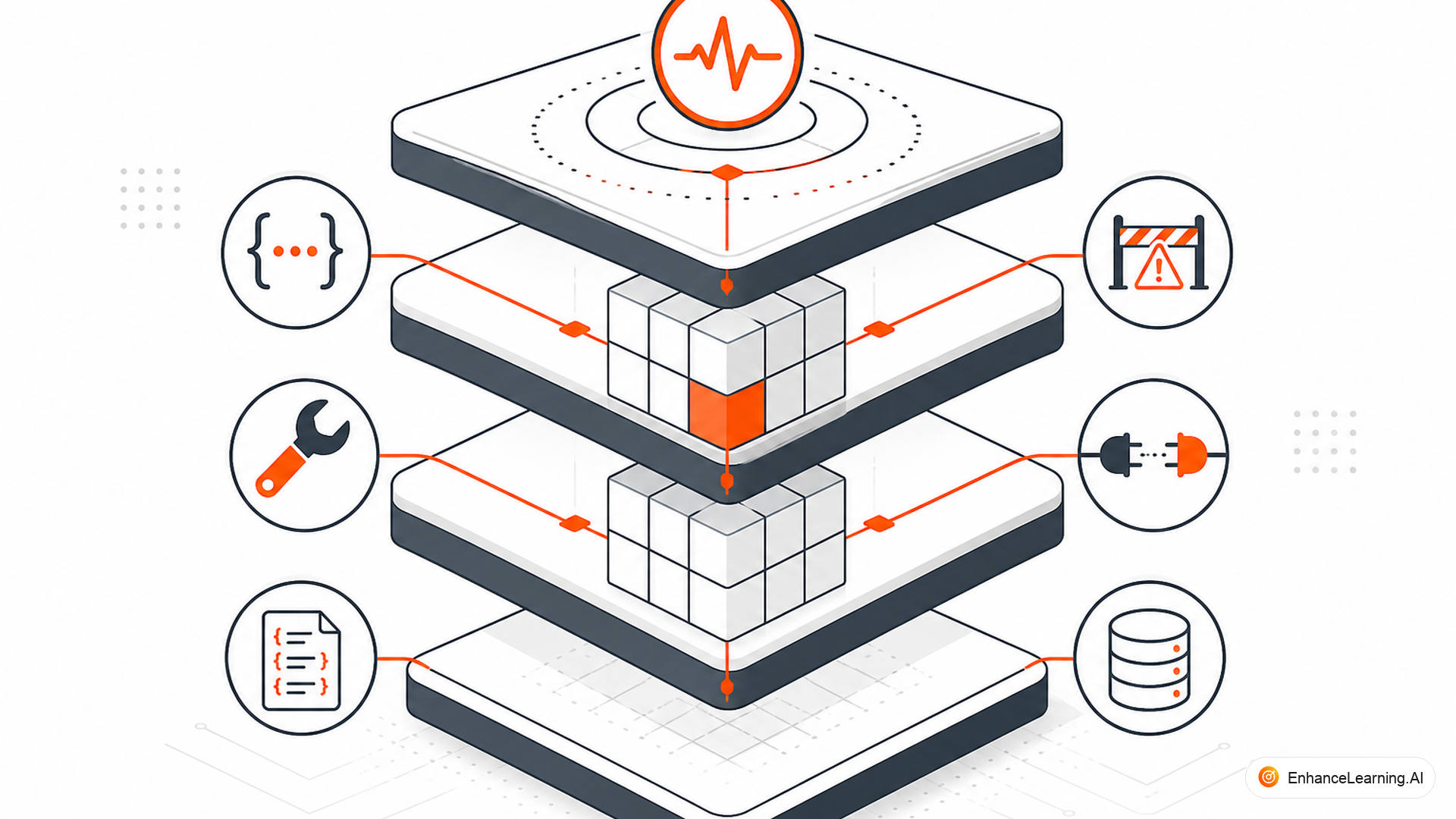
Most AI features fail in the seams. Structured output is solid in isolation. Tools work in a notebook. Guardrails exist as a slide. Reliability is someone else's on-call problem. Then you wire them into one request path and discover that a schema pass does not stop a dangerous tool call, a tool allowlist does not fix silent truncation, and retries without idempotency double-charge a customer. AI engineering is the discipline of making those layers meet — not collecting them as unrelated best practices.
Why a stack beats a checklist#
Checklists list virtues. Stacks show dependencies. In AI-native systems, lower layers constrain what upper layers can safely do:
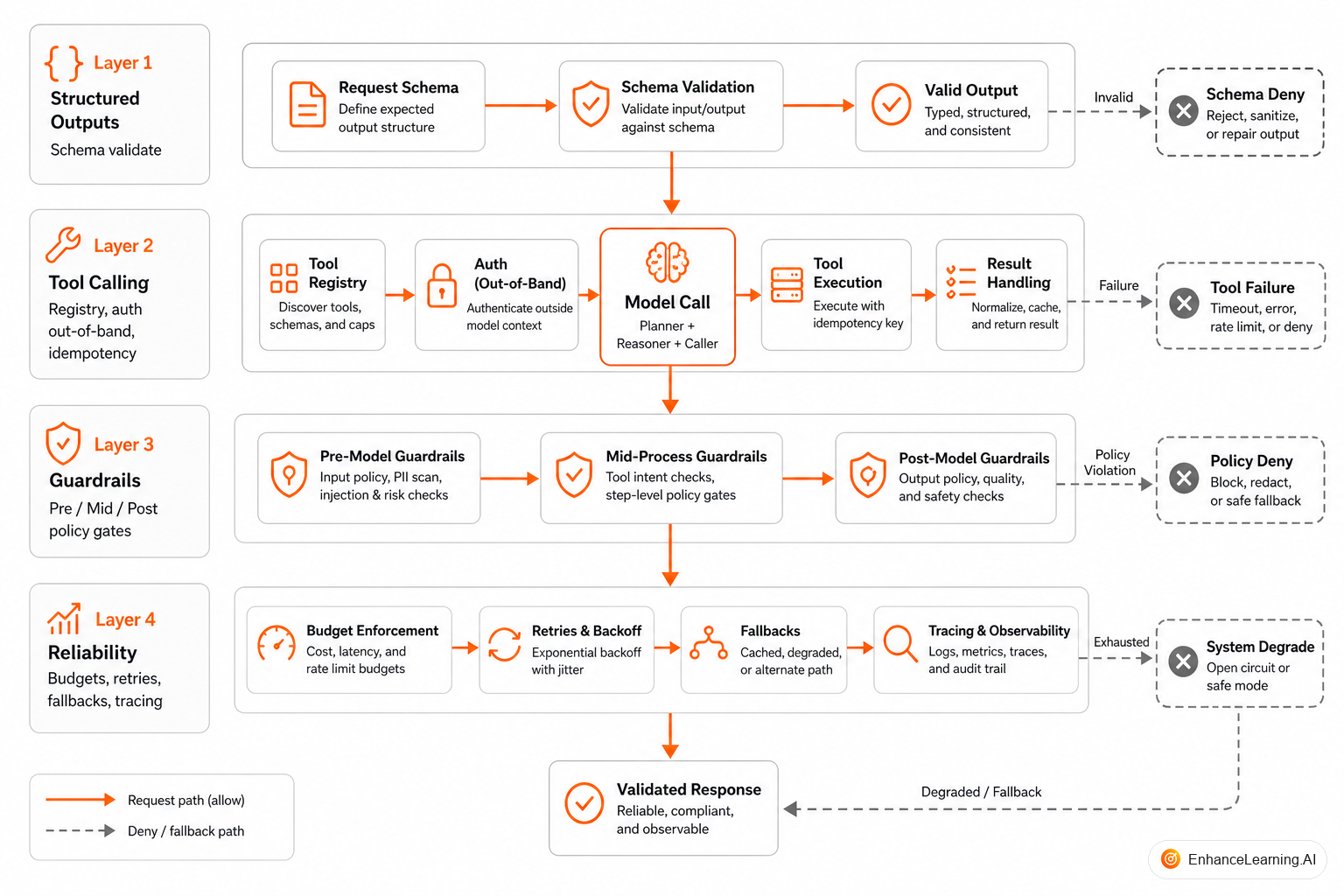
- Structured outputs make model results machine-checkable.
- Tool calling turns those results into side effects — under contracts.
- Guardrails decide what is allowed before and after the model acts.
- Reliability controls keep the path bounded when the model or tools misbehave.
Skip a layer and the others lie to you. Perfect JSON of a refund the policy forbids is still a breach. A safe refusal with no timeout still burns your p99. Treat the stack as one product surface.
Layer 1 — Structured outputs#
The model proposes; your code accepts only what validates. Prefer schemas over "return JSON please." Validation failures are first-class outcomes: retry with repair, degrade, or refuse — never parse-and-hope.
from pydantic import BaseModel, ValidationError

class TicketAction(BaseModel):
    action: str  # "reply" | "escalate" | "close"
    reason_code: str
    customer_visible: bool

def accept_action(raw: dict) -> TicketAction:
    try:
        return TicketAction.model_validate(raw)
    except ValidationError as e:
        raise ValueError(f"schema_reject:{e.error_count()}") from e
Structured output is not the whole stack. It is the interface every other layer should speak. Tools should consume typed args. Guardrails should inspect fields, not paragraphs. Reliability metrics should count schema_reject separately from model latency.
Layer 2 — Tool calling#
Tools are where AI leaves the sandbox. Engineering here is contract work: names, schemas, auth scope, idempotency keys, timeouts, and what "success" means when the upstream is eventually consistent.
| Concern | Weak practice | Stack practice |
|---|---|---|
| Discovery | Paste OpenAPI into the prompt | Machine-readable tool registry |
| Auth | Model sees secrets | Host injects credentials out of band |
| Side effects | Fire on first proposal | Allowlist + budget + confirm for privileged |
| Failure | Retry blindly | Classify retryable vs permanent; compensate |
The model chooses among tools you exposed. You own the blast radius. If a tool can move money, structured output of { "tool": "refund" } is necessary but not sufficient — the guardrail and reliability layers must still gate it.
Layer 3 — Guardrails#
Guardrails are policy made executable: input filters, output checks, tool allowlists, PII redaction, rate and spend caps, human approval for irreversible actions. They sit around the model, not only after it.
A useful split:
- Pre-model — prompt injection hygiene, tenant isolation of retrieved context, max context size.
- Mid-loop — step budgets, tool permission checks, schema validation before side effects.
- Post-model — toxicity/PII scans, citation requirements, business-rule validators.
A single "safety filter" after generation will not catch tool abuse that already happened. Put enforcement at the moment of risk — especially before privileged tools.
type ToolCall = { name: string; args: Record<string, unknown> };

function enforceToolPolicy(
  call: ToolCall,
  policy: { allow: Set<string>; maxRefundCents: number },
): "allow" | "deny" | "confirm" {
  if (!policy.allow.has(call.name)) return "deny";
  if (call.name === "issue_refund") {
    const amount = Number(call.args.amount_cents ?? 0);
    if (amount > policy.maxRefundCents) return "confirm";
  }
  return "allow";
}
Layer 4 — Reliability controls#
Reliability is how the stack behaves under failure: timeouts, retries with jitter, circuit breakers, fallback models, degraded modes (retrieval-only answers, human queue), and explicit stop conditions for agent loops.
AI-specific reliability needs:
- Budgeted nondeterminism — max steps, max tokens, max tool calls per request.
- Classified errors — schema reject ≠ tool 503 ≠ policy deny.
- Idempotent side effects — retries must not duplicate refunds or emails.
- Observable outcomes — traces that join model, tools, and gate decisions.
Without this layer, the other three look fine in demos and melt under load.
How the layers meet on one request#
Walk a support-agent turn:
- Retrieve context (tenant-scoped) — pre-model guardrail.
- Model proposes a structured
TicketActionplus optional tool call. - Schema validation — structured output layer.
- Tool policy check — guardrail at side-effect boundary.
- Execute tool with timeout + idempotency key — reliability.
- Post-checks on customer-visible text — guardrail.
- Emit metrics: schema_ok, policy_deny, tool_latency, task_success — reliability feedback into evals.
If any step has no owner, that seam becomes the failure you discover in production.
Design practices that keep the stack coherent#
- One registry for schemas and tools — versioned, reviewed, not copy-pasted per feature.
- Policy next to tools, not in prompt prose alone — prompts explain; code enforces.
- Separate SLOs for model latency, tool latency, and end-to-end task success.
- Fail closed on privileged paths; fail open only for low-risk assistive UX with clear labeling.
- Eval the seams — golden cases that assert schema, policy, and tool outcomes together, not only answer style.
Anti-patterns that break the seams#
Schema theater. You validate JSON in staging, then ship a prompt change that drops a required field and catch it only when a tool adapter throws at 2 a.m. Wire schema failures into the same alerts as 5xxs.
Prompt-as-policy. "Never refund over $50" lives only in the system prompt. An injection or a confused model will ignore it. Encode the cap in enforceToolPolicy (or equivalent) and keep the prompt as explanation, not enforcement.
Unbounded retries. A 429 from the model gateway plus a non-idempotent email tool equals duplicate messages. Classify errors; attach idempotency keys; cap attempts.
Observability that stops at token count. Token spend without policy_deny rate, schema_reject rate, and tool error class is vanity. Reliability needs outcome labels, not just cost dashboards.
One giant "AI service". When structured output, tools, and gates live in one undifferentiated module, nobody owns a layer. Split by stack layer even if they deploy together — ownership maps to failure modes.
Who owns which layer#
| Layer | Typical owner | Shared with |
|---|---|---|
| Structured outputs | Feature / platform eng | Data contracts team |
| Tool calling | Platform + system owners | Security (scopes) |
| Guardrails | Security + product policy | Legal/compliance for classes |
| Reliability | Platform / SRE | Feature owners for SLOs |
If your org chart has "the AI person" owning all four, you will ship demos and operate incidents. The stack is cross-functional by design.
What this stack is not#
It is not "prompt engineering with extra steps." Prompt craft lives inside the model call; AI engineering owns the machinery around it. It is also not AppSec alone — though identity and permissions plug into the guardrail layer. And it is not MLOps alone — training pipelines matter, but this stack is about serving correct, bounded behavior for each user request.
Summary#
Structured outputs, tool calling, guardrails, and reliability controls only work when they form one stack: schemas make outputs checkable, tools turn checks into actions, guardrails bound those actions, and reliability keeps the path alive under stress. Map every AI-native feature against these four layers. If a layer is a slide instead of a code path, that is where production will invent a failure mode for you.
Want premium architecture blueprints?
Be among the first to explore interactive reference architectures, implementation playbooks, and premium engineering resources at launch.
Related Articles
Recommended reading based on this topic.
Engineering Principles for Reliable AI-Native Products
Structured outputs, tool reliability, layered guardrails, and predictable failure — the principles that separate durable AI-native products from fragile demos.
Read ArticleHarness Engineering for Reliable Agents
The agent harness is the real product: tools, permissions, state, stops, and telemetry around a thin model call.
Read ArticleThe Architecture of Fallback in AI-Native Systems
When models fail or confidence drops, AI-native systems need layered fallbacks — rule engines, cached answers, human queues — not generic error messages.
Read Article