
Why Schema Validation is Non-Negotiable for AI Outputs
Make schema validation a hard gate before any LLM output reaches another system — catch fluent mistakes before they become tickets or refunds.
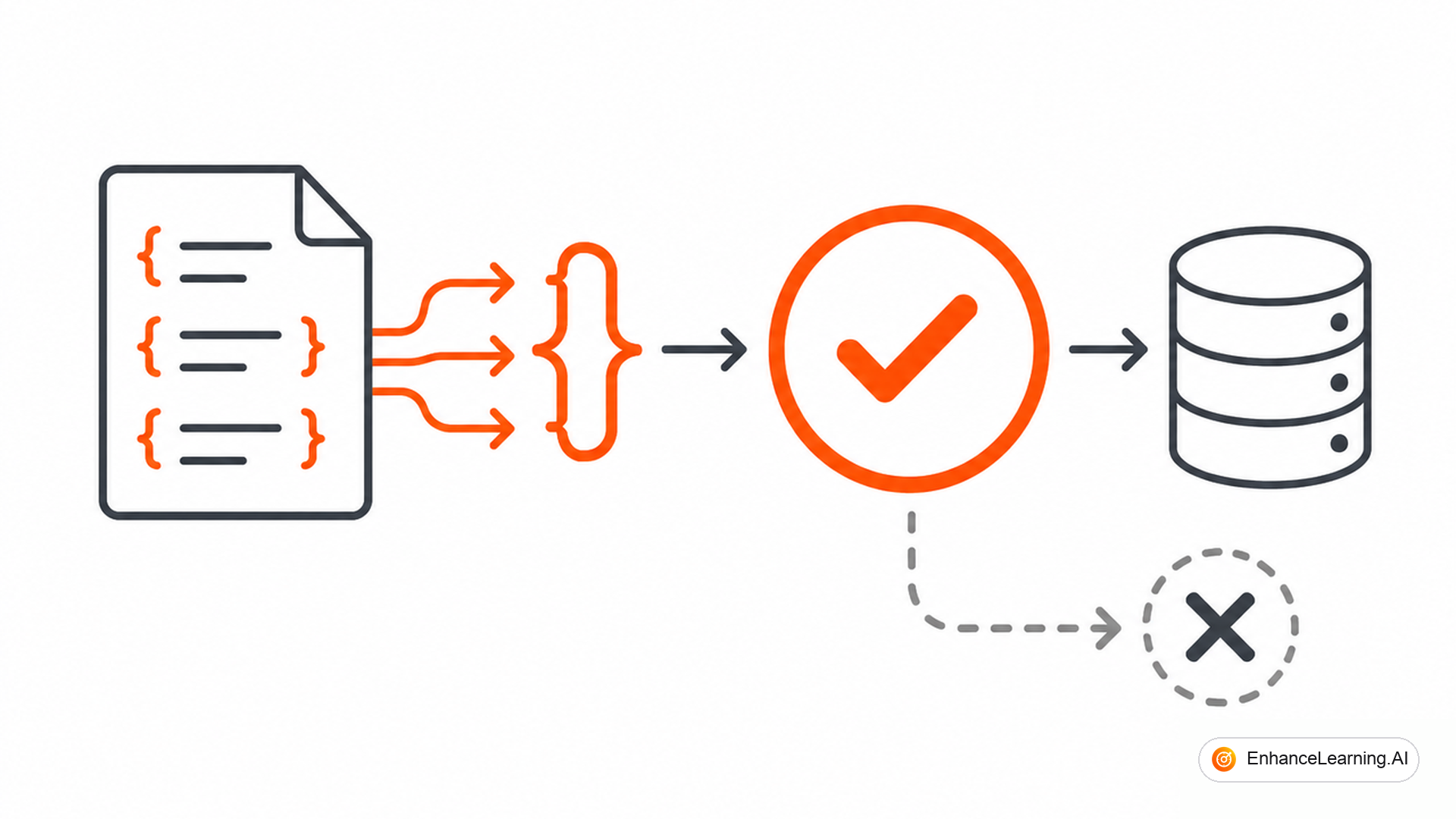
Models speak fluently even when they are wrong. That is exactly why schema validation is non-negotiable for any output that another component will trust. Validation is not pedantry. It is the line between a drafting aid and a system that can file tickets, move money, or change access without inventing fields that never existed.
Teams skip validation for understandable reasons: it feels slow, the model "usually" returns good JSON, and provider structured-output modes promise syntax guarantees. All three reasons age poorly. The model that usually returns good JSON will eventually return bad JSON on the request that matters most — the one at 2 a.m. with a real refund attached. Validation is how you sleep through that night.
The failure mode validation prevents#
Without a schema gate, a model can:
- Omit required fields (
amountmissing on a refund) - Invent enums (
status: "kinda_approved") - Swap types (
quantity: "two") - Smuggle prose into JSON (
{"id": 12, "note": "sure, go ahead"}) - Return extra fields that downstream code ignores until someone depends on them
- Nest structures incorrectly (
items: "widget, gadget"instead ofitems: ["widget", "gadget"])
Downstream code then either crashes or — worse — coerces garbage into a write. Fluent garbage is the expensive kind. A crash at least alerts someone. A silent coercion writes the wrong data and nobody notices until reconciliation.
Production scenario: an expense approval agent returns {"approved": true, "amount": "five hundred dollars", "approver": "system"}. The fragile pipeline stores amount as a string in a numeric column — the database coerces it to zero or throws depending on the engine. The reliable pipeline rejects the payload at validation, logs the failure, and routes to a human approver. The customer never sees a phantom approval for $0.
Validation is preventive, not post-hoc cleanup#
Post-hoc cleanup means: run the tool, notice the mess, apologise. Preventive validation means: no side effect until the payload is legal. That single ordering change eliminates a class of incidents.
The ordering matters more than the validator library. Teams that validate "after the write" — logging the error but not rolling back — have the shape of engineering without the substance. If execute_refund runs before model_validate_json, you do not have AI engineering. You have hope.
from pydantic import BaseModel, ValidationError, Field

class RefundRequest(BaseModel):
    ticket_id: str
    amount_cents: int = Field(gt=0, le=50000)
    currency: str
    reason_code: str

def handle_model_json(raw: str, execute_refund) -> str:
    try:
        req = RefundRequest.model_validate_json(raw)
    except ValidationError as e:
        return f"REJECTED: {e.error_count()} schema issues"
    return execute_refund(req)
Walk through what this code actually protects. amount_cents must be an integer between 1 and 50,000 — no strings, no floats, no negatives, no amounts that exceed your policy ceiling. reason_code must be present — the model cannot approve a refund without stating why. ticket_id must be a string — not an integer the model guessed, not a description. Every constraint maps to a business rule someone decided. The schema is where product policy becomes executable code.
What "strict" actually means#
Strict validation includes:
- Required fields — no silent defaults for money or identity
- Enums and ranges — closed sets for statuses and reason codes
- Referential checks — IDs that must exist in your systems
- Cross-field rules — e.g. partial refund cannot exceed original
- Size limits — prevent prompt-injection-sized blobs in string fields
- Type precision — integers where integers belong; no implicit coercion
JSON parse success is the floor, not the ceiling. json.loads('{"amount": "500"}') succeeds. Your business logic fails. Strict validation catches the difference.
| Validation level | What it catches | What it misses |
|---|---|---|
| JSON parse only | Syntax errors | Wrong types, missing fields, invented enums |
| Schema (types + required) | Type errors, missing fields | Business rules, referential integrity |
| Schema + enums/ranges | Invalid statuses, out-of-range amounts | Cross-field logic, existence checks |
| Schema + referential + cross-field | Most production failures | Adversarial inputs that pass all rules |
Aim for the row that matches your blast radius. Refund flows need the bottom row. Internal draft summaries might survive the second row — but only if they never trigger side effects.
Where to put the gate#
| Placement | Verdict |
|---|---|
| Inside the prompt only | Insufficient |
| Client-side "trust the model" | Dangerous |
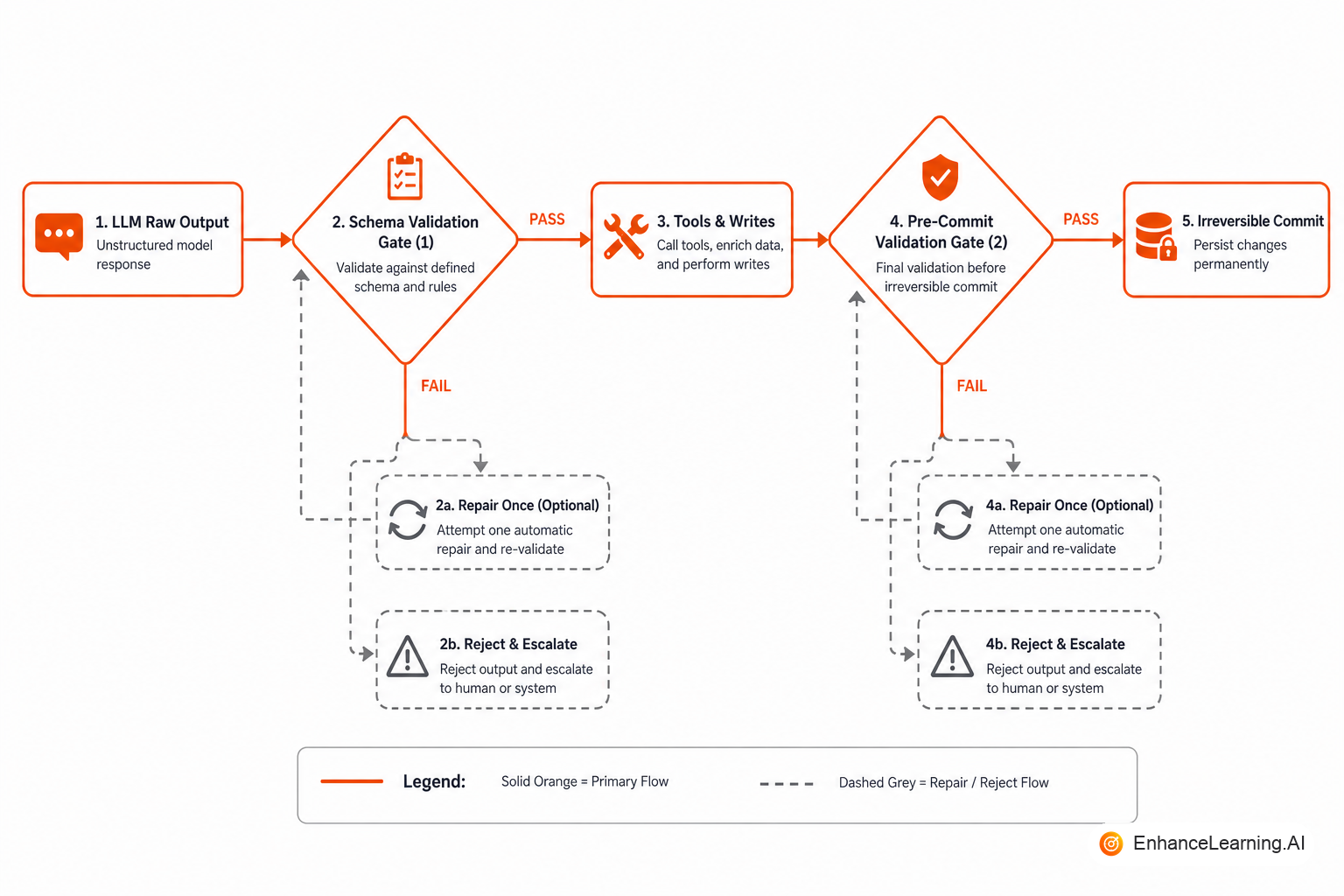
| Immediately after model response, before tools | Required |
| Again before irreversible commits | Required for high risk |
| At the API boundary (ingress from external agents) | Required if third parties call your model |
Defence in depth: validate at the model boundary and at the write boundary. The first gate catches model errors. The second gate catches bugs in your own pipeline — a transformation step that drops a field, a race condition that corrupts a payload, a code path that bypasses the first gate.
Provider JSON modes reduce syntax failures. They do not guarantee your business invariants. Keep application-level schema checks.
Repair vs reject#
Sometimes you allow one constrained repair pass: "fix JSON to match schema; do not change meaning." Cap repairs (usually one). If still invalid → escalate or safe fallback. Endless repair loops are just retries that burn tokens.
| Strategy | When to use | When to avoid |
|---|---|---|
| Reject immediately | High-blast-radius actions (refunds, access changes) | Low-stakes drafts where retry is cheap |
| Single repair pass | Occasional syntax errors on otherwise correct content | Systematic schema mismatches |
| Resample (new model call) | Transient failures, truncation | Business rule violations the model keeps repeating |
| Escalate to human | Repair and resample both failed | Never — always have this as the final fallback |
The repair prompt must be constrained. "Fix the JSON" is fine. "Fix the JSON and also decide if the refund is fair" is a new task disguised as a repair — and it will produce new errors.
Schema ownership#
Schemas need owners, versioning, and changelog notes — like APIs. When product adds a field, update schema, validators, evals, and prompts in one change. Orphan schemas rot into false confidence.
Treat your schema as a published contract:
- Version it —
RefundRequestV2addspartial: bool; V1 remains supported for thirty days - Changelog it — "Added
partialfield; required when amount < original" - Test it — golden cases for every field, plus a reject set that must fail (missing fields, bad enums, oversize strings, wrong types). If a reject case passes, the schema has a hole — fix the schema, not the test
- Own it — a named engineer approves schema changes, not whoever merged the PR
When schemas drift from prompts, validation failures spike. That spike is a signal — not noise to suppress by widening the schema. Investigate the drift. Either the prompt is wrong or the schema is wrong. One of them needs to change deliberately.
Validation in multi-step pipelines#
Single-call validation is the baseline. Multi-step agents need validation at every hop — not just the final output.
Example: a research agent plans steps, executes searches, then synthesises a report. Validate the plan schema before executing any search. Validate each search result schema before feeding it to synthesis. Validate the final report schema before storing it. A bad plan that passes through unchecked wastes tool calls. A bad synthesis that passes unchecked wastes the user's trust.
Each hop's schema should be independently testable. Do not rely on the final validation to catch errors introduced three steps earlier — by then, the damage (wasted tokens, wrong search queries, polluted context) is already done.
The cheapest place to catch an invalid payload is immediately after the call that produced it — before it enters shared context or triggers downstream work.
Summary#
Schema validation is the cheapest reliability control in AI-native systems. Put it between every model response and every side effect. Make it strict, owned, versioned, and tested with intentional failures. Fluency is not correctness — the schema gate is where engineering begins.
If you take one action this week: audit every model call that can cause a write. For each one, verify that a typed schema sits between the model response and the side effect. Any gap you find is not technical debt — it is an incident waiting for the wrong input.
Want premium architecture blueprints?
Be among the first to explore interactive reference architectures, implementation playbooks, and premium engineering resources at launch.
Related Articles
Recommended reading based on this topic.
Building Retry Logic for LLM Structured Output Failures
Retry structured LLM outputs without burning cost or latency. Separate retriable parse failures from schema bugs that need a fix, not another loop.
Read ArticleEngineering Principles for Reliable AI-Native Products
Structured outputs, tool reliability, layered guardrails, and predictable failure — the principles that separate durable AI-native products from fragile demos.
Read ArticleThe AI Engineering Stack: Where Reliability, Tools, and Outputs Meet
Map structured outputs, tool calling, guardrails, and reliability controls into one stack — how AI engineering decisions connect across an AI-native feature.
Read Article