
Explicit vs Implicit Memory Formation in AI
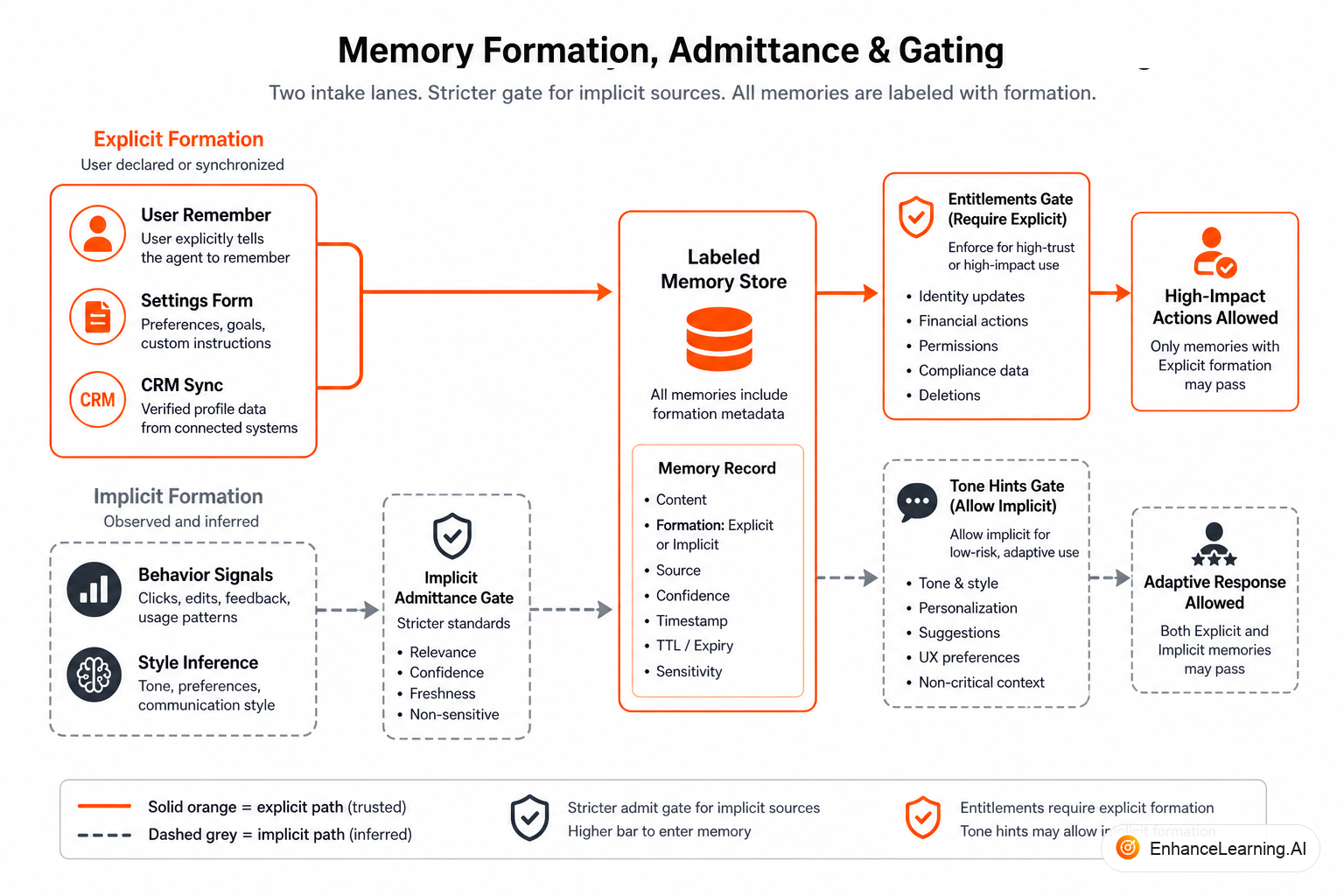
Explicit memory is what users or systems deliberately store. Implicit memory is inferred from behavior. Mixing them without labels breaks trust and consent.

A user types "please remember I prefer email." That is explicit memory formation — clear consent, clear content. Later the same assistant quietly writes prefers_short_answers=true because the user sent three one-line replies. That is implicit formation. Both can be useful. Only one was requested. When product, legal, and the model treat them identically, you get creepy personalization and un-debuggable behavior.
Explicit formation: deliberate writes#
Explicit memory enters the store because a person or trusted system said so:
- User: "Remember that…"
- UI checkbox / settings form
- CRM sync or verified webhook
- Agent tool
memory.writeafter a confirmation turn
Properties you should expect: clear provenance, higher trust for privileged actions, straightforward "forget this" mapping, easier explainability ("you asked us to save this on March 2").
Implicit formation: inferred writes#
Implicit memory is inferred from behavior or conversation without a direct store instruction:
- Sentiment and style preferences from reply length
- Likely locale from timezone and phrasing
- "Probably has children" from side comments
- Topic interests from repeated clicks
Properties: higher error rate, consent ambiguity, harder explanation ("why do you think that?"), greater regulatory sensitivity. Implicit writes need stricter admission, lower default confidence, and often an opt-in.
Why the distinction is architectural, not philosophical#
| Dimension | Explicit | Implicit |
|---|---|---|
| Trigger | Direct instruction or SoR sync | Model/rules infer from signals |
| Default confidence | High | Low–medium |
| Consent story | Strong | Weak unless disclosed + opted in |
| Safe for entitlements? | Often yes | Rarely |
| User correction | Edit/delete named item | Must expose inferred items too |
If your store does not label formation=explicit|implicit, every consumer must assume the worst — or, more commonly, assumes the best and ships a trust incident.
Inferring sensitive attributes (health, politics, children, finances) from chat side-channels is a product decision with legal weight. Default to not writing those classes unless policy explicitly allows and discloses.
Detection: how systems infer implicit memories#
Implicit formation usually runs on signals explicit formation never sees:
- Interaction patterns — message length, response latency, channel preference inferred from open rates
- Co-occurrence — repeated topic clusters across sessions
- Third-party enrichment — timezone → likely region (fragile, disclose if used)
- Extractor prompts — "infer preferences from this transcript" run without user visibility
Each path needs its own admission threshold. A single infer_memories() call that writes everything the model notices is how shadow profiles appear.
Explicit signals you should still treat carefully#
"Remember that…" is explicit, but content may be wrong or temporary. "Remember I'm never available on Tuesdays" vs "remember my bonus target is confidential" — formation is explicit; admission policy may still reject or quarantine. Explicit ≠ always durable.
Implement formation type as a first-class field#
from dataclasses import dataclass
from typing import Literal

Formation = Literal["explicit", "implicit"]

@dataclass
class MemoryWrite:
    user_id: str
    key: str
    value: str
    formation: Formation
    confidence: float
    source_ref: str

SENSITIVE_PREFIXES = ("health.", "finance.", "family.", "politics.")

def admit(write: MemoryWrite, *, implicit_opt_in: bool) -> bool:
    if any(write.key.startswith(p) for p in SENSITIVE_PREFIXES):
        return write.formation == "explicit"
    if write.formation == "implicit" and not implicit_opt_in:
        return False
    if write.formation == "implicit" and write.confidence < 0.7:
        return False
    return True

def prompt_label(write: MemoryWrite) -> str:
    tag = "saved by you" if write.formation == "explicit" else "inferred"
    return f"- [{tag}] {write.key}: {write.value}"
Surface inferred items in a "What we think we know" settings panel. If users cannot see and delete implicit memories, you do not have a serious memory product — you have a shadow profile.
UX and consent patterns that work#
- Opt-in for behavioral personalization — separate toggle from core service; default off in regulated industries.
- Inline confirmation for high-impact explicit writes — "Save email as your preferred contact?" before durable write.
- Periodic memory review — quarterly nudge: "Here's what we've saved. Remove anything wrong."
- Formation badges in internal traces — when debugging a bad action, see whether the influencing row was explicit or inferred.
Avoid dark patterns: pre-checked "allow us to learn from your conversations" buried in terms of service is not meaningful consent for implicit sensitive inference.
When implicit formation is worth the risk#
Implicit memory earns its place for low-stakes continuity: response length, formatting preferences, likely timezone for scheduling suggestions. The trade-off is error rate vs friction. Asking "do you prefer brief answers?" every session is worse UX than inferring — until the inference is wrong and the user feels misread. Mitigate with low prompt weight, easy override ("actually, give me the long version"), and short TTLs. Never let implicit formation drive access control, billing, or compliance decisions.
Agent behavior differences#
- Tools that spend money or change access should require explicit (or CRM) formation.
- Tone / style hints can use implicit formation with low weight and easy override.
- Conflict: explicit always beats implicit on the same key.
- Exports: include formation type so DSAR responses are honest.
Multi-agent and shared memory#
When several agents share a user memory store, formation labels prevent one agent's implicit inference from binding another. A research agent inferring "user is technical" should not cause a billing agent to skip plain-language explanations unless the user opted in. Namespace keys by agent role or propagate formation to read gates.
Regulatory and audit implications#
DSAR and deletion requests must cover implicit rows, not just user-named saves. If you cannot list inferred attributes, you cannot honestly respond to "what data do you hold about me?"
Audit logs should record formation type on write and on any action where memory influenced a decision. Post-incident, "the agent used an inferred preference" vs "the user explicitly saved this" changes remediation and comms.
TTL and retention by formation#
Explicit profile fields often need long retention — users expect saved preferences to persist until they delete them. Implicit inferences should expire faster unless refreshed by repeated signal. A six-month-old inferred "prefers brief answers" from three short replies is stale continuity, not personalization. Default implicit TTLs of 30–90 days with refresh-on-signal reduce shadow-profile drift and shrink DSAR surface area.
Design checklist#
- Label every row with
formation. - Separate admission thresholds and TTLs by formation.
- Disclose implicit memory in UX; provide bulk clear.
- Ban sensitive implicit classes by default.
- Log formation type in traces when a memory item influences an action.
Summary#
Explicit memory is requested or system-of-record truth. Implicit memory is inferred continuity. Both belong in sophisticated agents, but not under the same trust budget. Encode formation type in the schema, gate writes and privileged actions accordingly, and let users see what was inferred. Continuity without consent labeling is how assistants earn the wrong kind of reputation.
Want premium architecture blueprints?
Be among the first to explore interactive reference architectures, implementation playbooks, and premium engineering resources at launch.
Related Articles
Recommended reading based on this topic.
Why AI Memory Needs Confidence Scores, Not Just Facts
Agents reason over imperfect extracts. Store confidence and provenance with every memory item or you will treat guesses as ground truth.
Read ArticleWhy Memory Consolidation is the Central Challenge in AI Memory Design
Storing observations is easy. Merging them into coherent durable state without duplication or corruption is the hard problem agents keep rediscovering.
Read ArticleWhy AI Memory is Harder to Get Right Than Retrieval
Retrieval looks up what exists. Memory decides what to write, merge, trust, and forget. That write path is where production agents quietly fail.
Read Article