
Why AI Memory is Harder to Get Right Than Retrieval
Retrieval looks up what exists. Memory decides what to write, merge, trust, and forget. That write path is where production agents quietly fail.
"Just store embeddings per user and retrieve them like RAG" is the most common memory design seen in architecture reviews. It ships fast. Then preference A and preference B both retrieve, the agent invents a compromise, and support gets a ticket about a policy the bot "remembered" that nobody approved. Retrieval was never the hard part. Writing was.
Retrieval assumes a corpus; memory creates one#
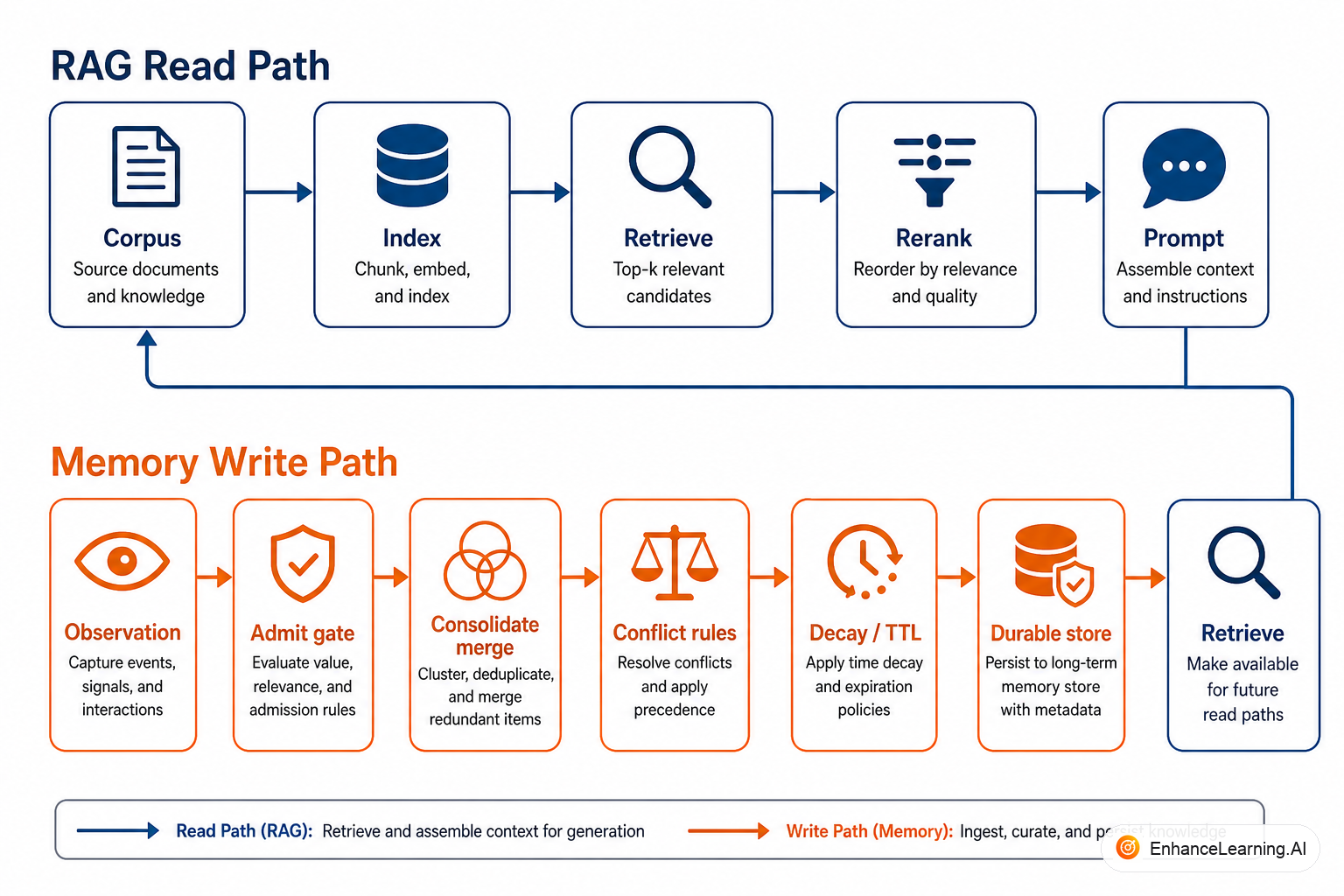
RAG pipelines assume documents already exist with owners, review cycles, and delete paths. You index, retrieve, rerank, cite. Quality problems are usually ranking, chunking, or freshness of external knowledge.
Memory systems must decide, on every turn, whether a new observation becomes durable state. That decision sits upstream of any vector lookup:
- Is this a fact, a preference, a rumor, or a one-off instruction?
- Does it supersede something already stored?
- Whose identity does it attach to?
- How long should it live?
- Who can read it on the next channel?
Calling that "RAG with a user ID" skips the product and compliance work. You still need retrieval later — but only after you earned a trustworthy store.
Why retrieval feels solved#
Most engineering teams have shipped RAG. The read path has mature tooling: embedding models, vector databases, rerankers, hybrid search, chunking recipes. Failures are measurable — recall@k, nDCG, citation accuracy. You can A/B chunk sizes without touching user data governance.
Memory's write path has no equivalent standard library. Every product must invent admission rules, merge semantics, and forget APIs. That invention happens under pressure — demos ship, users talk, extractors run — and the store fills before anyone writes the conflict table.
Four jobs retrieval does not do#
Write admission#
Not every utterance deserves a row. "Cancel that — I was joking" must not become a permanent preference. Admission needs signals: explicit user confirmation, structured form fields, high-confidence extractors, or human approval for sensitive keys.
Admission also needs negative rules: keys that never auto-write regardless of confidence. Entitlements, medical claims, legal commitments — these should require explicit confirmation or system-of-record sync, not cosine similarity on a chat turn.
Consolidation#
New observations collide with old ones. Addresses change. Plan tiers upgrade. Two sessions disagree. Consolidation is the merge logic — overwrite, version, or keep alternatives with confidence. Skip it and your index becomes a contradiction museum.
Conflict resolution#
When two memories disagree, retrieval happily returns both. The model then improvises. Production systems need deterministic rules: latest wins for mutable profile fields; append-only for audit events; escalate when confidence is low.
Decay and deletion#
Knowledge corpora go stale slowly. Personal memory goes stale weekly. Without TTL, soft-delete, and "forget this" APIs, you accumulate liability and noise. Decay is a feature, not an ops afterthought.
Same embedding machinery can back both. The product difference is the write path: admission, merge, conflict, and forget. If those are undefined, you built a personalized junk drawer with cosine similarity.
A failure story that looks like "bad retrieval"#
An enterprise assistant stored every tool result and user message as memory chunks. Retrieval for "shipping address" returned three addresses from six months of chat. The model picked the most fluent one. It was wrong. The postmortem blamed the embedding model. The real bug was missing consolidation: shipping address should have been a single typed field with last-write-wins and a source timestamp, not a similarity race.
The metrics that misled them#
Retrieval recall looked fine — all three addresses were findable. Nobody tracked active-field uniqueness or write admission rate. The dashboard showed green while the store accumulated contradictions. Memory quality metrics must include store invariants, not just search quality.
Read path vs write path ownership#
In mature RAG, platform teams often own indexing and retrieval; content owners own documents. Memory rarely splits cleanly. Product defines what should be remembered. Engineering defines how. Legal defines what must be forgettable. Security defines who can read across tenants.
If one team owns "the vector DB" without owning admission and consolidation, you get a shared junk drawer. Split ownership explicitly:
| Layer | Typical owner | Success metric |
|---|---|---|
| Admission policy | Product + compliance | False write rate, confirm prompt rate |
| Consolidation | Memory platform eng | Active-field conflicts, merge latency |
| Retrieval | Same eng or shared RAG | Recall@k on golden memory queries |
| Forget / DSAR | Platform + legal | Deletion propagation time |
Sketch the write path explicitly#
from dataclasses import dataclass
from enum import Enum
from typing import Optional

class Admit(Enum):
    DROP = "drop"
    WRITE = "write"
    NEEDS_CONFIRM = "needs_confirm"

@dataclass
class Observation:
    user_id: str
    key: str
    value: str
    confidence: float
    explicit: bool  # user said "remember" / filled a form

@dataclass
class MemoryItem:
    key: str
    value: str
    confidence: float
    version: int

def admit(obs: Observation) -> Admit:
    if obs.key.startswith("sensitive.") and not obs.explicit:
        return Admit.NEEDS_CONFIRM
    if obs.confidence < 0.6 and not obs.explicit:
        return Admit.DROP
    return Admit.WRITE

def consolidate(existing: Optional[MemoryItem], obs: Observation) -> MemoryItem:
    if existing is None:
        return MemoryItem(obs.key, obs.value, obs.confidence, version=1)
    # Mutable profile keys: higher confidence or explicit update wins
    if obs.explicit or obs.confidence >= existing.confidence:
        return MemoryItem(obs.key, obs.value, obs.confidence, existing.version + 1)
    return existing
Pair this with ordinary retrieval for reading. Do not let the retriever invent merge policy.
When to reuse RAG infrastructure#
You should reuse embeddings, vector stores, and rerankers for memory reads. Chunking strategies differ — memory items are often shorter and keyed — but the retrieval stack transfers. What does not transfer: document lifecycle assumptions. Memory items mutate, version, and die. Index pipelines built for immutable PDFs need write-through updates or dual indexes (active vs archive).
Hybrid search helps when users reference memories by exact key ("what's my case number?") and by semantic paraphrase ("that ticket from last Tuesday"). Plan for both.
What to demand in a design review#
- Admission policy — which keys auto-write, which need confirm, which are forbidden.
- Schema — typed profile fields vs free-text episodes; do not mix without rules.
- Conflict table — per-key merge strategy written down.
- Forget path — user and admin deletion with propagation to caches.
- Eval cases — contradictory updates, sarcasm, partial corrections, cross-channel sync.
If the deck only shows a vector DB box labeled "memory," send it back.
Summary#
Retrieval finds content that already exists. Memory must decide what becomes content in the first place, how updates merge, and when state dies. Treating memory as personalized RAG optimizes the easy half of the problem and leaves write-path failures for production users to discover. Build admission, consolidation, conflict rules, and decay first — then reuse your retrieval stack to read what you actually trust.
Want premium architecture blueprints?
Be among the first to explore interactive reference architectures, implementation playbooks, and premium engineering resources at launch.
Related Articles
Recommended reading based on this topic.
Explicit vs Implicit Memory Formation in AI
Explicit memory is what users or systems deliberately store. Implicit memory is inferred from behavior. Mixing them without labels breaks trust and consent.
Read ArticleWhy AI Memory Needs Confidence Scores, Not Just Facts
Agents reason over imperfect extracts. Store confidence and provenance with every memory item or you will treat guesses as ground truth.
Read ArticleWhy Memory Consolidation is the Central Challenge in AI Memory Design
Storing observations is easy. Merging them into coherent durable state without duplication or corruption is the hard problem agents keep rediscovering.
Read Article