
Why Memory Consolidation is the Central Challenge in AI Memory Design
Storing observations is easy. Merging them into coherent durable state without duplication or corruption is the hard problem agents keep rediscovering.

Most memory demos celebrate the write: "the agent remembered my dog's name." Production memory systems die on the next write: the dog's name becomes two embeddings, then a third after a typo correction, then a conflicting breed from a sarcastic joke the extractor believed. Storage worked. Consolidation did not.
What consolidation actually means#
Memory consolidation is the process that turns raw observations into a maintained store: merge duplicates, resolve conflicts, update mutable fields, summarize episodes into durable facts, and drop noise. Biological metaphors are optional. The engineering claim is not: without consolidation, every session adds entropy.
Retrieval quality cannot fix an unconsolidated store. You will retrieve the mess with higher recall.
Why naive append-only memory fails#
Append-only logs are excellent for audit. They are terrible as the sole working memory for an agent that must answer "what is true now?"
- Duplication — same preference phrased five ways wastes budget and confuses ranking.
- Contradiction — both "vegetarian" and "loves steak" retrieve; the model improvises.
- Partial updates — "new office is on Market St" without clearing the old address.
- Extractor drift — yesterday's model wrote verbose blobs; today's writes structured keys; both linger.
Teams often respond by retrieving top-k and hoping the LLM reconciles. That pushes merge policy into the least deterministic layer. Put reconciliation in code for typed fields; use models for summarization where ambiguity is expected — then store the result as a new consolidated artifact, not as five rivals.
If your roadmap lists "add vector memory" without a consolidation design, you budgeted for a write-only diary. Agents need a maintained world model, not a landfill.
Consolidation vs summarization#
Summarization compresses text. Consolidation maintains invariants. A nightly job that turns fifty chat turns into one paragraph is summarization — useful, but not sufficient if the paragraph coexists with the fifty raw chunks in the retrieval index.
Consolidation must answer: which artifact is authoritative for reads? Default retrieval should hit consolidated active records, not every historical observation. Summaries feed consolidation; they do not replace merge rules for typed profile fields.
Episode → profile extraction#
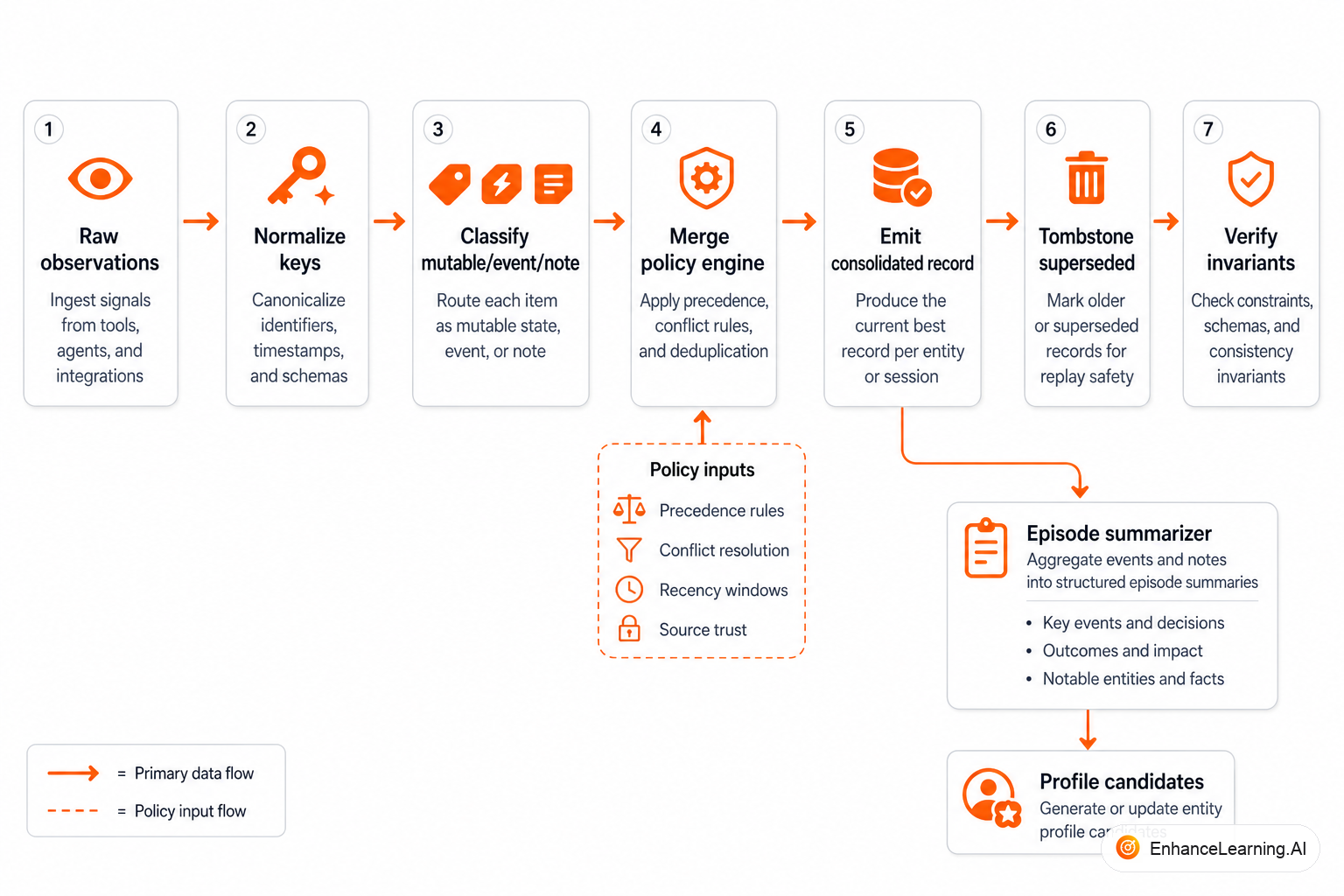
A common pattern: session ends → episode summarizer writes episode.2026-08-03_support_ticket_4412 → profile extractor proposes candidates (pref.contact_channel, case.resolution) → consolidation loop applies per-key merge policy → only active records enter default retrieval.
Skipping the last step leaves episodes and profile rows competing. Users hear contradictions; engineers blame "the model forgot."
A practical consolidation loop#
- Normalize — map free text into keys (
pref.contact_channel,profile.shipping_address). - Classify — mutable fact, append-only event, or ephemeral note.
- Merge — apply per-class rules (overwrite, version, append).
- Emit — write the consolidated record; tombstone or demote superseded items.
- Verify — sample conflicts weekly; alert on high dual-key rates.
from dataclasses import dataclass
from typing import Literal

Merge = Literal["overwrite", "version", "append", "reject"]

@dataclass
class Obs:
    key: str
    value: str
    confidence: float
    ts: str

@dataclass
class Record:
    key: str
    value: str
    confidence: float
    version: int
    active: bool = True

POLICY: dict[str, Merge] = {
    "profile.shipping_address": "overwrite",
    "pref.contact_channel": "overwrite",
    "event.purchase": "append",
    "note.freeform": "version",
}

def consolidate(existing: list[Record], obs: Obs) -> list[Record]:
    policy = POLICY.get(obs.key, "version")
    active = [r for r in existing if r.key == obs.key and r.active]

    if policy == "append":
        return existing + [Record(obs.key, obs.value, obs.confidence, 1)]

    if policy == "overwrite":
        out = [r for r in existing if not (r.key == obs.key and r.active)]
        ver = (max((r.version for r in active), default=0) + 1)
        out.append(Record(obs.key, obs.value, obs.confidence, ver))
        return out

    if policy == "reject":
        return existing

    # version: keep history, mark prior inactive for retrieval defaults
    out = []
    for r in existing:
        if r.key == obs.key and r.active:
            out.append(Record(r.key, r.value, r.confidence, r.version, active=False))
        else:
            out.append(r)
    ver = (max((r.version for r in active), default=0) + 1)
    out.append(Record(obs.key, obs.value, obs.confidence, ver, active=True))
    return out
Episode memory still needs summarization jobs: nightly (or end-of-session) compactors that turn turn logs into one episode card, then extract profile candidates for the loop above.
Sync vs async consolidation#
Not every merge can wait for a batch job. Mutable profile fields (address, phone, plan tier) should consolidate synchronously on write — the next read must see one active value. Episodes and freeform notes can consolidate asynchronously within seconds or minutes if you quarantine unmerged observations from default retrieval until processed.
The failure mode of async-only consolidation: user corrects their name, agent still uses the old name for the rest of the session because retrieval hit the stale active record before the compactor ran. For user-visible corrections, sync overwrite with version history is the safer default.
Hard cases consolidation must name#
| Case | Bad default | Better default |
|---|---|---|
| User corrects a fact | Second row beside the first | Overwrite + version history |
| Two channels disagree | Both retrieve | Channel priority + timestamp |
| Low-confidence extract | Silent write | Quarantine / confirm |
| Joke or hypothetical | Stored as preference | Admission filter before consolidate |
| GDPR forget | Delete one row | Cascade to summaries and caches |
Cross-session contradiction#
User says "I'm vegetarian" in January and orders a steak delivery integration sync in March. Both rows exist. Consolidation policy must define precedence: system-of-record events (purchase) may not overwrite self-reported preferences without confirmation, or may flag a conflict for the agent to clarify. Silent overwrite in either direction creates trust incidents.
Operational signals#
Track consolidation health like a data pipeline:
- Dual-active rate — fraction of keys with more than one
active=truerecord (should be ~0 for overwrite keys) - Quarantine backlog — observations waiting for merge
- Compactor lag — time from session end to episode card
- Manual override rate — human corrections per thousand writes
Alert on dual-active spikes. They mean merge logic broke or two writers bypassed consolidation.
Summary#
Writing memories is cheap. Keeping a coherent durable state is the central engineering problem in AI memory design — duplication, conflict, and decay do not solve themselves because you bought a vector database. Treat consolidation as a first-class pipeline with typed merge policies, summarization jobs, and evals on store invariants. Until that exists, "agent memory" is mostly an append-only guilt archive with a similarity search on top.
Want premium architecture blueprints?
Be among the first to explore interactive reference architectures, implementation playbooks, and premium engineering resources at launch.
Related Articles
Recommended reading based on this topic.
Explicit vs Implicit Memory Formation in AI
Explicit memory is what users or systems deliberately store. Implicit memory is inferred from behavior. Mixing them without labels breaks trust and consent.
Read ArticleWhy AI Memory Needs Confidence Scores, Not Just Facts
Agents reason over imperfect extracts. Store confidence and provenance with every memory item or you will treat guesses as ground truth.
Read ArticleWhy AI Memory is Harder to Get Right Than Retrieval
Retrieval looks up what exists. Memory decides what to write, merge, trust, and forget. That write path is where production agents quietly fail.
Read Article