
Why AI Design Patterns Are Essential for AI-Native Engineering
Why pattern literacy is a core competency for AI-native systems: shared control shapes, repeatable behaviour, and governance that survives team handoffs.
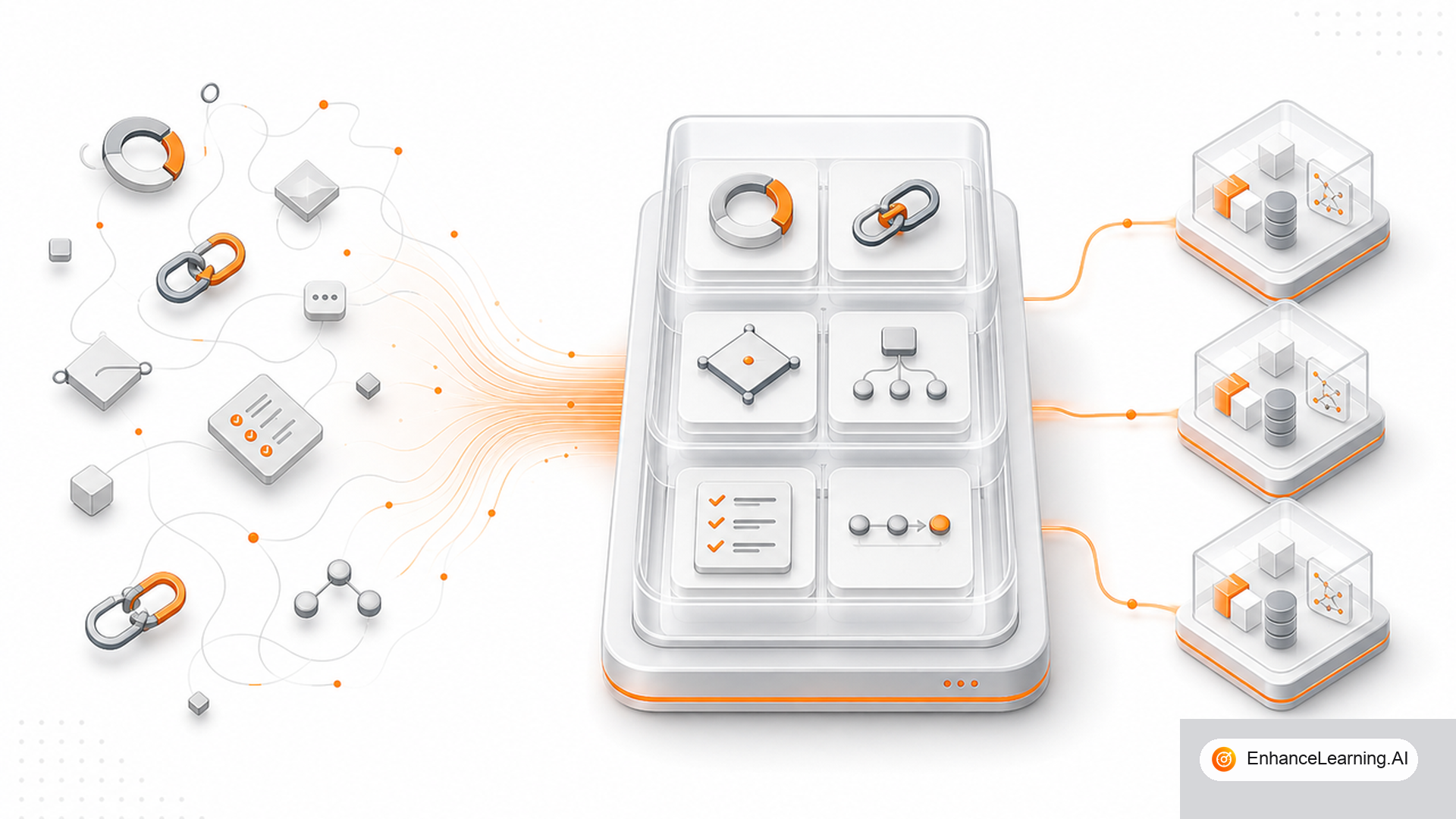
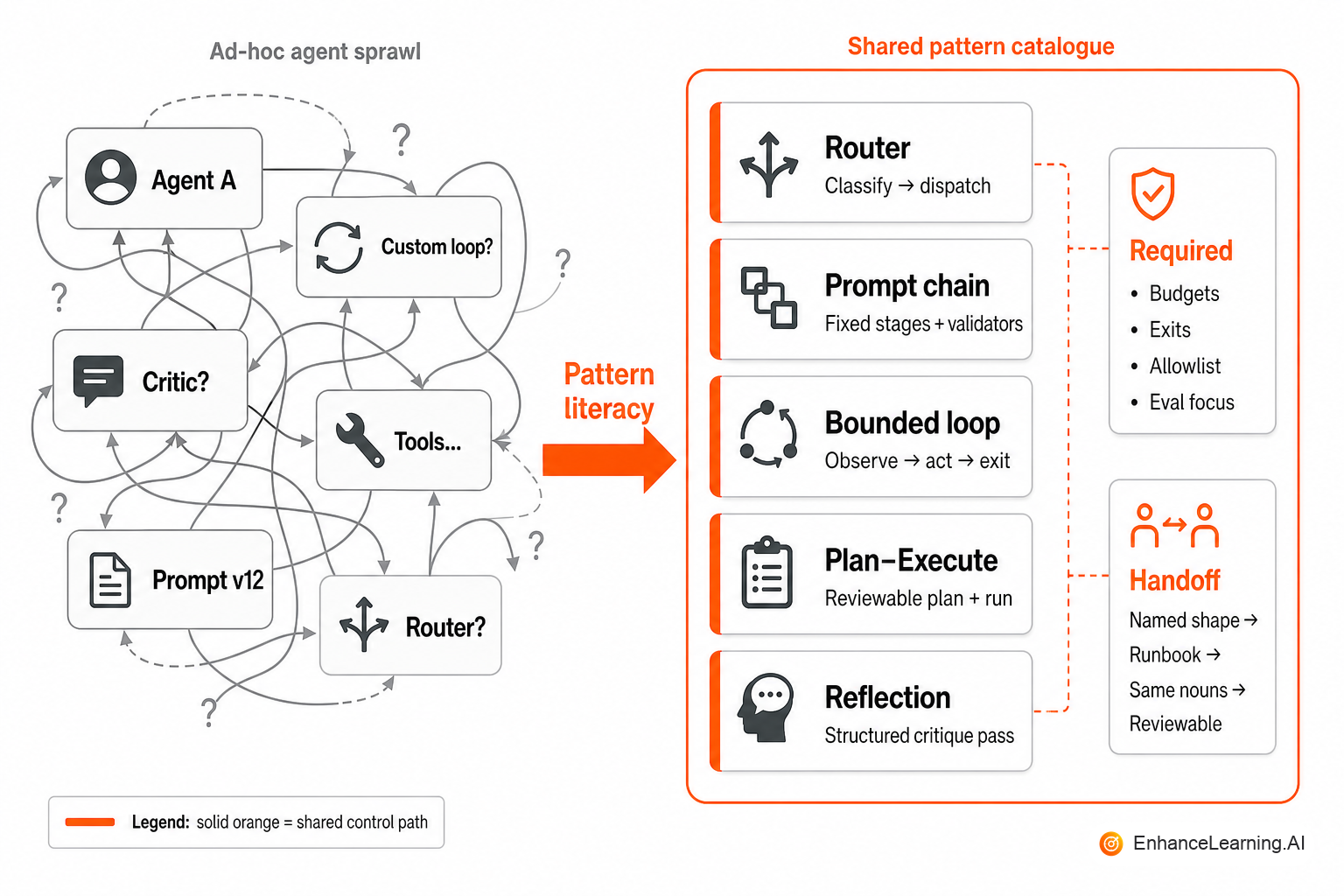
Most AI pilots do not fail because the model is weak. They fail because every engineer invents a slightly different control shape — another loop, another critic, another “smart” router — and nobody can explain why the system behaves the way it does on Tuesday afternoon. Design patterns are how you stop that drift. They turn non-deterministic model behaviour into named, reviewable system shapes that other teams can reuse without reverse-engineering your prompts.
The production problem patterns actually solve#
Traditional software has a vocabulary: factories, queues, circuit breakers, sagas. When you say “saga,” a senior engineer knows the failure story you are buying. AI-native systems often skip that step. Someone ships a LangGraph graph or a hand-rolled agent, demos well on five happy paths, and the team treats the graph as the design.
Six months later you have three products with three incompatible “agent frameworks,” none of which share budgets, stop conditions, or audit trails. Onboarding a new engineer means reading slack history. Incident review means guessing which prompt version was live.
Patterns are not decoration on top of working code. They are the shared nouns for control flow under uncertainty. Without them, every change is a rewrite of someone’s private mental model.
What an AI design pattern is (and is not)#
An AI design pattern is a named control structure that answers three questions:
- Who decides the next step? (fixed graph, model, rules, human)
- What may change between steps? (tool results, memory, plan, nothing)
- How does the run end? (success, clarify, escalate, budget stop)
Router, ReAct, Planner–Executor, Reflection, prompt chaining, and bounded agent loops are patterns because they answer those questions differently. A clever system prompt is not a pattern. A library is not a pattern. “We use agents” is not a pattern.
If two teams cannot draw the same boxes and edges for your system, you do not have a pattern — you have an implementation. Patterns earn their keep when architecture reviews, evals, and runbooks use the same names.
Why non-determinism makes patterns more important, not less#
Classic design patterns tamed complexity in deterministic code. LLM systems add a second problem: the same inputs can produce different tool sequences and different prose. That does not mean “anything goes.” It means you need stronger outer structure.
Patterns give you places to put deterministic rails:
- Schema and allowlists around tool calls
- Step and token budgets around loops
- Structured critique instead of “please be careful”
- Fixed stages when the business process is already known
The model stays probabilistic. The enclosing pattern is not. That split is the difference between a demo and a system you can operate.
Repeatability across teams#
Pattern literacy is how AI work scales past the first two engineers.
| Without patterns | With patterns |
|---|---|
| “Our agent just figures it out” | “This job is Planner–Executor with a human gate on write tools” |
| Every PR invents new control flow | PRs swap pattern, budgets, or tools — not the ontology |
| Evals compare applies to vibes | Evals score trajectory shape against a named pattern |
| Support cannot predict failure modes | Runbooks list known failure modes per pattern |
Enterprises already do this for API styles and data platforms. AI control flow deserves the same discipline. A Centre of Excellence that publishes a short pattern catalogue — with when to use and when not to — prevents ten teams from rediscovering Router under ten names.
Pattern literacy as an engineering competency#
Treat pattern literacy like concurrency literacy or distributed-systems literacy. You would not promote someone who cannot explain why a queue exists. Do not promote AI leads who cannot explain why this workflow is a chain and that one is a loop.
What “literate” looks like in practice:
- Can name the pattern in one sentence and draw it in under a minute
- Can state the failure mode the pattern is buying (misroute, infinite tool thrash, stale plan, over-critique)
- Can say what would have to be true to switch patterns
- Can point to the budgets and exits in the code, not only in the slide deck
You do not need twenty patterns. You need fluency with a small set and the judgment to refuse the rest.
What goes wrong without them#
A payments ops team bolted an “autonomous agent” onto case handling. No named pattern — just a model with tools and a max-iteration flag. It worked on refunds that matched training folklore. It also invented tool sequences that double-credited customers when a partial refund already existed. The postmortem blamed “hallucination.” The real defect was missing structure: irreversible tools inside an unbounded loop with no Reflection gate and no Planner artifact a human could approve.
A second team rebuilt the same job as prompt chaining: classify → retrieve policy → draft → schema validate → human approve for money movement. Same model family. Far fewer surprises. The difference was not model IQ. It was pattern choice.
How little “how” you need to start#
Implementation details matter, but they are secondary. Before frameworks and graph DSLs, write this down for each AI feature:
Pattern card template
6 fields
Pattern
<name>
Decider
<model | rules | human | fixed stages>
Mutable state
<tool results / plan / memory / none>
Hard stops
<max steps, max spend, escalate rules>
Forbidden
<tools or actions this pattern must never reach>
Eval focus
<what trajectory success means>
That card is enough to align product, security, and engineering. Code follows. Libraries come last.
Publish five patterns your org allows in production, each with a one-paragraph “use when / avoid when,” a reference diagram, and a required budget table. Ban unnamed agents in design review. The catalogue will feel pedantic for a month. Then it becomes how you ship.
Patterns and governance#
Governance asks: can we explain what the system did, and can we constrain what it may do next? Patterns are the unit of that explanation. “The ReAct loop exhausted its tool budget and escalated” is operable. “The agent got confused” is not.
Security reviews also get easier. Prompt-injection risk looks different in a fixed chain (attacker tries to corrupt a middle stage) versus an open loop (attacker tries to expand the tool trail). Name the pattern and the threat model sharpens.
Summary#
AI design patterns are essential because AI-native engineering is control-flow engineering under uncertainty. Patterns give teams a shared language, a place to hang deterministic rails, and a way to repeat behaviour across products without cloning prompts. Treat pattern literacy as a core competency: if your team cannot name the shape, they cannot operate, evaluate, or govern the system — no matter how strong the model is.
Want premium architecture blueprints?
Be among the first to explore interactive reference architectures, implementation playbooks, and premium engineering resources at launch.
Related Articles
Recommended reading based on this topic.
What Makes a Workflow AI-Native Rather Than Just Automated
The architectural traits that separate AI-native workflows from script pipelines — probabilistic steps, judgment gates, and context that survives retries.
Read ArticleCore AI Design Patterns Every Team Uses
Router, ReAct, Planner–Executor, and Reflection patterns explained with when to use each, when not to, and a small implementation sketch for production.
Read ArticleThe Hidden Coupling Between Prompts and AI System Architecture
Prompt length, role structure, and tool definitions leak into service boundaries, data flows, and API contracts — coupling teams thought was decoupled.
Read Article