
Why Building AI-Native Systems Requires a New Engineering Discipline
AI-native products need more than software engineering and data science — probabilistic control, evals, tool bounds, and operable failure modes.
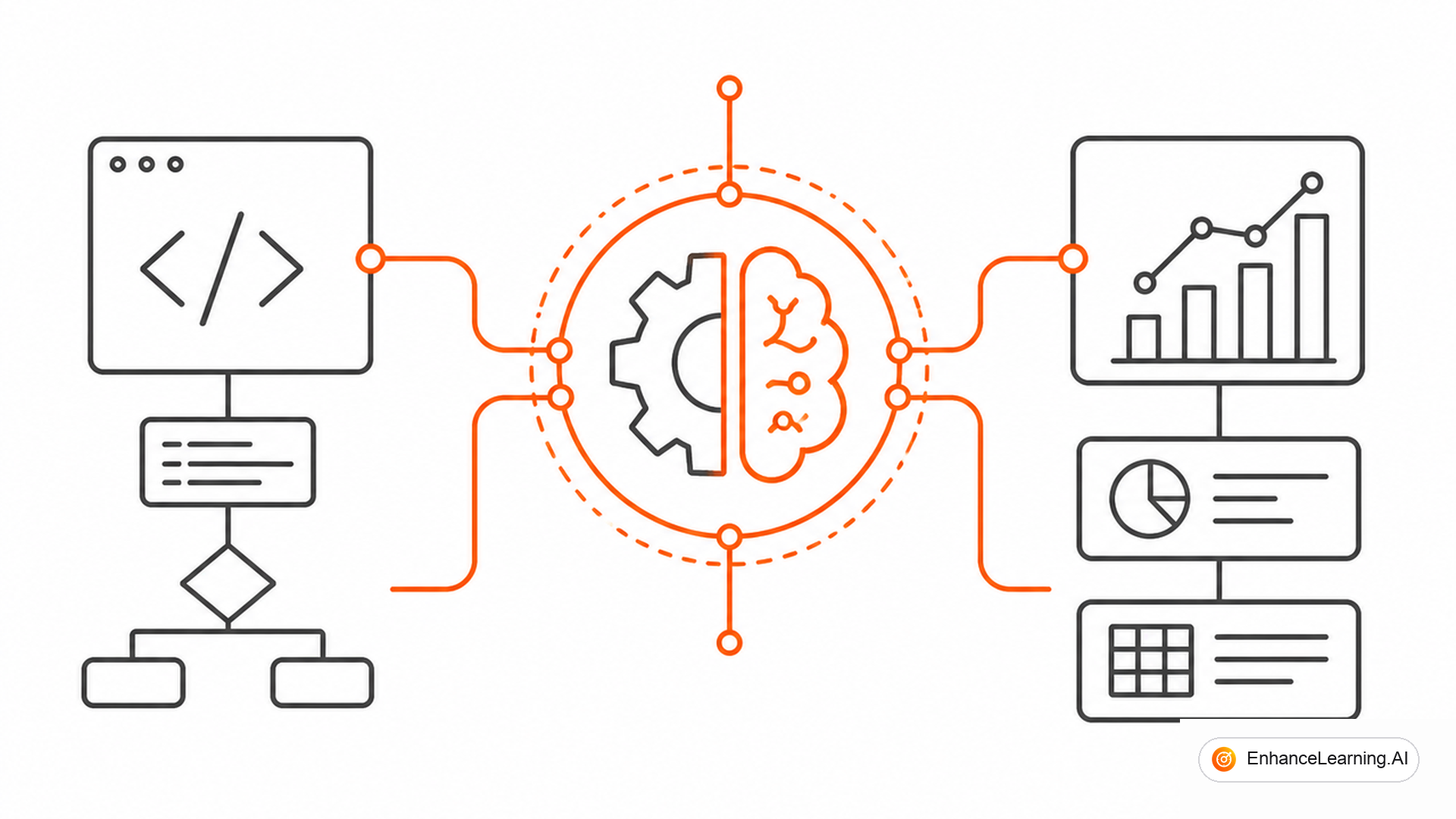
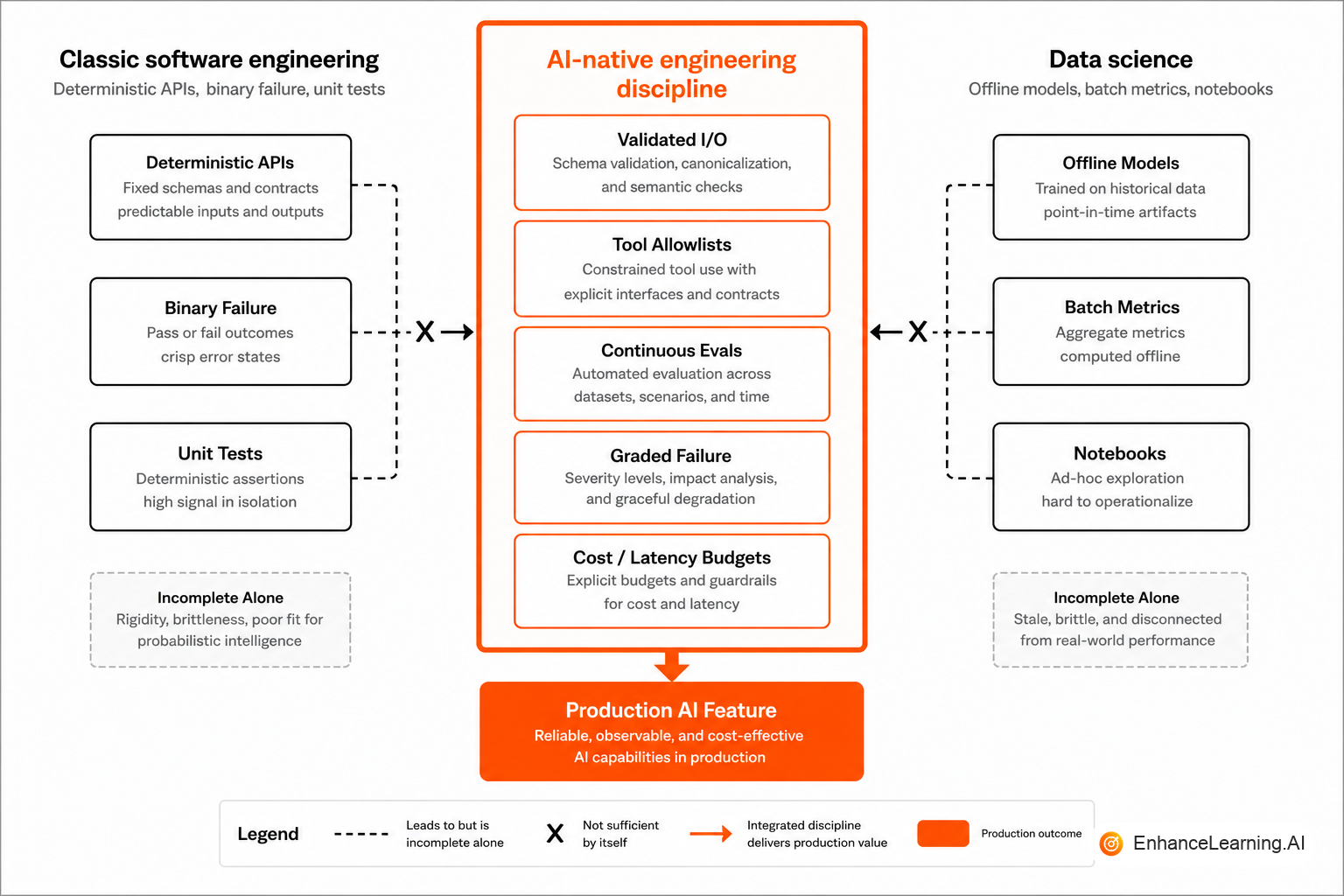
Shipping an LLM feature with a classic web playbook is how you get brittle demos that look smart in staging and lie in production. Traditional software engineering assumes determinism and binary failure. Data science assumes offline models and batch metrics. AI-native products sit in the messy middle: online, probabilistic, tool-using systems that write to real systems of record. That middle needs its own discipline — not a slogan, a checklist of practices teams actually staff.
The gap shows up fast. A backend team ships a REST endpoint that calls GPT-5 with a system prompt. Tests pass because they mock the model response. In production, the model occasionally returns a refund amount in words instead of cents, and the payment service accepts it because the type coercion is permissive. Nobody owned the boundary between "model output" and "financial transaction." Software engineering built the API. Data science picked the model. Neither discipline owns what happens in between.
What breaks when you reuse old playbooks#
Software engineering habits that misfire
- "Cover with unit tests" — useful for parsers and validators, useless as the only quality gate for free-form generation. You cannot unit-test your way to "the model will not invent a vendor name."
- "Exception = failure" — models fail softly: wrong, partial, overconfident. A HTTP 200 with a hallucinated field is worse than a 500 because nothing alerts.
- "Idempotent retry" — retries without schema awareness amplify bad spends. Retrying a malformed tool call three times triples your cost and may triple your damage if the tool is side-effecting.
- "Ship behind a feature flag" — flags control exposure, not correctness. Turning on a bad AI feature for ten percent of users still hurts ten percent of users.
Data science habits that misfire
- Offline F1 as the ship gate for an interactive agent. Batch accuracy on a held-out set does not predict behaviour when users ask questions you never imagined.
- Treating the model as the product instead of one component. The model is an engine; the product is the validated pipeline around it.
- Ignoring tool permissions because the notebook never called refunds. Jupyter does not have a production Stripe integration. Your agent does.
- Hyperparameter tuning as the primary lever. In production, schema design, context packing, and fallback routing often move the needle more than temperature adjustments.
Neither tribe is wrong in its home territory. Both are incomplete for AI-native runtime. The discipline that fills the gap is not "ML engineering" rebranded. It is a distinct set of practices centred on probabilistic control at the product boundary.
The mindset shift#
AI-native engineering assumes:
- Outputs are hypotheses until validated
- Control lives outside the model — allowlists, budgets, schemas, human gates
- Quality is continuous — golden sets, online graders, regression on model bumps
- Cost and latency are first-class requirements, not finance afterthoughts
- Failure is graded — refuse, degrade, escalate — not only crash
Teams that internalise those five stop arguing about "better prompts" as the only lever. They start asking: what validates this output, what happens when validation fails, and who owns the eval set that proves we did not regress?
Consider an internal IT helpdesk bot. The old playbook: build a chat UI, connect it to a model with a system prompt listing common fixes, deploy behind SSO. The AI-native playbook: define a schema for {diagnosis, recommended_action, confidence, requires_admin}. Validate that recommended_action is one of six allowed values. Route requires_admin: true to a human queue. Cap the agent at three tool calls per session. Run a golden set of fifty tickets before every prompt change. Trace every response with prompt version and retrieval hash.
Same feature request. Different blast radius.
What the discipline actually includes#
Contracts and structured I/O#
Every model call that feeds another system has a schema. Validation is mandatory. Repair is optional and bounded. Side effects never run on raw prose. This is not optional for "serious" features — it is the baseline. If your invoice parser returns free-form text that a downstream service regex-parses, you have deferred the engineering problem to a fragile middle layer.
Tool and policy engineering#
Tools are capabilities with blast radius. Engineering means least privilege, argument schemas, and denials that are observable — not a giant "agent can do anything" toolbelt. A tool catalogue with twelve integrations and no per-tool auth scoping is a liability catalogue. Each tool needs: allowed callers, argument validation, timeout, idempotency key support, and a denial reason that appears in traces.
Eval engineering#
Golden sets for the job class. Judges where human labels do not scale. Versioned prompts and datasets. Release gates that block silent quality drops. An eval set is not a one-time benchmark — it is a living artefact that grows with every production failure you promote to a test case.
Operability#
Traces that show stages, tokens, tool denials, and budget stops. Runbooks for the failure modes you designed for. Owners for prompts and validators. On-call should be able to answer: "What prompt version served this bad response?" without Slack archaeology.
Cost and latency design#
Right-sized models, caching where safe, pattern choice that respects p95. "Use the biggest model" is not a discipline; it is a default that finance will eventually question. Route simple classification to a small model. Reserve the large model for steps that measurably need it. Prove the routing with eval diffs, not intuition.
from dataclasses import dataclass

@dataclass
class AINativeGate:
    schema_ok: bool
    eval_pass: bool
    budget_ok: bool
    allowlist_ok: bool

def ship_ready(g: AINativeGate) -> bool:
    return all([g.schema_ok, g.eval_pass, g.budget_ok, g.allowlist_ok])

assert ship_ready(AINativeGate(True, True, True, True))
assert not ship_ready(AINativeGate(True, False, True, True))
The gate above is deliberately boring. That is the point. AI-native shipping criteria should be as checkable as a CI pipeline — not a subjective "looks good" review. If eval_pass is false, you do not ship, even if the demo was impressive. This is the discipline: probabilistic components governed by deterministic gates.
How roles change#
| Old assumption | AI-native reality |
|---|---|
| Backend owns APIs; ML owns models | Feature owners own model+validator+eval for the job |
| QA tests happy paths | Eval sets cover adversarial and schema failure paths |
| SRE watches CPU/error rate | Ops watches token spend, denial rates, judge regressions |
| PM writes acceptance criteria in prose | PM accepts measurable task success under budget |
| Security reviews auth and input sanitisation | Security also reviews tool allowlists and prompt injection surface |
| Data team maintains feature store | Engineering maintains golden sets and prompt versions |
You can keep titles. You cannot keep the old ownership map. The backend engineer who "just calls the model API" is now responsible for what happens to the model's output — including validation failures, retry policy, and fallback routing.
What to teach the team first#
- Schema validation before side effects
- One golden set per job class
- Explicit budgets on every agentic path
- Named owners for prompts and for harness code
- A peel plan when models improve (delete scaffolding, keep contracts)
Skip the manifesto offsite. Ship these five on the next feature. The discipline is learned by doing, not by reading — but reading the checklist saves you from learning every item through an incident.
Summary#
AI-native systems need a discipline that sits beside — not instead of — software engineering and data science. It centres probabilistic control, validated I/O, tool policy, continuous evals, and operable failure. Adopt the practices on real features. Titles can catch up later.
The question is not whether your team is "technical enough." Backend engineers and data scientists are plenty technical. The question is whether anyone owns the boundary where probabilistic outputs meet deterministic systems — and whether that ownership comes with schemas, evals, budgets, and runbooks, not just optimism.
Want premium architecture blueprints?
Be among the first to explore interactive reference architectures, implementation playbooks, and premium engineering resources at launch.
Related Articles
Recommended reading based on this topic.
Engineering Principles for Reliable AI-Native Products
Structured outputs, tool reliability, layered guardrails, and predictable failure — the principles that separate durable AI-native products from fragile demos.
Read ArticleBuilding Retry Logic for LLM Structured Output Failures
Retry structured LLM outputs without burning cost or latency. Separate retriable parse failures from schema bugs that need a fix, not another loop.
Read ArticleWhy Schema Validation is Non-Negotiable for AI Outputs
Make schema validation a hard gate before any LLM output reaches another system — catch fluent mistakes before they become tickets or refunds.
Read Article