
Why RAG is a First-Class Architecture Pattern, Not a Feature Flag
RAG is a structural design choice — indexing, retrieval contracts, and grounding — not an optional chatbot toggle you enable after launch.
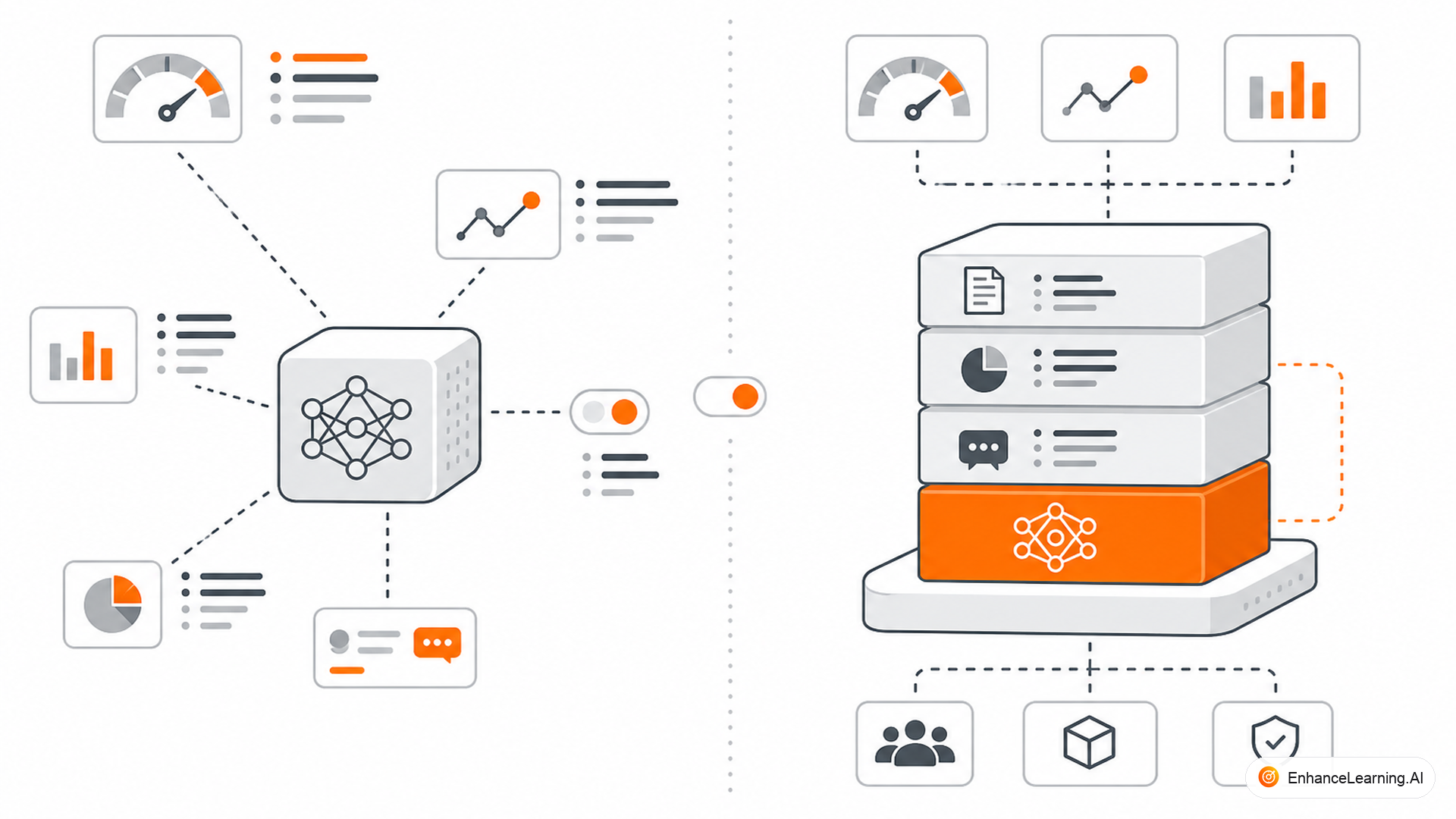
The slide deck says "Phase 2: add RAG." The codebase says if (featureFlags.ragEnabled) { ... }. Six months later, the index lives in a separate repo nobody on-call recognizes, ACL bugs leak deprecated policies into prompts, and product asks why answers still hallucinate after "we turned RAG on." That gap is not a tooling failure. It is what happens when retrieval is treated as a feature flag instead of an architecture pattern — a set of structural decisions about data flow, ownership, and failure behavior that should be designed in, not bolted on.
Feature flags vs architecture patterns#
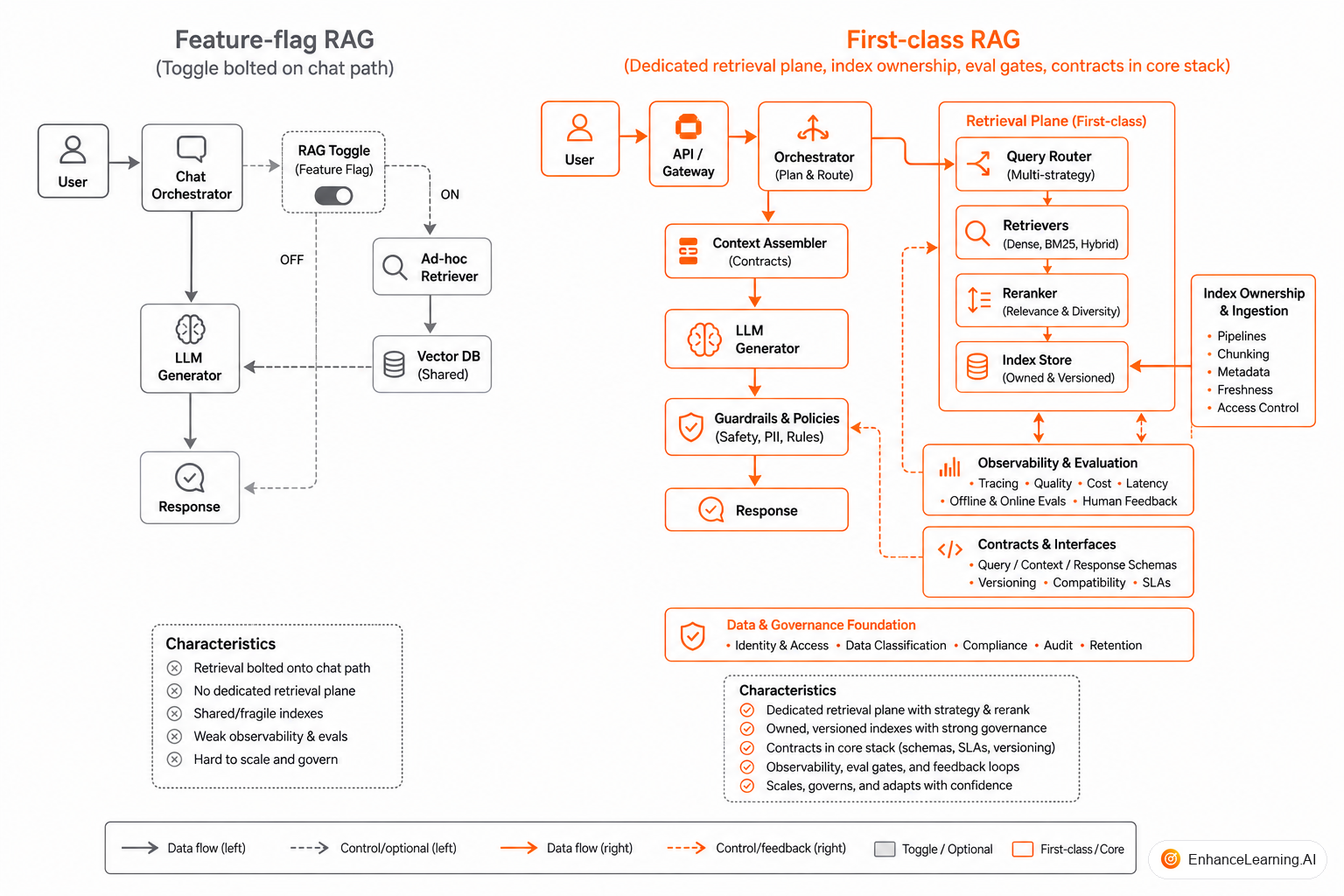
A feature flag hides incomplete work behind a toggle. Users get the same system shape; a branch executes or not. An architecture pattern changes the system shape: new services, new data stores, new contracts, new observability, new on-call surfaces.
RAG is the second kind. Enabling it implies:
- A document ingestion pipeline with schema and versioning
- An embedding and indexing tier with rebuild semantics
- A retrieval API with latency and quality SLOs
- A generation path that consumes retrieved evidence under explicit rules
- Evaluation and logging tied to chunk IDs and index builds
You cannot faithfully implement that behind a boolean without either faking retrieval (paste static context) or incurring hidden operational debt.
Notebook RAG is a function call. Production RAG is a data product with consumers, SLAs, and incident runbooks. Conflating the two is how "we already have RAG" becomes a lie in architecture reviews.
Core vs periphery: where RAG belongs#
In AI-native products where answers must reflect organizational knowledge, retrieval is core, not periphery — the same tier as authentication for customer-facing assistants, or as the inventory service for a commerce API.
Periphery would be: optional summarization of chat history, a nice-to-have suggested question chip, cosmetic citation formatting. Core is: without retrieval, the product cannot fulfill its primary job.
Ask one question in design review: If retrieval is down for an hour, is the product off or degraded? If the honest answer is "off," RAG is core. Staff it, monitor it, and put it on the architecture diagram's main path — not in a dashed box labeled "future."
What changes when RAG is structural#
Data ownership#
Feature-flag RAG often means "the ML team uploaded PDFs once." Pattern-level RAG means a defined owner for source systems, chunk schema, embedding model choice, and index freshness. Legal holds, retention, and regional data residency attach to the index pipeline — not to a one-off script.
API contracts#
Peripheral add-ons can return opaque strings. Core retrieval exposes typed results: passages, scores, document metadata, index snapshot, filter context. Downstream generation, agents, and eval harnesses depend on that contract. Breaking it is a breaking API change, not a prompt tweak.
Failure modes#
When RAG is a flag, failures fall through to "the model answers anyway" — the worst groundedness outcome. When RAG is core, empty or low-confidence retrieval triggers defined behavior: refusal, escalation, or cached canonical answers — chosen explicitly, tested, and logged.
Cost model#
Retrieval adds embedding spend, index storage, query-time compute, and reranking. Those costs scale with corpus size and query volume, independent of which LLM you call. Architecture reviews should budget them alongside token spend, not discover them after launch.
Comparison: flag mindset vs pattern mindset#
| Dimension | Feature-flag RAG | First-class RAG pattern |
|---|---|---|
| Trigger | Product toggle | Query path always runs retrieval when in scope |
| Index updates | Ad hoc re-upload | Event-driven ingestion, versioned builds |
| On-call | "Disable the flag" | Index lag, recall regressions, ACL incidents |
| Testing | Manual spot checks | Golden sets, retrieval metrics, faithfulness |
| Security | Hope the model ignores bad chunks | Metadata filters before generation |
| Documentation | README in ML repo | Platform architecture + data lineage |
The right column is more work upfront. It is also the column where "our copilot is trustworthy" is a claim you can defend.
Code shape reflects architecture priority#
Feature-flag implementations tend to look like this — retrieval inlined, skippable, untyped:
# Anti-pattern: RAG as optional branch
def answer(user_query: str, flags: dict) -> str:
    if flags.get("rag_enabled"):
        chunks = vector_db.similarity_search(user_query, k=5)
        context = "\n".join(c.text for c in chunks)
    else:
        context = ""
    return llm.complete(f"{context}\n\nQ: {user_query}")
Pattern-level RAG separates concerns and makes retrieval mandatory for in-scope queries:
from enum import Enum

class AnswerMode(str, Enum):
    GROUNDED = "grounded"
    REFUSED = "refused"
    OUT_OF_SCOPE = "out_of_scope"

class RagOrchestrator:
    def __init__(self, retriever, generator, policy):
        self.retriever = retriever
        self.generator = generator
        self.policy = policy

    def answer(self, query: str, principal) -> dict:
        if not self.policy.requires_grounding(query):
            return {"mode": AnswerMode.OUT_OF_SCOPE, "answer": None}

        result = self.retriever.retrieve(
            query=query,
            filters=self.policy.metadata_filters(principal),
            min_score=self.policy.min_relevance,
        )
        if result.is_empty():
            return {"mode": AnswerMode.REFUSED, "reason": "no_evidence"}

        return {
            "mode": AnswerMode.GROUNDED,
            "answer": self.generator.from_evidence(query, result),
            "citations": result.chunk_ids,
            "index_snapshot": result.snapshot_id,
        }
The orchestrator does not ask whether RAG is enabled. It asks whether the query class requires grounding — a product rule, not a deployment flag.
Organizational signals you are treating RAG as periphery#
Watch for these in meetings and repos:
- "We'll add citations in v2" while v1 already answers policy questions
- No service level objective for index lag or retrieval p99
- Search team and ML team disagree on who owns chunk quality
- Evals measure only final answer tone, not retrieval recall
- Incidents end with "turn off RAG" instead of "fix the index pipeline"
Each is a symptom of peripheral placement. Moving RAG to core means assigning a retrieval platform (even a small one) with the same seriousness as your inference gateway.
Coexistence with feature flags#
Not every flag is wrong. You might flag which corpus (EU docs vs US docs), experimental rerankers, or agentic multi-hop retrieval — variations on a core path. That is different from flagging the existence of retrieval itself for a product whose value proposition is "answers from our knowledge."
Use flags for rollout safety: canary index builds, shadow retrieval comparing two embedders, gradual tenant migration. The architecture still assumes retrieval runs; flags control how, not whether, for in-scope traffic.
Capacity planning when retrieval is core#
Core patterns get capacity reviews. Estimate embedding throughput for nightly ingestion, query-time embed QPS, index storage growth, and rerank CPU. A corpus that doubles every quarter is a planning input, not a surprise invoice. Pair retrieval capacity with inference capacity in the same spreadsheet — both scale with adoption.
If only the LLM autoscales while the index single-shards, you will hit a wall where generation is fast and retrieval queues. That feels like "latency regression" in the model when the bottleneck is architectural neglect.
Migration: from flag to pattern without a rewrite#
If you already shipped flag-shaped RAG:
- Draw the actual request path including index freshness and ACL checks. Gaps become a backlog, not surprises.
- Extract a retrieval service with a stable response type. Point the chat path and any agents at it.
- Define in-scope query classes where grounding is mandatory. Refuse or escalate outside them.
- Add retrieval metrics to dashboards — recall on golden questions, empty-hit rate, citation coverage.
- Remove the bypass that calls the LLM with no evidence for in-scope queries. Replace with explicit refusal UX.
You can keep a kill switch for incidents. Kill switches are operational levers, not product design.
Summary#
Retrieval-augmented generation is a first-class architecture pattern because it redefines how knowledge enters the AI request path: indexed corpora, query-time evidence, auditable citations, and operational ownership of freshness and access control. Treating it as a feature flag hides the data product underneath and guarantees a demo-quality pipeline at production traffic. Put RAG on the core diagram, type the contracts, staff the index pipeline, and measure retrieval — then "enabled" means something engineering and legal can both sign off on.
Want premium architecture blueprints?
Be among the first to explore interactive reference architectures, implementation playbooks, and premium engineering resources at launch.
Related Articles
Recommended reading based on this topic.
Why More Context Doesn't Improve LLM Output Quality
Stuffing the context window with more text often hurts LLM output — irrelevant tokens add noise, latency, and cost. Curation beats volume in production.
Read ArticleWhy Context Quality is the Bottleneck in Production AI
Context assembly — not model size — limits reliability, latency, and cost in production AI. It is the most under-engineered layer in most stacks.
Read ArticleWhy most RAG Systems Fail in Production
Where production RAG breaks: chunking mistakes, retrieval that looks fine in demos, missing reranking, and evaluation that never measures answer faithfulness.
Read Article