
The Difference Between a Base LLM and an Instruction-Tuned Model
Base models complete text; instruction-tuned models follow directions. That shift changes safety, reliability, and which workloads belong in production.
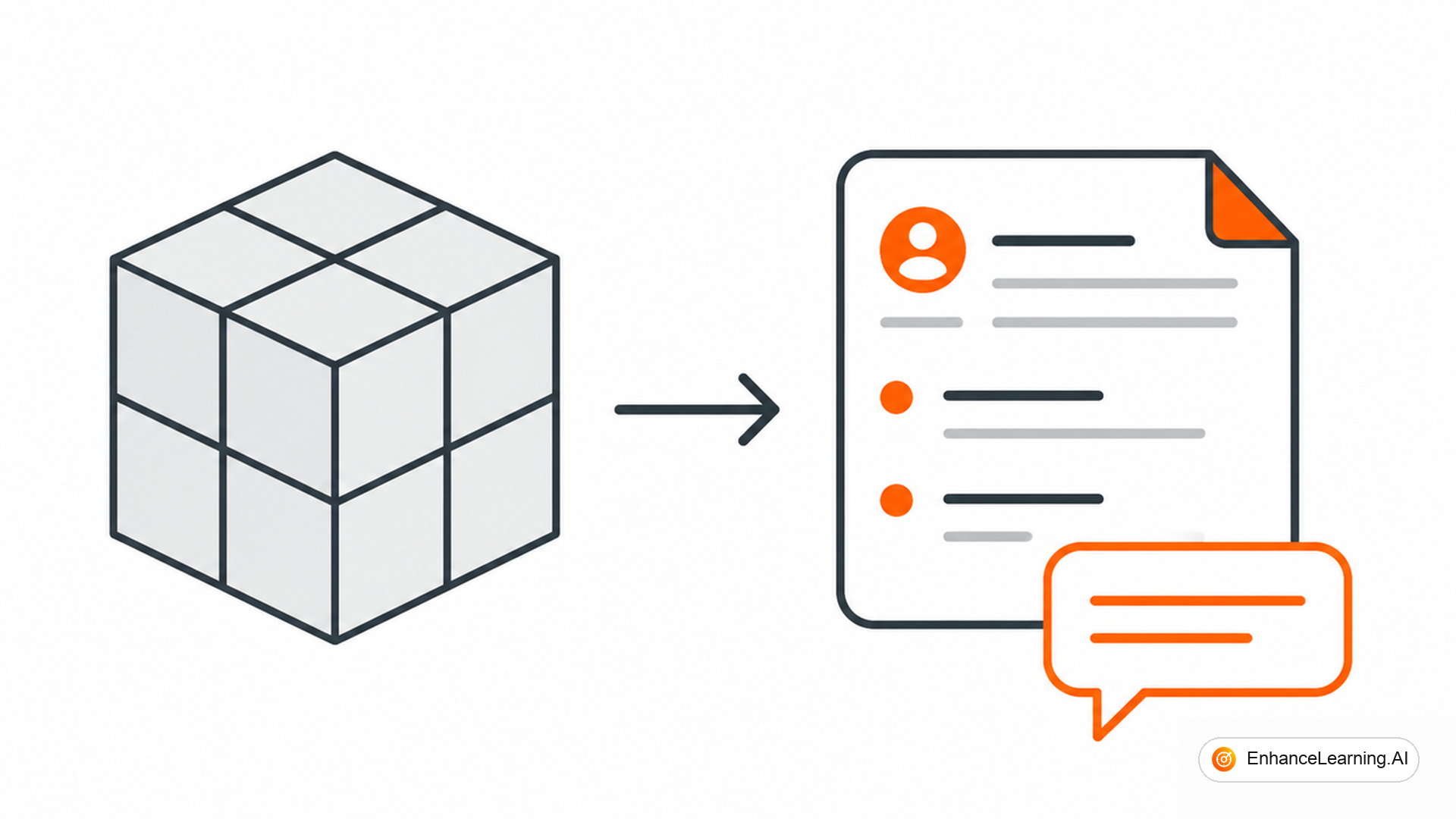
A base language model and an instruction-tuned variant can share the same parameter count, tokenizer, and pretraining corpus — yet behave like different products in production. Teams that treat them interchangeably get burned: base models ignore your "return JSON only" request and continue a paragraph; instruction-tuned models refuse or hedge when you needed raw completion for data augmentation. The distinction is foundational. It is not a fine detail for ML engineers alone.
What a base LLM actually is#
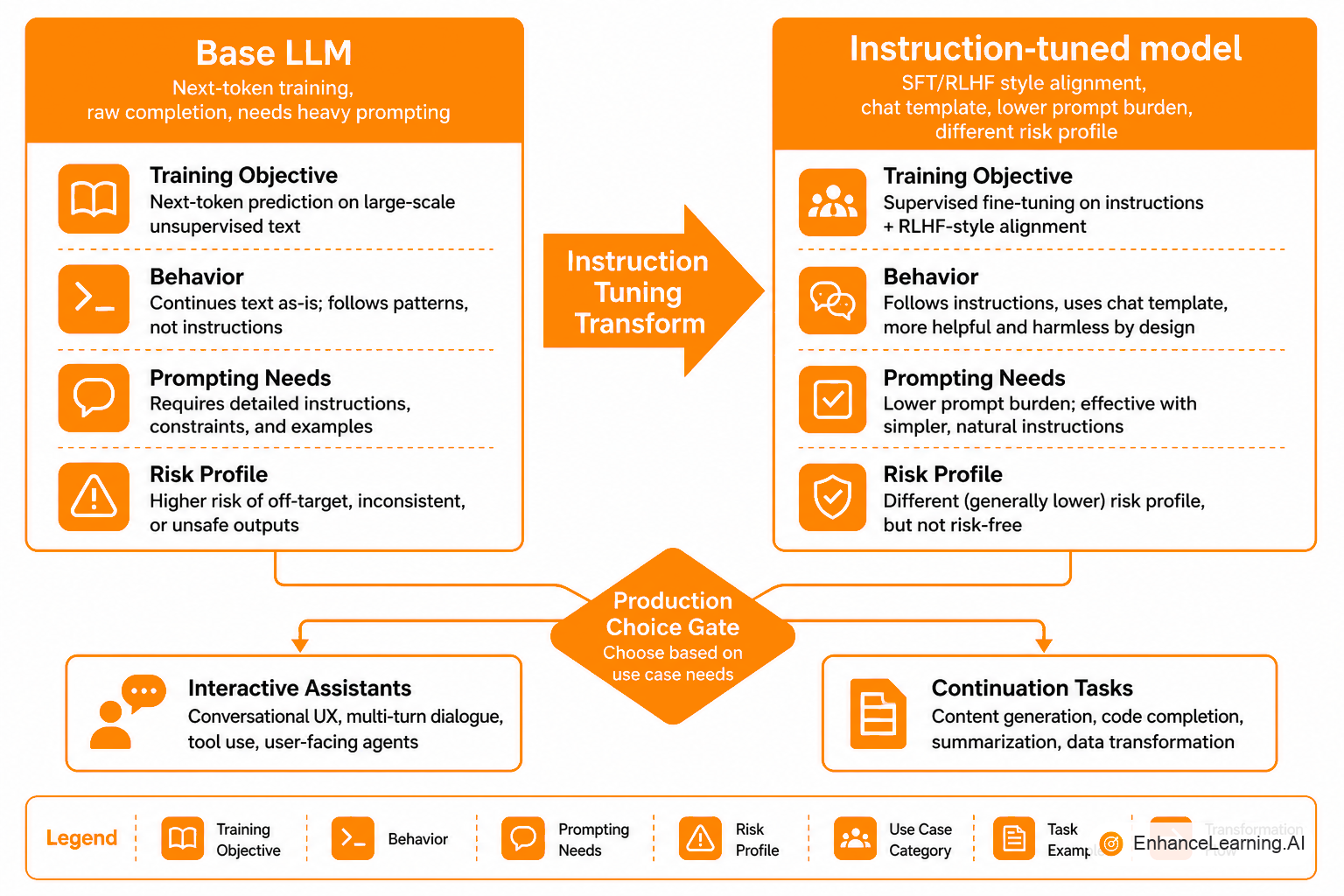
A base LLM is trained on next-token prediction over a large text corpus. Its objective is statistical: given preceding tokens, assign probability to what comes next. It learns grammar, facts, code patterns, and stylistic continuations because those reduce loss on internet-scale data.
Crucially, it was not optimized to obey a human operator. Ask a base model "Summarize the following in three bullets" and you may get a plausible continuation that starts a summary, drifts into unrelated commentary, or mimics a forum thread where someone else answers the question. The model is doing its job — continuing likely text — not yours.
Base models shine in controlled settings:
- Research and probing — measuring raw knowledge or bias without alignment layers
- Continued pretraining — domain corpora before a supervised fine-tune
- Synthetic data generation — when you want diverse completions, not compliant assistants
- Custom alignment pipelines — you plan your own SFT and RLHF stack
They are poor default choices for user-facing chat, agents with tool schemas, or anything that assumes cooperative behavior.
What instruction tuning adds#
Instruction tuning (often SFT — supervised fine-tuning) trains the model on curated (instruction, response) pairs. The objective shifts from "what text usually follows?" to "what response satisfies this request?" Quality depends entirely on dataset design: diversity of tasks, refusal examples, format adherence, multi-turn dialogs, tool-use traces.
The behavioral delta is large:
| Aspect | Base LLM | Instruction-tuned model |
|---|---|---|
| Primary objective | Next-token likelihood | Follow instructions / assist |
| Format control | Weak unless completion-like | Stronger JSON, lists, tone |
| Refusal behavior | Unpredictable | Trained policies, sometimes over-refusal |
| Multi-turn coherence | Drifts without structure | Better role adherence |
| Tool calling | Not native | Often added in later training stages |
| Risk surface | Unfiltered completion | Alignment trade-offs baked in |
Instruction tuning does not inject new facts magically. It reshapes how existing knowledge is accessed and presented. A model that never saw reliable medical guidelines in pretraining will not become clinical-grade because someone added "you are a helpful doctor" examples — but it will sound more authoritative, which is worse if you mistake tone for accuracy.
Why the difference shows up in production#
Prompt contracts#
Production prompts assume instruction-following: system messages, delimiters, "output only valid JSON." Base models treat system text as more context to continue, not as authority hierarchy. Your validator retries spike. Instruction-tuned models align with chat templates (<|im_start|>system variants, etc.) that vendors enforce in APIs.
If you self-host, sending the wrong template to a base checkpoint is a common outage. The fix is not more prompt engineering — it is using the correct model class and template pair.
Safety and compliance#
Instruction-tuned chat models include refusal training, tone control, and sometimes regulatory positioning. Base models may generate toxic, leaked-style, or policy-violating continuations because nothing trained them to stop. Exposing a base model to end users without your own guardrails is an incident waiting for legal.
Conversely, instruction tuning can over-refuse on benign enterprise tasks — boilerplate HR policy questions, security log snippets flagged as "harmful." Your mitigation is moderation layers and task-specific fine-tunes, not yelling "ignore previous instructions" in caps.
Evaluation mismatch#
Benchmarks on base models (perplexity, few-shot cloze) do not predict chat UX. Teams comparing vendors on MMLU alone miss instruction-following regressions on your schemas. Always eval the instruction-tuned SKU you will ship, with your templates and tools.
Cost of the wrong class#
Using a frontier instruction model for tasks that only need raw completion wastes alignment compute you pay for in latency and price. Using a base model for customer chat wastes engineering time on prompt hacks that instruction tuning already solved — poorly.
When you still reach for a base model#
Instruction-tuned models are the default for product surfaces. Base models remain legitimate:
- Building a proprietary assistant — you need clean weights before your SFT
- Domain adaptation — continued pretrain on legal, medical, or internal corpus, then instruct
- Controlled generation — poetry continuations, code infill experiments, logits analysis
- Distillation sources — teacher behavior sometimes starts from base + your pipeline
For everything else — support bots, copilots, extraction agents — assume instruction-tuned unless you have a written reason not to.
Detecting confusion in your stack#
Symptoms that someone deployed the wrong class:
- Model narrates the prompt ("Sure, here is your JSON:") despite strict schema prompts
- Ignores "do not invent facts" until repeated in few-shot examples
- Completes user message instead of answering
- Wildly different behavior between API
chatandcompletionsendpoints on "same" family
Run a three-prompt smoke test: strict JSON extraction, multi-turn tool follow-up, and refusal boundary (PII request). Base models fail differently from misaligned templates — but both fail.
from openai import OpenAI

client = OpenAI()

SMOKE = [
    {"role": "system", "content": "Reply with JSON only: {\"ok\": true}"},
    {"role": "user", "content": "Extract name from: Jane Doe signed on 2026-01-01."},
]

def probe_instruction_following(model: str) -> str:
    resp = client.chat.completions.create(model=model, messages=SMOKE, temperature=0)
    return resp.choices[0].message.content or ""

# Instruction-tuned chat models usually return parseable JSON.
# Base or wrong-template setups often prepend prose or invalid JSON.
print(probe_instruction_following("gpt-4o-mini"))
Log these probes when pinning model versions. Instruction-tuning datasets change between releases even when parameter counts do not.
A /v1/chat/completions endpoint still expects an instruction-tuned checkpoint and a matching chat template. Self-hosted stacks routinely expose base weights through chat-shaped APIs — the HTTP shape does not create alignment.
Alignment stages beyond SFT#
Modern chat models often add RLHF, DPO, or rule-based reward modeling after SFT. Each stage further shifts behavior: shorter answers, more refusals, better helpfulness on consumer tasks. Enterprise buyers care because "same model name, new snapshot" can move extraction F1 and refusal rates simultaneously.
Document alignment assumptions in your internal model card:
- Trained to refuse what categories?
- Tool-use pass included?
- Reasoning mode separate or same weights?
Base vs instruction-tuned is the first fork. Alignment depth is the second.
Chat templates bridge base and instruct — do not skip them#
Instruction-tuned models ship with a chat template: rules that wrap system, user, and assistant turns into the token sequence seen during training. Open-weight families document templates in model cards; closed APIs hide them inside the endpoint.
Self-hosters who load an instruct checkpoint but call generate() with raw concatenated strings get base-like behavior — run-on completions, ignored system messages, sporadic refusals. The weights were instruction-tuned; the inference path was not.
Template mistakes show up in cross-platform migrations. Moving prompts from Vendor A to Vendor B without re-testing tool-call formatting is a common regression. The models are both "instruction-tuned," but delimiter tokens differ.
Keep template IDs in config next to model IDs. When upgrading weights, re-run the smoke JSON probe and a multi-turn tool trace before widening traffic.
Versioning instruction-tuned releases#
Instruction-tuned models rev more often than base pretrain checkpoints. Patch notes mention "improved coding" or "better refusals" — both move your eval numbers. Pin versions in production the same way you pin dependencies.
Maintain a changelog per model ID:
- Did JSON mode reliability move?
- Did refusal rate on internal policy queries move?
- Did tool-call syntax change (name spacing, argument ordering)?
Base models sit stable for researchers; instruction-tuned SKUs are product surfaces that shift. Your MLOps discipline applies even when you only consume APIs.
Practical guidance for architects#
Default to instruction-tuned models for any human or agent consumer. Use base models only with an explicit downstream training or research plan. Never expose base models to untrusted input without filters.
When vendors offer "raw" or "foundation" endpoints alongside chat, read the spec. Some market base completions for power users; some use "foundation" to mean the whole pretrained family including instruct variants. Names are sloppy — verify with smoke tests and weight cards.
Separate your development experiments from production classes. It is fine to probe base logits internally; it is not fine to route customer traffic there because chat was misconfigured.
Summary#
Base LLMs predict text; instruction-tuned models optimize for helpful, formatted, policy-aware responses. That difference drives prompt design, safety posture, eval choice, and which API endpoints make sense. Model selection frameworks help you pick among instruction-tuned offerings for job classes — but only after you stop treating "the LLM" as a single behavioral object. Get the class wrong and no router saves you.
Want premium architecture blueprints?
Be among the first to explore interactive reference architectures, implementation playbooks, and premium engineering resources at launch.
Related Articles
Recommended reading based on this topic.
Model Selection Framework for Enterprise AI
A practical framework for choosing enterprise models: task fit, context and tool needs, cost-latency envelopes, eval gates, and when to use routers instead of one frontier model.
Read ArticleModel Distillation: Teaching Smaller Models to Match Larger Ones
Distillation trains a smaller model to reproduce a larger LLM's behavior. Learn when it cuts cost, when quality collapses, and how to eval the trade-off.
Read ArticleModel Architecture Still Shapes Your System, Even Behind an API
API access hides weights, not architecture. Transformer design shapes context limits, failure modes, multimodal gaps, and what your system can build.
Read Article