The Difference Between an Enterprise AI CoE and an AI Platform Team
Enterprise AI CoE sets standards and enablement; AI platform teams ship shared infrastructure — know the split to avoid role confusion.
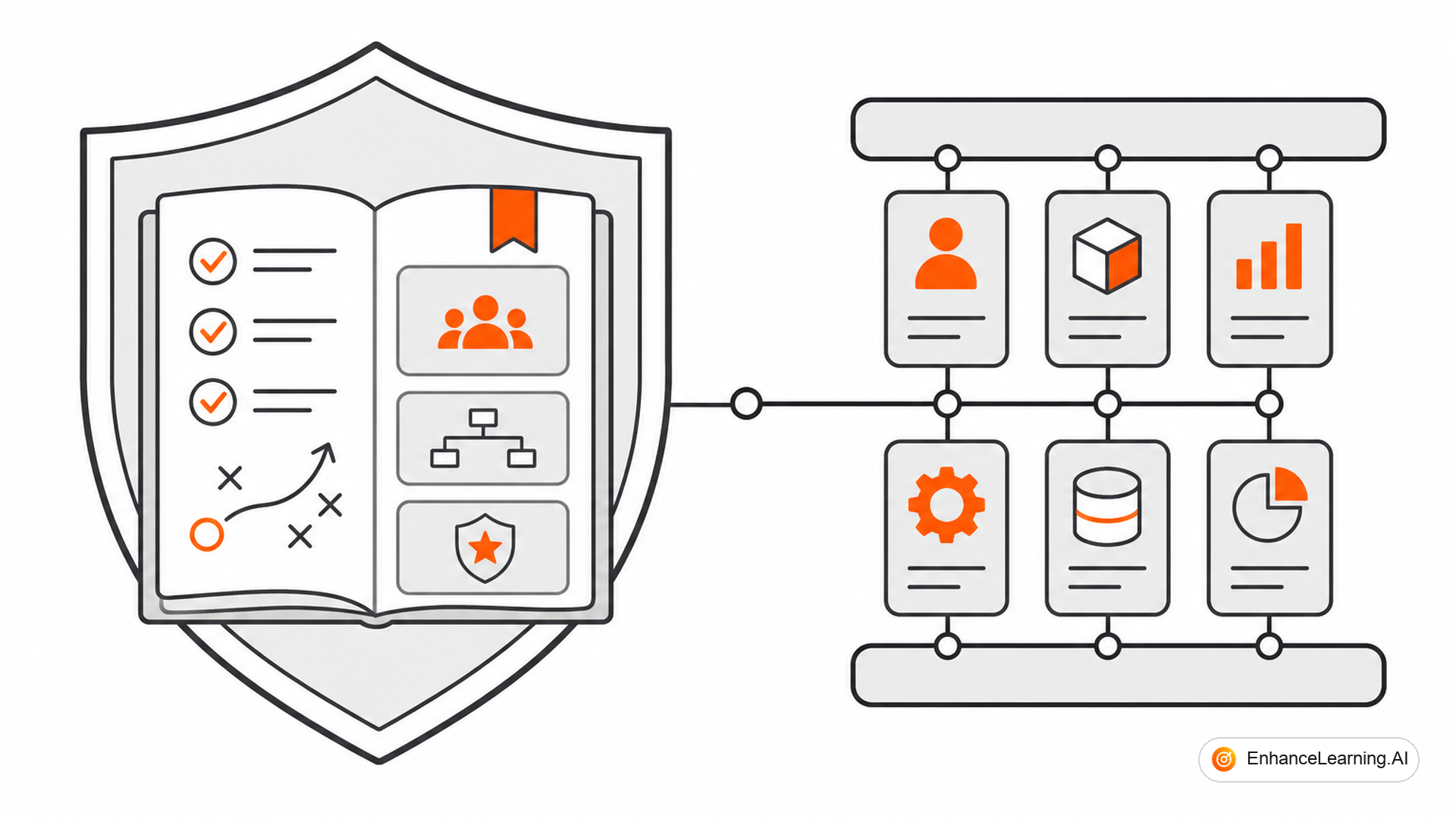
Job postings blur them. Steering committees conflate them. Engineers get told to "ask the CoE" for a broken gateway alias and "ask platform" for eval template guidance — and both teams shrug. An enterprise AI CoE and an AI platform team are complementary, not interchangeable. One sets standards and grows capability; one ships and operates shared infrastructure. Role confusion duplicates effort, creates gaps, and gives domains two teams to route around instead of one fast path.
The difference, plainly#
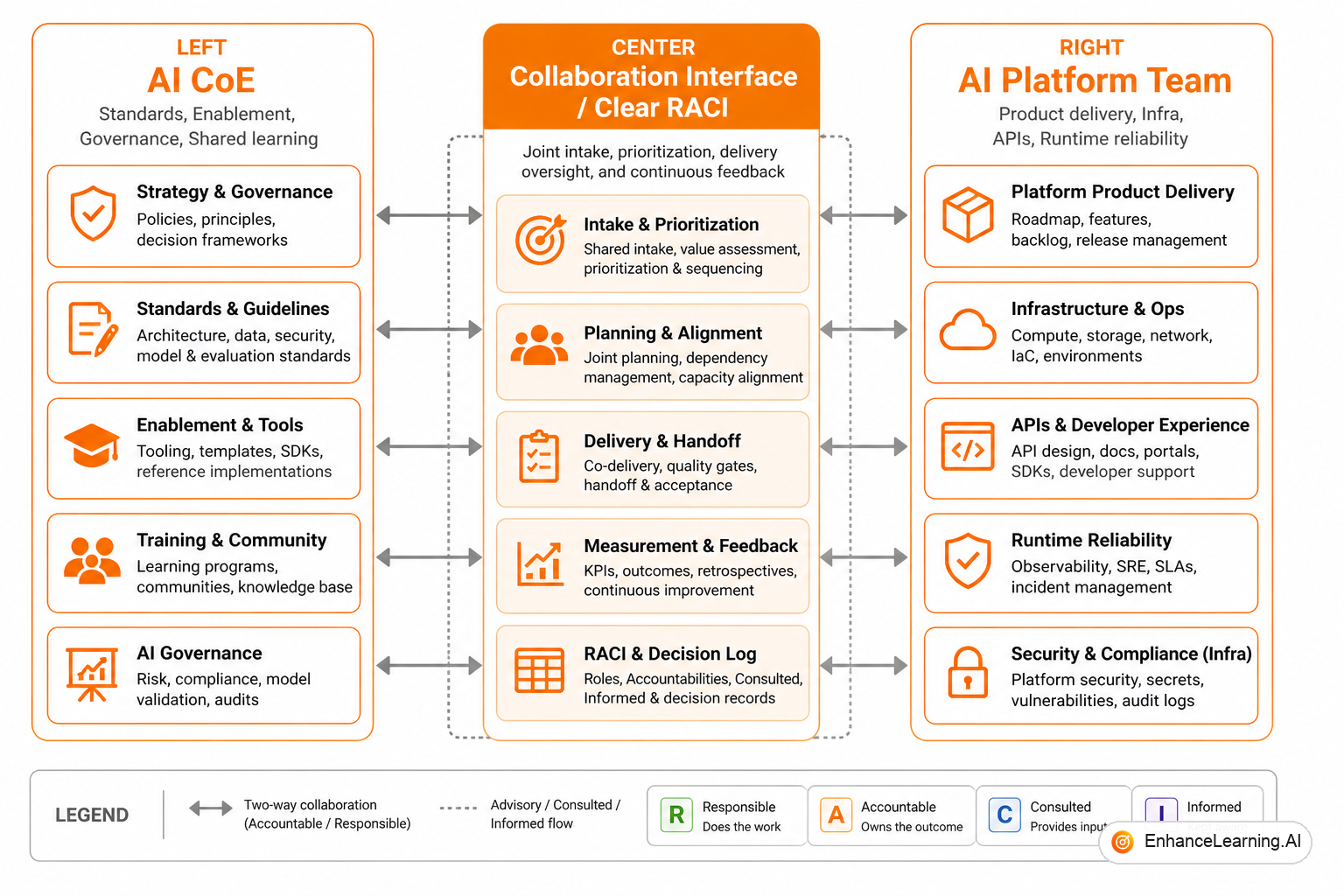
Platform builds and runs the rails. CoE teaches people to ride them — and curates which patterns belong on them.
Charter comparison#
| Dimension | AI CoE | AI platform team |
|---|---|---|
| Primary output | Patterns, training, portfolio view | Gateway, observability, deploy paths |
| Success metric | Time-to-prod on rails; skill uplift | Uptime, latency, cost visibility |
| Enforcement | Standards via docs + CI rules | Policy in gateway and infra |
| On-call | Usually no prod pager for domain apps | Yes — shared services pager |
| Customer | Domain engineers + product | Domain teams as internal customers |
| Roadmap driver | Repeat friction across BUs | Scale, reliability, security hardening |
| Typical failure | PDF factory / approval bottleneck | Ticket queue with no enablement |
Neither team should own end-user workflows. That stays with domain product + engineering.
When CoE runs the gateway "temporarily" and platform writes standards "for alignment," you get two owners and zero accountability. Split cleanly: platform operates; CoE documents how to comply — with CI and gateway as enforcement.
What platform owns#
Concrete platform responsibilities:
- Model gateway — aliases, routing, spend tags, rate limits
- Logging and redaction — prompt/response retention, PII handling
- Tool registry / MCP integration — allowlist, threat review hooks
- Eval harness infrastructure — runners, result storage, CI integration
- Deployment templates — how domain services connect to gateway and observability
- SLOs on shared services — error budget policy for internal customers
Platform says no to unsafe configs. It also publishes SLAs for provisioning and documents the blessed path.
What CoE owns#
CoE responsibilities that platform should not absorb:
- Reference architectures per job class — kept in sync with what platform actually supports
- Golden-set examples — starter evals domains copy and extend
- Training and office hours — eval design, tool governance, incident retros
- Portfolio reporting — pilots vs prod, kill recommendations
- Cross-BU learning — postmortem library, community of practice
CoE does not merge gateway PRs at 3 a.m. Platform does.
Handshake interfaces#
Healthy orgs define explicit interfaces:
from dataclasses import dataclass
from typing import Literal

Role = Literal["coe", "platform", "domain"]

@dataclass
class WorkItem:
    title: str
    primary_owner: Role
    consult: list[Role]

ROUTING_TABLE = [
    WorkItem("Add new model alias in prod gateway", "platform", ["coe"]),
    WorkItem("Publish eval template for RAG job class", "coe", ["platform"]),
    WorkItem("Domain workflow on-call incident", "domain", ["platform", "coe"]),
    WorkItem("Gateway outage", "platform", ["coe"]),
    WorkItem("Tier-2 autonomy policy update", "coe", ["platform", "domain"]),
    WorkItem("CI gate for minimum logging fields", "platform", ["coe"]),
    WorkItem("New tool MCP server approval", "platform", ["coe"]),
]

def resolve_owner(title: str) -> WorkItem | None:
    for item in ROUTING_TABLE:
        if item.title == title:
            return item
    return None
Publish this routing table internally. Ambiguity is how shadow IT wins.
Sequencing requests domains should follow#
- Design workflow — domain + CoE office hours optional
- Provision rails — platform ticket: gateway namespace, logging, CI template
- Implement + eval — domain, using CoE starter sets
- Risk review — tiered by job class; CoE does not replace risk
- Prod deploy — domain on-call; platform pager only for shared services
Domains that skip step 2 and paste API keys into a Lambda recreate the split teams were meant to prevent.
Metrics each team publishes monthly#
Confusion fades when dashboards show separate scorecards:
| Metric | CoE publishes | Platform publishes |
|---|---|---|
| Time-to-first-prod on rails | Median days by BU | Gateway provision SLA |
| Quality floor | Eval template adoption rate | Eval runner uptime |
| Safety | Repeat incident themes | Policy violation blocks |
| Efficiency | Pilots killed vs graduated | Cost per token by alias |
| Shadow signal | Bypass themes from portfolio review | Unsanctioned key detections |
If CoE reports high template adoption but platform sees traffic bypassing the gateway, someone is measuring the wrong thing — fix the metric, not the org chart again.
Escalation when routing fails#
Default to platform for shared-service uptime or gateway policy. Default to CoE for pattern gaps. Hold joint office hours weekly. Escalate to steering only when SLAs are missed twice — not for every disputed PR. Publish escalation next to the routing table.
Org chart patterns that work#
Three common patterns — pick one explicitly:
| Pattern | CoE reports to | Platform reports to | Best when |
|---|---|---|---|
| Dual track | CTO office / transformation | Platform engineering VP | Large enterprise, separate budgets |
| Platform-led enablement | Platform eng (dotted to transformation) | Platform engineering VP | Platform already strong |
| Federated guild | Rotating BU architects + small core | Central infra | Mature domains, light central team |
Dual track fails when CoE and platform do not meet weekly. Platform-led fails when enablement becomes afterthought ticket backlog. Federated fails early when domains lack AI depth — start centralized enablement, federate later.
Summary#
An enterprise AI CoE enables: standards, patterns, training, portfolio hygiene. An AI platform team delivers and operates: gateway, logging, eval infrastructure, deploy paths. CoE shapes behavior; platform shapes traffic. Define routing, avoid overlap on gateway ownership and standards enforcement, and keep domain workflows owned by domains. Clarity between the two teams is what makes the sanctioned path faster than shadow IT.
Want premium architecture blueprints?
Be among the first to explore interactive reference architectures, implementation playbooks, and premium engineering resources at launch.
Related Articles
Recommended reading based on this topic.
How an AI CoE Scales Enterprise Adoption
A well-scoped AI CoE accelerates standards, shared learning, and cross-BU reuse — without owning every use case.
Read ArticleWhy Enterprise AI Operating Models Need Periodic Redesign
Enterprise AI operating models must evolve with capability, maturity, and priorities — not stay frozen after a one-time setup.
Read ArticleModel Selection Framework for Enterprise AI
A practical framework for choosing enterprise models: task fit, context and tool needs, cost-latency envelopes, eval gates, and when to use routers instead of one frontier model.
Read Article