
How an AI CoE Scales Enterprise Adoption
A well-scoped AI CoE accelerates standards, shared learning, and cross-BU reuse — without owning every use case.
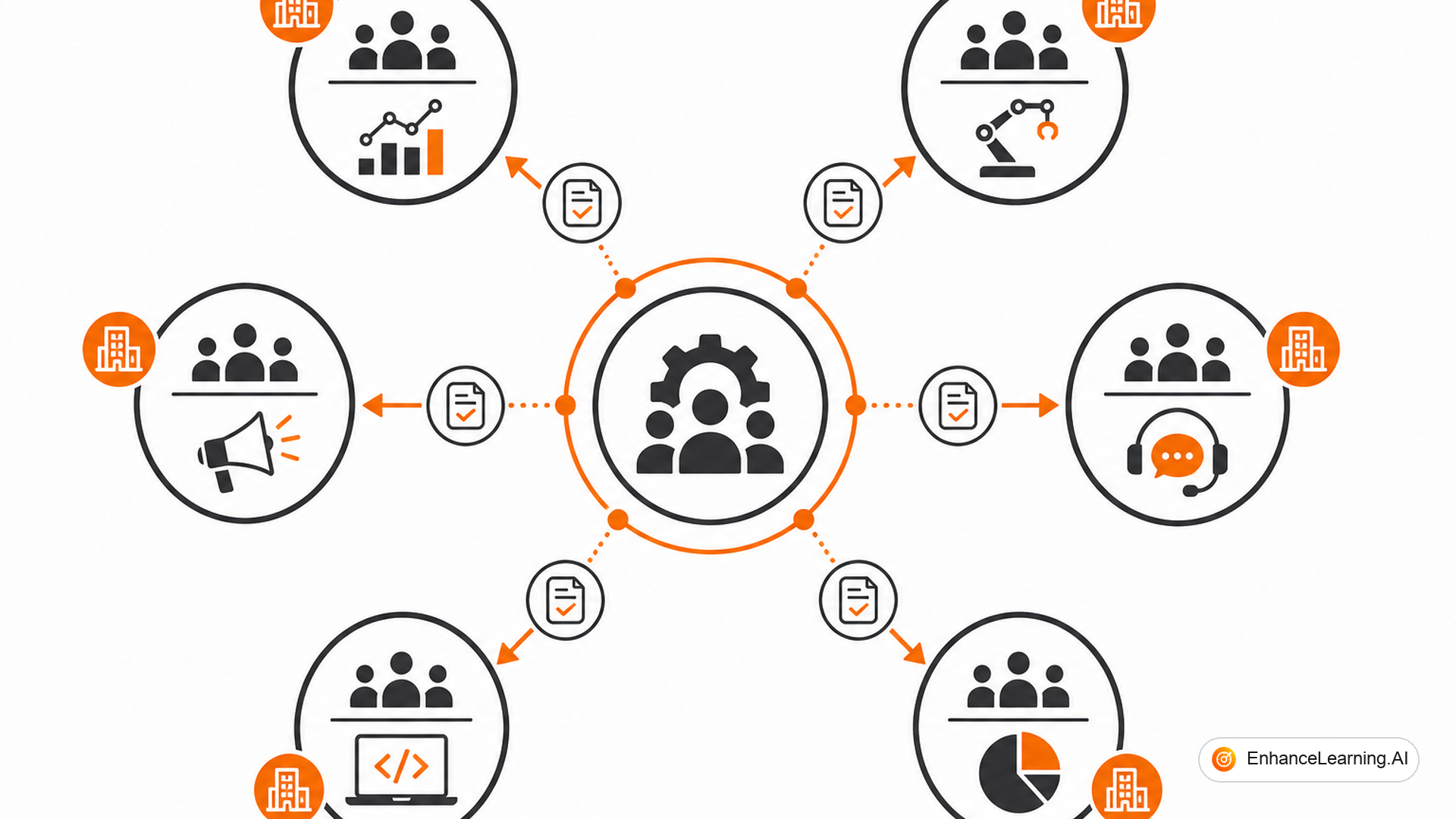
Every enterprise AI program eventually asks for a Centre of Excellence. Half the time it becomes a slide factory. The other half it becomes a bottleneck that domains learn to avoid. A well-scoped CoE accelerates adoption — standards people actually use, shared learning that cuts repeat mistakes, cross-BU reuse of eval patterns and gateway configs — without owning every workflow or every on-call rotation. The difference is mandate: enablement and rails, not empire.
What a CoE is for (and what it is not)#
A CoE exists to reduce duplicated learning and raise the floor on safety and quality. It is not a substitute for domain product teams, platform engineering, or risk functions.
| Responsibility | CoE should | CoE should not |
|---|---|---|
| Standards | Publish minimal viable patterns + examples | Write 200-page policies nobody reads |
| Learning | Curate postmortems, golden-set templates | Own every model fine-tune |
| Reuse | Maintain reference architectures | Ship all production features |
| Gateway | Define logging/eval requirements | Become sole approver on every deploy |
| Skills | Train engineers on eval + tool governance | Run endless prompt workshops |
| Portfolio | Track graduation/kill criteria | Grade every BU on pilot count |
When the CoE owns delivery, domains disengage. When the CoE only publishes PDFs, domains ignore it. The viable middle is platform-backed enablement: standards enforced by CI and gateway, CoE teaches how to pass.
Measure time-to-first-production-workflow on shared rails and repeat incident rate across domains — not CoE headcount or standards documents published.
CoE scope that scales#
Effective CoEs anchor on four services:
- Reference job classes — contract extract, ticket draft + retrieval, internal search with citations; each with a minimal eval pack
- Golden-path templates — repo skeletons wired to your gateway, logging fields, and eval harness
- Office hours + review — architects available for design review, not gatekeeping every PR
- Community of practice — monthly show-and-tell of prod workflows, failures included
They partner with platform for gateway defaults and with risk for tiered review templates. They do not run production pagers for domain apps.
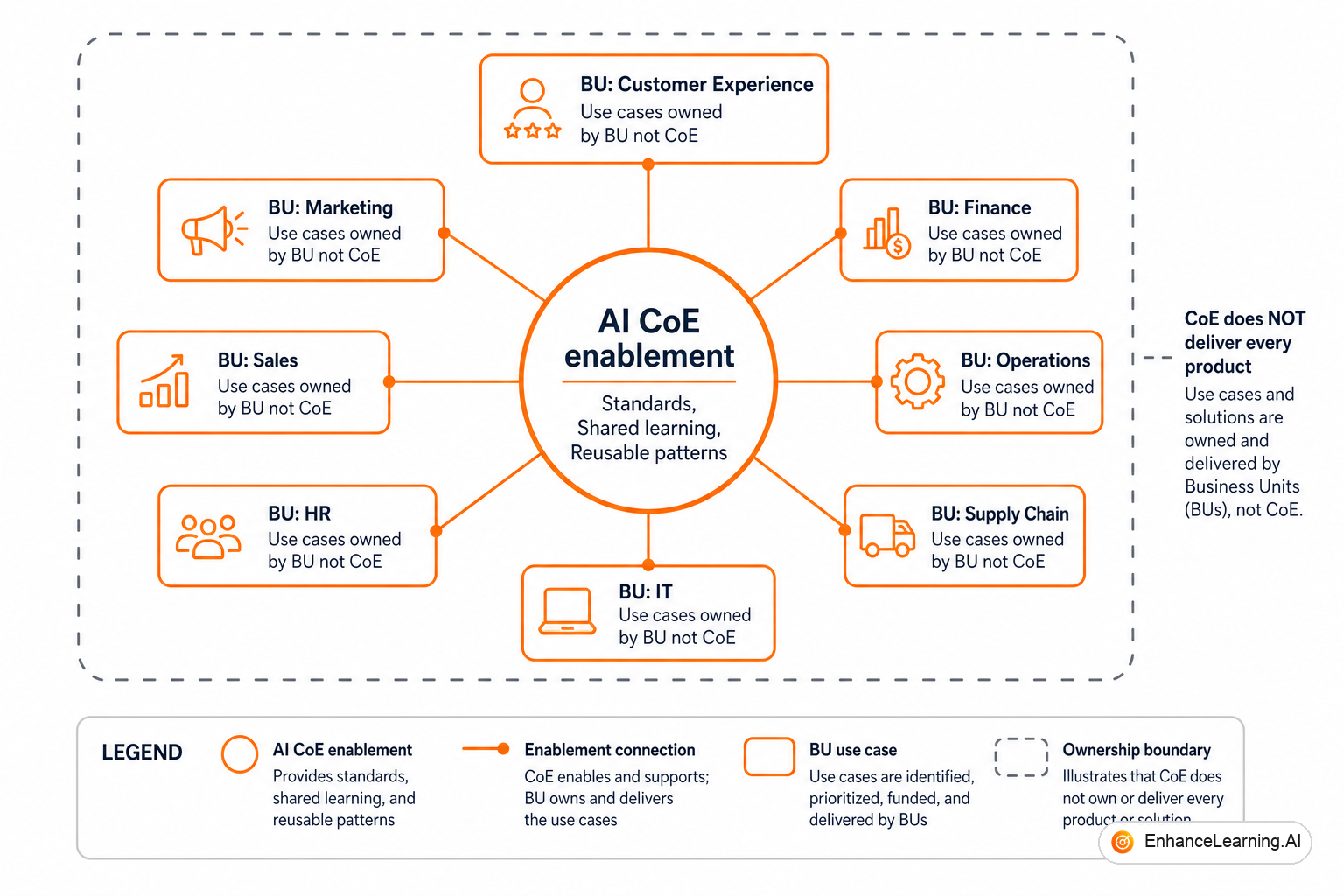
Relationship to platform and domains#
Think three layers:
- Domains — own workflows, users, domain evals, on-call for their apps
- Platform — gateway, tool registry, shared observability, deploy infrastructure
- CoE — patterns, training, portfolio hygiene, cross-BU learning
Friction appears when CoE tries to become platform ("we approve model aliases") or domain ("we will build the chatbot for HR"). Charter clarity prevents turf wars.
interface CoeCharter {
  readonly mandate: "enablement" | "delivery" | "governance"; // pick one primary
  readonly enforcedVia: ("ci_gates" | "gateway_policy" | "manual_approval")[];
  readonly slaDesignReviewDays: number;
  readonly ownsProductionOnCall: boolean;
}

const HEALTHY_COE: CoeCharter = {
  mandate: "enablement",
  enforcedVia: ["ci_gates", "gateway_policy"],
  slaDesignReviewDays: 5,
  ownsProductionOnCall: false,
};

function isBottleneck(charter: CoeCharter, backlogDays: number): boolean {
  return (
    charter.mandate === "governance" &&
    charter.enforcedVia.includes("manual_approval") &&
    backlogDays > charter.slaDesignReviewDays * 2
  );
}
If isBottleneck returns true, move enforcement into automated gates or shrink approval scope — do not hire more approvers.
Enablement for AI-native engineering#
CoE training should feel like staff engineering workshops, not prompt trivia:
- How to structure eval sets that catch regressions without flaking
- Tool allowlisting and threat modeling for write actions
- Context budgeting and retrieval evaluation
- When not to use an agent loop — workflow beats autonomy hype
- How to read production traces during incidents
Pair training with templates that encode the lessons. Engineers adopt patterns they can copy-paste and ship.
Reference implementations domains can fork#
Credibility comes from code, not slides. Maintain one reference implementation per major job class — wired to your actual gateway, logging schema, and eval runner. Domains fork the repo, swap corpus and prompts, keep the control plane intact.
A healthcare payer CoE shipped a ticket-draft + retrieval reference with 40 golden cases. Three BUs reached production in eight weeks by forking instead of reinventing auth. The CoE owned the template and office hours — not those pagers.
Reference implementations should be boring: minimal UI, maximal observability, eval CI on every PR.
Portfolio hygiene the CoE owns#
Someone must maintain the enterprise AI portfolio view:
- Workflows in prod vs pilots past graduation date
- Eval pass rate trends by job class
- Repeated shadow-IT patterns (same bypass, different BU)
- Kill recommendations for initiatives missing owners
CoE presents this quarterly to steering — not to shame, but to reallocate funding from zombie pilots to rails that work.
Scaling the CoE without scaling headcount linearly#
As portfolio grows, CoE should shift effort from bespoke review to repeatable assets:
- Pattern library — versioned docs tied to platform features actually shipped
- Office hours rotation — architects cover domains without owning delivery
- Community champions — one senior engineer per BU trained to first-line enable peers
- Automated compliance — CI fails PRs missing required logging fields; CoE stops reviewing what machines can check
When prod workflow count doubles, CoE headcount should not double if enforcement moves into gateway and CI. If headcount doubles anyway, you are still gatekeeping manually — redesign before hiring the tenth approver.
Staff with people who have shipped prod AI. As domains mature, federate: domain-owned evals, fast-track for repeat job classes, CoE focuses on portfolio hygiene and cross-BU learning. Sunset signals — shadow IT near zero, stable time-to-prod, domains teaching domains — mean success, not a reason to grow headcount.
Summary#
A Centre of Excellence scales enterprise AI when it enables domains on shared platform rails: reference patterns, templates, training, portfolio hygiene, and cross-BU learning — with standards enforced by CI and gateway, not by manual gatekeeping. It should not own every use case or every pager. Charter it for enablement, measure time-to-prod and incident repeat rate, and redesign the CoE itself when it becomes a bottleneck.
Want premium architecture blueprints?
Be among the first to explore interactive reference architectures, implementation playbooks, and premium engineering resources at launch.
Related Articles
Recommended reading based on this topic.
The Difference Between an Enterprise AI CoE and an AI Platform Team
Enterprise AI CoE sets standards and enablement; AI platform teams ship shared infrastructure — know the split to avoid role confusion.
Read ArticleWhy Enterprise AI Operating Models Need Periodic Redesign
Enterprise AI operating models must evolve with capability, maturity, and priorities — not stay frozen after a one-time setup.
Read ArticleModel Selection Framework for Enterprise AI
A practical framework for choosing enterprise models: task fit, context and tool needs, cost-latency envelopes, eval gates, and when to use routers instead of one frontier model.
Read Article