
Monolithic vs Modular AI-Native Architectures
Unified AI apps vs decomposed capability modules — trade-offs in velocity, eval isolation, team boundaries, and cost for production AI-native systems.

The first production agent almost always lives in one repository: one service, one prompt folder, one deploy button, one on-call rotation that learns the whole stack by fire drill. That monolith is rational. It ships. The question is not whether monoliths are bad — it is when decomposition earns its tax. AI-native systems amplify the usual modular-vs-monolith trade-offs because prompts, evals, retrieval indices, and model versions are coupling vectors that classical service boundaries ignore.
Pick the wrong shape and you either stall in integration hell or trap every feature behind a single fragile deploy.
What "monolithic" means for AI-native systems#
An AI-native monolith is not necessarily one binary. It is one ownership boundary for the probabilistic path: context assembly, model calls, tool dispatch, eval hooks, and fallbacks deploy together. Prompts live beside orchestration. Changing retrieval chunk size and tool schema happens in one PR.
Advantages:
- Velocity — one team, one pipeline, fewer cross-service contract negotiations
- Debugging — full trajectory in one log stream
- Eval coherence — golden sets match the exact bundle you ship
Costs:
- Blast radius — a prompt regression breaks every workflow in the service
- Scaling mismatch — inference-heavy and IO-heavy paths share fate
- Team contention — five product lines waiting on one release train
For a single product with one primary agent loop, monoliths often win through Series B.
What modular decomposition looks like#
Modular AI-native architecture splits capabilities into services or packages with explicit contracts:
- Inference gateway — model routing, token budgets, caching
- Retrieval service — embed, index, query, freshness
- Tool executor — authz, idempotency, per-domain adapters
- Workflow orchestrator — loops, state, human handoff
- Eval service — offline and sampled online scoring
Each module versions independently. Teams align to domains: platform owns gateway; legal owns contract-retrieval; product owns orchestration graphs.
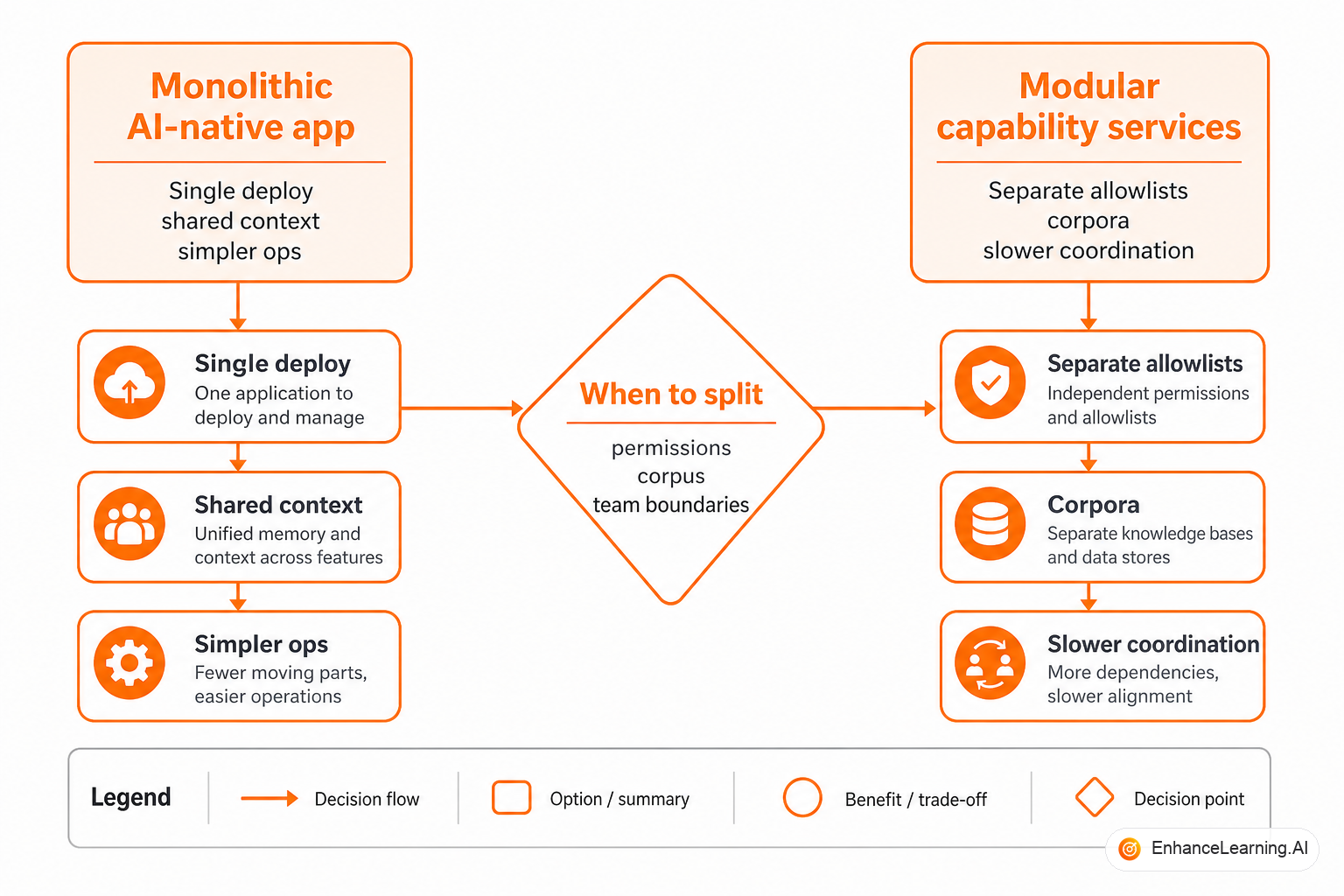
Comparison matrix#
| Factor | Monolith | Modular |
|---|---|---|
| Time to first production agent | Faster | Slower (contracts first) |
| Cross-team scaling | Painful merge queue | Parallel teams, integration tax |
| Model upgrade | One deploy, wide blast radius | Staged per module |
| Eval isolation | Shared suite, coupled regressions | Per-module suites + integration suite |
| Observability | Single trace | Correlation IDs across services |
| Cost attribution | Coarse | Per-module token and GPU meters |
| Best fit | Single product, small team | Platform + many workflows |
Neither column wins universally. The matrix is for forcing explicit trade-offs in architecture reviews — not for slide decks.
When to stay monolithic#
Stay consolidated when:
- One team owns end-to-end and will for the next twelve months
- Workflows share most context assembly and tools
- Request volume fits one inference footprint without noisy-neighbor pain
- Eval debt is still high — modularizing before you can regression-test is premature
A healthcare intake agent with three tightly coupled tools (parse referral, check coverage, schedule) often belongs together. Splitting before the loop is stable doubles incident surface without clear ownership wins.
When to modularize#
Decompose when:
- Independent release cadence — legal retrieval must not block consumer chat deploys
- Different SLO tiers — sub-second classification vs 30-second research agent
- Regulatory boundaries — PHI-handling modules with stricter audit
- Reuse — three products need the same inference gateway policies
- Cost isolation — one team's experiment burns token budget for everyone
Modularize along natural fault lines: inference, retrieval, tools, orchestration. Do not modularize by prompt paragraph.
from httpx import AsyncClient
from pydantic import BaseModel, Field

class RetrieveRequest(BaseModel):
    query: str
    tenant_id: str
    top_k: int = Field(default=8, le=20)

class RetrieveResponse(BaseModel):
    chunks: list[dict]
    index_version: str
    latency_ms: float

async def retrieve(req: RetrieveRequest) -> RetrieveResponse:
    async with AsyncClient(base_url="https://retrieval.internal", timeout=3.0) as client:
        resp = await client.post("/v1/query", json=req.model_dump())
        resp.raise_for_status()
        return RetrieveResponse.model_validate(resp.json())
A thin client like this is the modular boundary made visible: orchestrators depend on a schema, not on embedding code copy-pasted from another repo.
Build the first workflow monolithically. Extract a module when a second team needs the same capability with different release timing — not when a platform engineer prefers microservices. Premature extraction creates distributed monoliths with HTTP and worse debugging.
Hidden coupling in both shapes#
Monoliths hide coupling in shared prompt files and global config. Modules hide coupling in implicit prompt assumptions — orchestrator expects retrieval chunks in a shape the service never documented.
Both shapes need:
- Versioned contracts (schemas, protobuf, OpenAPI)
- Contract tests in CI
- Shared trace IDs across module boundaries
- Integration eval suites that run on every cross-module release
AI-native modular architecture fails when teams treat HTTP as the only interface. Semantic contracts — chunk metadata, confidence fields, refusal codes — matter equally.
Migration path that works#
- Stabilize the monolith loop — budgets, tools, evals green
- Extract read-only modules first — retrieval, classification
- Keep writes in orchestrator until authz story is solid
- Extract inference gateway when model routing complexity justifies it
- Never split eval ownership — central platform maintains golden integration suite
Big-bang rewrites from monolith to twelve services have the same body count as classical microservice migrations — with extra prompt drift.
Operational differences day to day#
Monolith on-call owns prompts, retrieval freshness, tool failures, and model latency in one rotation. Context switching is high; mean time to understand is lower because traces are local.
Modular on-call routes pages by service — but user-visible failures are often cross-module. Requires trajectory-first debugging: start from user impact, walk the correlation ID across boundaries, resist blaming "the model team" without evidence.
Runbooks must list which module owns which fallback layer. Ambiguity during outages burns minutes arguing ownership instead of climbing the ladder.
Build vs buy in each shape#
Monolith teams often embed vendor SDKs directly — fastest integration. Modular teams wrap vendors behind internal gateways early — slower start, easier provider swaps and policy enforcement.
Neither is universally correct. If you expect two model providers within a year, gateway extraction pays early. If you are proving one workflow in ninety days, embed and defer.
Testing strategy per shape#
Monolith: one integration test suite covers end-to-end trajectories; unit tests per tool handler.
Modular: contract tests per module plus integration suite that runs on any cross-module release candidate. Skipping the second reproduces distributed monolith failures in prod.
Record eval pass rates per module and for the composed workflow separately. A green retrieval module plus a broken orchestrator still yields red user experience.
Choosing shape under regulatory load#
Regulated domains often force modular boundaries — audit scope, data residency, access logs per module. A monolith handling both general FAQ and PHI extraction may be structurally convenient but audit-expensive.
Split where audit domains split, even if team size prefers monolith. The modular tax is often smaller than the compliance tax of mixed concerns in one deploy artifact.
Long-term ownership signals#
If three product lines share one agent monolith and each line's roadmap diverges, merge conflicts in prompts and tools signal decomposition time. If one product uses 90% of traffic and two others are experiments, stay monolith and isolate experiments behind feature flags — not new services.
Revisit the decision every two quarters with data: deploy frequency, incident blast radius, eval coupling, token cost attribution. Architecture is not permanent; it is a bet with expiry.
Communication with leadership#
Executives ask "why cannot we ship faster?" when modular boundaries slow cross-team releases. Answer with blast radius math: one monolith deploy affects four products; staged module deploy contains risk. Pair with data — incidents caused by undeclared coupling vs integration delays.
Conversely, when staying monolith, explain velocity debt: merge queue time, shared eval regressions blocking unrelated features. Honest trade-off language prevents wrong reorgs.
Starter heuristics#
If your team is fewer than eight engineers and ships one primary AI workflow, default monolith. If two or more workflows need different model SLAs or compliance scopes within six months, design modular interfaces now — implement extraction later.
Summary#
Monolithic AI-native architectures optimize for early velocity and coherent debugging; modular architectures optimize for team parallelism, staged model upgrades, and cost isolation. The decision hinge is ownership and release cadence, not ideology. Stay monolithic while one team learns the loop. Modularize along inference, retrieval, tools, and orchestration when second consumers or regulatory walls appear — with schemas, contract tests, and integration evals binding the pieces. Wrong shape shows up as either merge-queue paralysis or integration outages. Name the trade-off explicitly in every architecture review.
Want premium architecture blueprints?
Be among the first to explore interactive reference architectures, implementation playbooks, and premium engineering resources at launch.
Related Articles
Recommended reading based on this topic.
Why Traditional Software Architecture Breaks Down for AI-Native
Determinism, predictable latency, and binary failure assumptions from classical architecture collapse when LLMs sit on the critical path — and what to rebuild.
Read ArticleThe Hidden Coupling Between Prompts and AI System Architecture
Prompt length, role structure, and tool definitions leak into service boundaries, data flows, and API contracts — coupling teams thought was decoupled.
Read ArticleThe Architecture of Fallback in AI-Native Systems
When models fail or confidence drops, AI-native systems need layered fallbacks — rule engines, cached answers, human queues — not generic error messages.
Read Article