
Why Traditional Software Architecture Breaks Down for AI-Native
Determinism, predictable latency, and binary failure assumptions from classical architecture collapse when LLMs sit on the critical path — and what to rebuild.
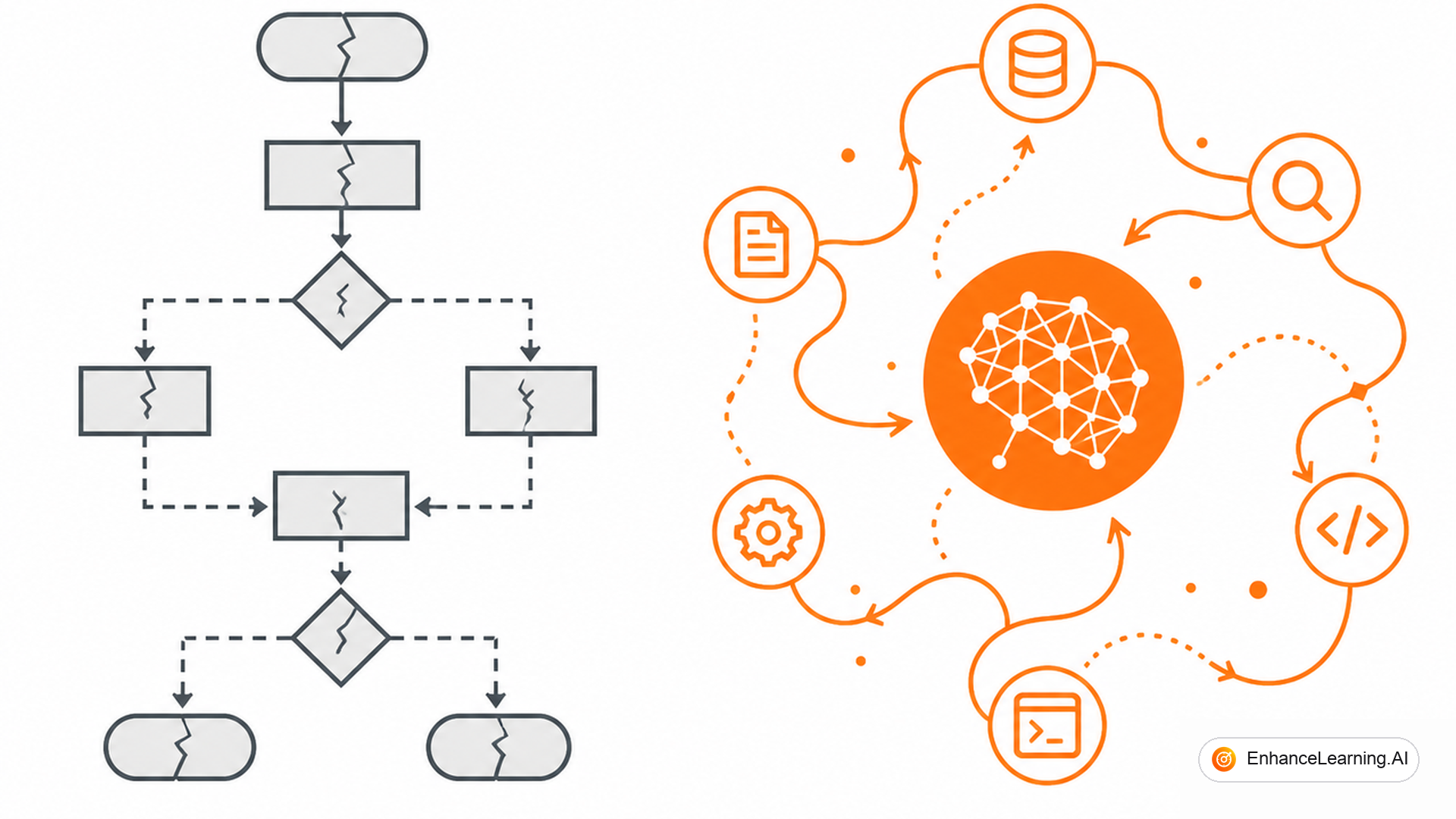
Three decades of software architecture rest on assumptions that were never questioned because they were almost always true: the same input produces the same output, latency is dominated by I/O you can cache, and failure is a discrete event you can catch with a try block and a status code. Drop a language model onto the critical path and those assumptions stop holding at the same time. Teams that keep designing AI features with classical mental models ship systems that pass integration tests and fail in production in ways their runbooks never anticipated.
This is not an argument against good engineering discipline. It is an argument that the discipline needs new primitives — not a chat widget stapled onto a three-tier monolith.
Determinism was the hidden foundation#
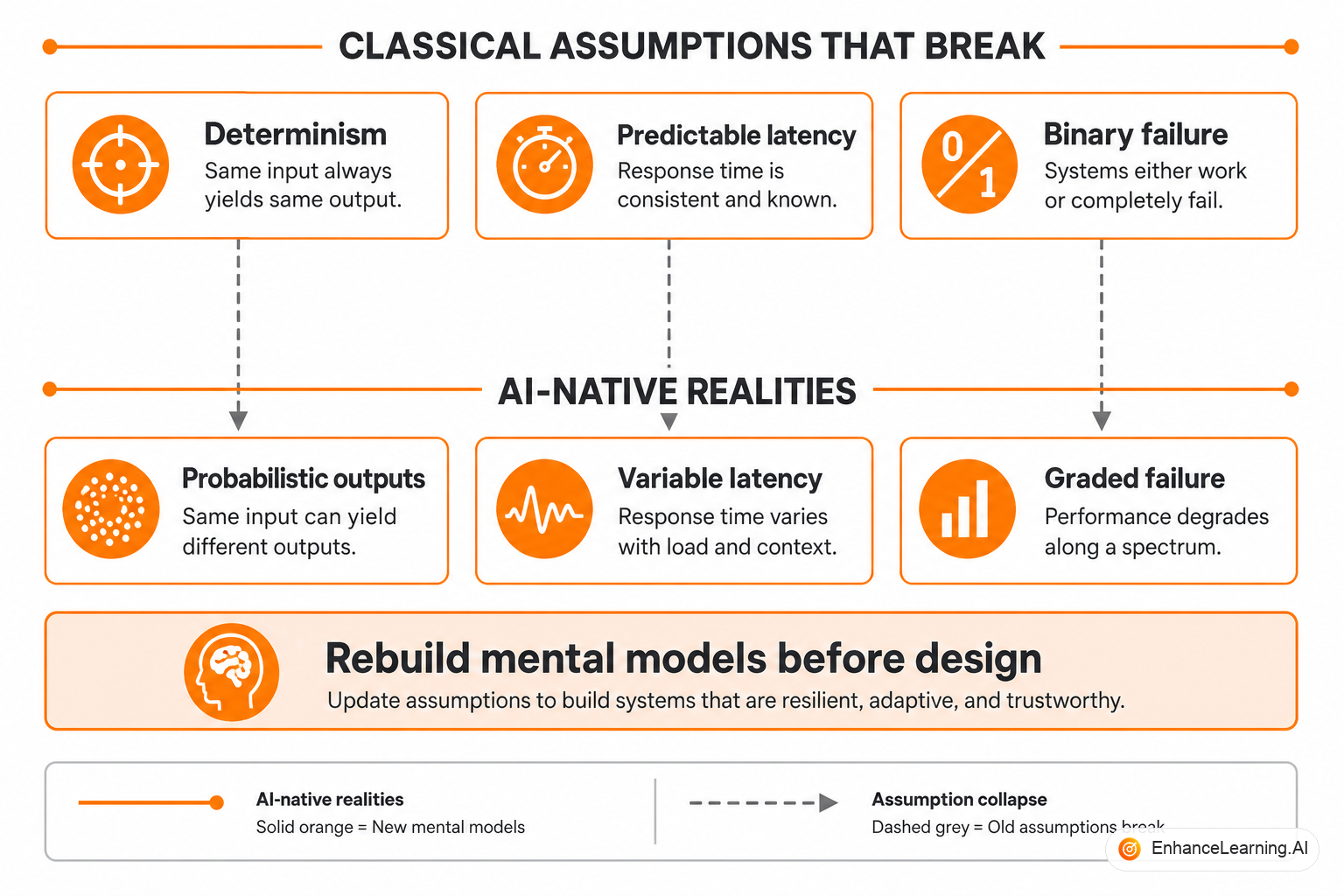
Classical architecture treats unpredictability as a bug. You isolate it behind queues, retries, and circuit breakers until the system behaves deterministically again. Unit tests assert equality. Integration tests replay fixtures. CI green means safe to deploy.
LLMs invert that contract. Two identical prompts, same temperature, same model version — you can still get different tool selections, different phrasing, different stopping points. That variance is not always a defect. It is sometimes the product. A support agent that rephrases an apology is fine. A billing agent that rephrases a refund amount is not.
The architectural mistake is pretending variance does not exist. Wrapping the model in a service with a REST endpoint does not make the interior deterministic. It hides the variance behind an HTTP 200. Production teams discover this when a "fixed" prompt deploys on Tuesday and refund misfires spike on Wednesday — not because the code changed, but because the model's interpretation of edge-case ticket language shifted.
| Classical assumption | What breaks with LLMs on the path | Architectural response |
|---|---|---|
| Same input → same output | Trajectories diverge; tool args vary | Structured outputs + schema validation at boundaries |
| Failures are explicit | Confident wrong answers return 200 | Outcome evals, confidence gates, human review queues |
| Latency is bounded by slowest I/O | Token generation is sequential and bursty | Streaming UX, step budgets, parallel retrieval |
| State lives in databases | Context window is volatile, expensive state | Context assembly pipelines with explicit budgets |
| Tests prove correctness | Spot checks miss distributional drift | Golden eval suites on every prompt/model change |
The table is not a migration checklist. It is a map of where your existing design documents lie to you.
Predictable latency was a design constraint you could plan around#
In a classical service mesh, p99 latency comes from database contention, cold starts, or a downstream vendor. You profile, add caching, shard, and the curve moves. The shape stays roughly predictable: fast path for cache hits, slower path for misses.
Model inference adds a latency component that scales with output length and does not parallelize the way a fan-out to three microservices does. A "simple" summarization that produces four hundred tokens can take longer than your entire previous request chain. Agent loops multiply that effect — each step waits for the previous completion before the next begins.
Teams accustomed to sub-200ms API SLOs panic when p50 jumps to three seconds. Some respond by hiding latency behind spinners. Better teams redesign the contract: stream partial results, show intermediate tool progress, cap loop depth so worst-case latency is calculable. The architecture change is not "add a faster GPU." It is "stop pretending the user experience is a single request-response."
A fintech team we worked with kept their fraud-review API at 150ms by running rules in-process. They added an LLM summarizer for analyst notes and left the SLA unchanged. On-call pages started firing within a week — not because the model was slow every time, but because tail latency on long cases blew the budget. The fix was architectural: async note generation with a polling endpoint, not a bigger instance type.
Binary failure models hide the real damage#
Traditional failure taxonomy is clean: timeout, 4xx client error, 5xx server error, constraint violation. Monitoring dashboards count these. On-call knows what to do.
AI systems add failures that succeed at the HTTP layer:
- Confident hallucination — structured JSON, valid schema, wrong facts
- Silent tool misuse — correct syntax, wrong entity ID, write applied
- Partial completion — two of three steps done before loop budget exhaustion
- Quality regression — same code, new model version, worse outcomes
None of these increment your error rate. All of them erode trust. Classical architecture has no slot for "successful response, bad outcome." You need a parallel failure plane: quality budgets, trajectory scoring, and escalation paths that trigger on low confidence rather than on exceptions.
Layered architecture does not map cleanly to model-in-the-loop#
The presentation / business / data layer split assumes business logic lives in code you control. When the model participates in routing, summarization, and tool selection, a slice of "business logic" moved into weights and prompts. That slice is versioned differently, tested differently, and owned by a different team in many orgs — often nobody.
Layered diagrams also encourage the fiction that the model is a data-layer concern ("we call OpenAI like we call Postgres"). In practice the model sits in the orchestration layer, proposing control flow. Treating it as infrastructure leads to missing budgets, missing allowlists, and missing eval hooks — because infrastructure teams do not usually own product correctness.
A healthier split for AI-native systems:
- Deterministic shell — auth, idempotency, policy gates, schema validation
- Orchestration — loop bounds, context assembly, tool routing
- Probabilistic core — model calls with explicit contracts in and out
- Observability plane — trajectories, token spend, outcome scores
That is not microservices for sport. It is naming where variance lives so you can bound it.
What to rebuild in your mental model#
Start by listing the invariants your current architecture assumes. For each one, ask whether an LLM on the critical path can violate it without throwing an exception. You will find more violations than you expect.
Then add three architectural commitments before you add features:
- Structured boundaries — every model output that triggers action passes schema validation
- Explicit budgets — max steps, max tokens, max tool calls, max cost per request
- Graded outcomes — success is not boolean; route low-confidence paths to fallbacks or humans
import { z } from "zod";
import OpenAI from "openai";

const ActionSchema = z.object({
  action: z.enum(["approve", "escalate", "deny"]),
  reason: z.string().max(500),
  confidence: z.number().min(0).max(1),
});

const client = new OpenAI();

async function classifyTicket(ticket: string) {
  const response = await client.chat.completions.create({
    model: "gpt-4o-mini",
    response_format: { type: "json_object" },
    messages: [
      { role: "system", content: "Return JSON matching the action schema." },
      { role: "user", content: ticket },
    ],
  });

  const raw = JSON.parse(response.choices[0].message.content ?? "{}");
  const parsed = ActionSchema.safeParse(raw);

  if (!parsed.success) {
    return { action: "escalate" as const, reason: "schema_failure", confidence: 0 };
  }
  if (parsed.data.confidence < 0.75) {
    return { action: "escalate" as const, reason: "low_confidence", confidence: parsed.data.confidence };
  }
  return parsed.data;
}
The code is boring on purpose. The architecture is in the schema, the confidence gate, and the fail-closed escalate path — not in prompt cleverness.
If your incident response assumes "check logs for 5xx" and "rollback the deploy," you are equipped for infrastructure failures, not quality failures. Add runbook steps for model version changes, prompt diffs, eval regressions, and retrieval poisoning. Those incidents look like "the AI got worse" until someone traces the trajectory.
Capacity planning and cost models break too#
Classical capacity planning counts requests per second and bytes over the wire. AI-native capacity planning counts tokens per workflow — and tokens are not interchangeable. Input tokens, cached tokens, output tokens, and embedding tokens often price differently. A retrieval-heavy path can cost more in embeddings than in generation. An agent that "thinks out loud" in long chain-of-thought burns output budget even when the final answer is one line.
Teams accustomed to flat per-request infra cost get surprised by bills that scale with user verbosity and model thoroughness. Architecture must expose per-workflow cost ceilings the same way it exposes latency ceilings.
Summary#
Traditional software architecture is not obsolete. Databases, queues, auth, and typed APIs still matter — more, not less, when models can propose actions. What breaks is the set of assumptions you imported without naming: determinism, predictable latency, binary failure, business logic that lives entirely in your repo, and cost models that ignore token economics. AI-native architecture rebuilds those assumptions explicitly. Variance becomes a first-class design input. Latency gets budgets and streaming contracts. Failure becomes a spectrum measured by outcome quality, not HTTP status alone. Teams that make that rebuild deliberately ship slower at first and sleep better later.
Want premium architecture blueprints?
Be among the first to explore interactive reference architectures, implementation playbooks, and premium engineering resources at launch.
Related Articles
Recommended reading based on this topic.
Monolithic vs Modular AI-Native Architectures
Unified AI apps vs decomposed capability modules — trade-offs in velocity, eval isolation, team boundaries, and cost for production AI-native systems.
Read ArticleThe Hidden Coupling Between Prompts and AI System Architecture
Prompt length, role structure, and tool definitions leak into service boundaries, data flows, and API contracts — coupling teams thought was decoupled.
Read ArticleThe Architecture of Fallback in AI-Native Systems
When models fail or confidence drops, AI-native systems need layered fallbacks — rule engines, cached answers, human queues — not generic error messages.
Read Article