
The Role of Tokenization in LLM Behavior and Limitations
Tokenization shapes cost, context use, multilingual quality, and code handling. Engineers who ignore it mis-size windows and misread model failures.
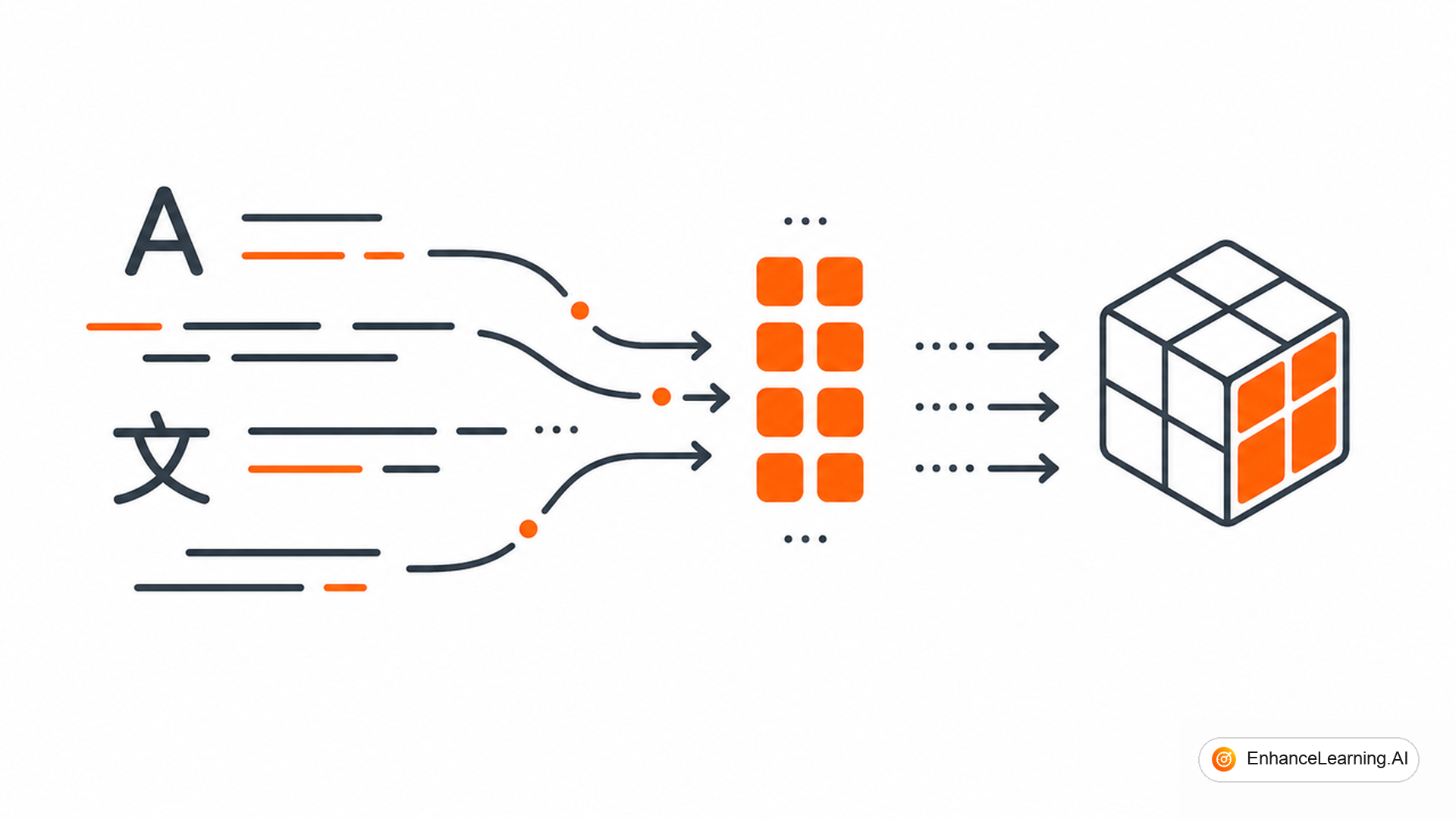
Models do not read characters or words — they read token IDs produced by a tokenizer fixed at training time. That invisible step decides whether your Japanese support ticket fits in the context window, whether Python stack traces cost twice as much as plain English, and why a model "cannot spell" a rare SKU that splits into awkward byte fragments. Tokenization is not an implementation detail for ML infrastructure teams. It is a first-class constraint in AI-native system design.
How tokenization works in practice#
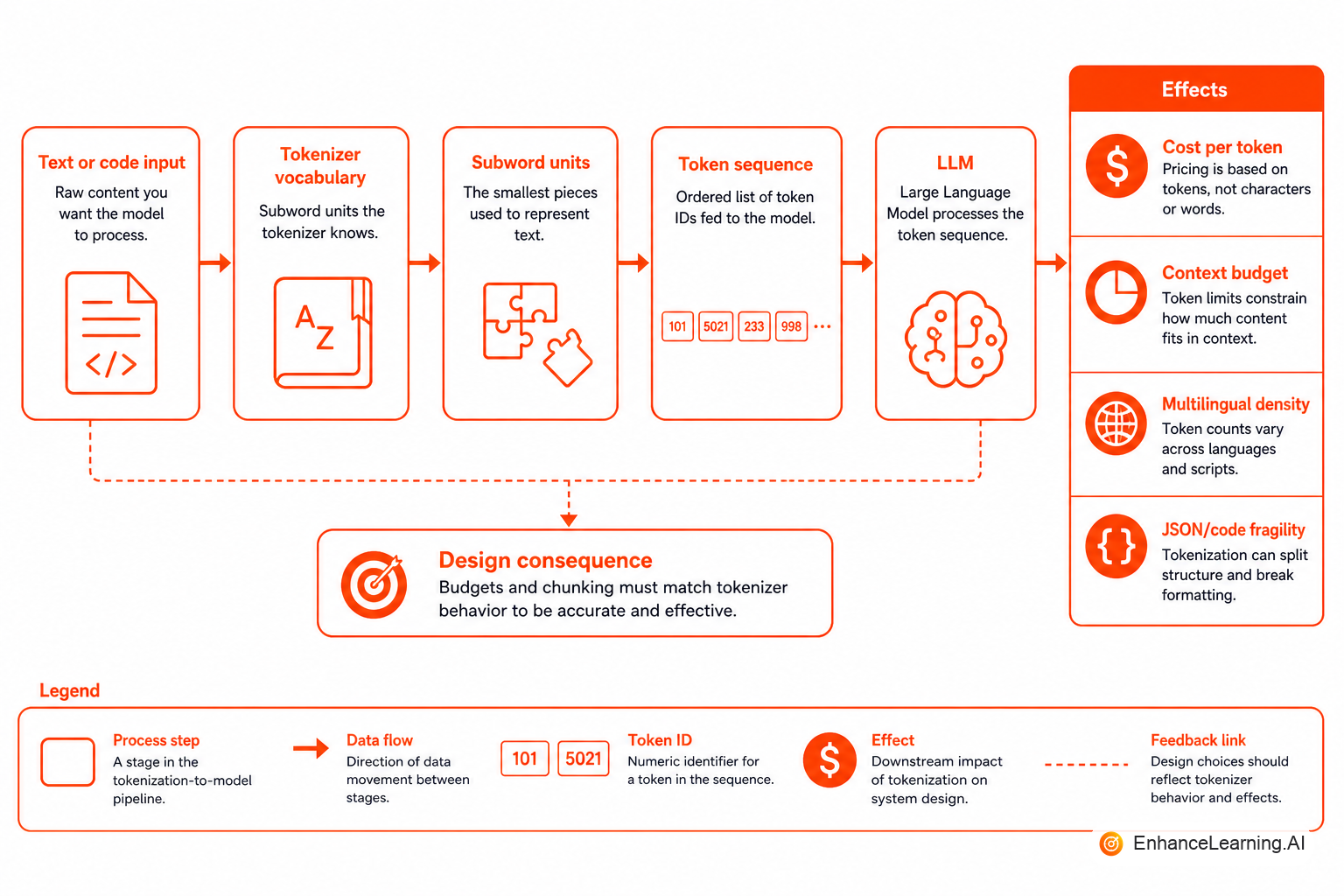
Most production LLMs use subword tokenizers — Byte Pair Encoding (BPE), SentencePiece, or variants. The algorithm merges frequent character sequences into tokens until vocabulary size (often 32k–200k entries) is reached. Common English words may be one token; rare strings split into many small pieces.
The model never sees "invoice_number". It sees something like ["invo", "ice", "_", "number"] or worse, byte-level shards. Every downstream behavior — attention, embeddings, generation — operates on that sequence.
Key implications:
- Length limits are token limits — API
max_tokensand context windows count tokens, not words. - Language fairness is uneven — English-heavy training corpora yield efficient English tokenization; other scripts often need more tokens per semantic unit.
- Code and JSON are token-heavy — braces, indentation, and long identifiers inflate counts.
- Tokenizer is paired to weights — you cannot swap tokenizers without retraining or breaking the model.
Effects on capability and apparent " stupidity"#
Some model failures are tokenizer failures wearing a reasoning costume — not gaps in "intelligence."
Spelling and counting tasks. Asking how many rs appear in "strawberry" challenges token boundaries because the model processes merged subwords, not graphemes unless char-level tooling exists. Production systems should not rely on raw LLM spelling for validation — use code.
Rare entity names. Product codes like XJ-9002-BETA may split unpredictably, reducing effective memorization within context. Combine retrieval with exact string tools instead of hoping the model "sees" the SKU as one unit.
Whitespace and punctuation sensitivity. Different tokenizations for "$1,000.00" vs "1000" affect numeric reasoning reliability. Normalization in preprocessing is architectural hygiene.
Case and unicode normalization. NFC vs NFD unicode can change token splits. Multilingual apps that skip normalization see flaky behavior across platforms.
These are not prompt bugs. They are structural.
Cost and context budgeting#
Token count drives bill and feasibility. A naive architecture loads 100k characters of logs and wonders why costs tripled — JSON logs tokenize poorly.
| Content type | Typical token density | Design note |
|---|---|---|
| Plain English prose | ~1.3 tokens per word | Baseline for estimates |
| Source code | 1.5–2.5× prose equivalent | Minify or extract symbols for prompts |
| JSON / logs | Often 2×+ vs compressed prose | Summarize or structured-filter first |
| CJK text | Variable; often more tokens per char | Test per language, do not assume English ratios |
| Base64 / hashes | Extremely token-heavy | Never inline; store by reference |
Context windows fill faster than product managers expect. Tokenization-aware design means:
- Pre-flight token counting before API calls
- Chunking strategies aligned to token boundaries, not character slices
- Compression prompts only after measuring token savings
import tiktoken

enc = tiktoken.get_encoding("cl100k_base")

def estimate_cost(text: str, price_per_million: float) -> dict[str, float]:
    tokens = len(enc.encode(text))
    return {
        "tokens": tokens,
        "usd": (tokens / 1_000_000) * price_per_million,
    }

sample_log = open("service.json.log").read()  # illustrative
print(estimate_cost(sample_log, price_per_million=3.0))
Swap cl100k_base for the encoding your vendor documents. Estimating from word count alone causes budget surprises.
Multilingual performance and tokenization#
English-centric BPE compresses English efficiently. Many other languages require more tokens to express the same content because training data imbalance left rare merges.
Consequences for global products:
- Shorter effective context for the same character screen limit in Japanese or Hindi
- Higher latency and cost per user message in non-English locales
- Quality gaps that look like "model does not speak X well" but partially reflect token fragmentation and less representation in pretraining
Mitigations:
- Locale-specific eval with token counts logged alongside quality scores
- Smaller prompts and stronger retrieval for non-English paths
- Models with explicitly multilingual tokenizers and training balance — verify with your text, not marketing
Do not assume one context limit serves all locales equally on a global rollout.
Code, tools, and structured output#
Agent pipelines stuff tool definitions, prior messages, and schema examples into one prompt. Tokenization pressure shows up as:
- Truncated tool lists when approaching context limits
- Degraded JSON adherence when schemas are verbose in tokens
- Higher retry rates on nested structures
Design responses:
- Minimize tool manifest to what the turn needs — dynamic tool retrieval
- Use compact schema representations; avoid pretty-printed megabytes
- Separate static system instructions (cacheable where vendors support prompt caching) from volatile user content
Prompt caching discounts assume stable token prefixes. Tokenization-aware caching splits static and dynamic segments deliberately.
Add a CI check that tokenizes representative prompts against your production tokenizer. Fail builds that exceed thresholds before load tests reveal p95 latency and cost blowups. Word-count guardrails miss JSON and code entirely.
AI-native design consequences#
Tokenization pushes several system patterns:
External exact matching. Never ask the LLM to compare two 64-character hashes. Use deterministic code; use the model for explanation.
Chunking for RAG. Split on tokens, not paragraphs, when using the same model family tokenizer. Character-based chunkers misalign with embedding models that tokenize differently — match embedding tokenizer or measure overlap empirically.
Streaming UX. Tokens stream to users; perceived speed ties to tokens per second, not characters. Long-token languages feel slower even at equal TPS.
Moderation and PII scanning. Byte-level evasion splits banned strings across tokens moderation models mishandle. Layer normalization and canonical forms pre-tokenization.
Version upgrades. New model versions sometimes change tokenizers. Migration changes cost profiles and context fit — re-benchmark on upgrade.
Observability your platform team should ship#
Log per request:
- Input/output token counts
- Locale / script detection
- Truncation flags (silent vs explicit)
- Tokenizer encoding ID when self-hosting
Dashboard English averages hide multilingual pain until APAC launches. Token metrics explain mysteriously high bills on code-heavy agents.
Common myths to discard#
"8k tokens ≈ 6k words everywhere." Only for English prose approximations.
"We will fix context by summarizing later." Summarization still tokenizes; bad summaries often delete structured fields that tokenized inefficiently in the first place.
"Smaller prompts always help quality." Sometimes — but under-prompting removes format anchors whose tokens bought reliability.
Embedding and RAG tokenization alignment#
RAG adds a second tokenizer problem. Your chunker often runs on characters; your embedding model tokenizes differently from your completion model. A chunk that fits "512 tokens" in the embedding encoder may balloon when injected into a completion prompt with metadata wrappers.
Practical rule: measure overlap using the completion model tokenizer when sizing chunks for injection. If embedding and completion diverge, use the tighter limit or accept retrieval noise at boundaries.
Cross-language RAG hurts twice when tokenization is inefficient — chunks hold fewer semantic units per token, and rerankers trained on English queries underperform. Log tokens_per_chunk by locale in observability; do not rely on English averages in dashboards.
Vendor tokenizer differences#
OpenAI cl100k_base, Llama SentencePiece, Gemini internal encodings — all produce different counts for the same UTF-8 string. Multi-vendor architectures need per-model token budgets in the router, not one global character limit in the API gateway.
When comparing model costs across vendors, normalize prompts through each vendor's counter. A/B tests that equalize character length but not token count bias results toward token-efficient families.
Worked example: support ticket routing#
Consider a ticket with mixed English and Korean, plus a JSON error blob. Token count might land at 2,400 for completion while a English-only estimate predicted 1,600. Routing rules keyed on character length send it down a "small model" path; quality fails because the small model never saw the full stack trace.
Fix: token-count gate at ingress, language-aware thresholds, and structured-field extraction before LLM summarization. Tokenization literacy turns a mystery quality cliff into a routing bug you can grep.
Summary#
Tokenization converts text into the units models actually process. It governs context consumption, cost, multilingual equity, code-heavy workloads, and a class of errors mistaken for reasoning gaps. AI-native architects count tokens with the same discipline they count milliseconds — and they choose pipelines that do not ask language models to do byte-exact work token boundaries were never built for.
Want premium architecture blueprints?
Be among the first to explore interactive reference architectures, implementation playbooks, and premium engineering resources at launch.
Related Articles
Recommended reading based on this topic.
Model Selection Framework for Enterprise AI
A practical framework for choosing enterprise models: task fit, context and tool needs, cost-latency envelopes, eval gates, and when to use routers instead of one frontier model.
Read ArticleModel Distillation: Teaching Smaller Models to Match Larger Ones
Distillation trains a smaller model to reproduce a larger LLM's behavior. Learn when it cuts cost, when quality collapses, and how to eval the trade-off.
Read ArticleModel Architecture Still Shapes Your System, Even Behind an API
API access hides weights, not architecture. Transformer design shapes context limits, failure modes, multimodal gaps, and what your system can build.
Read Article