
The AI Inference Stack Explained
A clear map of the AI inference stack: gateways, model serving, caching, embeddings, queues, and observability — and what to own versus buy at each layer.
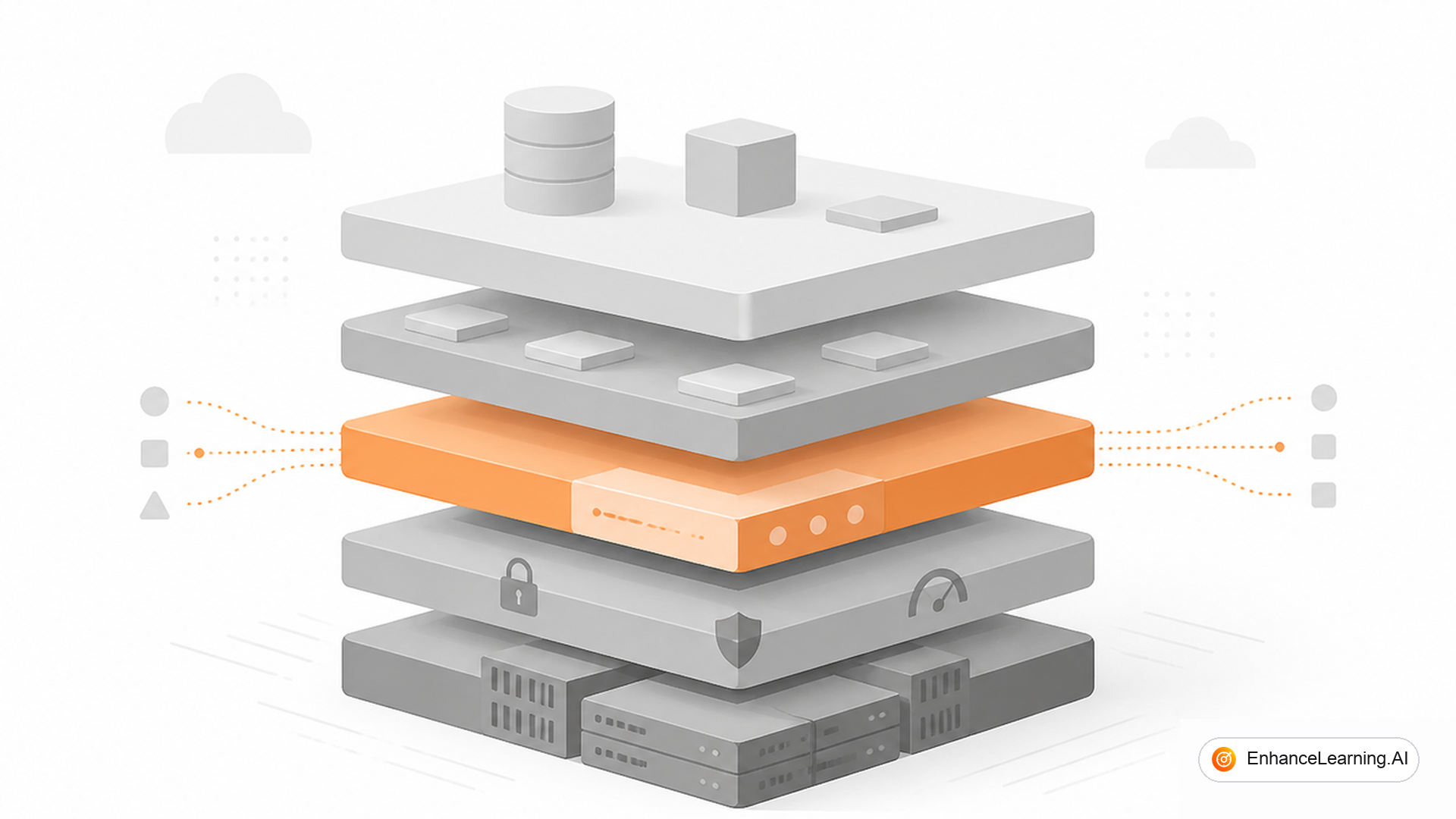
Application teams discover infrastructure when the first invoice arrives, the first provider outage hits, or p95 latency doubles after a prompt change. The AI inference stack is the set of components between your product code and tokens on the wire: gateways, serving, caches, embedding pipelines, and the telemetry that makes the rest operable. You do not need to own every layer on day one.
A layered map#
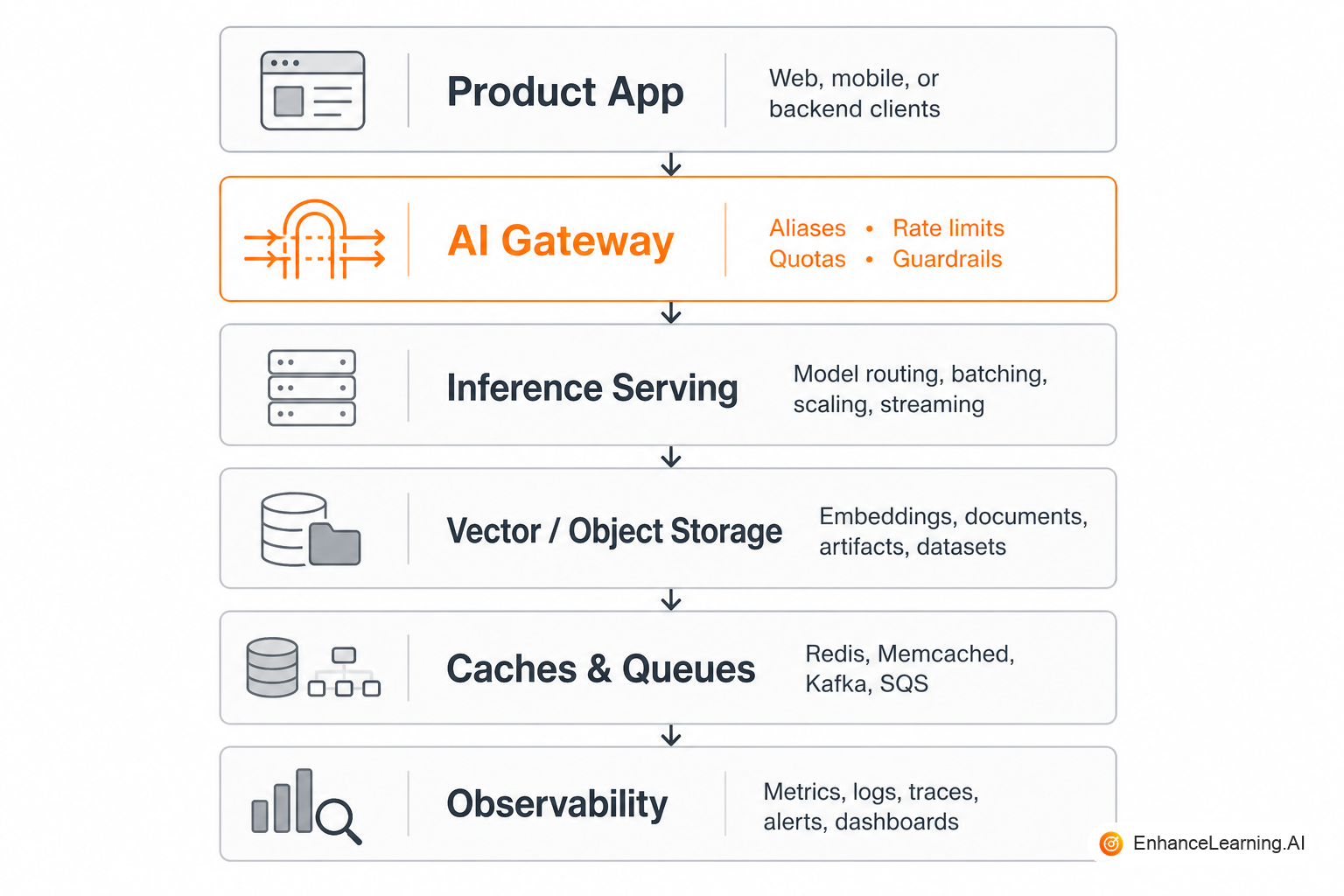
From the app downward:
- Product / orchestrator — agents, workflows, RAG assembly
- AI gateway — auth, routing, rate limits, model aliases, spend caps
- Inference serving — vendor APIs or self-hosted model servers
- Supporting data plane — vector indexes, object storage, feature stores
- Caches & queues — semantic cache, prompt cache where available, async jobs
- Observability — traces, token metrics, quality samples
Why a gateway earns its place#
Calling provider SDKs directly from every service works until you have three models, two regions, and a finance question. A gateway (or shared client library with teeth) gives you:
- Stable model aliases (
rag-answer→ pinned version) - Central rate limits and API key custody
- Retry/fallback policies that are consistent
- Request/response logging with redaction
// App code talks to aliases, not raw vendor model strings
const result = await aiGateway.complete({
  alias: "rag-answer",
  input: prompt,
  timeoutMs: 8000,
  tags: { service: "support", workflow: "ticket_reply" },
});
Pinning happens in gateway config. Apps stop silently tracking "latest."
Serving: buy vs host#
| Option | Fits when | Tradeoffs |
|---|---|---|
| Managed API | Fast iteration, variable load | Data handling terms, egress, rate limits |
| Dedicated/VPC endpoint | Stronger network controls | Still vendor-operated weights |
| Self-host GPUs | Hard residency, custom models, steady load | Ops cost, batching, scaling expertise |
Self-hosting to "save money" often fails the spreadsheet once you add idle GPUs, reliability engineering, and a second model family. Self-host when constraints demand it, not as a default flex.
Caching that earns its keep#
- HTTP/edge cache — almost never right for personalized completions
- Exact prompt cache — useful for repeated system prefixes (provider-dependent)
- Semantic cache — skip duplicate intents when answers are safe to reuse; short TTL; tenant-aware keys
Cache invalidation for AI includes policy changes and corpus updates — treat TTLs as product decisions.
Embeddings and async paths#
Embedding and index builds belong on worker queues, not on the user request thread when volumes grow. Separate online inference (user waiting) from offline inference (batch classify, eval runs, memory extraction). Same GPUs or APIs, different latency classes and failure budgets.
Capacity and failure design#
Budget tokens and concurrency explicitly. Shed load with degraded modes (smaller model, skip critique, retrieve less) before you shed the whole feature. Multi-provider failover helps availability; it does not remove the need to re-validate quality on the fallback model.
GPU and batching realities (when you self-host)#
If you do host models, the hard parts are packing, batching, and cold starts — not downloading weights. Continuous batching, sensible max sequence lengths, and separate pools for interactive vs batch traffic matter more than micro-optimizing kernels on day one. Keep a canary model revision. Roll forward like any other stateful service: health checks on quality samples, not only on "process is up."
Networking and data path#
Prefer private connectivity to vendors when contracts allow. Do not bounce prompts through random serverless functions in unknown regions. Embeddings and document bytes should follow the same residency rules as the rest of the system of record. Infrastructure diagrams that ignore data movement get rejected by security for good reason.
What a mature stack looks like#
- Apps call aliases, never raw moving model ids
- Token and dollar spend tagged by product and workflow
- Traces join app span → gateway → provider request id
- Semantic cache hit rate and eval scores visible next to latency
- A written degraded-mode playbook for provider outages
If you only have SDKs scattered in services, you are early. That is fine — as long as the next platform milestone is the gateway and telemetry, not another model bake-off.
Observability signals that matter#
Token counts alone do not explain user pain. Instrument and dashboard:
- Latency breakdown — gateway queue, provider TTFB, tool round-trips, total user-visible time
- Cache hit rate by tenant and workflow — semantic cache that never hits is cost without benefit
- Fallback rate — how often alias routing switches to backup model; correlate with quality sample
- Retry multiplier — average provider calls per successful user request; spikes mean brittle prompts or tools
- Context size percentiles — p95 input tokens predict cost cliffs before finance does
Join provider request ids to application trace ids in the gateway. When a vendor opens a ticket, you should answer in minutes, not by grep across twelve services.
Sample outputs for quality the same way you sample for cost — tagged by alias and workflow. Infrastructure metrics without quality samples green-light bad model migrations.
Cost allocation that finance will accept#
Tag every gateway request with product, workflow, and environment. Monthly reports should read like a cloud bill, not like "we spent a lot on OpenAI":
| Workflow | Spend share | Notes |
|---|---|---|
support/ticket_reply | 42% of completion spend | $0.08 per successful task |
legal/contract_extract | 31% of embedding spend | Batch-heavy |
internal/search_copilot | 18% of spend | High cache hit on system prefix |
Chargebacks do not need to be politically perfect on day one. They need to be directionally correct so teams optimize the workflows they own. A team that discovers its critique pass doubles cost will cap it — if they can see the line item.
Set envelopes per alias: hard caps in dev, soft alerts in prod, automatic degraded mode when spend rate exceeds threshold. Inference is a utility; utilities without meters get wasted.
Platform milestones should be ordered: gateway plus tracing first, semantic cache second, self-host exploration only when residency or unit economics justify it. Teams that skip straight to GPU clusters often lack the aliases and evals needed to know whether serving changes helped or hurt.
Review provider SLAs the way you review database SLAs: maintenance windows, rate-limit behavior, and what "degraded" means for your aliases. Outages are easier to survive when degraded mode is pre-tested, not invented under pressure. Run a game day before your first real provider incident.
Summary#
The AI inference stack is a gateway-shaped control plane over serving, data, cache, and telemetry. Own the aliasing, policy, and observability early; buy or host serving based on real constraints; and measure cost as a waterfall including retries. Infrastructure for AI is still infrastructure — plus tokens as a first-class resource.
Want premium architecture blueprints?
Be among the first to explore interactive reference architectures, implementation playbooks, and premium engineering resources at launch.
Related Articles
Recommended reading based on this topic.
What AI Infrastructure Includes in an AI-Native Stack
AI infrastructure spans gateways, compute, caching, scaling, and API management — not just model weights. See where each layer sits in an AI-native stack.
Read ArticleHorizontal vs Vertical Scaling for GPU-Backed AI Workloads
When to add GPU nodes versus upgrade existing ones for LLM inference — tradeoffs across model size, traffic patterns, latency targets, and budget.
Read ArticleThe Architecture of a Production LLM Inference Platform
Production LLM inference as control and data planes: intake, routing, compute scheduling, response delivery, and observability — a platform mental model.
Read Article