
What AI Infrastructure Includes in an AI-Native Stack
AI infrastructure spans gateways, compute, caching, scaling, and API management — not just model weights. See where each layer sits in an AI-native stack.
Teams that treat AI infrastructure as "pick a model and call the API" hit the same wall: spend grows faster than usage, one provider outage takes down three product features, and nobody can explain why p95 latency doubled after a prompt tweak. AI infrastructure is the operational substrate that turns model capability into a reliable product surface — and it extends well beyond the weights themselves.
Three layers, one product#
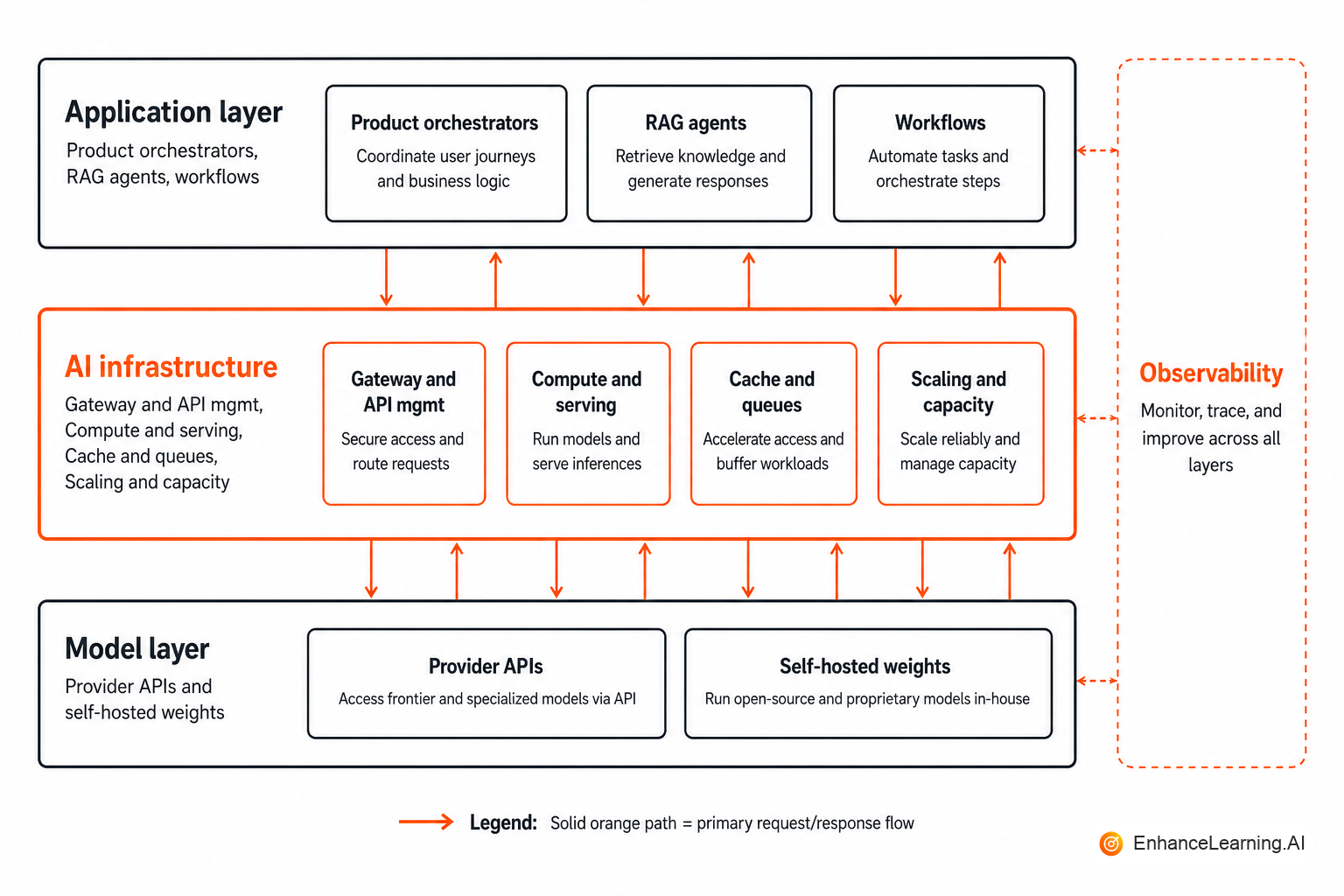
An AI-native stack has three distinct layers that product engineers often collapse into one:
- Application layer — orchestration, RAG assembly, agent loops, tool execution, business logic
- Inference infrastructure layer — gateways, routing, compute scheduling, caching, queues, API management
- Model layer — weights, tokenizers, embedding models, fine-tuned variants
The application layer decides what to ask. The model layer decides how to answer. Inference infrastructure decides whether the answer arrives on time, within budget, and with enough telemetry to debug the next incident. Most production failures trace to gaps in layer two, not to a wrong model choice in layer three.
Gateways and API management#
Every service calling a provider SDK directly creates a distributed configuration problem. Model strings drift. Rate limits collide. API keys sprawl into environment variables nobody rotates. A gateway — or a shared client library with gateway-level enforcement — centralises the contract between application code and everything below.
Gateways handle authentication, request validation, model aliasing, spend caps, retry policies, and structured logging with redaction. They are the choke point where you enforce "this workflow may not exceed 8,000 input tokens" without editing twelve microservices.
import { createGatewayClient } from "@company/ai-gateway";

const gateway = createGatewayClient({
  baseUrl: process.env.AI_GATEWAY_URL,
  apiKey: process.env.AI_GATEWAY_KEY,
});

export async function summarizeTicket(ticketId: string, body: string) {
  return gateway.complete({
    alias: "support-summary-v2",
    messages: [{ role: "user", content: body }],
    maxOutputTokens: 512,
    tags: { workflow: "ticket_summary", ticketId },
    timeoutMs: 6000,
  });
}
Application code references stable aliases. Platform teams pin versions, configure fallbacks, and rotate credentials in one place. API management here means the same thing it meant for REST services a decade ago — except the payload is tokens, not JSON fields.
Compute and serving#
Compute covers where tokens actually get generated: managed vendor APIs, dedicated endpoints, or self-hosted GPU clusters running vLLM, TensorRT-LLM, or similar serving engines. The choice is not permanent. Many teams start on managed APIs and move specific workloads to self-hosted pools when residency, unit economics, or latency requirements justify the operational cost.
Serving infrastructure includes batching strategies, max sequence length limits, model warm-up, health checks, and revision rollout. A model server that is "up" but serving degraded quality is worse than one that fails loudly — you need health probes that sample outputs, not only process heartbeats.
Separate interactive pools (user waiting) from batch pools (nightly classification, eval runs, embedding backfills). Same hardware family, different SLOs and failure budgets. Mixing them on one pool without isolation guarantees that a batch job will starve interactive traffic during peak hours.
Caching at the infrastructure boundary#
Caching in AI systems operates at multiple levels, and infrastructure owns most of them:
| Cache type | Owned by | Typical TTL | Invalidation trigger |
|---|---|---|---|
| Provider prompt prefix cache | Vendor + gateway config | Hours to days | System prompt change |
| Semantic response cache | Inference infra | Minutes to hours | Corpus update, policy change |
| Embedding cache | Data plane | Days | Document re-index |
| Exact hash cache | Gateway | Short | Prompt template change |
Semantic caching belongs in infrastructure, not in application code scattered across services. Keys must be tenant-aware. TTLs are product decisions — a cached legal answer that outlives a policy update is a compliance incident, not a performance win.
Infrastructure teams should expose cache hit rates per workflow in the same dashboard as latency. A semantic cache with 2% hit rate and 200ms lookup overhead is pure cost.
Scaling, queues, and async paths#
Not every inference call belongs on the synchronous request path. Embedding generation, document classification, memory extraction, and eval batch runs should flow through worker queues with explicit concurrency limits and dead-letter handling.
Scaling inference infrastructure means scaling token throughput, not just HTTP request count. A single agent loop can generate five provider calls per user action. Your autoscaling trigger must account for that multiplier or you will scale too late, every time.
Queue depth, worker utilisation, and time-in-queue are infrastructure metrics. They tell you when to add GPU nodes, when to shed load, and when a downstream model server is falling behind — before user-visible latency crosses your SLO.
Where inference infra sits in the org chart#
In mature teams, inference infrastructure is owned by a platform group — the same people who would own an API gateway, a Kubernetes cluster, or a data pipeline. Application teams own orchestration logic and eval quality. Model teams own fine-tuning, evaluation datasets, and weight selection.
The boundary matters. When application engineers also operate GPU clusters, eval coverage suffers. When platform engineers pick models without product input, quality suffers. Inference infrastructure is the contract surface between those groups.
Supporting data plane (often forgotten)#
Inference infrastructure does not float in isolation. Vector indexes, object storage for documents, feature stores for routing signals, and secret management for tool credentials all sit adjacent to the inference path. A RAG pipeline that retrieves in 40ms but waits 800ms for an embedding call that bypasses the gateway has an infrastructure gap, not a retrieval gap.
Network topology matters as much as software. Prompts and document bytes should follow the same residency rules as the rest of your system of record. Diagrams that show "app → model" without data movement get rejected by security review for good reason.
What to build vs buy at each component#
| Component | Buy when | Build when |
|---|---|---|
| Gateway / API management | Small team, <3 models, early stage | Multi-tenant, strict policy, complex routing |
| Managed inference API | Variable load, fast iteration | N/A for most early teams |
| Self-hosted GPU serving | Steady high volume, residency rules | Never as a default cost-saving move |
| Semantic cache | Eval coverage is weak | Strong evals + tenant isolation needs |
| Token observability | Never skip — buy tooling if needed | Custom dashboards once scale demands |
Buying a gateway product and building custom routing rules on top is normal. Building a gateway from scratch when mature open-source and commercial options exist is rarely the best use of senior engineering time.
Common mistakes that look like model problems#
- Retry storms — application-level retries multiplied by gateway retries multiplied by provider rate-limit backoff. Cap total attempts in the gateway.
- Unbounded context — no infrastructure enforcement of max input tokens per workflow. Cost cliffs appear suddenly.
- Missing degraded mode — no pre-tested fallback alias when the primary model pool is saturated. Outages become full feature outages.
- Observability at HTTP layer only — request counts without token volume hide the real cost driver.
These are infrastructure problems. Swapping models does not fix them.
Summary#
AI infrastructure in an AI-native stack is the full operational layer between application orchestration and model weights: gateways, compute scheduling, caching, scaling, queues, API management, and the telemetry that makes all of it debuggable. Own the aliasing, policy enforcement, and token-level observability early. Treat model selection as a dependency of infrastructure, not a substitute for it. Products that scale past a single model and a single team almost always fail in layer two first — plan accordingly.
Want premium architecture blueprints?
Be among the first to explore interactive reference architectures, implementation playbooks, and premium engineering resources at launch.
Related Articles
Recommended reading based on this topic.
The AI Inference Stack Explained
A clear map of the AI inference stack: gateways, model serving, caching, embeddings, queues, and observability — and what to own versus buy at each layer.
Read ArticleHorizontal vs Vertical Scaling for GPU-Backed AI Workloads
When to add GPU nodes versus upgrade existing ones for LLM inference — tradeoffs across model size, traffic patterns, latency targets, and budget.
Read ArticleThe Architecture of a Production LLM Inference Platform
Production LLM inference as control and data planes: intake, routing, compute scheduling, response delivery, and observability — a platform mental model.
Read Article