
Why AI-First and AI-Native Are Not the Same Thing
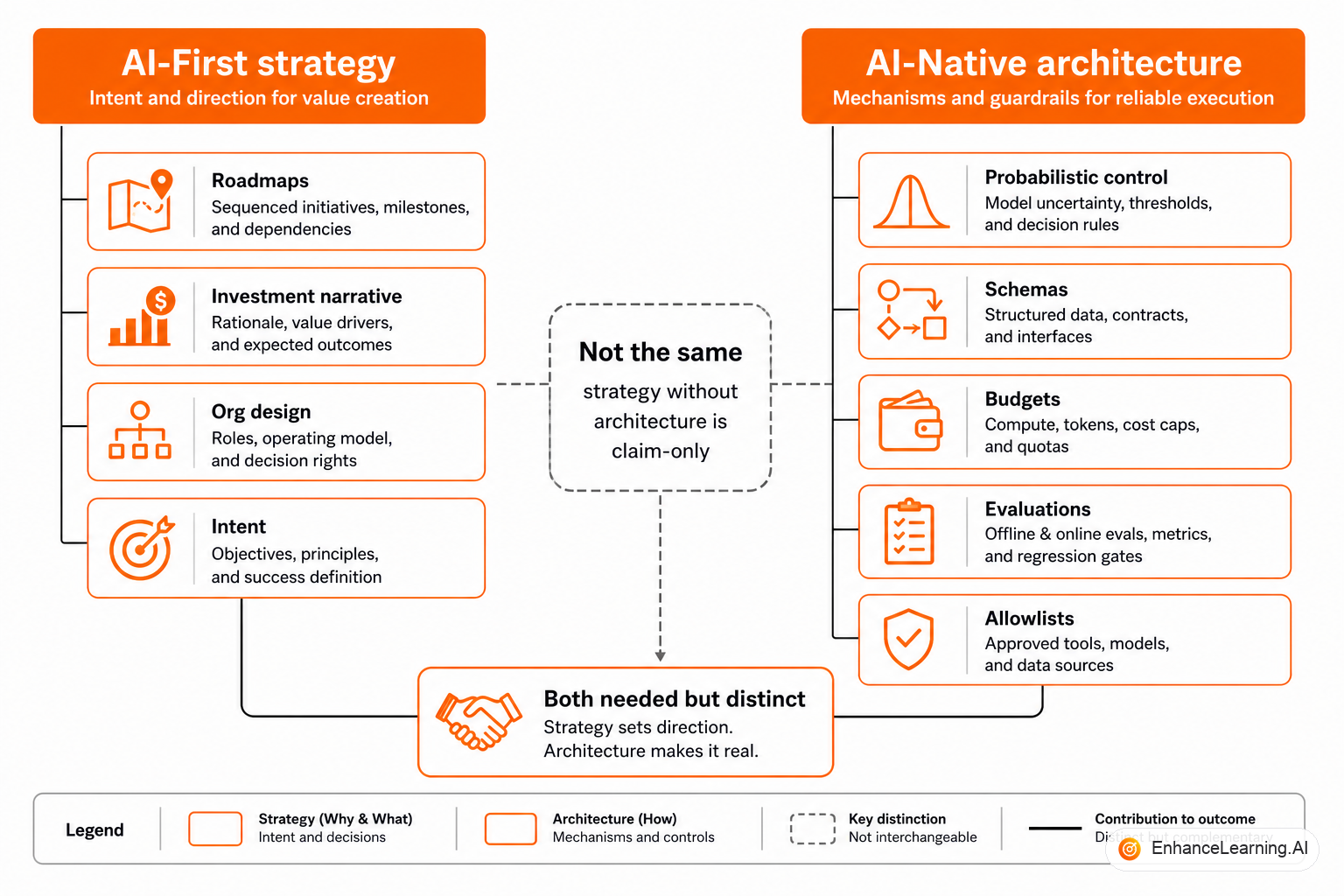
AI-first is business strategy; AI-native is architectural property. Conflating them produces slide-deck transformations and systems that still bolt models on.
Every quarter another enterprise announces it is "AI-first." Press releases mention copilots, foundation models, and innovation labs. Six months later the same company runs the same monolith, the same batch jobs, the same ticket router — with a chat sidebar and a Slack bot that hallucinates headcount numbers from last year's all-hands PDF. They are AI-first in narrative. They are not AI-native in architecture. The gap between those two labels is where budget burns and trust erodes.
Confusing strategy with structure is expensive. AI-first without AI-native foundations produces demos that scale poorly and governance teams that cannot explain what the system actually does on Tuesday at 2 a.m.
AI-first is a posture about priority#
"AI-first" answers a business question: where do we invest attention, headcount, and roadmap priority relative to AI capabilities? An AI-first company might:
- Reorganize product teams around AI features
- Require AI impact statements in PRDs
- Prefer vendors with model APIs over manual workflows
- Train executives on prompt literacy
None of that guarantees the billing service was redesigned because a model now proposes refund amounts. AI-first is about what you choose to build and sell. It says nothing about whether the runtime path, failure modes, or data flows were engineered for probabilistic components.
You can be AI-first and still bolt models onto deterministic systems. Many companies are. The strategy is sincere. The architecture is lazy. Users notice the difference before the board deck updates.
AI-native is a property of the system#
AI-native describes how the system is built, not how the press release reads. The model(s) sit on critical paths with real side effects. Control flow is bounded but not fully enumerated. Context is assembled deliberately. Tools are typed contracts. Quality is measured continuously, not demoed once.
A system can be AI-native without an AI-first company behind it. A small team building a document agent with tight loops, evals, and fallbacks may be more AI-native than a Fortune 500 "AI transformation" with a wrapper around SharePoint search.
| Dimension | AI-first (strategy) | AI-native (architecture) |
|---|---|---|
| Primary question | "Are we leading with AI in the market?" | "Is the system designed for probabilistic control?" |
| Evidence | Roadmap, hiring, partnerships | Runtime paths, budgets, evals, fallbacks |
| Failure when wrong | Hype without delivery | Production incidents, silent quality loss |
| Can exist without the other? | Yes — strategy without redesign | Yes — deep engineering without marketing |
| Owned by | Product, executive sponsors | Engineering, platform, SRE |
The table explains why two teams in the same "AI-first" program can have wildly different operational maturity. One redesigned the workflow. One added a prompt.
Where terminology collisions hurt#
Procurement. Vendors sell "AI-native platforms" that are dashboards over API calls. Buyers hear architecture; vendors mean positioning. Contracts lack SLAs for trajectory quality, model drift, or eval compatibility.
Hiring. Job posts ask for "AI-native engineers" but interview for LeetCode and microservice trivia. Candidates who know loop bounds and schema validation lose to candidates who tuned a chatbot demo.
Governance. Compliance teams ask "is this AI-first?" and get a strategy memo. They needed "where does the model write data, and what happens when it is wrong?" — an architecture question.
Internal politics. The AI-first initiative gets budget because it is visible. Refactoring the ticket router to add confidence gates is invisible until it prevents an incident. Architecture work starves while hackathons flourish.
Naming the distinction gives cover to teams doing unglamorous work: budgets, allowlists, replay tooling. That work is AI-native engineering. It is not less strategic than a keynote.
Signs you are AI-first but not AI-native#
Honest diagnostics beat branding audits:
- Model off the critical path — core workflow completes if the model times out
- No trajectory logs — incidents become "the bot was weird" with no replay
- Prompts versioned in Notion — not in git beside the code they invoke
- Quality measured in demos — no regression suite on model or prompt change
- Fallback = error message — no degraded mode that still delivers value
If three or more apply, you have an AI-first story on a classical architecture. That is a valid starting point. It is not a destination.
Signs you are AI-native without claiming AI-first#
Less common but worth recognizing:
- Internal tools with tight eval loops and no external marketing
- Batch pipelines where extraction models sit behind schemas and human review queues
- Platform teams shipping inference gateways with token budgets before product asks
These teams often resist the "AI-first" label because their work is infrastructure, not spotlight. They are nonetheless building the properties that make AI-first strategies survivable at scale.
import { createHash } from "crypto";

interface PromptBundle {
  system: string;
  tools: string[];
  schemaVersion: string;
}

function fingerprint(bundle: PromptBundle): string {
  const payload = JSON.stringify(bundle);
  return createHash("sha256").update(payload).digest("hex").slice(0, 12);
}

// Deploy artifact ties code + prompt + schema — not "v47 final FINAL"
export function buildReleaseMetadata(
  gitSha: string,
  prompt: PromptBundle,
  model: string,
) {
  return {
    gitSha,
    model,
    promptFingerprint: fingerprint(prompt),
    schemaVersion: prompt.schemaVersion,
    evalSuiteRequired: true,
  };
}
Small utilities like this separate AI-native discipline from AI-first rhetoric. Releases become auditable. Rollbacks include prompt and model identity, not just container tags.
In design reviews, ask two questions explicitly: "Does this advance our AI-first roadmap?" and "Does this make the system more AI-native?" They can diverge. A customer-facing copilot might be AI-first marketing with a bolt-on backend. A internal schema validator might be AI-native plumbing with zero slide presence. Both can be right — if you name the trade-off instead of smuggling one under the other.
Aligning strategy and architecture deliberately#
Alignment is a sequence, not a slogan:
- Pick workflows where probabilistic control is the actual product value — not where a checkbox needs filling
- Redesign those paths — budgets, tools, evals, fallbacks — before scaling headcount on prompts
- Let AI-first narrative follow shipped architecture — users trust working systems, not adjectives
Some features should remain deterministic with AI assist on the side. That is not failure. It is honest scope. AI-first pressure often refuses that honesty, pushing models onto paths that do not need them.
Case patterns in the wild#
The keynote copilot. AI-first launch, six-week deadline, single team. Ships chat over existing REST APIs. No tool allowlist, no trajectory logging. Demo wins award; production support volume doubles. Architecture debt is real; strategy success is real. Both can be true simultaneously — which is why the distinction matters for post-launch funding.
The quiet platform team. No AI-first branding. Ships inference gateway with token caps, schema validation middleware, and mandatory eval hooks for internal consumers. Product teams complain about friction until an provider outage hits and only gateway-enabled services stay partially usable. AI-native plumbing saved the week; AI-first narrative was irrelevant.
The compliance retrofit. Legal mandates human review on all model-drafted customer communications. AI-first program promised full automation. Honest resolution: AI-native draft path with deterministic send gate — model composes, rules engine approves. Strategy adjusted; architecture honest.
Metrics that expose the gap#
Track separately:
- AI-first metrics — features shipped, MAU on AI surfaces, revenue attributed to AI SKUs
- AI-native metrics — eval pass rate, fallback rate by layer, tool policy denial accuracy, mean corrections per thousand requests, prompt/model bundle stability
Leadership dashboards that show only the first set optimize for visibility. Incidents surface the missing second set.
Communication templates that help#
In PRDs, add two sections: Strategic intent (AI-first) and Architectural requirements (AI-native). Example native requirements: max five tool steps, schema-validated outputs, sampled outcome eval in prod, degraded mode defined for provider outage.
In vendor evals, ask: "Show replay of a failed trajectory" not "Show the demo again." Architecture reveals itself under failure, not under script.
Roadmap language that preserves honesty#
Roadmaps should separate AI-first milestones (launch dates, user adoption targets) from AI-native milestones (eval coverage, fallback drills, trajectory logging shipped). Mixing them lets teams declare victory on launch while skipping the work that makes launch survivable.
Summary#
AI-first and AI-native are not interchangeable. AI-first describes strategic priority — where the organization aims its attention and capital. AI-native describes architectural reality — whether probabilistic components are first-class citizens with bounds, contracts, and observability. Conflating the two produces organizations that sound transformed and systems that behave like last decade's software with a language model attached. Name the difference in roadmaps, hiring, and governance so architecture work gets funded alongside narrative work. Strategy without structure is theater. Structure without strategy is invisible — but it is what keeps production upright when the demo ends.
Want premium architecture blueprints?
Be among the first to explore interactive reference architectures, implementation playbooks, and premium engineering resources at launch.
Related Articles
Recommended reading based on this topic.
The Hidden Coupling Between Prompts and AI System Architecture
Prompt length, role structure, and tool definitions leak into service boundaries, data flows, and API contracts — coupling teams thought was decoupled.
Read ArticleWhy Enterprise AI Operating Models Need Periodic Redesign
Enterprise AI operating models must evolve with capability, maturity, and priorities — not stay frozen after a one-time setup.
Read ArticleModel Selection Framework for Enterprise AI
A practical framework for choosing enterprise models: task fit, context and tool needs, cost-latency envelopes, eval gates, and when to use routers instead of one frontier model.
Read Article